Is Hillary Clinton’s Medicare buy-in proposal a step towards single payer?
Hillary Clinton Takes a Step to the Left on Health Care
By Alan Rappeport and Margot Sanger-Katz
The New York Times, May 10, 2016
Mrs. Clinton is moving to the left on health care and this week took a significant step in her opponent’s direction, suggesting she would like to give people the option to buy into Medicare.
“I’m also in favor of what’s called the public option, so that people can buy into Medicare at a certain age,” Mrs. Clinton said on Monday at a campaign event in Virginia.
Mrs. Clinton’s suggestion was that perhaps younger Americans, “people 55 or 50 and up,” could voluntarily pay to join the program.
Mr. Sanders calls his single-payer health care plan “Medicare for all.” What Mrs. Clinton proposed was a sort of Medicare for more.
http://www.nytimes.com/2016/05/11/us/politics/hillary-clinton-health-care-public-option.html
***
Comment:
By Don McCanne, M.D.
Hillary Clinton is once again bringing back the proposal to allow for people under 65 to have the option of purchasing coverage under Medicare – the so-called public option. We have written much about this in the past, but since her comments have renewed enthusiasm amongst single-payer advocates for a Medicare buy-in, let’s discuss it one more time.
First of all, without additional coverage such as Medigap plans, the traditional Medicare program leaves individuals potentially exposed to significant costs. It does not even have a catastrophic cap on coverage. Would an individual opting for a Medicare buy-in need to also purchase a Medigap plan? Or would a special Medicare plan be offered that included those benefits?
How would the premium for a Medicare buy-in be determined? Would it be based on the current Medicare risk pool that includes the elderly with all of their chronic disorders and end-of-life care, plus the high costs of Medicare beneficiaries with long term disabilities or end stage renal disease? That alone would price the Medicare buy-in out of the market. Would a separate risk pool be established – one that likely would be subject to adverse selection?
The public option was included in the House version of the Affordable Care Act (Affordable Health Care for America Act), but when these issues were faced it did not end up resembling Medicare. It became simply another plan similar to private plans but with even greater restrictions in order to prevent the insurers from having to face “unfair competition” from the public plan. In the Senate version, which was the version that eventually became law, Sen. Lieberman was successful in having the public option stripped out of the bill. But had it been left in, it would have been an unsatisfactory program. Think of how Congress set up the co-ops to fail, again simply to protect the private insurers from competition. The lessons of the co-ops provide lessons for the public option.
Also Congress is a force to reckon with. Medicare needs many improvements, but instead Congress continues to nurture the private Medicare Advantage (MA) plans while neglecting the traditional Medicare program. The Medicare improvements in the Affordable Care Act (ACA) were negligible compared to the need. It is difficult to see Congress enacting a Medicare public option that has better benefits and lower costs than the private MA plans – certainly not as long as the private insurance industry holds sway over Congress.
Further, the public option fails to capture most of the efficiencies and savings of the single payer model. The public option would be only one more player in our wasteful, administratively-complex, fragmented system of financing care. Even the current Medicare program, as large as it is, is unable to revise the fragmented financing infrastructure that permeates the rest of the health care system and is responsible for so much of our waste. Adding the public option to the individual insurance market could not have more than a negligible impact.
Okay, let’s fantasize and pretend that we have a Congress and administration that really wants to enact a Medicare buy-in. Let’s pretend that they improve the benefits, though that would cause an increase in the premiums. Let’s pretend that they could put together a package that would compete with private plans, though that would result in greater administrative costs than we already have with Medicare. Let’s pretend that they would offer the same premium subsidies and tax credits that are currently offered for private plans in the exchanges. You would still have a relatively small impact on the market since most individuals would still be covered through employer-sponsored plans, Medicare, Medicaid, the VA, and other programs.
Let’s suppose that employers finally decide to eliminate their plans. At present, it appears that they would likely refer their employees to private insurance exchanges, which do not happen to be eligible for the credits and subsidies and likely would remain that way unless the government were to take over the private exchanges. Can you imagine the public response to the government nationalizing private exchanges?
If you read the Physicians’ Proposal again, you would find that most of the advantages of a single payer system will not have been enacted even with a well designed Medicare public option.
No, a Medicare buy-in or public option is not a step towards single payer. It would be merely another player in our dysfunctional system. Worse, it would further postpone enactment of the reform that we really need merely because we would be thinking that we’ve done something when we really haven’t.
Sorry, but we have to change that chant from “Public Option” to “Medicare for All, not just some.”
Is Hillary Clinton’s Medicare buy-in proposal a step towards single payer?
Hillary Clinton Takes a Step to the Left on Health Care
By Alan Rappeport and Margot Sanger-Katz
The New York Times, May 10, 2016Mrs. Clinton is moving to the left on health care and this week took a significant step in her opponent’s direction, suggesting she would like to give people the option to buy into Medicare.
“I’m also in favor of what’s called the public option, so that people can buy into Medicare at a certain age,” Mrs. Clinton said on Monday at a campaign event in Virginia.
Mrs. Clinton’s suggestion was that perhaps younger Americans, “people 55 or 50 and up,” could voluntarily pay to join the program.
Mr. Sanders calls his single-payer health care plan “Medicare for all.” What Mrs. Clinton proposed was a sort of Medicare for more.
http://www.nytimes.com/2016/05/11/us/politics/hillary-clinton-health-care-public-option.html
Hillary Clinton is once again bringing back the proposal to allow for people under 65 to have the option of purchasing coverage under Medicare – the so-called public option. We have written much about this in the past, but since her comments have renewed enthusiasm amongst single-payer advocates for a Medicare buy-in, let’s discuss it one more time.
First of all, without additional coverage such as Medigap plans, the traditional Medicare program leaves individuals potentially exposed to significant costs. It does not even have a catastrophic cap on coverage. Would an individual opting for a Medicare buy-in need to also purchase a Medigap plan? Or would a special Medicare plan be offered that included those benefits?
How would the premium for a Medicare buy-in be determined? Would it be based on the current Medicare risk pool that includes the elderly with all of their chronic disorders and end-of-life care, plus the high costs of Medicare beneficiaries with long term disabilities or end stage renal disease? That alone would price the Medicare buy-in out of the market. Would a separate risk pool be established – one that likely would be subject to adverse selection?
The public option was included in the House version of the Affordable Care Act (Affordable Health Care for America Act), but when these issues were faced it did not end up resembling Medicare. It became simply another plan similar to private plans but with even greater restrictions in order to prevent the insurers from having to face “unfair competition” from the public plan. In the Senate version, which was the version that eventually became law, Sen. Lieberman was successful in having the public option stripped out of the bill. But had it been left in, it would have been an unsatisfactory program. Think of how Congress set up the co-ops to fail, again simply to protect the private insurers from competition. The lessons of the co-ops provide lessons for the public option.
Also Congress is a force to reckon with. Medicare needs many improvements, but instead Congress continues to nurture the private Medicare Advantage (MA) plans while neglecting the traditional Medicare program. The Medicare improvements in the Affordable Care Act (ACA) were negligible compared to the need. It is difficult to see Congress enacting a Medicare public option that has better benefits and lower costs than the private MA plans – certainly not as long as the private insurance industry holds sway over Congress.
Further, the public option fails to capture most of the efficiencies and savings of the single payer model. The public option would be only one more player in our wasteful, administratively-complex, fragmented system of financing care. Even the current Medicare program, as large as it is, is unable to revise the fragmented financing infrastructure that permeates the rest of the health care system and is responsible for so much of our waste. Adding the public option to the individual insurance market could not have more than a negligible impact.
Okay, let’s fantasize and pretend that we have a Congress and administration that really wants to enact a Medicare buy-in. Let’s pretend that they improve the benefits, though that would cause an increase in the premiums. Let’s pretend that they could put together a package that would compete with private plans, though that would result in greater administrative costs than we already have with Medicare. Let’s pretend that they would offer the same premium subsidies and tax credits that are currently offered for private plans in the exchanges. You would still have a relatively small impact on the market since most individuals would still be covered through employer-sponsored plans, Medicare, Medicaid, the VA, and other programs.
Let’s suppose that employers finally decide to eliminate their plans. At present, it appears that they would likely refer their employees to private insurance exchanges, which do not happen to be eligible for the credits and subsidies and likely would remain that way unless the government were to take over the private exchanges. Can you imagine the public response to the government nationalizing private exchanges?
If you read the Physicians’ Proposal again, you would find that most of the advantages of a single payer system will not have been enacted even with a well designed Medicare public option.
No, a Medicare buy-in or public option is not a step towards single payer. It would be merely another player in our dysfunctional system. Worse, it would further postpone enactment of the reform that we really need merely because we would be thinking that we’ve done something when we really haven’t.
Sorry, but we have to change that chant from “Public Option” to “Medicare for All, not just some.”
All New Yorkers need access to health care
By Oscar A. Marcilla and Marc Lavietes
The Times Ledger (Queens, N.Y.), May 7, 2016
Queens has been severely impacted by our nation’s health care crisis. As of 2014, 332,000 people—14 percent of Queens residents—were still uninsured. Within the last decade, five hospitals (Mary Immaculate, Parkway, Peninsula, St. John’s and Victoria Memorial) have closed. With these closings, 1,054 hospital beds have been lost, as well as over 1,000 jobs. Hospital crowding is severe.
The Affordable Care Act, passed six years ago, expands access to health insurance but fails to limit rising costs or provide universal coverage. While some have benefited from the ACA, insurance companies continue to raise premiums and maintain soaring profits. The average deductible on all plans—$1,077 in 2015—discourages many from seeking care. The relentless merger of insurance company conglomerates lessens the possibility that competition will limit future cost escalations.
Our state has proposed a viable solution to this crisis. In 2015, our State Assembly passed the New York Health Act (A.5062), a bill to provide health care for every resident via a single public fund, aka a single-payer health care system. This bill has received little attention from the press and now faces an uphill battle in the state Senate (S.3525). Many doctors, nurses, social workers, small business owners and patients, however, support this.
Given the current national political climate, passage of a universal health care system is unlikely. Republicans vote to repeal the ACA almost daily. Yet there is hope. The ACA provides that a state can institute its own universal health care system in 2017 as long as it meets three criteria: it must cover at least as many people as the ACA, it cannot increase cost to the government, and it must offer the minimum benefit package stipulated by the ACA.
While guaranteeing access to health care for all residents, S.3525 provides for a single-payer payment mechanism, similar to those used successfully in other industrialized countries. S.3525 establishes a fund designed solely to facilitate the flow of money needed for health care. We all pay into it according to our ability. 98 percent of New Yorkers will save money under this plan.
Hospitals and physicians will continue to operate privately. There are no “networks” limiting your choice of providers: patients would be free to select their own physicians and hospitals.
Opponents of the plan often say “we can’t afford it.” In truth, we cannot afford not to have it. Other countries with economies comparable to ours have universal coverage, yet pay half as much per person as we pay for health care in the United States. Approximately 30% of our health care dollars are consumed by administrative costs because of our wasteful private health insurance system. We urge all Queens residents to familiarize themselves with this bill and to ask their state Senators and Assembly persons to support it.
Oscar A. Marcilla, MD, is Associate Director, Emergency Medicine, Flushing Hospital Medical Center.
Marc Lavietes, MD, is Secretary, Physicians for a National Health Program, New York – Greater Metropolitan Area Chapter.
http://www.timesledger.com/stories/2016/19/marcilla_2016_05_06_q.html
Urban Institute’s attack on single payer
The Sanders Single-Payer Health Care Plan: The Effect on National Health Expenditures and Federal and Private Spending
By John Holahan, Matthew Buettgens, Lisa Clemans-Cope, Melissa M. Favreault, Linda J. Blumberg, Slyabonga Ndwandwa
Urban Institute, May 9, 2016
Abstract
Presidential candidate Bernie Sanders proposed a single-payer system to replace all current health coverage. His system would cover all medically necessary care, including long-term care, without cost-sharing. We estimate that the approach would decrease the uninsured by 28.3 million people in 2017. National health expenditures would increase by $6.6 trillion between 2017 and 2026, while federal expenditures would increase by $32.0 trillion over that period. Sanders’s revenue proposals, intended to finance all health and nonhealth spending he proposed, would raise $15.3 trillion from 2017 to 2026—thus, the proposed taxes are much too low to fully finance his health plan.
Urban Institute Board of Trustees:
http://www.urban.org/about/board-of-directors
***
An Analysis of Senator Bernie Sanders’s Tax and Transfer Proposals
By Gordon B. Mermin, Leonard E. Burman, Frank Sammartino
Tax Policy Center, May 9, 2016
Abstract
Presidential candidate Bernie Sanders proposes significant tax increases that would raise $15.3 trillion over the next decade. All income groups would pay more tax, but most would come from high-income households, particularly those with very high incomes. Sanders would also implement new government benefits—notably government-financed single-payer health care, long-term services and supports, college, and family leave benefits—and expand Social Security benefits. TPC finds the new government benefits would more than offset new taxes for 95% of households but the combined tax and transfer plan would increase federal budget deficits by more than $18 trillion over the next decade.
http://www.taxpolicycenter.org/publications/analysis-senator-bernie-sanderss-tax-and-transfer-proposals
***
The Urban Institute’s Attack On Single Payer: Ridiculous Assumptions Yield Ridiculous Estimates
By David Himmelstein and Steffie Woolhandler
The Huffington Post, May 9, 2016
The Urban Institute and the Tax Policy Center today released analyses of the costs of Sen. Bernie Sanders’ domestic policy proposals, including single-payer national health insurance. They claim that Sanders’ proposals would raise the federal deficit by $18 trillion over the next decade.
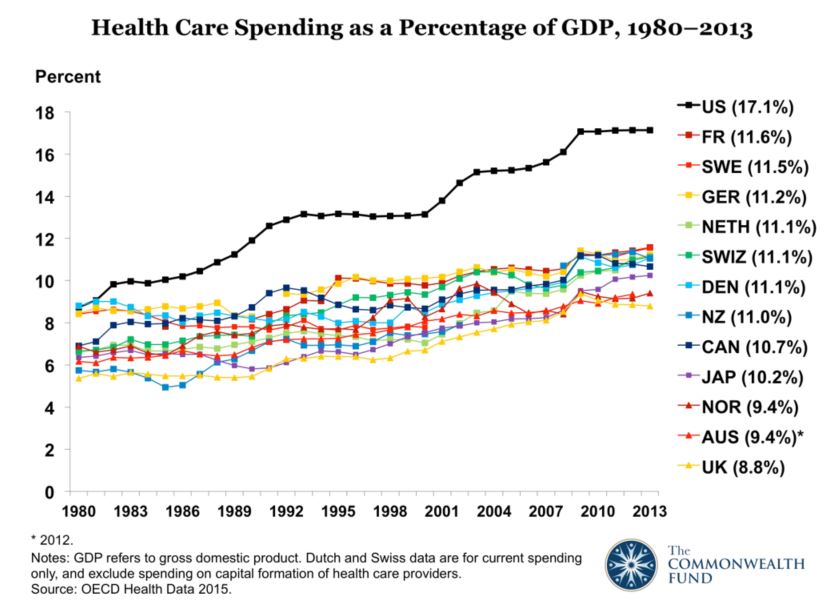
We won’t address all of the issues covered in these analyses, just single-payer Medicare for all. To put it bluntly, the estimates (which were prepared by John Holahan and colleagues) are ridiculous. They project outlandish increases in the utilization of medical care, ignore vast savings under single-payer reform, and ignore the extensive and well-documented experience with single-payer systems in other nations – which all spend far less per person on health care than we do.
The authors’ anti-single-payer bias is also evident from their incredible claims that physicians’ incomes would be squeezed (which contradicts their own estimates positing a sharp rise in spending on physician services), and that patients would suffer huge disruptions, despite the fact that the implementation of single-payer systems elsewhere, as well as the start-up of Medicare, were disruption-free.
We outline below some of the most glaring errors in the Holahan analysis (which served as the basis for Tax Policy Center’s estimates) regarding health care spending under the Sanders plan.
1. Administrative savings, Part 1: Holahan assumes that insurance overhead would be reduced to 6 percent of total health spending from the current level of 9.5 percent. They base this 6 percent estimate on figures for Medicare’s current overhead, which include the extraordinarily high overhead costs of private Medicare HMOs run by UnitedHealthcare and other insurance firms. However, Sen. Sanders’ proposal would exclude these for-profit insurers, and instead build on the traditional Medicare program, whose overhead is less than 3 percent. Moreover, even this 3 percent figure is probably too high, since Sanders’ plan would simplify hospital payment by funding them through global budgets (similar to the way fire departments are paid), rather than the current patient-by-patient payments. Hence a more realistic estimate would assume that insurance overhead would drop to Canada’s level of about 1.8 percent. Cutting insurance overhead to 2 percent (rather than the 6 percent that Holahan projects) would save an additional $1.7 trillion over the next 10 years.
2. Administrative savings, Part 2: Holahan completely ignores the huge savings on hospital administration and doctors’ billing under a streamlined single-payer system. Every serious analyst of single-payer reform has acknowledged these savings, including the Congressional Budget Office, the Government Accountability Office, the Lewin Group (a consulting firm owned by UnitedHealth Group), and even Kenneth Thorpe (a former Clinton administration official who has criticized Sanders’ plan, although his recent estimates of savings are far lower than those he made prior to the current presidential campaign).
These provider savings on paperwork would, in fact, be much larger than the savings on insurance overhead. At present, U.S. hospitals spend one-quarter of their total budgets on billing and administration, more than twice as much as hospitals spend in single-payer systems like Canada’s or Scotland’s. Similarly, U.S. physicians, who must bill hundreds of different insurance plans with varying payment and coverage rules, spend two to three times as much as our Canadian colleagues on billing.
Overall, these administrative savings for doctors and hospitals would amount to about $2.57 trillion over 10 years. Additional savings of more than $1.5 trillion from streamlined billing and administration would accrue to nursing homes, home care agencies, ambulance companies, drug stores and other health care providers.
In total, the Holahan analysis underestimates administrative savings by about $6 trillion over 10 years.
3. Drug costs: Holahan projects that a single-payer plan would have to pay 50 percent higher drug costs than those paid at present by Medicaid. Moreover, their estimate assumes that the U.S. would continue to pay much higher prices for drugs than other nations, despite the fact that a U.S. single-payer system would have much greater negotiating leverage with drug companies than other national health insurance schemes.
Reducing drug prices to the levels currently paid by European nations would save at least $1.1 trillion more than Holahan posits over 10 years.
4. Utilization of care: Holahan projects a massive increase in acute care utilization, but does not provide detailed breakdowns of how big an increase they foresee for specific services like doctor visits or hospital care. However, it is clear that the medical care system does not have the capacity to provide the huge surge in care that he posits.
For instance Holahan’s figures for the increase in acute care suggest that Sanders’ plan would result in more than 100 million additional doctor visits and several million more hospitalizations each year. But there just aren’t enough doctors and hospital beds to deliver that much care. Doctors are already working 53 hours per week, and experience from past reforms tells us that they won’t increase their hours, nor will they see many more patients per hour.
Instead of a huge surge in utilization, more realistic projections would assume that doctors and hospitals would reduce the amount of unnecessary care they’re now delivering in order to deliver needed care to those who are currently not getting what they need. That’s what happened in Canada. Doctors and hospitals can adjust care to meet increasing demand, as happens every year during flu season.
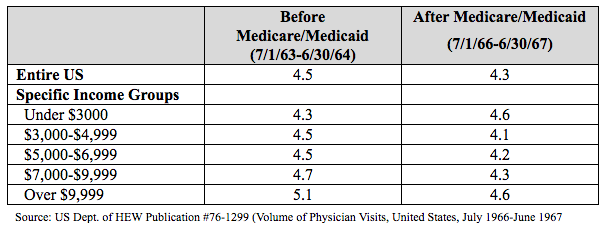
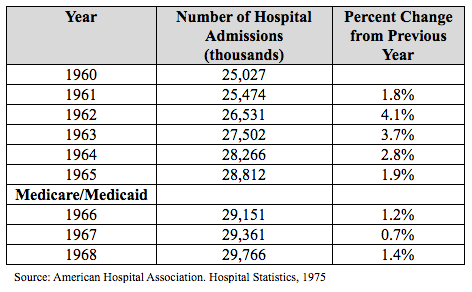
Moreover, no surge materialized when Medicare was implemented and millions of previously uninsured seniors got coverage. Between 1964 (before Medicare) and 1966 (the year when Medicare was fully functioning) there was absolutely no increase in the total number of doctor visit in the U.S.; Americans averaged 4.3 visits per person in 1964 and 4.3 visits per person in 1966. Instead, the number of visits by poor seniors went up, while the number of visits by healthy and wealthy patients went down slightly. The same thing happened in hospitals. There were no waiting lists, just a reduction in the utilization of unneeded elective care by wealthier patients, and the delivery of more care to sick people who needed it.
Bizarrely, despite projecting a roughly $1.6 trillion increase in total payments to doctors over 10 years, Holahan says in his discussion that “Physician incomes would be squeezed by the new payment rates.”
5. Holahan’s argument that the Sanders plan would cause a huge disruption of health care: This argument mirrors scare tactics used by Medicare’s opponents in 1963. Back then, there were claims that doctors would boycott Medicare, and Wall Street Journal headlines warned of a “Patient Pileup,” as “flocks of Medicare beneficiaries … suddenly clog the nation’s 7,200 hospitals.” Nothing like that ever happened, nor did it happen when Taiwan implemented single payer more recently. And there’s no reason to think it would happen here.
Moreover, surveys show that most doctors would welcome national health insurance, and thousands of doctors have recently issued a call (and detailed proposal) for single-payer reform in the American Journal of Public Health.
In summary, Holahan grossly underestimates the administrative savings under single payer; projects increases in the number of doctor visits and hospitalizations that far exceed the capacity of doctors and hospitals to provide this added care; and posits that our country would continue to pay much more for drugs and medical equipment than people in every other nation with national health insurance.
Rather than increasing national health spending, as Holahan claims, Sanders’ plan (and the plan proposed by Physicians for a National Health Program) would almost certainly decrease total health spending over the next 10 years.
Drs. Himmelstein and Woolhandler are professors of health policy and management at the City University of New York School of Public Health and lecturers in medicine at Harvard Medical School. The opinions expressed do not necessarily reflect those institutions’.
http://www.huffingtonpost.com/david-himmelstein/the-urban-institutes-attack-on-single-payer-ridiculous-assumptions-yield-ridiculous-estimates_b_9876640.html
***
Comment:
By Don McCanne, M.D.
The health policy literature is rich with studies, reports and data confirming the that single payer health care financing is much more effective in ensuring universal coverage at lower costs than is our current fragmented, dysfunctional system of financing health care. Yet there has been a recent surge of interest in analyzing the single payer model, directly attributed to Sen. Bernie Sanders’ advocacy for it during his presidential campaign. These reports from the Urban Institute and the Tax Policy Center are the latest which question the well documented fact that single payer would reduce per capita spending.
What is going on here? These two organizations are highly reputable and have produced many studies that are quite credible. Yet the nation’s two leading researchers in single payer, Steffie Woolhandler and David Himmelstein, with their impeccable integrity, have shown that the researchers producing the critical reports have used incorrect assumptions in their analyses. This is not a matter of conflicting opinions, but rather a matter of the factual basis behind the assumptions. Yet the media ignore the facts and distribute only the compromised results from these otherwise reputable individuals and institutions that challenge the savings that would be accrued through the single payer model.
Why would John Holahan and his colleagues at the Urban Institute do this, at this time? Perhaps the composition of the Board of Trustees might give us a clue (link above). Most of them are members of “the establishment”, many of them have served in President Clinton’s administration (as did another critic – Kenneth Thorpe), and some are conservatives opposed to single payer. (The Tax Policy Center is a joint project of the Urban Institute and the Brookings Institution.) The timing of this report suggests that it is more than coincidental that it would be used to help defeat the only current challenger to Hillary Clinton’s quest for the Democratic presidential nomination.
But why would respected researchers agree to such a blatantly political use of their work product? If you check their credentials, they are all deeply involved in health policy research that is designed to improve the function of our health care system, particularly its financing. That is, they are avowed incrementalists. Single payer would displace much of the work they have done with private insurance markets, Medicare, Medicaid, safety-net institutions and other aspects of our dysfunctional system. They are likely not well informed on single payer policy science since that has not been on their radar. This is not questioning the integrity of these researchers but merely an observation as to how they could come up with invalid conclusions. Their minds are simply pre-programmed to produce the results they get.
Hillary Clinton has declared that she will not consider single payer. When the policy community should be making efforts to convince her to support a superior model of reform they are instead discrediting that model in order to support her and Obamacare – the most expensive model of reform and one that fails to accomplish our goals of universality, efficiency and equity. Sadly, that reflects poorly on the policy community.
PNHP is a single issue organization supporting research and education on single payer reform. PNHP does not support nor oppose any political candidates.
The Urban Institute’s Attack On Single Payer: Ridiculous Assumptions Yield Ridiculous Estimates
By David U. Himmelstein, M.D., and Steffie Woolhandler, M.D., M.P.H.
The Huffington Post, May 9, 2016
The Urban Institute and the Tax Policy Center today released analyses of the costs of Sen. Bernie Sanders’ domestic policy proposals, including single-payer national health insurance. They claim that Sanders’ proposals would raise the federal deficit by $18 trillion over the next decade.
We won’t address all of the issues covered in these analyses, just single-payer Medicare for all. To put it bluntly, the estimates (which were prepared by John Holahan and colleagues) are ridiculous. They project outlandish increases in the utilization of medical care, ignore vast savings under single-payer reform, and ignore the extensive and well-documented experience with single-payer systems in other nations – which all spend far less per person on health care than we do.
The authors’ anti-single-payer bias is also evident from their incredible claims that physicians’ incomes would be squeezed (which contradicts their own estimates positing a sharp rise in spending on physician services), and that patients would suffer huge disruptions, despite the fact that the implementation of single-payer systems elsewhere, as well as the start-up of Medicare, were disruption-free.
We outline below some of the most glaring errors in the Holahan analysis (which served as the basis for Tax Policy Center’s estimates) regarding health care spending under the Sanders plan.
1. Administrative savings, Part 1: Holahan assumes that insurance overhead would be reduced to 6 percent of total health spending from the current level of 9.5 percent. They base this 6 percent estimate on figures for Medicare’s current overhead, which include the extraordinarily high overhead costs of private Medicare HMOs run by UnitedHealthcare and other insurance firms. However, Sen. Sanders’ proposal would exclude these for-profit insurers, and instead build on the traditional Medicare program, whose overhead is less than 3 percent. Moreover, even this 3 percent figure is probably too high, since Sanders’ plan would simplify hospital payment by funding them through global budgets (similar to the way fire departments are paid), rather than the current patient-by-patient payments. Hence a more realistic estimate would assume that insurance overhead would drop to Canada’s level of about 1.8 percent. Cutting insurance overhead to 2 percent (rather than the 6 percent that Holahan projects) would save an additional $1.7 trillion over the next 10 years.
2. Administrative savings, Part 2: Holahan completely ignores the huge savings on hospital administration and doctors’ billing under a streamlined single-payer system. Every serious analyst of single-payer reform has acknowledged these savings, including the Congressional Budget Office, the Government Accountability Office, the Lewin Group (a consulting firm owned by UnitedHealth Group), and even Kenneth Thorpe (a former Clinton administration official who has criticized Sanders’ plan, although his recent estimates of savings are far lower than those he made prior to the current presidential campaign).
These provider savings on paperwork would, in fact, be much larger than the savings on insurance overhead. At present, U.S. hospitals spend one-quarter of their total budgets on billing and administration, more than twice as much as hospitals spend in single-payer systems like Canada’s or Scotland’s. Similarly, U.S. physicians, who must bill hundreds of different insurance plans with varying payment and coverage rules, spend two to three times as much as our Canadian colleagues on billing.
Overall, these administrative savings for doctors and hospitals would amount to about $2.57 trillion over 10 years. Additional savings of more than $1.5 trillion from streamlined billing and administration would accrue to nursing homes, home care agencies, ambulance companies, drug stores and other health care providers.
In total, the Holahan analysis underestimates administrative savings by about $6 trillion over 10 years.
3. Drug costs: Holahan projects that a single-payer plan would have to pay 50 percent higher drug costs than those paid at present by Medicaid. Moreover, their estimate assumes that the U.S. would continue to pay much higher prices for drugs than other nations, despite the fact that a U.S. single-payer system would have much greater negotiating leverage with drug companies than other national health insurance schemes.
Reducing drug prices to the levels currently paid by European nations would save at least $1.1 trillion more than Holahan posits over 10 years.
4. Utilization of care: Holahan projects a massive increase in acute care utilization, but does not provide detailed breakdowns of how big an increase they foresee for specific services like doctor visits or hospital care. However, it is clear that the medical care system does not have the capacity to provide the huge surge in care that he posits.
For instance Holahan’s figures for the increase in acute care suggest that Sanders’ plan would result in more than 100 million additional doctor visits and several million more hospitalizations each year. But there just aren’t enough doctors and hospital beds to deliver that much care. Doctors are already working 53 hours per week, and experience from past reforms tells us that they won’t increase their hours, nor will they see many more patients per hour.
Instead of a huge surge in utilization, more realistic projections would assume that doctors and hospitals would reduce the amount of unnecessary care they’re now delivering in order to deliver needed care to those who are currently not getting what they need. That’s what happened in Canada. Doctors and hospitals can adjust care to meet increasing demand, as happens every year during flu season.
Moreover, no surge materialized when Medicare was implemented and millions of previously uninsured seniors got coverage. Between 1964 (before Medicare) and 1966 (the year when Medicare was fully functioning) there was absolutely no increase in the total number of doctor visit in the U.S.; Americans averaged 4.3 visits per person in 1964 and 4.3 visits per person in 1966. Instead, the number of visits by poor seniors went up, while the number of visits by healthy and wealthy patients went down slightly. The same thing happened in hospitals. There were no waiting lists, just a reduction in the utilization of unneeded elective care by wealthier patients, and the delivery of more care to sick people who needed it.
Bizarrely, despite projecting a roughly $1.6 trillion increase in total payments to doctors over 10 years, Holahan says in his discussion that “Physician incomes would be squeezed by the new payment rates.”
5. Holahan’s argument that the Sanders plan would cause a huge disruption of health care: This argument mirrors scare tactics used by Medicare’s opponents in 1963. Back then, there were claims that doctors would boycott Medicare, and Wall Street Journal headlines warned of a “Patient Pileup,” as “flocks of Medicare beneficiaries … suddenly clog the nation’s 7,200 hospitals.” Nothing like that ever happened, nor did it happen when Taiwan implemented single payer more recently. And there’s no reason to think it would happen here.
Moreover, surveys show that most doctors would welcome national health insurance, and thousands of doctors have recently issued a call (and detailed proposal) for single-payer reform in the American Journal of Public Health.
In summary, Holahan grossly underestimates the administrative savings under single payer; projects increases in the number of doctor visits and hospitalizations that far exceed the capacity of doctors and hospitals to provide this added care; and posits that our country would continue to pay much more for drugs and medical equipment than people in every other nation with national health insurance.
Rather than increasing national health spending, as Holahan claims, Sanders’ plan (and the plan proposed by Physicians for a National Health Program) would almost certainly decrease total health spending over the next 10 years.
Drs. Himmelstein and Woolhandler are professors of health policy and management at the City University of New York School of Public Health and lecturers in medicine at Harvard Medical School. The opinions expressed do not necessarily reflect those institutions’.
http://www.huffingtonpost.com/david-himmelstein/the-urban-institutes-attack-on-single-payer-ridiculous-assumptions-yield-ridiculous-estimates_b_9876640.html
PNHP note: Physicians for a National Health Program (PNHP) is a nonpartisan educational and research organization. It neither supports nor opposes any candidate for public office.
Urban Institute’s attack on single payer
The Sanders Single-Payer Health Care Plan: The Effect on National Health Expenditures and Federal and Private Spending
By John Holahan, Matthew Buettgens, Lisa Clemans-Cope, Melissa M. Favreault, Linda J. Blumberg, Slyabonga Ndwandwa
Urban Institute, May 9, 2016Abstract
Presidential candidate Bernie Sanders proposed a single-payer system to replace all current health coverage. His system would cover all medically necessary care, including long-term care, without cost-sharing. We estimate that the approach would decrease the uninsured by 28.3 million people in 2017. National health expenditures would increase by $6.6 trillion between 2017 and 2026, while federal expenditures would increase by $32.0 trillion over that period. Sanders’s revenue proposals, intended to finance all health and nonhealth spending he proposed, would raise $15.3 trillion from 2017 to 2026—thus, the proposed taxes are much too low to fully finance his health plan.
Urban Institute Board of Trustees:
http://www.urban.org/about/board-of-directors***
An Analysis of Senator Bernie Sanders’s Tax and Transfer Proposals
By Gordon B. Mermin, Leonard E. Burman, Frank Sammartino
Tax Policy Center, May 9, 2016Abstract
Presidential candidate Bernie Sanders proposes significant tax increases that would raise $15.3 trillion over the next decade. All income groups would pay more tax, but most would come from high-income households, particularly those with very high incomes. Sanders would also implement new government benefits—notably government-financed single-payer health care, long-term services and supports, college, and family leave benefits—and expand Social Security benefits. TPC finds the new government benefits would more than offset new taxes for 95% of households but the combined tax and transfer plan would increase federal budget deficits by more than $18 trillion over the next decade.
http://www.taxpolicycenter.org/publications/analysis-senator-bernie-sanderss-tax-and-transfer-proposals
***
The Urban Institute’s Attack On Single Payer: Ridiculous Assumptions Yield Ridiculous Estimates
By David Himmelstein and Steffie Woolhandler
The Huffington Post, May 9, 2016The Urban Institute and the Tax Policy Center today released analyses of the costs of Sen. Bernie Sanders’ domestic policy proposals, including single-payer national health insurance. They claim that Sanders’ proposals would raise the federal deficit by $18 trillion over the next decade.
We won’t address all of the issues covered in these analyses, just single-payer Medicare for all. To put it bluntly, the estimates (which were prepared by John Holahan and colleagues) are ridiculous. They project outlandish increases in the utilization of medical care, ignore vast savings under single-payer reform, and ignore the extensive and well-documented experience with single-payer systems in other nations – which all spend far less per person on health care than we do.
The authors’ anti-single-payer bias is also evident from their incredible claims that physicians’ incomes would be squeezed (which contradicts their own estimates positing a sharp rise in spending on physician services), and that patients would suffer huge disruptions, despite the fact that the implementation of single-payer systems elsewhere, as well as the start-up of Medicare, were disruption-free.
We outline below some of the most glaring errors in the Holahan analysis (which served as the basis for Tax Policy Center’s estimates) regarding health care spending under the Sanders plan.
1. Administrative savings, Part 1: Holahan assumes that insurance overhead would be reduced to 6 percent of total health spending from the current level of 9.5 percent. They base this 6 percent estimate on figures for Medicare’s current overhead, which include the extraordinarily high overhead costs of private Medicare HMOs run by UnitedHealthcare and other insurance firms. However, Sen. Sanders’ proposal would exclude these for-profit insurers, and instead build on the traditional Medicare program, whose overhead is less than 3 percent. Moreover, even this 3 percent figure is probably too high, since Sanders’ plan would simplify hospital payment by funding them through global budgets (similar to the way fire departments are paid), rather than the current patient-by-patient payments. Hence a more realistic estimate would assume that insurance overhead would drop to Canada’s level of about 1.8 percent. Cutting insurance overhead to 2 percent (rather than the 6 percent that Holahan projects) would save an additional $1.7 trillion over the next 10 years.
2. Administrative savings, Part 2: Holahan completely ignores the huge savings on hospital administration and doctors’ billing under a streamlined single-payer system. Every serious analyst of single-payer reform has acknowledged these savings, including the Congressional Budget Office, the Government Accountability Office, the Lewin Group (a consulting firm owned by UnitedHealth Group), and even Kenneth Thorpe (a former Clinton administration official who has criticized Sanders’ plan, although his recent estimates of savings are far lower than those he made prior to the current presidential campaign).
These provider savings on paperwork would, in fact, be much larger than the savings on insurance overhead. At present, U.S. hospitals spend one-quarter of their total budgets on billing and administration, more than twice as much as hospitals spend in single-payer systems like Canada’s or Scotland’s. Similarly, U.S. physicians, who must bill hundreds of different insurance plans with varying payment and coverage rules, spend two to three times as much as our Canadian colleagues on billing.
Overall, these administrative savings for doctors and hospitals would amount to about $2.57 trillion over 10 years. Additional savings of more than $1.5 trillion from streamlined billing and administration would accrue to nursing homes, home care agencies, ambulance companies, drug stores and other health care providers.
In total, the Holahan analysis underestimates administrative savings by about $6 trillion over 10 years.
3. Drug costs: Holahan projects that a single-payer plan would have to pay 50 percent higher drug costs than those paid at present by Medicaid. Moreover, their estimate assumes that the U.S. would continue to pay much higher prices for drugs than other nations, despite the fact that a U.S. single-payer system would have much greater negotiating leverage with drug companies than other national health insurance schemes.
Reducing drug prices to the levels currently paid by European nations would save at least $1.1 trillion more than Holahan posits over 10 years.
4. Utilization of care: Holahan projects a massive increase in acute care utilization, but does not provide detailed breakdowns of how big an increase they foresee for specific services like doctor visits or hospital care. However, it is clear that the medical care system does not have the capacity to provide the huge surge in care that he posits.
For instance Holahan’s figures for the increase in acute care suggest that Sanders’ plan would result in more than 100 million additional doctor visits and several million more hospitalizations each year. But there just aren’t enough doctors and hospital beds to deliver that much care. Doctors are already working 53 hours per week, and experience from past reforms tells us that they won’t increase their hours, nor will they see many more patients per hour.
Instead of a huge surge in utilization, more realistic projections would assume that doctors and hospitals would reduce the amount of unnecessary care they’re now delivering in order to deliver needed care to those who are currently not getting what they need. That’s what happened in Canada. Doctors and hospitals can adjust care to meet increasing demand, as happens every year during flu season.
Moreover, no surge materialized when Medicare was implemented and millions of previously uninsured seniors got coverage. Between 1964 (before Medicare) and 1966 (the year when Medicare was fully functioning) there was absolutely no increase in the total number of doctor visit in the U.S.; Americans averaged 4.3 visits per person in 1964 and 4.3 visits per person in 1966. Instead, the number of visits by poor seniors went up, while the number of visits by healthy and wealthy patients went down slightly. The same thing happened in hospitals. There were no waiting lists, just a reduction in the utilization of unneeded elective care by wealthier patients, and the delivery of more care to sick people who needed it.
Bizarrely, despite projecting a roughly $1.6 trillion increase in total payments to doctors over 10 years, Holahan says in his discussion that “Physician incomes would be squeezed by the new payment rates.”
5. Holahan’s argument that the Sanders plan would cause a huge disruption of health care: This argument mirrors scare tactics used by Medicare’s opponents in 1963. Back then, there were claims that doctors would boycott Medicare, and Wall Street Journal headlines warned of a “Patient Pileup,” as “flocks of Medicare beneficiaries … suddenly clog the nation’s 7,200 hospitals.” Nothing like that ever happened, nor did it happen when Taiwan implemented single payer more recently. And there’s no reason to think it would happen here.
Moreover, surveys show that most doctors would welcome national health insurance, and thousands of doctors have recently issued a call (and detailed proposal) for single-payer reform in the American Journal of Public Health.
In summary, Holahan grossly underestimates the administrative savings under single payer; projects increases in the number of doctor visits and hospitalizations that far exceed the capacity of doctors and hospitals to provide this added care; and posits that our country would continue to pay much more for drugs and medical equipment than people in every other nation with national health insurance.
Rather than increasing national health spending, as Holahan claims, Sanders’ plan (and the plan proposed by Physicians for a National Health Program) would almost certainly decrease total health spending over the next 10 years.
Drs. Himmelstein and Woolhandler are professors of health policy and management at the City University of New York School of Public Health and lecturers in medicine at Harvard Medical School. The opinions expressed do not necessarily reflect those institutions’.
http://www.huffingtonpost.com/david-himmelstein/the-urban-institutes-attack-on-single-payer-ridiculous-assumptions-yield-ridiculous-estimates_b_9876640.html
The health policy literature is rich with studies, reports and data confirming the that single payer health care financing is much more effective in ensuring universal coverage at lower costs than is our current fragmented, dysfunctional system of financing health care. Yet there has been a recent surge of interest in analyzing the single payer model, directly attributed to Sen. Bernie Sanders’ advocacy for it during his presidential campaign. These reports from the Urban Institute and the Tax Policy Center are the latest which question the well documented fact that single payer would reduce per capita spending.
What is going on here? These two organizations are highly reputable and have produced many studies that are quite credible. Yet the nation’s two leading researchers in single payer, Steffie Woolhandler and David Himmelstein, with their impeccable integrity, have shown that the researchers producing the critical reports have used incorrect assumptions in their analyses. This is not a matter of conflicting opinions, but rather a matter of the factual basis behind the assumptions. Yet the media ignore the facts and distribute only the compromised results from these otherwise reputable individuals and institutions that challenge the savings that would be accrued through the single payer model.
Why would John Holahan and his colleagues at the Urban Institute do this, at this time? Perhaps the composition of the Board of Trustees might give us a clue (link above). Most of them are members of “the establishment”, many of them have served in President Clinton’s administration (as did another critic – Kenneth Thorpe), and some are conservatives opposed to single payer. (The Tax Policy Center is a joint project of the Urban Institute and the Brookings Institution.) The timing of this report suggests that it is more than coincidental that it would be used to help defeat the only current challenger to Hillary Clinton’s quest for the Democratic presidential nomination.
But why would respected researchers agree to such a blatantly political use of their work product? If you check their credentials, they are all deeply involved in health policy research that is designed to improve the function of our health care system, particularly its financing. That is, they are avowed incrementalists. Single payer would displace much of the work they have done with private insurance markets, Medicare, Medicaid, safety-net institutions and other aspects of our dysfunctional system. They are likely not well informed on single payer policy science since that has not been on their radar. This is not questioning the integrity of these researchers but merely an observation as to how they could come up with invalid conclusions. Their minds are simply pre-programmed to produce the results they get.
Hillary Clinton has declared that she will not consider single payer. When the policy community should be making efforts to convince her to support a superior model of reform they are instead discrediting that model in order to support her and Obamacare – the most expensive model of reform and one that fails to accomplish our goals of universality, efficiency and equity. Sadly, that reflects poorly on the policy community.
PNHP is a single issue organization supporting research and education on single payer reform. PNHP does not support nor oppose any political candidates.
Mark Pauly’s answer to high drug prices: Walk away
Maybe we are to blame in part for rising cancer drug prices
By Mark V. Pauly, PhD
Philly.com, May 9, 2016
The prices of oral cancer drugs are rising. This will come as no surprise to anyone who has cancer or who knows someone who has it.
Why did these prices increase at this pace? My visceral reaction, which I suspect is the same as yours, is to rail against “corporate greed,” something we have seen on display for even old drugs to a spectacular extent lately.
But here is my guess. The combination of rising consumer income (even with the recession) and the spread of drug insurance meant that the maximum amount consumers or their insurers were willing to pay for these effective drugs for desperate situations grew. It was growth in demand or consumer value that persuaded drug firms to develop drugs that would be profitable if introduced at higher prices.
If we consumers want to do something about rising prices for cancer drugs, we need (according to the hard-hearted economist) to do what happens when prices for gas, or steak, or designer ties is rising — we need to walk away from them. A tepid demand response will itself temper prices as well as total spending, and perhaps offer a cautionary lesson for future health care price increases.
http://www.philly.com/philly/blogs/health-cents/Maybe-we-are-to-blame-in-part-for-rising-cancer-drug-prices.html
***
S&P Healthcare Claims Index Monthly Report
Key 2015 Takeaways:
The December 2015 S&P Healthcare Claims Indices (the Indices) describe commercial healthcare costs that rose 50% more rapidly in 2015 than in 2014 – 6.50% vs. 4.33%.
Drug costs played a role by significantly increasing for the second straight year – rising 15.83% in 2015 (up from 12.58% in 2014 and 2.73% in 2013).
http://us.spindices.com/index-family/healthcare-claims/all
***
Comment:
By Don McCanne, M.D.
Drug prices are out of control. Wharton School’s Mark V. Pauly, PhD, of “moral hazard” fame, suggests that we, as consumers, can do something about it. We simply walk away from the high-priced drugs we need and then the markets will take care of the prices.
That might satisfy “the hard-hearted economist,” but there are other economic tools that can be used to achieve our objective: ensuring that everyone receives all essential health care services and products. Predominant amongst the alternative methods of health care financing would be single payer Medicare for all.
A publicly-financed system with government administered pricing and first dollar coverage is much more effective than markets in ensuring both appropriate pricing and access. Using the market tool of walking away eliminates access. That might be fine for designer ties, but it isn’t for health care.
More than 2,000 physicians back single-payer healthcare system that would save taxpayers $500 billion annually
The proposal would keep hospitals and clinics private, allow physicians to bill under a fee-for-service model, and be funded by combining current sources of government health spending into a single fund with modest new taxes.
By Jeff Lagasse
Healthcare IT News, May 9, 2016
More than 2,000 doctors backed a single-payer healthcare system in an article published by the American Journal of Public Health.
While Presidential candidate Vermont Sen. Bernie Sanders is running on a Medicare for all platform, the proposal authors called their recommendation strictly non-partisan and described a single-payer system as publicly financed and covering all Americans for medically necessary care.
Under the national health program outlined by the physicians, patients could choose to go to any doctor or hospital of their preference. Most hospitals and clinics would remain privately owned and operated, receiving a budget from the program to cover all operating costs. Physicians could continue to practice on a fee-for-service basis, or receive salaries from group practices, hospitals or clinics.
The program would be paid for by combining current sources of government health spending into a single fund with modest new taxes they claim would be fully offset by reductions in premiums and out-of-pocket spending. Co-pays and deductibles would be eliminated.
The single-payer program, they said, would save about $500 billion annually by eliminating the high overhead and profits of insurance firms, and the “massive paperwork” they inflict on hospitals and doctors.
The physicians also argued that the administrative savings of the streamlined system would fully offset the costs of covering the uninsured, as well as upgraded coverage for everyone else, including full coverage of prescription drugs, dental care and long-term care. Savings would also be redirected to what the group cites as “underfunded health priorities,” particularly public health.
The study also claims the “single payer” would be in a strong position to negotiate lower prices for medications and other medical supplies, yielding additional savings and reining in costs.
Adam Gaffney, a Boston-based pulmonary disease and critical care specialist who was co-chair of the working group that produced the proposal, said in a statement that the nation was at a crossroads.
“Despite the passage of the Affordable Care Act six years ago, 30 million Americans remain uninsured, an even greater number are underinsured, financial barriers to care like co-pays and deductibles are rising, bureaucracy is growing, provider networks are narrowing, and medical costs are continuing to climb,” he said. “Caring relationships are increasingly taking a back seat to the financial prerogatives of insurance firms, corporate providers, and Big Pharma. Our patients are suffering and our profession is being degraded and disfigured by these mercenary interests.”
Marcia Angell, a co-author of the proposal and member of the faculty of global health and social medicine at Harvard Medical School, said in a statement that the country “can no longer afford to waste the vast resources we do on the administrative costs, executive salaries, and profiteering of the private insurance system. We get too little for our money. It’s time to put those resources into real health care for everyone.”
Surveys show support for single-payer national health insurance may be rising among physicians. A 2008 survey of physicians found that 59 percent supported “legislation to establish national health insurance,” up from 49 percent five years earlier.
Mark Pauly’s answer to high drug prices: Walk away
Maybe we are to blame in part for rising cancer drug prices
By Mark V. Pauly, PhD
Philly.com, May 9, 2016The prices of oral cancer drugs are rising. This will come as no surprise to anyone who has cancer or who knows someone who has it.
Why did these prices increase at this pace? My visceral reaction, which I suspect is the same as yours, is to rail against “corporate greed,” something we have seen on display for even old drugs to a spectacular extent lately.
But here is my guess. The combination of rising consumer income (even with the recession) and the spread of drug insurance meant that the maximum amount consumers or their insurers were willing to pay for these effective drugs for desperate situations grew. It was growth in demand or consumer value that persuaded drug firms to develop drugs that would be profitable if introduced at higher prices.
If we consumers want to do something about rising prices for cancer drugs, we need (according to the hard-hearted economist) to do what happens when prices for gas, or steak, or designer ties is rising — we need to walk away from them. A tepid demand response will itself temper prices as well as total spending, and perhaps offer a cautionary lesson for future health care price increases.
http://www.philly.com/philly/blogs/health-cents/Maybe-we-are-to-blame-in-part-for-rising-cancer-drug-prices.html***
S&P Healthcare Claims Index Monthly Report
Key 2015 Takeaways:
The December 2015 S&P Healthcare Claims Indices (the Indices) describe commercial healthcare costs that rose 50% more rapidly in 2015 than in 2014 – 6.50% vs. 4.33%.
Drug costs played a role by significantly increasing for the second straight year – rising 15.83% in 2015 (up from 12.58% in 2014 and 2.73% in 2013).
http://us.spindices.com/index-family/healthcare-claims/all
Drug prices are out of control. Wharton School’s Mark V. Pauly, PhD, of “moral hazard” fame, suggests that we, as consumers, can do something about it. We simply walk away from the high-priced drugs we need and then the markets will take care of the prices.
That might satisfy “the hard-hearted economist,” but there are other economic tools that can be used to achieve our objective: ensuring that everyone receives all essential health care services and products. Predominant amongst the alternative methods of health care financing would be single payer Medicare for all.
A publicly-financed system with government administered pricing and first dollar coverage is much more effective than markets in ensuring both appropriate pricing and access. Using the market tool of walking away eliminates access. That might be fine for designer ties, but it isn’t for health care.
There’s no place for rampant capitalism in treating the sick
By Michael Jones
Los Angeles Times, May 8, 2016
A good friend of mine recently found herself between jobs, with a gap in her health insurance and a recurrence of her kidney stones. What she needed were fluids and pain relief, fast. I’m a gastroenterologist, and hoping to minimize the financial impact, I went with her to our local ER and had a conversation with the attending physician. Maybe we could pass on the CT scan and extraneous lab work?
The attending was in her room for less than two minutes and never examined her. But the CT scan and blood work were ordered. My friend received intravenous fluids (about $1 worth), pain meds (about $5 worth of dilaudid), and a $10,000 bill from the hospital. To add insult to injury, the bill from the ER attending was for service at the highest billable level.
My friend had the good sense and gumption to call the ER group’s practice manager to point out that billing at that level was fraudulent. The ER group had the good sense to reduce the bill by half.
Shortly after that, I received a call from a patient on whom I had performed an upper endoscopy to remove a small gastric polyp. Because removing stomach polyps can be complicated by bleeding, I did the procedure in the hospital rather than an outpatient center. The whole thing took 15 minutes. Anesthesia wasn’t required, just routine conscious sedation. So, my patient wanted to know, what had I done that warranted an $18,000 bill from the hospital?
I had absolutely no explanation. For $18,000, you can just about buy your own endoscope. Amortized costs for an upper endoscopy at this hospital, including the use of the endoscopy unit, salaries for the whole staff, medication and equipment expenses is probably not more than $200 for 15 minutes. By the way, the doctor doing the procedure — in that case, me — typically gets about $175 for an upper endoscopy.
And then there are the costly procedures you could probably do without.
Recently, a surgical group owned by the same hospital hired a surgeon with an interest in esophageal disorders, particularly surgery for acid reflux — heartburn. He’s a good guy and capable.
So the hospital decided to create a “center of excellence” for esophageal diseases. A hurdle quickly became apparent. My town isn’t flush with esophageal experts. The hospital has excellent generalists who could contribute, but just one specialist surgeon who was retiring (hence the new hire). Still, the Joint Commission, an independent healthcare accreditation outfit, would certify the hospital’s new center if certain standards were met and a fee was paid. That’s not exactly the same as excellence.
A marketing plan was developed to get the word out. But really, far fewer than 1% of frequent heartburn sufferers will benefit from surgery. Most people with heartburn would be best served by getting help modifying their lifestyle. That’s particularly true because the behaviors associated with reflux (overeating, obesity, alcohol consumption and smoking, to name a few) are also risk factors for heart disease, diabetes and a variety of cancers.
However, lifestyle modifications are not profitable and surgery is very profitable. The surgeon (and his colleagues who agreed to work with the center) doesn’t want to perform surgery that’s inappropriate or not indicated. He’s not like that. But he’s employed by the hospital. You can see where this is going. The center is up and running.
The American healthcare system is capable of many wonderful things, but not all of them are about health or care. It is just as often about selling you things you probably don’t need at a ridiculous price, or finding ways to charge you a ridiculous price even for what you do need.
The folks driving it aren’t generally physicians, nurses or other “healthcare providers” (to use the parlance of the times). They are businesspeople — executives that run hospitals, pharmaceutical concerns and insurance companies — using healthcare as their instrument to make money. And sadly, the average physician doesn’t have a lot of choice about lashing his raft to these organizations if he wants to practice his trade.
As a nation, we spend far more than other developed countries for healthcare, and our outcomes are not as good. Those other countries generally have some form of a single-payer system. Here, we’re told single-payer horror stories: People are dying in Canada and England waiting for care.
I’ve got news from the front lines of the U.S. system. People are dying here, too, in large numbers, and at the same time they’re going broke paying the bills. Medical expenses, even now that many more people have some form of insurance, are a prime cause of bankruptcy and financial insecurity in the U.S.
No healthcare system is perfect, but here’s what the rest of the civilized world understands: Healthcare is a right. There is no place for rampant capitalism in treating the sick. This advice is harsh but true: When it comes to your healthcare, buyer beware.
Michael Jones is in private practice on the Eastern seaboard.
http://www.latimes.com/opinion/op-ed/la-oe-jones-healthcare-buyer-beware-20160508-story.html
Doctors Agree With Sanders on Universal Health Care; Interview With Dr. Adam Gaffney
By Viji Sundara
New America Media, May 7, 2016
Presidential hopefuls have their own ideas on what to do with the Affordable Care Act (ACA), President Obama’s signature legislation, when they move into the White House.
Sen. Bernie Sanders thinks it should be replaced with a single-payer health plan of the kind Europe and Canada have. This federally administered universal health care program would eliminate copays and deductibles. There’s currently a move afoot in Colorado to have such a plan.
Secretary Hillary Clinton would like to keep the ACA, with a few fixes.
Donald Trump says he will uproot the ACA, get Congress to allow the sale of health insurance across state lines and allow individuals to take tax deductions for insurance premium payments. But that would not help low-income Americans because they do not pay much in income taxes.
This week, the American Journal of Public Health carried a proposal by a working group of more than 2,000 physicians nationwide titled: Moving Forward from the Affordable Care Act to a Single-Payer system. The physicans warn that the risks of continuing the ACA will leave millions uninsured indefinitely.
NAM health editor Viji Sundaram interviewed Dr. Adam Gaffney, a co-chair of the working group.
Your proposal calls for a single-payer health care plan for the United States. Obamacare has helped 16.9 million people become newly insured. Would it not be less disruptive to expand the provisions in the ACA instead of repealing the law and replacing it?
The U.S. health system is highly disruptive as things stand now. You’re liable to lose your insurance at any time – for instance, if you change your job or get divorced. Similarly, those purchasing plans on the “marketplaces” may find that they can keep down premium increases by changing plans on an annual basis. Every time your insurance plan changes, you may need to change all of your doctors and hospitals in order to stay “in network.” This is enormously disruptive to people’s health care. In contrast, in a single-payer system, everyone has free choice of doctors and hospitals.
Your proposal promises health coverage for all. Does this include undocumented U.S. residents?
Yes, it would. The single-payer national health program we envision would include everyone regardless of country of origin, including undocumented residents. If we believe that health care is truly a human right, then this is the right thing to do. At the same time, it is also financially achievable. Immigrants, on average, have lower health care spending as compared to those born in the United States. One study demonstrated that immigrants actually pay more into Medicare than what they use in terms of health care. Everyone would be included in the national health program we envision.
Why do you think there would be no additional government spending if the United States has a single-payer health care plan? Countries such as Canada and the England run their national health program on the backs of taxpayers. Will that happen in the United States as well? Can it be done without raising taxes?
There would be additional government spending with a single-payer plan, but this would be offset by the elimination of spending by individuals and employers on premiums, co-payments, and deductibles. We can expand coverage to everyone in the country and eliminate co-payments and deductibles, and at the same time keep overall current health care spending roughly unchanged.
Some providers criticize single-payer plan as one that will force them to contract with the one payer available. Currently, providers have some choice of insurers. They can even opt out of Medicare and Medicaid.
There are many benefits for practices to have to contract with only one payer: it’s much simpler and is less costly from an administrative perspective.
How would you respond to the criticism of the single payer program as having the capacity to get doctors to sign in with fairly attractive reimbursement rates, but once in, those rates can come down, leaving providers helpless?
Because the vast majority of the nation’s doctors would participate in the national health program, there would be a powerful lobby fighting to ensure that reimbursements remain fair.
In countries that have a single-payer health care system, there seems to be a long waiting period before a patient can see a doctor. How can we keep that from happening in this country?
The problem of waiting times for care in other nations is often exaggerated. Moreover, where there are excessive waiting times for elective procedures, it is often due to underinvestment. We spend much more than other countries on health care, and have the resources to ensure that waiting times for elective procedures are reasonable. It’s also worth noting that we have waiting times in the United States also, though they are not as visible. Indeed, if you have the wrong insurance plan [currently], the waiting time for some providers may, so to speak, be infinite.
The UK allows people to be in both the national health plan as well as subscribe to a private insurance plan, which they can fall back on for expedited care. But your plan calls for an end to commercial insurance.
First, if providers must bill and contend with multiple different insurance plans, we lose the efficiency savings that come with a single universal system. Second, if we give the rich preferential access to superior and expedited care while relegating everyone else to an inferior tier, we make a mockery of the idea of an equal right to health care. Third, the best way to ensure that the quality of health care is superb is having everybody – whether rich or poor – in the same system together.
Medicaid and Medicare depend on the cost shift from private payers. Some providers say the only way doctors are willing to get into the Medicare network is because they get higher payment from commercial insurers.
Doctors would continue to do well under a Medicare-for-All system. The transition to a single-payer system would eliminate the need to bill and contend with a multiplicity of payers, producing substantial savings for practices (and hospitals).
How much could the United States save by switching to a single-payer health plan? What does it currently spend?
It is estimated that upwards of $400 billion a year could be saved from reduced spending on administration and billing that would occur through the transition to a single-payer plan. Additional money could be saved when the national health program enters into direct negotiations with pharmaceutical companies over drug prices. These savings could then be used to cover everybody in the country, while at the same time eliminating copayments and deductibles. Overall health care spending, at the end of the day, would be approximately the same as it is now, but nobody would ever again have to worry about losing insurance, about paying a big deductible if they got sick, or about not having access to the doctor or hospital of their choose.
Dr. Adam Gaffney, M.D. is in the Pulmonary and Critical Care Fellowship Program at Massachusetts General Hospital.
http://newamericamedia.org/2016/05/doctors-agree-with-sanders-on-universal-health-care.php
PNHP note: Physicians for a National Health Program (PNHP) is a nonpartisan educational and research organization. It neither supports nor opposes any candidate for public office.