Visit msnbc.com for Breaking News, World News, and News about the Economy
For many, ‘medical bankruptcy’ leaves permanent scars
Visit msnbc.com for Breaking News, World News, and News about the Economy
Would a MedPAC-like IMAC effectively control costs?
Centrists Win Backing on Medicare Cost Cuts
By Greg Hitt and Naftali Bendavid
The Wall Street Journal
July 22, 2009
Democratic centrists said they won a tentative commitment from the White House to back a proposal to curb the growth of Medicare costs, as party leaders braced for a vote next week on health-care legislation.
One proposal pushed both by President Barack Obama and some centrists is to give the executive branch the authority to implement cuts to Medicare spending that would be recommended by independent experts. Congress could stop the cuts, but only if it acted swiftly. Fiscal conservatives say that under the current system, which gives Congress more power, lawmakers shy away from politically tough votes to restrain Medicare costs.
After a more-than-two-hour meeting at the White House Tuesday, centrists said they secured a verbal commitment to add such a mechanism on Medicare cost-cutting to the House bill.
White House budget chief Peter Orszag was among those at the meeting, and said the mechanism was a big focus of discussion. He said adding it would alleviate the concerns of fiscally conservative “Blue Dog” Democrats. “I think it’s probably the most important piece that could be added to the House legislation,” he said.
http://online.wsj.com/article/SB124822098850870337.html?mod=googlenews_wsj
And…
IMAC, UBend
By Peter Orszag, Director
Office of Management and Budget (OMB)
July 17, 2009
… one of the most potent reforms is a change in the process of health care policymaking: empowering an independent, non-partisan body of doctors and other health experts to make recommendation about Medicare payment rates and other reforms.
Today, the Administration sent a letter to congressional leaders outlining our support for this approach, with a proposal for an Independent Medicare Advisory Commission (as well as Senator Rockefeller’s similar proposal to accomplish this through the existing MedPAC) to detail how one might accomplish this goal.
The Independent Medicare Advisory Council (IMAC) would be an independent, non-partisan body of doctors and other health experts, appointed by the President, confirmed by the Senate, and serving for five-year terms. The IMAC would issue recommendations as long as their implementation would not result in any increase in the aggregate level of net expenditures under the Medicare program; and either would improve the quality of medical care received by the program’s beneficiaries or improve Medicare’s efficiency.
http://www.whitehouse.gov/omb/blog/09/07/17/IMACUBend/
And…
OMB proposed legislation to create IMAC
Short Title
This Act may be cited as the “Independent Medicare Advisory Council Act of 2009.”
(The four pages of the proposed act describe the establishment of the Council, its authority to make annual Medicare payment updates, and its authority to recommend Medicare reforms.)
And…
Report to the Congress: Improving Incentives in the Medicare Program
Medicare Payment Advisory Commission (MedPAC)
June 2009
In this report, the Commission:
* describes Medicare’s role in graduate medical education and offers future directions;
* examines ways accountable care organizations could affect the growth in service volume;
* lays out principles for reporting resource use to physicians so they can actively and collaboratively participate in appropriately constraining service volume;
* provides new information on the role of self-referral in imaging use and the effect of imaging use on Medicare cost growth;
* explores ideas to ensure that pricing for follow-on biologics produces value for Medicare;
* examines restructuring Medicare’s benefit design to provide beneficiaries with better incentives and protections;
* analyzes various aspects of Medicare Advantage payment, fulfilling a requirement mandated by Section 169 of the Medicare Improvements for Patients and Providers Act of 2008; and
* discusses care management for beneficiaries with chronic conditions, as required by Section 150 of the Medicare Improvements for Patients and Providers Act of 2008.
Entire “Report to the Congress” (299 pages):
http://www.medpac.gov/documents/Jun09_EntireReport.pdf
And…
Providing Better Health Care For Less Money
By Julie Rovner
NPR
July 22, 2009
An even larger problem is that while there is relative consensus that Medicare’s current payment system encourages doctors and hospitals to provide too much of the wrong care, no one is quite sure how to revise it to encourage just the right amount of care.
“I guess the way I would put it is even if I was a benevolent dictator for a day, I wouldn’t feel comfortable at this point, given the state of knowledge, completely overhauling the Medicare payment system,” said White House Budget Director Peter Orszag, who has been studying the issue for several years.
That has led to a conundrum in lawmakers’ efforts to try to achieve long-term savings in the health care system. They know that overhauling Medicare payments is a key means to achieving that goal. They also know that if they do it wrong, they could leave the health care system — and the patients it serves — worse off than it is now.
http://www.npr.org/templates/story/story.php?storyId=106875583
Comment:
By Don McCanne, MD
There has been intense interest in providing the administration with greater control over Medicare spending in order to bend down the trajectory of projected increases in spending. Members of Congress and the administration have been considering an Independent Medical Advisory Council (IMAC) much like the Medicare Payment Advisory Commission (MedPAC), but with one very important difference.
Currently MedPAC serves only in an advisory capacity to Congress, and any recommendations must be specifically enacted by Congress. Under this proposal, IMAC would have the power to put into force these recommendations, with the approval of the President. Congress’s power would be limited to the ability to reject, by a joint resolution of Congress, the intact, full package of IMAC reforms and updates.
To get an idea of what IMAC might be able to accomplish in controlling spending through independent decisions, we might look at an example of a MedPAC function that was enacted by Congress. The Sustainable Growth Rate (SGR) was a sincere effort to slow the increases in aggregate physician payments by making adjustments based on 1) changes in physician fees, 2) changes in the number of Medicare beneficiaries, 3) change in GDP per capita, and 4) changes due to new laws or regulations. This seemed to be a very reasonable approach that was fair for physicians and fair for taxpayers.
What was not anticipated was the degree to which physicians would increase the frequency and intensity of services. Growth in imaging services was especially problematic. This resulted in a measured excess growth in aggregate physician payments, with calculations requiring a reduction in physician payments, now for several consecutive years. Each year, Congress has overridden the scheduled reductions, but the deficits have been carried forward. This is the source of the $245 billion excess deficit scored by the CBO but that the administration and Congress don’t count because they were going to give it back anyway.
This is not a criticism of the intent of the SGR adjustments. It merely demonstrates an example of how the MedPAC/Congress interaction has not been nearly as effective in slowing Medicare cost increases as had been hoped.
Imagine if MedPAC had already been converted to IMAC. Look at the report MedPAC released last month on the recommendations to improve incentives in the Medicare program. Now imagine that these recommendations were accepted by the President and placed into effect.
As only one example in this 299 page report, value-based insurance design is discussed as a method of motivating patients to consider value by varying the amount of patient cost-sharing based on the value of the service or product. Think about the difficulties they would have in attempting to accomplish that. Then imagine such a policy becoming the national standard merely on the action of one committee and the stamp of approval of the President. Scary.
An Independent Medical Advisory Council might have some legitimate role in our dysfunctional multi-payer system, but no matter how noble the recommendations, it cannot begin to correct the severe deficiencies in both our health care financing and our health care delivery system. To do that it would take the fundamental structural reform of a single payer national health program.
The Blue Dogs have demanded an IMAC or independent MedPAC, and the amendments are being prepared to include the concept in the tri-committee legislation. It will be yet another patch on a financing framework that is structurally unsound. Those still wanting to move the proverbial deck chairs around need to be reminded of the condition of the framework of the Titanic.
Medicare for all
Letter to the Editor
Salt Lake Tribune
07/17/2009
Because I am a physician and attorney with many years of experience in both fields, I can say unequivocally that the best way to solve the escalating cost in health care is also the best way to reduce medical errors and nearly eliminate medical malpractice lawsuits. It is also the simplest solution and it pays for itself without resorting to budgetary tricks.
The solution I refer to is single-payer Medicare for all, embodied in Rep. John Conyers’ bill, HR676. Simply put, single-payer Medicare for all eliminates health insurance companies as the middleman. Health care that is publicly financed and privately delivered returns health decisions to their proper place — solely between the doctor and the patient.
People who don’t have to worry about paying for their future medical care are much less likely to sue, even when injured by negligence. Doctors who don’t have to spend 30 percent of their time and income dealing with bills to 1,200 different insurance companies, and with unjustified denials or limitations of care, will have more time to treat their patients carefully and adequately.
Single-payer Medicare for all is a simple solution that already works for seniors, and it will work for all of us.
Clark Newhall
Salt Lake City
Is NPR Ignoring the Single-Payer Health Care Proposal?
By Alicia C. Shepard
NPR ombudsman
July 17, 2009
The dilemma is a classic for all news organizations covering government or elections.
The news media doesn’t cover a proposal or political candidate because the media doesn’t think either has a chance of success. But without news coverage, how will either get enough attention to make a difference?
In this case, it’s the single-payer approach to the current national debate over paying for health care.
More than 300 listeners have complained that NPR is ignoring the single-payer movement in covering Congress’s overhaul of health care. NPR says it’s just being practical.
A single-payer medical system would be similar to a broadened Medicare, with doctors, hospitals and health-care facilities run privately but the government paying the bills with taxpayer money.
Supporters consider it the best solution to a crumbling health care system. Often they cite polls indicating broad public support. For example, an April 2009 CBS/New York Times poll said 57 percent of respondents were “willing to pay higher taxes so that all Americans have health insurance.”
“The majority of Americans want single payer,” wrote Selma Goldberg of Crofton, MD. “It is the health care of choice for almost all other industrialized nations. There is no question it is superior in every way to alternatives. Why are you opting to exclude coverage of this system? I am unhappy with the way you cover the news, bowing as you do to commercial interests.”
But here’s the reality. NPR says it is not avoiding coverage because it is beholden to the health insurers or big Pharma — as claimed by an “NPR Watch” piece for Counterpunch, a political newsletter.
“Revenue in the pharmaceutical category represents only 3 percent of total underwriting revenue,” said John King, operations manager for NPR Sponsorship.
The decision not to devote a lot of attention to single-payer, I’m told, is based on pragmatism.
“This issue is not getting a lot of attention from NPR because it’s simply not on the table in Congress,” said Julie Rovner, NPR’s lead reporter covering the health care overhaul. “I think the reason that single-payer is not on the table is because it’s too big a change.”
There are two major bills in the House and Senate to provide health care to all Americans. H.R. 676, introduced by Rep. John Conyers (D-MI) has 85 co-sponsors and endorsements from 550 labor organizations, according to the Thomas database for the Library of Congress. Senate bill S. 703 introduced by Sen. Bernie Sanders (I-VT) has no co-sponsors. The California state legislature twice passed a single-payer bill. Gov. Arnold Schwarzenegger vetoed both.
NPR’s most recent story solely on single-payer was Dec. 24, 2008 on All Things Considered. It explored the political prospects (not good) for a single-payer system. Last summer, NPR did a series that explored national health plans (each with similarities to a single-payer system) in France, Germany, Great Britain, The Netherlands and Switzerland.
Since late February, the single-payer approach has been mentioned or discussed in broader health care stories at least 25 times. All NPR healthcare stories are aggregated here. On July 8, Talk of the Nation, looked at the politics behind health care for 20 minutes and single-payer was discussed.
“NPR’s coverage is not much different than other media in that it tends to dismiss the single-payer alternative as a marginal phenomenon and discount it as a legitimate solution to the health care crisis,” said Mark Almberg, communications director for Physicians for a National Health Program, a 16,000-member group supporting the concept. “Such discounting excludes us from the political process.”
Rovner said that 160 million Americans now get employer-provided health insurance. “There are enough people who are satisfied with what they have now and it would be too big a shock to do such a massive change,” she said. “All the experts I talk to say this doesn’t have a chance because it would mean getting rid of employer-provided insurance.”
She pointed out that “most polls that offer a wide range of choices show that a good 30 percent of the public is for single-payer.”
“The problem is it’s not a majority,” Rovner said. “I feel like I’m one of the few reporters that has recognized from the beginning that the single-payer supporters are an important element in this debate.” Rovner is one of the most experienced and widely respected reporters covering health care policy in the U.S.
One reality for NPR is that there are dozens of aspects of the health care debate to cover.
“We are giving single-payer as much attention as it needs given the discussion in the nation’s capital about overhauling health care,” said Anne Gudenkauf, who heads the science desk. “We need to give them [the listeners] information about what’s on the table. Not what’s not.”
Rovner did several news spots in May for newscasts when single-payer advocates, upset they weren’t invited to testify, disrupted several health care hearings. Thirteen were arrested at one.
“We haven’t done a stand-alone single payer story since last year, but as you’ll note in the sheaf of stories I handed you,” said Rovner, “I have gone out of my way to include the single-payer viewpoint in nearly a dozen stories I’ve done this year. I think that’s far more than most of the mainstream media can claim.”
Rovner’s correct about including single-payer views. But I think NPR could have done a few stories directly on the single-payer concept — especially because by Rovner’s own statement, polls show 30 percent of the public supports it.
Shortly before posting this, Rovner stopped by to say that she intends to do a piece next week on single-payer and another long-shot health care proposal that are both noteworthy but won’t pass because they would eliminate employer-provided health insurance. She said it’s been on her list of stories to do for weeks.
PNHP editor’s note: According to a recent poll, 59 percent or more of Americans support national health insurance, not “30 percent” as claimed by NPR’s Julie Rovner. (CBS News/New York Times, Jan 15, 2009).
An ERISA waiver/state single-payer amendment introduced by Rep. Kucinich passed the Education and Labor committee, 25-19 (7/17/09)
Why Obama's Public Option Is Defective, and Why We Need Single-Payer.
By Drs. Steffie Woolhandler and David Himmelstein
The Progressive
July 22, 2009
Once Congress finishes mandating that we all buy private health insurance, it can move on to requiring Americans to purchase other defective products.
A Ford Pinto in every garage?
Lead-painted toys for every child?
Melamine-laced chow for every puppy?
Private health insurance doesn’t work.
Even middle-class families with supposedly good coverage are just one serious illness away from financial ruin.
Illness and medical bills contribute to 62 percent of personal bankruptcies — a 50 percent increase since 2001. And three-quarters of the medically bankrupt had insurance, at least when they first got sick.
Coverage that families bought in good faith failed to protect them. Some were bankrupted by co-payments, deductibles, and loopholes. Others got too sick to work, leaving them unemployed and uninsured.
Now Congress plans to make it a federal offence not to purchase such faulty insurance.
On top of that, it’s threatening to tax workers’ health benefits to meet the costs of simultaneously covering the poor and keeping private insurers in business.
President Obama’s plan would finance reform by draining funds from hospitals that serve the neediest patients. His other funding plans aren’t harmful, just illusory. He’s gotten unenforceable pledges from hospitals, insurers and the American Medical Association to rein in costs, a replay of promises they made (and broke) to Presidents Nixon and Carter. And Obama trumpets savings from computerized medical records and better care management, savings the Congressional Budget Office has dismissed as wishful thinking.
The president’s health plan can’t make universal, comprehensive coverage affordable.
Only single-payer health reform — Medicare for All — can achieve that goal.
Single-payer national health care could realize about $400 billion in savings annually — enough to cover the uninsured and to upgrade coverage for all Americans. But the vast majority of these savings aren’t available unless we go all the way to single payer.
A public plan option might cut into private insurers’ profits. That’s why they hate it. But their profits — roughly $10 billion annually — are dwarfed by the money they waste in search of profit. They spend vast sums for marketing (to attract the healthy); demarketing (to avoid the sick); billing their ever-shifting roster of enrollees; fighting with providers over bills; and lobbying politicians. And doctors and hospitals spend billions more meeting insurers’ demands for documentation.
A single-payer plan would eliminate most insurance overhead, as well as these other paperwork expenses. Hospitals could be paid like a fire department, receiving a single monthly check for their entire budget. Physicians’ billing could be similarly simplified.
With a public insurance option, by contrast, hospitals and doctors would still need elaborate billing and cost-tracking systems. And overhead for even the most efficient competitive public option would be far higher than for traditional Medicare, which is efficient precisely because it doesn’t compete. It automatically enrolls seniors at 65 and deducts their premiums through the social security system, contracts with any willing provider, and does no marketing.
Health insurers compete by NOT paying for care: by seeking out the healthy and avoiding the sick; by denying payment and shifting costs onto patients; and by lobbying for unfair public subsidies (as under the Medicare HMO program). A kinder, gentler public plan that failed to emulate these behaviors would soon be saddled with the sickest, costliest patients and the highest payouts, driving premiums to uncompetitive levels. To compete successfully, a public plan would have to copy private plans.
Decades of experience teach that private insurers cannot control costs or provide families with the coverage they need. And a government-run clone of private insurers cannot fix these flaws.
Drs. Steffie Woolhandler and David Himmelstein are associate professors at Harvard Medical School. They co-founded Physicians for a National Health Program, a nonprofit research and education organization of 16,000 physicians, medical students, and health professionals who support single-payer national health insurance. For more about the group, go to www.pnhp.org. This piece was distributed by the Progressive Media Project, an affiliate of The Progressive magazine.
We can afford a single-payer health plan
Letter to the Editor
San Francisco Chronicle
Wednesday, July 22, 2009
If congressional leaders are disturbed by the Congressional Budget Office report that their proposed health reform legislation will deepen “the already staggering national debt” (“Fiscal conservatives grumble over tab for reform,” July 20), they need to ask the question: How would the cost of a single-payer program compare?
Many health policy authorities believe that the “Medicare for all” bills introduced by Rep. John Conyers, D-Mich., and Sen. Bernie Sanders, independent-Vt., are the most fiscally prudent and affordable approach to universal, comprehensive, high-quality health care.
It’s time for the president and congressional leaders to stop ignoring reality: The United States can afford national health insurance if the government administers a single-payer program. But what we cannot afford is to continue squandering $400 billion annually on the current dysfunctional patchwork of for-profit private insurance plans.
By adopting a single-payer system, that amount could be plowed back into providing expanded services for the entire population at no additional cost to the country.
LI-HSIA WANG, M.D.
HENRY L. ABRONS, M.D.
Berkeley
Why Obama’s Public Option Is Defective, and Why We Need Single-Payer.
By Drs. Steffie Woolhandler and David Himmelstein
The Progressive
July 22, 2009
Once Congress finishes mandating that we all buy private health insurance, it can move on to requiring Americans to purchase other defective products.
A Ford Pinto in every garage?
Lead-painted toys for every child?
Melamine-laced chow for every puppy?
Private health insurance doesn’t work.
Even middle-class families with supposedly good coverage are just one serious illness away from financial ruin.
Illness and medical bills contribute to 62 percent of personal bankruptcies — a 50 percent increase since 2001. And three-quarters of the medically bankrupt had insurance, at least when they first got sick.
Coverage that families bought in good faith failed to protect them. Some were bankrupted by co-payments, deductibles, and loopholes. Others got too sick to work, leaving them unemployed and uninsured.
Now Congress plans to make it a federal offence not to purchase such faulty insurance.
On top of that, it’s threatening to tax workers’ health benefits to meet the costs of simultaneously covering the poor and keeping private insurers in business.
President Obama’s plan would finance reform by draining funds from hospitals that serve the neediest patients. His other funding plans aren’t harmful, just illusory. He’s gotten unenforceable pledges from hospitals, insurers and the American Medical Association to rein in costs, a replay of promises they made (and broke) to Presidents Nixon and Carter. And Obama trumpets savings from computerized medical records and better care management, savings the Congressional Budget Office has dismissed as wishful thinking.
The president’s health plan can’t make universal, comprehensive coverage affordable.
Only single-payer health reform — Medicare for All — can achieve that goal.
Single-payer national health care could realize about $400 billion in savings annually — enough to cover the uninsured and to upgrade coverage for all Americans. But the vast majority of these savings aren’t available unless we go all the way to single payer.
A public plan option might cut into private insurers’ profits. That’s why they hate it. But their profits — roughly $10 billion annually — are dwarfed by the money they waste in search of profit. They spend vast sums for marketing (to attract the healthy); demarketing (to avoid the sick); billing their ever-shifting roster of enrollees; fighting with providers over bills; and lobbying politicians. And doctors and hospitals spend billions more meeting insurers’ demands for documentation.
A single-payer plan would eliminate most insurance overhead, as well as these other paperwork expenses. Hospitals could be paid like a fire department, receiving a single monthly check for their entire budget. Physicians’ billing could be similarly simplified.
With a public insurance option, by contrast, hospitals and doctors would still need elaborate billing and cost-tracking systems. And overhead for even the most efficient competitive public option would be far higher than for traditional Medicare, which is efficient precisely because it doesn’t compete. It automatically enrolls seniors at 65 and deducts their premiums through the social security system, contracts with any willing provider, and does no marketing.
Health insurers compete by NOT paying for care: by seeking out the healthy and avoiding the sick; by denying payment and shifting costs onto patients; and by lobbying for unfair public subsidies (as under the Medicare HMO program). A kinder, gentler public plan that failed to emulate these behaviors would soon be saddled with the sickest, costliest patients and the highest payouts, driving premiums to uncompetitive levels. To compete successfully, a public plan would have to copy private plans.
Decades of experience teach that private insurers cannot control costs or provide families with the coverage they need. And a government-run clone of private insurers cannot fix these flaws.
Drs. Steffie Woolhandler and David Himmelstein are associate professors at Harvard Medical School. They co-founded Physicians for a National Health Program, a nonprofit research and education organization of 16,000 physicians, medical students, and health professionals who support single-payer national health insurance. For more about the group, go to www.pnhp.org. This piece was distributed by the Progressive Media Project, an affiliate of The Progressive magazine.
Biotech lobbyists cast their nets
Biotech firms lobby for say on healthcare
$66m effort to protect drug-patent exclusivity
By Lisa Wangsness
The Boston Globe
July 21, 2009
The 46 million Americans without health insurance are probably not spending much time thinking about how Congress should curb monopolies on expensive biotech drugs. But the issue, which offers a case study in the ways of Washington influence, is among dozens that have spurred a lobbying frenzy this summer as Congress debates a historic healthcare overhaul.
Pharmaceutical interests alone, including many from Massachusetts, spent more than $66 million on lobbying in just the first quarter of this year, up 25 percent from last year, according to the nonpartisan Center for Responsive Politics.
Biotech firms produce the most expensive drugs on the market, charging $10,000 to $100,000 a year for a single patient, and generics would seriously undercut those prices. In their quest to win a 12-year exclusivity period for their drugs, free from such competition, biotech companies have launched a massive education campaign about what they say are the sky-high research and development costs involved with bringing them to market.
To help carry the message, they are paying well-connected lobbying firms, sponsoring radio ads as well as academic studies, and contributing to the campaign coffers of influential lawmakers.
“You get one crack at it,” said Robert Coughlin, president of the Massachusetts Biotechnology Council, speaking of the task of drawing up a licensing system for “biogenerics.” “If it isn’t done right, it could literally put the biotech industry out of business.”
The quest for influence is not always obvious.
Howard Dean, the former Democratic Party chairman, wrote an opinion piece this month in The Hill, an influential Capitol Hill newspaper, arguing that fewer than 12 years of monopoly rights for biotech companies’ products “would prematurely rob innovators of their intellectual property and . . . destroy incentives to develop new cures.”
Within hours Joe Trippi, a Democratic consultant who ran Dean’s 2004 presidential race, hyped Dean’s opinion piece in a blog post that he sent to The Huffington Post, a widely read website. “He’s a doctor and lifelong advocate for health reform – he knows what he’s talking about,” Trippi wrote, urging readers to contact their lawmakers.
Dean failed to note in his editorial that he is an adviser to McKenna, Long & Aldridge, a global law firm that is advising the Biotechnology Industry Organization, the influential trade group. Nor did Trippi mention that his public relations firm handles social media projects in a partnership with the Boston public relations company Brodeur Partners, which also has BIO as a client.
Dean said his editorial was part of McKenna’s rapid-fire response to an unexpected, eleventh-hour Senate health committee proposal (which biotech firms ultimately fought off).
“It was a huge scramble, all hands on deck,” Dean said.
The legions of lobbyists, strategists, and legal consultants involved include former senior aides to key lawmakers and executives. Top biotech companies are clients of Foley Hoag, a law firm with offices in Boston and Washington, which has deployed Nick Littlefield, former staff director and chief counsel for Senator Edward M. Kennedy’s health committee, and Paul Kim, the former deputy health counsel to the Kennedy’s committee.
Biotech won a major battle last week when Kennedy’s Senate health committee gave biotech firms the 12-year protections they wanted, plus six months for pediatric versions. The committee rejected a proposal by Senator Sherrod Brown, Democrat of Ohio, for a much shorter monopoly period. After the vote, generics companies said they wouldn’t even bother trying to make generic biologics because the 12-year protection would make the enterprise unprofitable.
“The pharmaceutical industry, especially the biotech industry has an awful lot of power in the halls of Congress,” Brown told reporters.
State leaders from around the country, including Governor Deval Patrick, wrote letters to their delegations supporting a biotech-friendly bill. CEOs have flown to Washington to drive their points home. The Globe reported earlier this year that Amgen donated $1 million to the Edward M. Kennedy Institute for the United States Senate at the University of Massachusetts Boston, a project being developed by people close to the senator but not Kennedy.
In the health committee vote last week, a number of other left-leaning Democratic senators sided with the industry, including Patty Murray of Washington, Barbara Mikulski of Maryland, Jack Reed and Sheldon Whitehouse of Rhode Island, and Kay Hagan of North Carolina. Kennedy supported the measure by proxy.
Hagan, a freshman senator whose state is home to a biotech sector, was assigned to the health committee this winter. Few were surprised when she cosponsored the industry-friendly amendment. But biotech firms were not taking chances: In the first half of this year, they poured $16,000 into her campaign account. Hagan believes the protections are necessary to support research for new drugs.
http://www.boston.com/news/health/articles/2009/07/21/biotech_firms_lobby_hard_for_say_on_healthcare/
July 14 qotd on the 12-year data exclusivity amendment:
https://pnhp.org/news/2009/july/senate_help_amendmen.php
The vote on the data exclusivity amendment was covered in a qotd last week, at the link above. More background information is provided by Lisa Wangsness in her Boston Globe article. Because of the implications for the reform process unfolding in Washington, we are taking a second look.
Having a twenty year patent on a biological that can command a one hundred thousand dollar price tag is not enough for the biotech firms. They also want a 12 year lead time before competitors can begin to use the data, produced in our academic medical centers, for developing new innovative drugs or even generic equivalents. This doesn’t change the 20 year patent exclusivity, but it requires future competitors to wait 12 years before beginning their research that would be based on the existing data.
That slows future innovation and research. It slows the introduction of generics that can result in competitive pricing. It decreases the chance of breakthroughs that could replace a one hundred thousand dollar biologic with a two hundred dollar product that might be more effective and less toxic.
Watching the prolonged committee deliberations on the 12 year data exclusivity amendment, it was obvious that the arguments presented by the senators in support of this amendment had been written by the biotech lobbyists. It was also obvious that only a few of the senators had rejected the lobbyists’ overtures.
The Boston Globe article demonstrates that this was not about policy, but about process. It shows how the most powerful lobbyists can cast their nets and pull in the best of them.
Howard Dean was a part of the “all hands on deck” scramble to support the data exclusivity amendment. It was simply a job that he was expected to do as part of the McKenna rapid-fire response team.
It was particularly painful to watch Senator Dodd, acting chairman of the Senate HELP Committee, cast an aye vote by proxy on behalf of Sen. Ted Kennedy, even though Sen. Dodd had already cast a no vote on his own behalf. It would be unfair to speculate what may have caused Sen. Kennedy to communicate his wishes on that vote, but it is likely that Amgen feels that they paid a million dollars for that vote, fair and square.
Does anyone else agree that we need a fully transparent re-start on reform?
Biotech lobbyists cast their nets
Biotech firms lobby for say on healthcare
$66m effort to protect drug-patent exclusivity
By Lisa Wangsness
The Boston Globe
July 21, 2009
The 46 million Americans without health insurance are probably not spending much time thinking about how Congress should curb monopolies on expensive biotech drugs. But the issue, which offers a case study in the ways of Washington influence, is among dozens that have spurred a lobbying frenzy this summer as Congress debates a historic healthcare overhaul.
Pharmaceutical interests alone, including many from Massachusetts, spent more than $66 million on lobbying in just the first quarter of this year, up 25 percent from last year, according to the nonpartisan Center for Responsive Politics.
Biotech firms produce the most expensive drugs on the market, charging $10,000 to $100,000 a year for a single patient, and generics would seriously undercut those prices. In their quest to win a 12-year exclusivity period for their drugs, free from such competition, biotech companies have launched a massive education campaign about what they say are the sky-high research and development costs involved with bringing them to market.
To help carry the message, they are paying well-connected lobbying firms, sponsoring radio ads as well as academic studies, and contributing to the campaign coffers of influential lawmakers.
“You get one crack at it,” said Robert Coughlin, president of the Massachusetts Biotechnology Council, speaking of the task of drawing up a licensing system for “biogenerics.” “If it isn’t done right, it could literally put the biotech industry out of business.”
The quest for influence is not always obvious.
Howard Dean, the former Democratic Party chairman, wrote an opinion piece this month in The Hill, an influential Capitol Hill newspaper, arguing that fewer than 12 years of monopoly rights for biotech companies’ products “would prematurely rob innovators of their intellectual property and . . . destroy incentives to develop new cures.”
Within hours Joe Trippi, a Democratic consultant who ran Dean’s 2004 presidential race, hyped Dean’s opinion piece in a blog post that he sent to The Huffington Post, a widely read website. “He’s a doctor and lifelong advocate for health reform – he knows what he’s talking about,” Trippi wrote, urging readers to contact their lawmakers.
Dean failed to note in his editorial that he is an adviser to McKenna, Long & Aldridge, a global law firm that is advising the Biotechnology Industry Organization, the influential trade group. Nor did Trippi mention that his public relations firm handles social media projects in a partnership with the Boston public relations company Brodeur Partners, which also has BIO as a client.
Dean said his editorial was part of McKenna’s rapid-fire response to an unexpected, eleventh-hour Senate health committee proposal (which biotech firms ultimately fought off).
“It was a huge scramble, all hands on deck,” Dean said.
The legions of lobbyists, strategists, and legal consultants involved include former senior aides to key lawmakers and executives. Top biotech companies are clients of Foley Hoag, a law firm with offices in Boston and Washington, which has deployed Nick Littlefield, former staff director and chief counsel for Senator Edward M. Kennedy’s health committee, and Paul Kim, the former deputy health counsel to the Kennedy’s committee.
Biotech won a major battle last week when Kennedy’s Senate health committee gave biotech firms the 12-year protections they wanted, plus six months for pediatric versions. The committee rejected a proposal by Senator Sherrod Brown, Democrat of Ohio, for a much shorter monopoly period. After the vote, generics companies said they wouldn’t even bother trying to make generic biologics because the 12-year protection would make the enterprise unprofitable.
“The pharmaceutical industry, especially the biotech industry has an awful lot of power in the halls of Congress,” Brown told reporters.
State leaders from around the country, including Governor Deval Patrick, wrote letters to their delegations supporting a biotech-friendly bill. CEOs have flown to Washington to drive their points home. The Globe reported earlier this year that Amgen donated $1 million to the Edward M. Kennedy Institute for the United States Senate at the University of Massachusetts Boston, a project being developed by people close to the senator but not Kennedy.
In the health committee vote last week, a number of other left-leaning Democratic senators sided with the industry, including Patty Murray of Washington, Barbara Mikulski of Maryland, Jack Reed and Sheldon Whitehouse of Rhode Island, and Kay Hagan of North Carolina. Kennedy supported the measure by proxy.
Hagan, a freshman senator whose state is home to a biotech sector, was assigned to the health committee this winter. Few were surprised when she cosponsored the industry-friendly amendment. But biotech firms were not taking chances: In the first half of this year, they poured $16,000 into her campaign account. Hagan believes the protections are necessary to support research for new drugs.
July 14 qotd on the 12-year data exclusivity amendment:
https://pnhp.org/news/2009/july/senate_help_amendmen.php
Comment:
By Don McCanne, MD
The vote on the data exclusivity amendment was covered in a qotd last week, at the link above. More background information is provided by Lisa Wangsness in her Boston Globe article. Because of the implications for the reform process unfolding in Washington, we are taking a second look.
Having a twenty year patent on a biological that can command a one hundred thousand dollar price tag is not enough for the biotech firms. They also want a 12 year lead time before competitors can begin to use the data, produced in our academic medical centers, for developing new innovative drugs or even generic equivalents. This doesn’t change the 20 year patent exclusivity, but it requires future competitors to wait 12 years before beginning their research that would be based on the existing data.
That slows future innovation and research. It slows the introduction of generics that can result in competitive pricing. It decreases the chance of breakthroughs that could replace a one hundred thousand dollar biologic with a two hundred dollar product that might be more effective and less toxic.
Watching the prolonged committee deliberations on the 12 year data exclusivity amendment, it was obvious that the arguments presented by the senators in support of this amendment had been written by the biotech lobbyists. It was also obvious that only a few of the senators had rejected the lobbyists’ overtures.
The Boston Globe article demonstrates that this was not about policy, but about process. It shows how the most powerful lobbyists can cast their nets and pull in the best of them.
Howard Dean was a part of the “all hands on deck” scramble to support the data exclusivity amendment. It was simply a job that he was expected to do as part of the McKenna rapid-fire response team.
It was particularly painful to watch Senator Dodd, acting chairman of the Senate HELP Committee, cast an aye vote by proxy on behalf of Sen. Ted Kennedy, even though Sen. Dodd had already cast a no vote on his own behalf. It would be unfair to speculate what may have caused Sen. Kennedy to communicate his wishes on that vote, but it is likely that Amgen feels that they paid a million dollars for that vote, fair and square.
Does anyone else agree that we need a fully transparent re-start on reform?
Drug Makers Score Early Wins as Plan Takes Shape
By ALICIA MUNDY and LAURA MECKLER
The Wall Street Journal
JULY 17, 2009
WASHINGTON — The pharmaceuticals industry, which President Barack Obama promised to “take on” during his campaign, is winning most of what it wants in the health-care overhaul.
The final contours of the legislation are far from settled, but the industry, led by a onetime powerful congressman, has notched a string of victories.
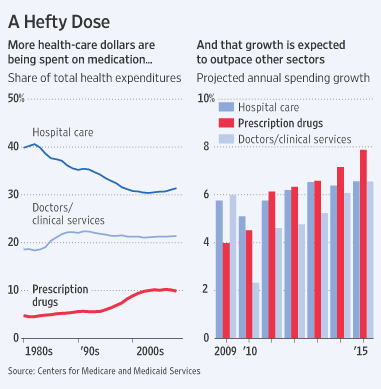
Legislation expected soon in the powerful Senate Finance Committee will leave out cost-cutting steps as part of an agreement with the industry and the White House, according to Congressional aides, industry lobbyists and others involved in the talks.
[a hefty dose]
The missing items include two planks of Mr. Obama’s campaign platform: allowing cheaper drugs to be imported from Canada and giving the federal government the right to negotiate Medicare drug prices directly with pharmaceutical companies.
While the industry has engaged in vigorous lobbying just as Mr. Obama took office, that alone doesn’t explain all the success. Reimportation and Medicare drug-price negotiation are largely symbolic and Congressional researchers have said they won’t save much money in the long run.
Meanwhile, a separate Senate committee voted this week as part of its health bill to give branded biotechnology drugs at least 12 years of market exclusivity, a defeat for makers of cheaper copycat medicines. “This is the best year the drug industry has had in decades,” said Nancy LeaMond of AARP, the seniors’ lobby, which is seeking greater price-cutting on drugs.
Pharmaceutical firms say cutting drug prices would hurt innovation and make it harder to bring new medicines to market, and say they are making sacrifices as part of the health-care overhaul.
Last month, the industry agreed to what Mr. Obama touted at the White House as $80 billion over 10 years in give-backs to help pay for expanded health insurance. About $50 billion of the total is available to help pay for the overhaul, expected to cost $1 trillion over a decade.
The remainder comes from an agreement to sell more brand-name drugs to certain Medicare beneficiaries at a 50% discount — which saves those seniors money but also generates new business for the industry. White House spokeswoman Linda Douglass said the deal represented “an unprecedented commitment” from “an industry that has opposed health-reform efforts in the past.”
The pharmaceuticals industry has a war chest it can use either to back a health-care bill or rally public support against it.
Already radio spots helped secure congressional support for extended protection for biotech drugs.
If Mr. Obama retreats on some drug-industry issues, it might help him land a much bigger prize: a broad health-care bill. “The motivation for the White House and Finance Committee is to take PhRMA and its money out of any possible opposition, and that’s really what’s driving these agreements, along with the desire to get financing for the bill,” said John Rother, another AARP lobbyist, referring to the Pharmaceutical Research and Manufacturers of America. “Think about who has money enough to cause a problem.”
On Thursday, PhRMA and the liberal group Families USA unveiled television ads featuring “Harry and Louise,” the fictional couple in ads that helped defeat health legislation during the Clinton administration. In the new ads, the couple now favors a health overhaul.
PhRMA didn’t respond to requests for comment on its ad strategy.
Some Democrats, including Mr. Obama, have pushed Congress to establish a pathway for generic biological drugs. But the Senate health committee voted this week to give biologics 12 years of market exclusivity — separate from any patent protection they might enjoy. The White House had proposed seven years.
Last month, when it seemed that the bill would be more favorable to generics, Watson Pharmaceuticals Inc., a big generics maker, announced the acquisition of Arrow Group of Europe for $1.7 billion as a platform to develop biologics. “Now we have to rethink our strategy,” said Watson Chief Executive Paul Bisaro. “We’re all very disappointed.”
In a statement, the Biotechnology Industry Organization said the 12-year window is a “fair and reasonable period to ensure continued biomedical innovation.”
PhRMA is headed by former Republican Rep. Billy Tauzin, who was chairman of the House Energy and Commerce Committee and began reaching out to Democrats shortly after Mr. Obama was elected.
He was among the first people in the health-care industry to sit down in negotiations with the administration when it took office. That effort came to fruition with the June announcement of the $80 billion deal. “I think they probably are the most effective and well-financed health stakeholder group in the country,” said Ron Pollack, president of Families USA.
The House bill includes about $30 billion more in cuts to the drug industry than the Senate version, according to calculations by outside analysts. It also contains one particular measure that drug companies don’t like. When the Medicare drug benefit went into effect, certain seniors who were getting drug coverage through Medicaid moved on to the new Medicare program. “It was like a $2 billion-a-year windfall for drug companies,” said Rep. Henry Waxman (D., Calif.), because Medicare prices are higher.
The House bill proposes rebates that would take back that money, but the Senate Finance Committee left that out, and the White House declined to say whether it supports the effort to impose the rebates.
The Finance Committee had proposed using this policy as a stick to make sure that drug companies gave seniors the 50% discount they were promising as part of the $80 billion deal.
Drug makers found that objectionable, and the announcement of the agreement was delayed for 48 hours while they found another enforcement mechanism, according to one lobbyist involved.
Write to Alicia Mundy at alicia.mundy@wsj.com and Laura Meckler at laura.meckler@wsj.com