Health Care Choices and Decisions in the United States and Canada
Joseph S. Ross, MD, MHS; Allan S. Detsky, MD, PhD
JAMA. 2009;302(16):1803-1804. 10/28/2009
Media speculation about the scope of proposals for health care reform in the United States has led many Americans to be “very concerned” that changes will limit their choices in the future.1 Health care choices are made on 3 levels: insurance plans, sources of care (physicians and hospitals), and clinical decisions (diagnostic tests and treatments). In this Commentary, the extent to which Americans currently are able to exercise choices is discussed. For context, the US environment is compared with that in Canada, partly because the Canadian health system, with much greater government involvement, is often publicly portrayed in the United States as limiting choice.
Insurance Coverage
United States
All US citizens, other than those aged 65 years or older and the very poor, make the choice to purchase private health insurance (or not). It is estimated that nearly 47 million individuals have no coverage. It is unknown how many choose not to purchase coverage, cannot afford coverage, or cannot obtain coverage. Uninsured persons are severely limited in all other health care choices. They must either receive charity care or pay for care out of pocket, possibly incurring substantial debt or bankruptcy.
The choice of insurance plan is also often limited; 96% of US Metropolitan Statistical Areas have insurance markets that are highly concentrated, consolidated among only a few companies.2-3 Employers who offer health insurance also frequently limit choices. One plan is often established as preferred and made less expensive through lower premiums and co-payments. Few working adults can afford to purchase plans outside of their employer because other plans’ costs and risks are neither subsidized nor pooled. In addition, loss or change of jobs often results in loss of insurance coverage or substantially higher payments to retain existing coverage.
In contrast, insurers have the choice to accept or deny individuals coverage for innumerable reasons, often related to prior or current medical conditions. They may even deny coverage among those they insure for specific care related to preexisting conditions.
Canada
All Canadian citizens and landed immigrants are eligible to receive health insurance through the 1 government-sponsored plan administered by their province or territory. Because the application process is simple, without screening for current or preexisting health conditions or means testing, unenrolled individuals who seek care are routinely enrolled by clinical practices and hospitals, removing the need for charity care. Insurance coverage is not tied to employment and so does not change with loss or change of jobs.
The Canadian government mandates that all provincial plans cover “necessary care,” including most physician and hospital services. However, there are private insurance plans to obtain coverage for services that are not covered by some provincial plans, such as pharmaceuticals, private rooms in hospitals, dental care, home care, physiotherapy, and chiropractic care.
Hospitals and Physicians
United States
The choice of hospital or physician is often made by an individual’s insurance plan. Whether structured as a health maintenance organization, preferred provider organization, or otherwise, most plans attempt to limit costs by designating hospitals and physicians, offering either discounted coinsurance or additional benefits to promote their use. Receiving care “out of network” requires that individuals pay substantially larger co-payments.
Health insurance plans often require individuals to choose a primary care physician on enrollment who arranges referrals to specialist physicians. Forty percent of sicker adult Americans report difficulties seeing a specialist, 40% because of long waiting times, 31% because of a denied referral or waiting for a referral, and 17% because they cannot afford private insurance.4
Choice is also influenced by availability of care. The United States ranks last in international comparisons for patients finding it somewhat or very difficult to obtain care on nights or weekends without going to an emergency department.5
Canada
Canadians may choose to receive care from any physician or hospital anywhere in Canada. Typically, a family physician provides primary care and makes referrals to specialists. There is no limit to the number of different physicians a patient can see. If patients are not satisfied with the care of one physician or hospital, they may change to another. Specialists generally require a referral from another physician (not necessarily the family physician) to be reimbursed for a “consultation” but can evaluate any patient and be reimbursed for an “assessment.” Individuals may present to any hospital emergency department and request specialty care, which is scheduled as long as the emergency physician, who has no incentive not to, agrees.
Diagnostic Testing and Treatments
United States
The common presumption is that there is access to every new diagnostic test, procedure, medication, and intervention in the United States. However, insurance plans make use of formularies that restrict medications. Generally, at least 1 medication in any pharmacologic class is offered among “first-tier” medications, for which co-payments are the least expensive. Choosing less expensive or generic medications is also facilitated by requiring prior authorization for brand-name medications when a generic alternative exists or by offering 1 medication in a class at a lower co-payment after contracting with the manufacturer to obtain a discounted price.
Similarly, although many routine, less expensive services are not restricted, prior authorization is often used to limit the use of expensive health care services such as magnetic resonance imaging or experimental interventions.
In international comparisons, US waiting times are consistently shorter for elective surgeries and procedures.6 However, even though physicians and hospitals generally are able and willing to provide care quickly and efficiently, insurance plans are not necessarily similarly willing to fully reimburse charges. Often, it is not until after the procedure and utilization review that patients become aware of the substantial portion of the payment they must incur.
Canada
Virtually all health care services available in the United States are also available in Canada. There is regionalization of specialized services, such as surgical, oncology, or imaging procedures. For services unavailable in all parts of Canada, such as gamma knife surgery, governments will reimburse care received in the United States, but patients are required to apply in advance. In contrast with common perception, Canadians’ use of elective health care services in the United States is not common.7 For care in Canada, there is no utilization review and all services are covered in full without co-payment. Physicians and hospitals are paid promptly by the government. Patients receive no bill and fill out no forms. However, as opposed to prior authorization, the use of expensive health care services is limited by supply; there are fewer facilities per capita that provide this care. Provincial and private drug plans use formularies similar to those in the United States.
Waiting time is less a health care issue than a political one. Both federal and provincial governments have responded to media-facilitated public pressure to reduce wait times for specific services, such as hip and knee replacement, cataract surgery, cancer surgery, and emergency care through strategies that resemble pay for performance.8-9 Moreover, there is provincial variation in reliance on private facilities that charge individuals directly for common diagnostic services (eg, blood drawing, imaging); some provinces have allowed (or tacitly encouraged) these facilities, allowing patients to choose to pay for some routine care to receive it sooner.
The Bottom Line
Government-sponsored plans like Canada’s are frequently publicly portrayed as limiting choice. However, there is clear evidence that for Canada’s health care system, less choice in insurance coverage (although guaranteed) has not resulted in less choice of hospitals, physicians, and diagnostic testing and treatments compared with the United States. In fact, there is arguably more choice.
AUTHOR INFORMATION
Corresponding Author: Allan S. Detsky, MD, PhD, Mount Sinai Hospital, 429-600 University Ave, Toronto, ON M5G 1X5, Canada (adetsky@mtsinai.on.ca).
Financial Disclosures: None reported.
Funding/Support: Dr Ross is currently supported by the National Institute on Aging (K08 AG032886) and by the American Federation of Aging Research through the Paul B. Beeson Career Development Award Program.
Role of the Sponsor: The funding organizations had no role in the preparation, review, or approval of the manuscript.
Disclaimer: The views expressed in this article are those of the authors and do not necessarily represent the views of the US Department of Veterans Affairs.
Author Affiliations: Departments of Geriatrics and Palliative Care and Medicine, Mount Sinai School of Medicine, New York, New York, and Health Services Research and Development Research Enhancement Award Program and Geriatrics Research, Education, and Clinical Center, James J. Peters Veterans Administration Medical Center, Bronx, New York (Dr Ross); Department of Medicine, Mount Sinai Hospital and University Health Network, and Departments of Health Policy, Management, and Evaluation and Medicine, University of Toronto, Toronto, Ontario, Canada (Dr Detsky).
REFERENCES
1. Current satisfaction vs future worry defines the battle on health reform. June 24, 2009. http://abcnews.go.com/images/PollingUnit/1091a2HealthCareReform.pdf. Accessed October 7, 2009.
2. American Medical Association. Competition in Health Insurance: A Comprehensive Study of US Markets: A 2007 Update. 2007. http://www.ama-assn.org/ama1/pub/upload/mm/368/compstudy_52006.pdf. Accessed August 13, 2009.
3. Biles B, Pozen J, Guterman S. Paying Medicare Advantage by Competitive Bidding: How Much Competition Is There? 2009. http://www.commonwealthfund.org/~/media/Files/Publications/Issue%20Brief/2009/Aug/1311_Biles_paying_Medicare_Advantage_plans_competitive_bidding.pdf. Accessed August 13, 2009.
4. Blendon RJ, Schoen C, DesRoches C, Osborn R, Zapert K. Common concerns amid diverse systems: health care experiences in five countries. Health Aff (Millwood). 2003;22(3):106-121. FREE FULL TEXT
5. Davis K, Schoen C, Schoenbaum SC; et al. Mirror, Mirror on the Wall: An International Update on the Comparative Performance of American Health Care. New York, NY: Commonwealth Fund; May 2007.
6. Blendon RJ, Schoen C, DesRoches CM, Osborn R, Zapert K, Raleigh E. Confronting competing demands to improve quality: a five-country hospital survey. Health Aff (Millwood). 2004;23(3):119-135. FREE FULL TEXT
7. Katz SJ, Cardiff K, Pascali M, Barer ML, Evans RG. Phantoms in the snow: Canadians’ use of health care services in the United States. Health Aff (Millwood). 2002;21(3):19-31. FREE FULL TEXT
8. Canada’s new government announces patient wait times guarantees office of the prime minister [press release]. April 4, 2007. http://www.pm.gc.ca/eng/media.asp?id=1611. Accessed October 7, 2009.
9. Tam P. Key surgical wait times dropping fast; cataract surgery, joint replacements speedier but still behind provincial targets. Ottawa Citizen. November 26, 2008:C1.
Sanders to push for single-payer
By DANIEL BARLOW
Times-Argus (Vt.)
Oct. 29, 2009
MONTPELIER — U.S. Sen. Bernard Sanders will likely make history this year when — for the first time ever — he brings a bill creating a national single-payer health care system to the floor of the Senate for a vote.
As a compromise on a public-option plan that would allow states to opt out gains steam in the U.S. Senate, Sanders, a Vermont independent, continues to focus his attention on a single-payer bill, although he acknowledges that there are not enough votes to pass it.
“That bill will lose,” Sanders said Wednesday morning during a telephone interview. “The question, however, will be how much support it will get.”
Introduced in the early spring, Sanders’ American Health Security Act of 2009 would eliminate the role of private insurance companies in health care and create a public fund that would insure all residents of the United States.
Sanders said his bill would insure the 46 million Americans without coverage and could save upwards of $400 million annually by eliminating insurance overhead and medical bureaucracy.
The system would be paid for through existing sources of government health care spending along with some tax increases, which advocates say would be less than what people pay now in co-pays or out-of-pocket expenses.
Sanders’ bill has received little attention in Washington political circles as this summer’s health-care debate focused more on discredited fears of government death panels and the cost of a public health insurance option, which President Obama favors.
There has never been a vote on a single-payer health care system in either the U.S. Senate or the House, according to Mark Almberg, communications director for the organization Physicians for a National Health Program, a national advocacy organization that supports a single-payer system.
“We do believe that this could be the first time a single-payer bill gets a vote in Congress,” said Almberg, whose organization supports Sanders’ bill.
Almberg agreed that single-payer does not have the votes to pass the U.S. Congress. He said there are about 80 co-sponsors of a similar House bill, but would not hazard a guess as to how many votes for such a plan there are in the Senate.
Knowing that his single-payer bill is likely to fail, Sanders said he also plans to try including a provision in the final health-care bill that would allow states such as Vermont to experiment with a single-payer system on a state level.
If that legislation is approved, it would be welcomed by some lawmakers in Vermont. Sen. Doug Racine, D-Chittenden, a candidate for governor in 2010, said he plans to kick off hearings at the Statehouse in January on exactly what a single-payer system in the Green Mountain State would look like.
Racine said Vermont would need certain waivers from the federal government to conduct a single-payer health care system here — exactly the type of clearance that Sanders’ proposed provision would allow.
“There are lots of different questions that need to be answered,” Racine said. “I think we need to move past the question of whether or not a single-payer system would be good for Vermont and begin looking at how it would work.”
Sanders was hesitant to make predictions of where health care reform will end up in the Senate — his staff has yet to see a final version of the bill and a date for a vote has not been scheduled.
But his expectation is that the final bill will have the required 60 votes to overcome a Republican filibuster to bring it to a final vote, which only requires more than 50 votes to pass.
“I think that, once we get closer to a vote, the American people will look closely at what is in the Senate bill and what is in the House bill,” Sanders said. “I hope that we will see a groundswell of support for health care reform that will force some members to take a stand and allow for a vote.”
Still, Sanders is not too enthusiastic about the public-option opt-out plan pushed by Senate Majority Leader Harry Reid, a Nevada Democrat, this week.
“All the American people should be given the option of a public health insurance plan that competes on the market with the private insurance companies,” he said.
Doctors risking arrest for single-payer health care for all
By Kevin Gosztola
OpEd News
Oct. 28, 2009
At least three doctors will be risking arrest in civil disobedience actions during Mobilization for Health care for All’s third wave of actions this week, which are being held to demand an end to insurance abuse and to demand real health care reform for all.
Ken Weinberg, who will be risking arrest at the Wellpoint Offices in New York City, says it dawned on him that this is a moral issue, he needs to be out there, and he is risking arrest because he doesn’t know what else to do.
“I’ve met with my senators and congressman and nothing works,” says Weinberg. “I think what really pushed me over was the new study that came out from Harvard that showed that 45,000 people die each year because they don’t have health insurance and that to me is criminal.”
Weinberg adds, “Our elected representatives are so in the pockets of the insurance companies that they’re not doing anything. They’re not responsive to the American people. So, this is a wake up call to them as well.”
Matt Hendrickson, who will be risking arrest at the Cigna offices in Glendale near downtown Los Angeles, says he’s “inspired by the people that have already gotten arrested in the last three weeks.”
“They’re just as angry as I am by how the private insurance industry is ruining our health care system,” says Hendrickson.
Additionally, Hendrickson cites the fact that 50 percent of his patients either have no insurance or they are underinsured, being a self-employed doctor whose premiums are going up 15 percent a year, and previous human rights movements (civil rights, anti-war, self-determination, etc) as reasons for being willing to risk arrest.
Margaret Flowers, who will be risking arrest at Carefirst Blue Cross/Blue Shield in Baltimore, Maryland on Thursday, explains that as the Senate Finance Committee hearing started hearings on health care single-payer advocates were excluded. This really showed Flowers that America’s democratic process was not in tact and functioning.
She explains at the first meeting “there were 41 people that testified. They had AHIP, Pharma, and Big Business” but nobody was there “that really represented the health providers and the patient’s point of view.” And, there definitely was no person advocating for a national health care program.
So, at the second Finance Committee hearing on May 5, she and other single-payer advocates showed up at the hearing to ask why their voices weren’t being included in the debate.
Since the spring, there has been an effort to discount and outright ignore the single-payer action movement that has been carrying out several campaigns to push back against anti-health care reform agendas and improve any reform that may funnel or divert money into the hands of insurance companies for profits instead of patient care.
Despite snubs from Democrats and Obama, the single-payer action movement has momentum and is why the public option is being considered.
“The reason why the public option was introduced, according to congress people that have spoken to the single-payer movement, was because of the single-payer movement,” says Hendrickson. “There was such an upswell [by progressives] for single payer that [leaders] opted for some compromise that would not have been given if there wasn’t so much support for single payer.”
So, why are progressives settling for incremental change? Why are they settling for a public option that has proven to be a failure in states like Tennessee, Oregon, and Massachusetts?
With the public option now being outfitted with an opt-out provision, with leaders doing everything they can to make sure the option will fail to compete with insurance companies, and with Sen. Joe Lieberman publicly declaring that he has no problem with obstructing a vote on health care on behalf of for-profit insurers, isn’t it time to up the ante?
And isn’t it time for more doctors and nurses to come out of the woodwork for real health care reform?
“We swore an oath when we finished our medical school and part of that was to practice our professional dignity and honor and to keep the health of our patients first and foremost,” says Flowers. “So, how can we continue to be silent in the face of a private insurance market-based model of health care which is literally killing our patients?”
“We’re all complicit in this. We’re forced to be complicit,” says Weinberg. “What we want is patient care. We want the best possible patient care for people and we are constantly having to play games to skirt around what the insurance companies are forcing us to do.”
Or, as Hendrickson so eloquently puts it: “It is a personal decision and everybody knows when it’s the right time to make that sacrifice. Doctors do have an enormous moral authority in our society. And when you see physicians that advocate for a status quo approach that the American Medical Association has basically pushed, it really hurts our image as physicians.
“We as physicians have a noble duty to care for our patients,” he continued. “And to be given an opportunity to make a relatively small sacrifice — spend a few hours, maybe a night in jail — in exchange for bringing this issue of the private insurance industry and how much harm they’re doing to medicine [to the forefront] — I think it’s a phenomenal opportunity.
Hendrickson also hopes the physicians getting arrested tomorrow and others planning to be arrested in the next wave in November will give “more confidence, more motivation, more inspiration to follow suit because so many of us know how badly the insurance industry is harming our ability to practice medicine.”
Flowers is a pediatrician and mother who quit her practice a few years ago to educate legislators, colleagues and others on real health care reform.
Weinberg is an emergency care physician who has been practicing for 25 years and who has been advocating for single-payer for 15 years.
Hendrickson is a self-employed doctor.
Each of these doctors will be participating in actions, which will occur Wednesday, Oct. 28 or Thursday, Oct. 29. MobilizeforHealthcare.org will post updates on the actions as they are received.
To join or support the campaign that is motivating doctors to risk arrest, visit Mobilization for Health Care for All and sign up today at www.MobilizeForHealth care.org
Kevin Gosztola writes regularly at OpEdNews and Open Salon and he is a 2009 Young People For (YP4) Fellow. He is a documentary filmmaker currently completing a film/video degree at Columbia College in Chicago.
http://www.prosperityagenda.us/node/2462
Weiner single payer amendment tanks
Nancy Pelosi starts clock on House health bill
By Patrick O’Connor and Chris Frates
Politico
October 29, 2009
(House Speaker Nancy Pelosi) backed down from a deal granting liberals a vote to establish single-payer government-run health care. She cut the deal with New York Rep. Anthony Weiner to break a last-minute logjam on the Energy and Commerce Committee. But, in the end, party leaders were concerned the final cost would be astronomical and the vote would fail to garner votes from even half the caucus.
http://www.politico.com/news/stories/1009/28884.html
Comment:
By Don McCanne, MD
What the… !?
The ethics of health care reform
"Making Sense of the Health Care Debate"
A round table discussion of health care reform
University of California at Irvine
The UCI Interdisciplinary Center for the Scientific Study of Ethics and Morality
October 27, 2009
Comments of Don McCanne, M.D. (from memory, edited and abridged):
I’ll be brief because I want to make only one very simple point: An ethical health care system is designed to take care of patients. What could be more obvious? If the health care system is doing its job in taking care of patients then the health care system itself is being taken care of. Special interests legitimately involved in health care delivery will do just fine.
Although this principle seems very obvious, it hasn’t been guiding the process in Washington, DC. Our politicians are designing a health care system that is taking care of the private insurance industry. Patient care is secondary, as it must conform to the private insurance model.
As Senator Joe Dunn just said, legislation is 10 percent principles and 90 percent politics. Congress is providing us with a political solution rather than a solution based on sound health policy science.
We were told that we would have health care reform that would cover everyone, and that costs would be controlled, making health care affordable for each of us. Yet when they insisted that reform be based on private insurance plans and that the budget be limited to $900 billion over the next ten years, they realized that at least 20 million people could not be insured under this proposal. Likely it will be many more, especially after four more years of health care inflation before the basics of this plan are even in place. And since there are no effective measures for controlling costs, health care will be even less affordable.
The limitations imposed have resulted in such bizarre policy proposals as granting waivers to individuals to exempt them from the fines that would be imposed for committing the criminal act of being uninsured.
A fundamental flaw of their proposal was to try to craft reform based on a package of benefits in a private insurance plan that has a premium assigned to it. That premium plus the out-of-pocket expenses must cover the average family health care costs of $16,771 (Milliman Medical Index). With a typical family income of perhaps $60,000, those costs now create a financial hardship for families, especially those at income levels where the subsidies phase out.
By designing reform that primarily benefits insurers, the most productive sector of our society – middle income Americans – is going to be the hardest hit by the adverse consequences of this legislation.
Since this is a forum on ethics, I have to conclude that our legislators, by failing to place the patient first, compromised ethics when they crafted this reform.
Why the Health Insurance Excise Tax Is a Bad Idea
By Steve Early & Rand Wilson
The Nation
Oct. 21, 2009
Twenty years ago, 60,000 workers from New York City to Maine rallied against healthcare cost-shifting at the telecom giant then known as NYNEX (since “rebranded” as Verizon).
NYNEX was a very profitable, multinational company seeking to capitalize on a demoralizing decade of lost strikes, contract givebacks and widespread unionbusting. At a time when many workers were forced to make concessions, NYNEX strikers held the line for four months and emerged victorious. They successfully resisted the company’s demand that they pay hundreds and eventually thousands of dollars a year for medical benefits. But this singular union win didn’t come cheap. Customer service was disrupted by the work stoppage, resulting in tens of millions of dollars worth of lost wages. Hundreds of strikers were arrested, fired or suspended–and one, Gerry Horgan, was killed on a picket line in Westchester County.
In every other advanced industrial nation, the contentious issue of who pays for medical care was taken off the bargaining table long ago. And no worker would ever lose his or her life defending job-based private health insurance.
To this day, members of the Communications Workers of America (CWA) and the International Brotherhood of Electrical Workers (IBEW) who work at the phone company in the Northeast make no premium contributions for their individual or family coverage–an arrangement now enjoyed by a fraction of the labor force. To avoid being stigmatized as a privileged group–selfishly trying to preserve better-than-average benefits–the NYNEX strikers were careful about how they countered management’s demand for premium-sharing and framed the central issue in dispute. Their buttons, banners, press releases and leaflets made it clear that the solution to medical cost inflation was “Health Care For All, Not Health Cuts At NYNEX!”
Backed by allies like Jesse Jackson, Citizen Action and Physicians for a National Health Program (PNHP), the strike became a focal point for ongoing public and membership education about the need for Canadian-style national health insurance. CWA and IBEW took the position that givebacks in telecom wouldn’t benefit the millions of other workers with less insurance or none at all; in fact, any medical cost savings achieved by NYNEX would simply relieve financial pressure on that corporation and others to support real healthcare reform.
Not long after the walkout began, NYNEX provided strikers with a vivid reminder of why healthcare shouldn’t be controlled by employers: the company canceled coverage for all 60,000 employees and their families. Undeterred, NYNEX workers used strike benefits, contributions from other unions or personal savings to pay their doctor and hospital bills and, when necessary, arrange COBRA coverage. As part of the strike settlement, their old health insurance was restored and some costs reimbursed. However, a year later, when CWA tried to put a pro-single-payer resolution before NYNEX shareholders, management got the Securities and Exchange Commission to exclude the proposal from proxy materials sent out before its 1990 annual meeting.
In subsequent rounds of bargaining, the cost of providing generous benefits for active and retired Verizon workers has led to several more strikes and, in 2003, a protracted “work-to-rule” wrangle about the same issue. To this day, telecom executives remain staunch ideological foes of any expansion of the social wage in the form of “Medicare for all.” In its own corporate lobbying, Verizon props up a dysfunctional status quo–the current mishmash of public and private plans–while still objecting to picking up the tab for the latter. Just last month CWA had to file charges before the National Labor Relations Board against Verizon over its refusal to bargain over an announced change in HMO options.
Meanwhile, after twenty years of battling to keep fully paid insurance in place, telecom workers find their medical benefits back in the news–and much demonized–thanks to the tax on “Cadillac” health insurance favored by the Senate Finance Committee. In its current form, the proposed 40 percent excise tax would be applied, four years from now, to the portion of the value of any employer-provided coverage that then exceeds $8,000 for individuals and $21,000 for families. In the Boston area, where medical expenses are particularly high and Verizon’s workforce is getting older, the bill for family care is almost that much now. As CWA national president Larry Cohen pointed out in the New York Times on October 13, “at least half my members would be in health plans subject to the tax in 2013.”
As health policy expert Len Rodberg noted in a recent article, “Is There Any Way Out for Obama?”, quoted on the PNHP website, funding “healthcare reform” in this fashion simply penalizes employers like Verizon who have, under duress, continued to provide “good insurance.” At the same time, the Finance Committee bill approved on October 13 does little to compel better coverage by employers who currently underinsure their employees. In the case of big self-insured firms in the telecom industry, this is not a “tax on insurance companies”–as often reported misleadingly in the media. It’s an additional bottom-line cost that, as Rodberg observes, provides “a strong incentive to cut back on benefits.” Workers who lack collective bargaining rights will have their coverage reduced unilaterally. At unionized firms like Verizon or AT&T–where healthcare has bogged down union bargaining again this year–an excise tax on existing benefits will trigger more 1989-style labor-management conflict at a time when union strike capacity is far weaker than twenty years ago.
This is not what labor activists voted for last fall when they backed Barack Obama and the Democrats in key battleground states or the safer precincts of the Northeast. Because of the searing experience of the NYNEX strike, many of its participants became far more receptive to trading in their so-called Cadillac for the cradle-to-grave security of tax-supported universal coverage no longer tied to now-precarious telecom jobs. But no one wants to pay more for less–particularly when that’s far from the best or fairest route to “healthcare for all.” Senator Max Baucus’s misbegotten scheme to tax the benefits of workers who are slightly better off–so revenue can be raised for budget-busting private insurance subsidies–is, in fact, a lose-lose proposition. If it’s not killed on the Senate floor, or eliminated in a House-Senate conference committee, this undermining of past union gains will leave many embittered workers in its wake.
http://www.thenation.com/doc/20091102/early_wilson
Single-payer proponents say state health care system 'broken'
By Kyle Chene
Belmont (Mass.) Citizen-Herald
Wed Oct 21, 2009
Boston, Mass. – Although state leaders have bristled at the pointed, dismissive and sometimes downright false claims made about the Massachusetts health care system by outsiders, they have said little about the dissent from within.
A quarter of the Legislature has signed onto a proposal to scrap the state’s landmark health care system, which still relies on private insurance companies to cover millions of residents, in favor of a single-payer system, publicly run and available to all residents.
Backers of the single-payer plan (H 2127) argued Tuesday that the state’s current system has failed to control costs, prevented even insured residents from obtaining needed care and left as much as 5 percent of the population without coverage.
The legislative supporters include Rep. Ellen Story (D-Amherst), a member of House Speaker Robert DeLeo’s leadership team and a stable of reliably liberal legislators. Officials from the League of Women Voters, the National Association of Social Workers, the Massachusetts Nurses Association and other social advocacy organizations were also on hand to register support. While such proposals have sparked fierce opposition nationally, no opponents spoke at the hearing.
The proposal by Rep. Matt Patrick (D-Falmouth) would establish a “Massachusetts Health Care Trust” reimbursing providers for health care costs, investing in health care facilities, streamlining health care bureaucracy and incentivizing quality of care. The trust would be funded by a “dedicated tax” on employers, workers and citizens, intended to replace funds currently spent on insurance premiums. The trust would also consolidate all municipal and federal health care dollars.
The trust would be overseen by a board that includes the secretary of health and human services, the secretary of administration and finance, the commission of public health, three gubernatorial appointees, three appointees of the attorney general and eight members elected by state residents.
All Massachusetts residents would be eligible to receive health care through the trust, as well as non-residents who work more than 20 hours a week in Massachusetts, pay Massachusetts income and payroll taxes and pay premiums established by the trust. Benefits would include prescription drugs, emergency care, doctor visits, hearing, vision and dental care, home health, maternity coverage and various other medical procedures.
The debate comes at a time that the governor and top lawmakers are eyeing a fundamental overhaul in the way the state pays for care. A special commission of legislators, administration officials, doctors, hospitals, insurers and health care experts recommended over the summer that Massachusetts implement a system of “global payments” aimed at curbing health care costs by coordinating individual patients’ care among various providers.
Gov. Deval Patrick has said he expects legislation enshrining such a system to be ready by the end of the month, and stakeholders from across the health care system voiced conditional support for ending the state’s current “fee-for-service” model.
Noting that the commission report “sounded the alarm” about soaring health care costs, Rep. Patrick questioned the recommendations because the members did not consider a single payer system.
“I dare you to read the report and tell me how it will work,” he said.
Sen. Patricia Jehlen (D-Somerville), a sponsor of the proposal, said passing it this year would be “politically unrealistic,” although she said health care costs would crowd out other government programs if left unchecked.
Despite the criticism of the state’s current system, aimed at offering universal access to health insurance, there is a wide array of support. Backers of the existing structure, while acknowledging that health care costs have continued to climb, note that the state has covered about 430,000 residents since the inception of health care reform in 2006. Individuals are required to purchase health insurance, and low-income residents without access to health care through their employers may obtain partially or fully-subsidized care through the state’s Connector Authority, an exchange that pairs consumers with private plans.
Opponents of single-payer care worry that it places government bureaucrats in charge of important health care decisions, would add layers of bureaucracy to the existing system, would reduce the quality of care and would disrupt relationships between doctors and patients, arguments that single-payer backers reject.
For much of the hearing, single-payer backers spoke to a sparse panel of legislators, as House members flitted between a Democratic caucus and the basement hearing room. In addition, Senate Chair Susan Fargo (D-Lincoln) and Vice Chair Mark Montigny (D-New Bedford) were absent, leaving Sen. Jennifer Flanagan (D-Leominster) with the gavel for much of the hearing. House Chair Jeffrey Sanchez (D-Boston) and Reps. Jason Lewis (D-Winchester), Cleon Turner (D-Barnstable) and Michael Brady (D-Brockton) attended parts of the hearing.
Single-payer advocate Benjamin Day, executive director of MassCare, said his favored system often fails to gain political traction because of intense lobbying efforts by the insurance industry.
“I think it’s tough because single-payer contains effective cost control,” he said. “Every bill that contains cost control is a political slugfest.”
He and other proponents of a single-payer system argued that every ambitious health care reform plan enacted by states has ultimately failed because of unsustainable costs.
Dr. Steffie Woolhandler, a Harvard University professor and advocate with Physicians for a National Health Program, questioned a 97.4 percent health insurance rate in Massachusetts, a figure highly touted by the Patrick administration.
“That’s a single organization, the Urban Institute, that gives that number,” she said. “The problem of underinsurance, being unable to afford care despite having insurance, has actually gotten worse in the state … We’ve tried a reform in this state that’s left 5 percent of the people uninsured, costing the commonwealth $1.3 billion this year.”
Rep. Timothy Madden, a freshman Democrat from Nantucket, said his family has “been through the mill” with insurance companies.
“I think the system is broken,” he said. “We should set the tenor in the leadership and the message to Washington.”
Why Isn't 122 Dead Americans Every Day a National Health Emergency?
By Donna Smith
CommonDreams.org
Published on Monday, October 26, 2009
Why does H1N1 call for a Presidential designation as a national emergency while the preventable deaths of 45,000 Americans every year (122 every day) is not?
Swine flu leads the news. You can die from swine flu, or should we say H1N1, even if you have no underlying health conditions. Young people have died, and pregnant women are at risk. People are lining up to be vaccinated. Health professionals are at risk due to poor preparations at some health facilities. As many as 1,000 deaths have occurred due to this flu outbreak. It’s scary out there.
But the swine flu is no match for the killing going on at the hands of the for-profit healthcare system in these United States. We bury kids, pregnant moms, babies, teens, young fathers, mid-lifers and older folks too without even batting an eye in the chambers of power in this nation.
Some have termed it the spine flu as they say it is the failure of our leadership to stand up to the money interests promoting and protecting this system. But it is worse than simply failing to stand up to the for-profit insurance industry, the big pharmaceutical companies, the large hospital conglomerates, the medical equipment profiteers and the financial service industry salivating at the prospects of more suffering and more want for healthcare in this nation.
There is no lack of spinal fortitude in this lot of legislators or in the Oval Office. They stand up to the American people just fine. We voted for a man who told us he knows healthcare is a basic human right yet we have a President who is not willing to issue a cease fire in this profit-driven healthcare war upon his own citizens. We swept in with him large numbers of Congressional members who said they got it — they would stop the carnage at the hands of the broken system.
But we are told to wait. It’s hard — they say — to get their bipartisan reform done. Blue Dogs might be upset. The Republicans want to protect the free market of death-care, and the Democrats want to stay in office. So they all stand up all right, they stand up for their own self-interests and the death count rises ever higher each day.
Yet, they dribble and dawdle and bumble and act as though it’s just too damned difficult to immediately stop the losses. Extend Medicare like coverage to all, right now, and then haggle about the details later boys and girls.
Issue an executive order, President Obama. Declare a national emergency. No one else denied care when it is available. Save the lives of as many as you can right now. It could be that simple. Really.
It is a national health emergency in this nation when pregnant 24-year-olds like Jenny Fritts of Indiana are turned away for appropriate care because she doesn’t have a way to pay for it and she dies along with her baby. It is a national emergency when teenagers like Nataline Sarkisyan are denied lifesaving treatments until protests grow loud enough to pressure the insurance industry and she dies due to that delay and the need to protest.
So, if the hospital that killed Jenny Fritts had treated her (and her unborn child) and was then worried about the money to cover her care, is that something we can fix? That’s an issue we have time to haggle over. But the time to save Jenny came and went. We allowed her to be killed. And because we all know these deaths are happening every single day in every single state in this nation, we are all to be held to account.
The media doesn’t help either. They are leading the news with the swine flu fears but completely ignoring the kids and moms and dads and neighbors dying underfoot for a lack of healthcare of any kind when they need it. Shameful excuse for journalism in most cases, I’m afraid.
A public health emergency is defined as “an occurrence or imminent threat of an illness or health condition, caused by bioterrism, epidemic or pandemic disease, or novel and highly fatal infectious agent or biological toxin, that poses a substantial risk of a significant number of human fatalities or incidents of permanent or long-term disability. Such illness or health condition includes, but is not limited to, an illness or health condition resulting from a national disaster.”
What do we not understand about the appropriate role of our elected and democratic government to protect us from such a threat killing 122 of us every day? As far as I am concerned, the whole lot of them is not fulfilling their legal duties to me or to the rest of the citizens of this nation. They are failing in the most fundamental way to protect for the common welfare and common good of this nation.
Declare the emergency, Mr. President. Back him up, Speaker Pelosi and Senator Reid. Treat the sick. There is time to fight the payment battle. Healthcare is a basic human right in America.
Donna Smith is a community organizer for the California Nurses Association and National Co-Chair for the Progressive Democrats of America Healthcare Not Warfare campaign.
Managing Disease Without Insurance
By Roni Caryn Rabin
New York Times
Prescriptions Blog
October 23, 2009
Americans without health insurance are less likely to know if they have diabetes or high cholesterol than those with coverage, and they’re less likely to keep their high blood pressure under control than the insured, a new study reports.
The researchers used national health survey data to look at three chronic but manageable health conditions — diabetes, hypertension and high cholesterol — that can lead to serious long-term complications when not kept in check. The long-term problems, including heart attacks, strokes and kidney disease, are expensive conditions that are often treated at public expense, contributing to overall health care costs.
Some 46 percent of uninsured people with diabetes had never been diagnosed with the disease, compared with only 23.2 percent of insured diabetics, the researchers found. Over half of the uninsured people with high cholesterol, or 52 percent, did not know about their condition, compared with 29.9 percent of the insured.
Whether insured or not, about three-quarters of those with high blood pressure had been given a diagnosis, which may reflect a broad public health effort to raise awareness about this common condition and the ease with which it can be checked at a health fair or drugstore. But without insurance, people were less likely to keep their blood pressure under control: 58 percent of uninsured hypertensives had uncontrolled blood pressure, compared with 51.2 percent of the insured.
Likewise, 77.5 percent of uninsured patients with elevated cholesterol were not keeping it under control, compared with 60.4 percent of the insured.
While the goal of the study was to learn how common it is for uninsured people to have a perfectly manageable condition that goes undiagnosed and therefore untreated, the researchers stumbled on a disturbing finding: even people with insurance weren’t doing very well keeping these conditions under control.
“It was striking,” said Andrew P. Wilper, lead author of the paper, which appeared in the journal Health Affairs. “The control of some of these chronic illnesses, even for the insured, is not that great. Among the uninsured, it is even worse.”
The insured and uninsured did not differ much in their control of diabetes, for example. Some 44.2 percent of insured diabetics had uncontrolled diabetes, compared with 46.6 percent of uninsured diabetics.
The study analyzed data about from the National Health and Nutrition Examination Survey of 1999-2006, which included interviews of 41,510 people. Other information was gleaned from questionnaires, physical exams and lab data, and individuals who were under 18 or older than 64 were excluded. About one in five people in the sample did not have health insurance.
Unlikely friends – Donna Smith, American SiCKO and Wendell Potter, former CIGNA executive
Donna Smith, American SiCKO, and Wendell Potter, former CIGNA executive turned whistleblower, at rally in Harrisburg, PA, on October 20, 2009. The rally was organized in support of Pennsylvania’s single-payer healthcare legislation and was co-sponsored by many state and national organizations advocating for healthcare system overhaul, including the Pennsylvania Association of Staff Nurses and Allied Professionals (PASNAP), the California Nurses Association/National Nurses Organizing Committee, Healthcare for All Pennsylvania, Progressive Democrats of America, Healthcare-Now, Physicians for a National Health Program, the Western PA Coalition for Single-Payer Healthcare, and the Pennsylvania AFL-CIO .
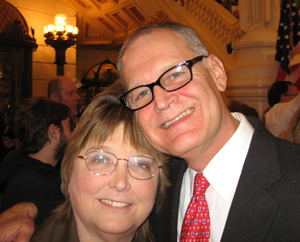
Donna and her husband Larry were bankrupted due to medical crisis even though they carried health insurance coverage, disability insurance and a small healthcare savings account.
Donna told Wendell, “I forgive you.”
Wendell worked as an executive in the private, for-profit insurance industry (for Humana and then CIGNA) until May of 2008 when he finally decided he could not play a part in the suffering that resulted from so many of the practices of the industry.
The crowd of more than 1,200 people cheered, as Wendell teared up, embraced Donna and said, “God bless you.”
Health Reform: Where Obama Went Wrong
by Leonard Rodberg
Tikkun Magazine
November/December 2009
President Obama’s health reform plan is in trouble. Public support for it is only lukewarm; both Left and Right oppose it. Pundits and editorial writers complain that Obama has turned the issue over to Congress, or that he hasn’t explained the plan well enough. He and his staff have been working closely with many members of Congress from the very beginning, and he has described his plan repeatedly and in many forums — and no one questions that he is a superb communicator. And yet disquiet and confusion persist. What has gone wrong?
The President’s Fateful Choice
Sixty percent of all Americans get their health insurance from private insurers, mostly through their employers, with some buying it directly from insurance companies. About half as many — 87 million according to the latest report from the Census Bureau — are covered by Medicare (the federal program for the elderly and the disabled), Medicaid (the joint federal-state program for the poor), the VA, and other public programs.
However, when you look at who pays the bills, you find a very different picture: nearly half of all medical bills are paid by government, largely through Medicare and Medicaid, but also through support for community health centers, the VA, and so on. Private insurance accounts for barely a third of all health care spending. The reason is clear: government covers those who are most in need of medical care, the elderly and the poor, while private insurance covers the healthy part of the population, those who are working.
When Obama decided to tackle health care reform, he could have chosen to build it upon either the public or the private systems. He said he wanted to build on what works, and he could have proposed expanding the public programs we now have to cover everyone (or everyone who wanted that kind of coverage). These programs work, and they work well. Instead, he chose to base his program on for-profit private insurance, the part of our health financing system that is most expensive and deficient. He chose the private path, and, as Robert Frost said, that has made all the difference. No plan that rests on multiple weakly regulated for-profit insurance companies can possibly achieve the goals he has set out and still claims his plan will achieve.
The Obama Mandate Model
Obama has declared many times that his chief goal is to contain the escalating cost of health care. However, the president and the congressional committees that have followed his lead have chosen principally to focus on getting insurance for the uninsured. That seemed simpler to address so, as a result, they have adopted the “mandate model” as exemplified most recently by the plan passed in Massachusetts in 2006.
Everyone will be required to have insurance, and at least the larger employers may be required to offer insurance or contribute to a public fund that will subsidize the purchase of insurance by their low-income employees and others. (An important exception: low-income individuals with incomes below 133 percent of the federal poverty level will be able to sign up for Medicaid.)
In an op-ed published in the New York Times on August 16, the president claimed that “if you don’t have health insurance, you will have a choice of high-quality, affordable coverage for yourself and your family.” However, as put forward in slightly differing versions by five congressional committees, nothing in his plan guarantees that the insurance offered by these private companies will be either “high-quality” or “affordable.”
Currently, the average premium paid by employers for a family policy is $13,375; by 2013, when this plan would go into effect, insurance is sure to be even more costly. Insurance plans will have to meet new requirements, including no exclusions for pre-existing medical conditions, no co-pays for preventive care, annual limits on cost-sharing (co-pays and deductibles) of $5,000 for individuals and $10,000 for families, and no limits on lifetime coverage. All of these requirements, while desirable, will make insurance policies even more expensive. What many are beginning to realize, and to find objectionable, is that the plan does not regulate premiums, deductibles, or co-pays, so we will be required to buy insurance from companies that can charge us whatever they choose.
Employment-based insurance will be otherwise unchanged. Employers will still be able to change the coverage and the plan they offer their employees. Insurers can still change their provider networks, dropping or adding physicians and hospitals. Employees are still locked into their jobs if they want to keep their current plan. But now, employees must accept their employer’s plan; the individual mandate requires it.
But won’t the vaunted “public option” address some of these problems? The original “robust” plan would have provided real competition to the private insurers. It would have had open enrollment — anyone could have joined. Like Medicare, it would have been backed by the federal government, and, according to the best estimates, nearly 120 million people would have joined it. Such a large public program could have had an enormous impact in reducing costs and leading to an efficient restructuring of health care delivery.
However, what even the most progressive committees in Congress are proposing is something very different. Enrollment in this public plan will be restricted to the uninsured and the smallest employers. The plan must be self-sustaining, following the same rules as private insurers and receiving no federal subsidy. And, as the president himself has said, the best estimate is that barely 5 percent of the American people will join it. The 800-pound gorilla has been turned into a mouse!
Costs Will Keep Climbing
In his New York Times op-ed, Obama went on to claim that “reform will finally bring skyrocketing health care costs under control.” But nothing in the plan directly cuts costs. In fact, this plan will increase the overall cost of the health care system by hundreds of billions of dollars as millions of Americans who now have no insurance purchase policies from the insurance companies. The director of the Congressional Budget Office has said, “We do not see the sort of fundamental changes that would be necessary to reduce federal health spending by a significant amount.” Instead, the plan relies on reducing waste and inefficiency in Medicare and Medicaid, on competition among insurance companies, and on a series of innovations — computerization, chronic disease management, and new ways of providing and paying for medical services such as the “medical home” — that are certain to cost added billions for the next few years and may, or may not, eventually produce some savings.
Then how will the plan be paid for? In his September 9 speech to Congress, Obama said “most of this plan can be paid for by finding savings within the existing health care system.” Taxes on “Cadillac” health insurance, reductions in planned Medicare and Medicaid reimbursements to hospitals and other providers; cuts in subsidies to Medicare Advantage plans (the private plans that provide insurance to Medicare recipients); and reduced waste and fraud in Medicare and Medicaid are counted on to yield the necessary funds.
Congress is envisioning devoting nearly $1 trillion to this program over ten years. Unfortunately, even this substantial sum is not nearly enough to enable everyone to buy insurance under this plan. According to the Congressional Budget Office, between 17 million and 25 million people will need “hardship waivers” and will remain uninsured. So the designers of this plan have failed to achieve even their most basic goal.
The Public Alternative
The alternative that Obama might have chosen is the public route to real health care reform, using Rep. John Conyers’ Expanded and Improved Medicare for All Act, HR 676. This plan is straightforward. It would expand the existing Medicare program so that everyone would be covered via automatic enrollment, just as seniors are automatically covered now when they turn 65. It would provide comprehensive benefits, much improved over the existing Medicare program, which has deductibles and co-pays that keep many seniors from getting the care they need. It would allow free choice of doctor and hospital, which would remain independent, as they are now. A public agency would process and pay the bills, and the system would be financed through a progressive tax.
Numerous studies conducted over the past several decades have shown that — in sharp contrast to a plan that relies on private, for-profit insurance companies — such a simplified, publicly funded system would cost no more than we are now spending. Estimates based on a number of studies performed over the last decade suggest that covering the uninsured and improving the coverage of the underinsured, including eliminating co-pays and deductibles, would cost about $250 billion each year. On the other hand, the reduction in the cost of insurance administration (Medicare averages 3 percent overhead, while insurance companies average 20 percent) — along with savings in hospital and doctor billing costs, savings from bulk purchasing, and savings from the better coordination of care that a single funding source could achieve — will yield even more than that in savings. The excess could be used to retrain those who are now processing insurance bills, so they could begin doing useful work.
A Medicare for All program could be paid for in many ways. The simplest would be through a payroll tax in which, for instance, employees would pay between 4 percent and 5 percent of their paycheck while employers would pay between 8 percent and 10 percent. For both employers and employees, this would be a significant saving compared to what they’re paying now.
Further, a Medicare for All program, unlike the congressional plans now on the table, offers real tools for containing costs in the future. These include the use of annual budgets, especially for hospitals; the planning of capital investment; and an emphasis on primary care, coordination of care, and more cost-efficient ways of paying for physician services.
Conclusion
Private health insurance is a defective product that needs an expensive fix. By building his program on private insurance, President Obama has tied himself to a system that is too expensive and is unlikely to achieve the goals he has set. It will not lead to universal coverage and cannot contain costs going into the future.
On the other hand, an expanded Medicare for All system can provide comprehensive services while costing no more than we now spend, and it provides real mechanisms for containing costs. Should a private mandate plan be passed, the problems of the health care system will not go away. Real health care reform will continue to be essential. As costs continue to climb faster than incomes, health care will absorb a larger and larger fraction of our national livelihood. At some point, we will have to move to a unified public mechanism for funding health care that will be truly sustainable.
Leonard Rodberg is professor and chair of urban studies at Queens College, City University of New York, and research director of the NY Metro Chapter of Physicians for a National Health Program.