The Insur-Animals bring to life the inane way the current health care system is run, exposing the obvious question — why do we to allow the current system of coverage to stay broken?
ACS testimony on underinsurance
Hearing on the Instability of Health Coverage in America
Statement of Stephen Finan, Associate Director of Policy, American Cancer Society
House of Representatives
Committee on Ways and Means
Subcommittee on Health
April 15, 2008
Little Help Available for Those with Inadequate Insurance
The stories we are giving you come from our Health Insurance Assistance Service (HIAS), which is a service offered through the American Cancer Society’s National Cancer Information Center (NCIC). HIAS is a free resource that connects callers with health insurance specialists who work to address their needs.
Conclusion
Much of the public debate today is about the need to cover the 47 million uninsured, and the American Cancer Society fully shares that concern. However, we need to recognize more fully the very significant problem of underinsurance. Health plans vary enormously in their deductibles, co-pays, benefits covered, and exceptions. Insurance plans are written in very detailed legalistic language that very few lay people can begin to comprehend, and the summary plan documents that are provided to enrollees almost never begin to convey the adequacy of coverage. Put another way, if you were to look at an array of plans that might be available to you as a consumer, and you were to ask, what would be the adequacy of your coverage if you were to be diagnosed with cancer or some other serious disease, you would probably conclude that you have no idea whether the plan would be adequate. As we see all too often in our HIAS cases, people often discover after their diagnosis what their plan really means — and that is a point where for most patients it is virtually impossible to change coverage.
Hearing Witness List and Testimony:
http://waysandmeans.house.gov/hearings.asp?formmode=detail&hearing=624
Testimony of Stephen Finan:
http://waysandmeans.house.gov/hearings.asp?formmode=view&id=6865
And…
Co-Payments Soar for Drugs With High Prices
By Gina Kolata
The New York Times
April 14, 2008
Health insurance companies are rapidly adopting a new pricing system for very expensive drugs, asking patients to pay hundreds and even thousands of dollars for prescriptions for medications that may save their lives or slow the progress of serious diseases.
Insurers say the new system keeps everyone’s premiums down at a time when some of the most innovative and promising new treatments for conditions like cancer and rheumatoid arthritis and multiple sclerosis can cost $100,000 and more a year.
But the result is that patients may have to spend more for a drug than they pay for their mortgages, more, in some cases, than their monthly incomes.
http://www.nytimes.com/2008/04/14/us/14drug.html?_r=2&hp=&oref=slogin&pagewanted=all&oref=slogin
Comment:
By Don McCanne, MD
To keep premiums affordable, the private insurance industry has no choice other than to pass more of the costs of health care on to individuals who have greater health care needs – thus the epidemic of underinsurance.
The current leading political proposals for reform call for using government policies and/or market forces to cover more of the uninsured with private health plans with affordable premiums. Since plans that would cover high-cost care, such as $100,000 drugs, are no longer affordable, underinsurance is rapidly becoming the standard in the private insurance market.
Covering the uninsured with private plans that do not prevent financial hardship is about like whitewashing a rotting picket fence. It might look prettier very briefly, but certainly not after it soon collapses.
Let’s do it right. Put away the whitewash. Let’s build a proper fence.
Health Plan Payments to Lobbyists Soared in 2007, Could Grow More in 2008
By Steve Davis
Managing Editor
sdavis@aispub.com
AIS’s Health Business Daily
Featured Story April 11, 2008
Reprinted from HEALTH PLAN WEEK, the industry’s leading source of business, financial and regulatory news of health plans, PPOs and POS plans.
Health insurers collectively paid more money to lobbyists in 2007 than they did a year earlier, according to disclosure forms made available last month by the U.S. Senate’s public records office (see table, below). Much of that money was spent to lobby lawmakers on issues related to Medicare Advantage (MA) and the reauthorization of the State Children’s Health Insurance Program (SCHIP). With both issues still unresolved — combined with the threat of health care reform under a potential Democratic president – industry observers say lobbyists might see even heftier paychecks this year from their health insurance clients.
“The number-one issue for health plans last year was payment under Medicare Advantage,” says Robert Laszewski, president of Health Policy and Strategy Associates, LLC, a policy and marketplace consulting firm based in Alexandria, Va. That issue, along with SCHIP, has been pushed forward and will continue to be a key topic for health plans and their lobbyists in 2008 and 2009, he adds.
Some lawmakers advocated legislation that would have used cuts to the MA program to fund SCHIP and to offset fee cuts to physicians in the Medicare fee-for-service program. While the legislation enacted late last year left MA payment intact, after heavy lobbying by health plans, cuts to the program have been proposed since then.
Although health insurers generally support an expansion to the SCHIP program, they oppose legislation that would cut MA spending to fund it, says Sara Rosenbaum, chair of the Department of Health Policy at the George Washington University School of Public Health and Health Services. Health plans will be spending to lobby in opposition to MA cuts again this year, she predicts.
Health Plans Target Medicare, Medicaid
Several insurers that rely on revenue from Medicare and Medicaid programs significantly boosted their lobbying budgets last year. Centene Corp., for example, spent less than $10,000 on lobbying in 2006, but paid $220,000 in 2007, according to documents filed with the Senate. The reauthorization of SCHIP was the only issue identified in the lobbying report filed by Centene.
WellCare Health Plans, Inc., which spent just $80,000 on lobbying in 2006, quadrupled its spending in 2007 to $320,000. More than half of that, $180,000, was paid to Washington, D.C.-based law firm Hogan & Hartson to lobby on Medicare issues, according to public records. Molina Healthcare, Inc., which paid $660,000 to lobbyists in 2007, said its top lobbying issues were MA, Medicaid funding and SCHIP reauthorization.
Health Plans Paid $22 Million to Lobbyists
HPW analyzed dollars paid to lobbyists by 15 health plan operators in 2006 and in 2007. Collectively, those firms paid more than $22 million in 2007 — up from $18 million in 2006 — to lobby Congress, the White House, CMS, the Congressional Budget Office as well as the departments of HHS, Labor and Transportation, and the National Economic Council.
UnitedHealth Group paid $4.56 million to its lobbyists in 2007 — up from $2.82 million spent a year earlier. Some of United’s top issues, according to its filing, included personal health records, Medicare advertising and genetic information non-discrimination. CIGNA Corp. also nearly doubled its lobbyist spending from $680,000 in 2006 to $1.22 million in 2007. Along with bills tied to MA and SCHIP, CIGNA’s lobbyists targeted a bill to protect health plan enrollees if a national insurer becomes insolvent.
Collectively, the nation’s Blues plans spent $9.8 million on lobbying efforts in 2007, which was a slight increase from the $9.5 million spent a year earlier. About $1.5 million of that was spent by WellPoint, Inc. Along with lobbying on MA funding and SCHIP reauthorization, the insurer also lobbied on issues related to industrial banks. That seems to have been money well spent. In September, the Federal Deposit Insurance Corp. approved WellPoint’s application to open an industrial bank that will be used to administer health accounts such as health savings accounts.
The trade association America’s Health Insurance Plans paid $6.9 million to lobbyists in 2007, which is slightly less than the $7.1 million it spent in 2006. In addition to bills that called for the expansion of SCHIP, AHIP lobbied in favor of legislation that would allow for the marketing of generic biotech drugs, and against MA payment cuts.
Fear of Reform Could Mean More Lobbying
Now that health reform has become a centerpiece of the Democratic presidential candidates’ platforms, 2008 is likely to be a bigger year for health insurance lobbying than 2007 or 2006, says Devon Herrick, senior fellow at the National Center for Policy Analysis. Moreover, both Sen. Barack Obama (D-Ill.) and Sen. Hillary Clinton (D-N.Y) favor guaranteed issue and community rating for health coverage, and both support an employer mandate (i.e., pay or play). And both candidates would work to expand SCHIP, he says.
Although health plans might spend more on lobbying effort in 2008 than they did the previous year, little is expected to be resolved. “We’re really treading water in 2008, but in 2009 the dam breaks loose” when a new president is sworn in, Laszewski says. “George Bush has said he will veto any changes to MA, but I doubt John McCain will be as strong of a defender of that program. And if a Democrat wins the White House, it’s game over” for MA. In 2009, major health reform will be the biggest issue for health insurers.
To access lobbying records, visit http://soprweb.senate.gov/index.cfm?event=choosefields
Money Paid to Lobbyists by Health Insurers and AHIP |
||
|
Company or Association |
Dollars Spent Lobbying in 2007 |
Dollars Spent Lobbying in 2006 |
|
Aetna Inc. |
$2.09 million |
$2.24 million |
|
America’s Health Insurance Plans (AHIP) |
$6.9 million |
$7.1 million |
|
AMERIGROUP Corp. |
$220,000 |
$183,000 |
|
Blue Cross and Blue Shield plans* |
$9.8 million |
$9.5 million |
|
Centene Corp. |
$220,000 |
Less than $10,000 |
|
CIGNA Corp. |
$1.22 million |
$680,000 |
|
Coventry Health Care, Inc. |
$690,000 |
$410,000 |
|
Harvard Pilgrim Health Care |
$20,000 |
Not available |
|
Health Insurance Plan of Greater New York |
$120,000 |
$120,000 |
|
Health Net, Inc. |
$1.22 million |
$500,000 |
|
Humana Inc. |
$683,074 |
$510,000 |
|
Kaiser Foundation Health Plan/ Kaiser Permanente Medical Group |
$940,000 |
$657,500 |
|
Molina Healthcare, Inc. |
$660,000 |
$420,000 |
|
Tufts Health Plan |
$160,000 |
$80,000 |
|
UnitedHealth Group, Inc. |
$4.56 million |
$2.82 million |
|
WellCare Health Plans, Inc. |
$320,000 |
$80,000 |
|
*Includes WellPoint, Inc. SOURCE AND METHODOLOGY: Compiled by AIS based on data from the Senate Office of Public Records and www.opensecrets.gov, March 2008. |
||
Statement of Stephen Finan, Associate Director of Policy, American Cancer Society
Testimony Before the Subcommittee on Health of the House Committee on Ways and Means
April 16, 2008
Good morning, Mr. Chairman and distinguished members of the Committee. My name is Stephen Finan, Associate Director of Policy for the American Cancer Society. The American Cancer Society is a nationwide, community-based, voluntary health organization, dedicated to eliminating cancer as a major health problem by preventing cancer, saving lives, and diminishing suffering from cancer through research, education, advocacy, and services.
Thank you for inviting the American Cancer Society to testify. As you may know, ACS, and its sister advocacy organization the American Cancer Society Cancer Action Network (ACS CAN) are working together to elevate the issue of access to care and its impact on cancer patients and their families by educating the public and policymakers about problems in the health care system and the need for change. We look forward to working with this subcommittee as you work toward solutions to improve and expand access to quality care.
This morning you are listening to other speakers on the panel describe the problem of availability of health insurance. Although we fully share that concern, I would like to take this time to shed light on the under-appreciated, and at times overlooked, problem of adequacy of insurance. I would like to paint a picture — all too common in America — of how cancer patients and survivors with inadequate insurance face barriers and financial burdens in getting the quality health care they need to fight their dreadful disease.
Doreen’s Struggle with Inadequate Insurance Coverage
Let me begin our discussion of inadequate insured by sharing Doreen’s story with you. Doreen, a 57 year-old former medical office receptionist, was diagnosed with Stage IV breast cancer in the fall of 2005. The cancer metastasized to her spinal column, liver, lungs, and left femur. Doreen and her husband, a retired New York City police officer, have health insurance through his retirement plan. The insurance covers 30 outpatient visits a year, a number Doreen quickly exceeded after beginning treatment for her cancer. After she reached this annual limit, she was billed $5,000 a week for chemotherapy treatments. In less than a year, Doreen and her husband owed more than $100,000 to the hospital for her treatment. By the time Doreen’s insurance company informed her that she had exceeded her maximum number of outpatient visits, she had already made additional visits the plan would not cover. Fortunately for Doreen, she spoke at an American Cancer Society event about her inadequate insurance and the story ran in the Long Island Newsday. Upon reading the article, the insurer reversed the decision and paid Doreen’s medical bills in full. While Doreen’s story turned out well, countless others are not as fortunate to have a platform to share their story.
It was stories like Doreen’s and the countless stories of uninsured Americans’ struggle with this dreadful disease that brought the American Cancer Society to the conclusion that we had to enter the broader national debate about access to care.
Defining Adequate Health Insurance
As defined by the Society, adequate health insurance ensures timely access to the full range of evidence-based health care services (i.e., rational, science-based, patient-centered) — including prevention and primary care — necessary to maintain health, avoid disease, overcome acute illness, and live with chronic illness. These services include the complete continuum of evidence-based cancer care for treatment and support needs including clinical trials. Coverage should be comprehensive and protect the individual from incurring catastrophic expenditures.
Little Help Available for Those with Inadequate Insurance
The stories we are giving you come from our Health Insurance Assistance Service (HIAS), which is a service offered through the American Cancer Society’s National Cancer Information Center (NCIC). HIAS is a free resource that connects callers with health insurance specialists who work to address their needs. The specialists at NCIC handle inquiries about health insurance, coverage dynamics, and state programs — all specific to the caller’s needs. To date HIAS has captured almost 16,000 cases from 32 states, with plans to expand the program to other states.
The volume and type of calls received are captured as part of an internal database that allows for analysis of trends and emerging issues. While the database is not systematic or representative of all Americans, the volume and type of calls we receive identify serious problems that exist in our insurance system today. A recent analysis of the cases in the database revealed interesting information about cancer patients who have inadequate health insurance. In general, the Society is able to assist 1 in 6 cancer patients who contact HIAS about their health insurance problems. In the cases where we were unable to help the cancer patient, we can identify barriers in the current health insurance system facing cancer patients.
HIAS receives calls from individuals who are uninsured, those who are transitioning between plans, and cancer patients who are currently insured. Many of these callers are people who have been recently diagnosed or who are in treatment for cancer.
The problems we have specifically identified among those with inadequate insurance include:
* Annual or lifetime benefit limits within the plan that results in the patient not being able to access further cancer care without incurring medical debt.
* No or limited coverage within the plan for out-of-network specialists, limiting the patient’s ability to access quality cancer care.
* No or limited coverage within the plan for prescription drugs or treatments.
* Mounting, affordable co-pays or co-insurance.
For these callers, there is seldom help available to solve their problems. Unfortunately, there are few safety net options for the under-insured.
The biggest single issue is related to cost-sharing being too high. Nearly two-thirds (63%) stated cost-sharing as their primary reason to call HIAS. These callers had trouble meeting deductibles, paying their co-insurance for prescription drugs and treatment, and covering costs for physician visits and non-network specialty care.
Martha’s Financial Struggle With High Cost-Sharing
I would like to share a story from HIAS of a cancer patient who was insured and struggled financially because of the high cost-sharing for covered benefits. Martha, a 63 year-old retired woman, was diagnosed with Stage I breast cancer in November 2007. For her cancer treatment, Martha had surgery followed by radiation. Martha is now post-treatment, but still needs periodic follow-up visits to her oncologist to monitor for recurrence. Martha has a health insurance policy, but the policy is inadequate for her needs. For example, the insurance paid $1,000 of a $10,000 hospital bill for her surgery. Martha said she is $28,000 in medical debt due to her cancer diagnosis, and the hospital is threatening her with a collection agency. Martha lives in a state that has a medically underwritten individual insurance market, so it is unlikely she would be offered another policy. Martha beat her cancer, but now she is struggling with keeping her head above water financially.
Patients Interrupting Treatment Because of Inadequate Coverage
Some of the most disheartening kind of stories we hear come from people who have had to interrupt their treatment because of inadequate coverage. Nearly 900 of the cases logged in the last year have involved cancer patients interrupting their treatment, meaning they elect to stop their treatment before it has been completed. Please think about this for a moment — these are people who stop treatment for a deadly disease because they cannot afford to pay. The consequences of this decision could be detrimental to their health and may very well be a life or death situation.
Another common problem we see involves pre-existing condition restrictions on coverage. Although this is an access problem, it can also be viewed as an adequacy issue. If the caller has a current cancer diagnosis or a history of cancer, insurers may limit their coverage by imposing a pre-existing exclusion period. These exclusions eliminate all coverage for cancer-related health care for the duration of the exclusion period — usually 6-12 months, but sometimes permanently, depending on the coverage type. Pre-existing condition exclusion periods are a leading reason why HIAS callers do not enroll in coverage options available to them. They cannot afford to pay for premiums without receiving coverage for their cancer.
Let me share a story illustrating the adequacy problems related to the exclusion of pre-existing conditions. Thomas, a 35 year-old married father of three, was diagnosed with testicular cancer in March 2004. At the time, he was insured able to get the appropriate care to successfully treat his cancer with surgery and radiation. Thomas’ wife called HIAS because Thomas was without insurance and needed follow-up care to ensure his cancer remained in remission. Thomas could not receive the follow-up tests, which cost more than $2,500, without insurance or a means to pay. Since his remission, Thomas started his own business and lost his previous coverage. He attempted to get coverage in the individual market, but due to medically underwriting he was denied several insurance policies. Thomas was eligible for the state high risk pool; however, Thomas said the 12 month pre-existing exclusion period renders this option not viable. Thomas remains uninsured and unable to access the follow-up care to monitor his health.
Cancer and the “Under-Insured”
The problem of paying costly medical bills affects middle-class families, particularly those with chronic diseases such as cancer. Often insurance policy deductibles, co-payments and limits on health services may leave cancer patients without access to the timely, lifesaving treatment they need. Cancer patients may have to deal with major financial burdens because of out-of-pocket costs in addition to their cancer diagnosis. We receive calls everyday from cancer patients with these problems and published research is available that supports these problems of inadequate and unaffordable insurance as illustrated through the HIAS stories.
A recent study analyzing data from the Medical Expenditures Panel Survey (MEPS) shows the breadth of this kind of financial problem.[1] The MEPS household survey, sponsored by the Agency for Health Care Research and Quality (AHRQ), collects information from the non-elderly, non-institutionalized U.S. population. The survey asks American families questions about health insurance coverage, health care utilization, and health care expenditures. In this study, the researchers defined “under-insured” as people with insurance spending 10 percent or more of their tax-adjusted family income on health care services, including insurance premiums. Nearly 1 in 3 (28.8 percent) cancer patients who are insured have an out-of-pocket health care burden that exceeds 10 percent of their family income. More than 1 in 9 cancer patients with insurance have out-of-pocket health care burdens exceeding 20 percent of their family income in health care expenditures.
Cancer patients who have inadequate coverage have higher medical costs and must deal with the additional stress of financial instability. A survey of cancer patients and their families found that one in five cancer patients with insurance uses all or most of their savings when dealing with the financial costs of cancer.[2] Another study found that more than one in five people with chronic conditions have problems paying medical bills. Furthermore, the incidence of burdensome out-of-pocket spending among low-income, privately insured people with chronic conditions is rising dramatically.[3]
Medical debt has been an important cause of bankruptcy filing in the US. An analysis of national survey data found nearly six of ten adults who had current-year difficulty paying medical bills and 70 percent of those reporting medical debt said they were insured at the time their problems began.[4] Another study examined the causes of bankruptcy and found that 1.9-2.2 million Americans experienced bankruptcy related to medical problems in 2001.[5] Among those with illnesses that led to bankruptcy, their out-of-pocket costs average $11,854 and three-quarters had insurance at the time of their diagnosis.
Despite having insurance, many cancer patients and survivors experience major financial burdens. The situation of the “under-insured” is difficult to measure because wide variation exists among health insurance plans and people do not realize they are “under-insured” until they have a health crisis such as cancer. Furthermore, studies like the one I previously mentioned use a narrow definition to measure the number of “under-insured”–that is, they do not include those who stop or delay treatment because they will not be able to afford it. While we use these studies to talk about the “under-insured,” they do not fully capture the nature and extent of the problem.
American Cancer Society’s Commitment to Access to Care
Our testimony this morning focused on the issue of adequacy, but the American Cancer Society is also greatly concerned about the problems of the uninsured, which the other witnesses this morning are addressing.
We have made significant progress in recent years in addressing the cancer problem. Cancer death rates have decreased by 18.4% among men and 10.5% among women since the early 1990s. Despite this significant progress, the American Cancer Society realizes that its long-term goals of reducing the incidence and mortality of cancer cannot be achieved unless the gaps that exist within the current health care system are addressed. The challenge lies in the fact that our health care system is not up to the task.
A recent American Cancer Society study of 12 types of cancer among more than 3.5 million cancer patients dramatically demonstrates the problem of access today for uninsured cancer patients.[6] The study found uninsured patients were significantly more likely to present with advanced stage cancer compared to patients with private insurance. The study found consistent associations between insurance status and stage at diagnosis across multiple cancer sites. Compared to patients with private insurance, uninsured patients had significantly increased likelihoods of being diagnosed with cancer at more advanced stages. The greatest risk for diagnosis with moderately advanced cancer (stage II) instead of the earliest stage (stage I) was in colorectal cancer, while the highest risk for diagnosis at the most advanced stage of cancer (stage III/IV) was in breast cancer. The study shows that too many cancer patients are being diagnosed too late, when treatment is more difficult, more expensive, and has less chance of saving lives.
We know that individuals and families who are uninsured or have inadequate insurance often go without preventive care despite research showing that early detection and timely treatment are effective in improving outcomes.
We know that cancer patients who are uninsured or have inadequate insurance often do not receive necessary and appropriate treatment in a timely manner, and that they have worse health because of these problems.
And we know we cannot meet the American Cancer Society’s goals of reducing cancer mortality by 25 percent and cancer incidence by 50 percent by 2015 if we don’t achieve greater improvements in our nation’s coverage and health care delivery systems.
The recognition of these problems for cancer patients led the American Cancer Society to decide to enter the broader national debate on health care reform. Last year, the Society developed evidence-based principles defining meaningful health insurance to be adequate, available, affordable, and administratively simple without regard to health status or risk. These guiding principles, known as the 4As, are essential to any health care reform.
Conclusion
Cancer death rates are decreasing and we know what we must do as a nation to defeat cancer. Much of the public debate today is about the need to cover the 47 million uninsured, and the American Cancer Society fully shares that concern. However, we need to recognize more fully the very significant problem of underinsurance. Health plans vary enormously in their deductibles, co-pays, benefits covered, and exceptions. Insurance plans are written in very detailed legalistic language that very few lay people can begin to comprehend, and the summary plan documents that are provided to enrollees almost never begin to convey the adequacy of coverage. Put another way, if you were to look at an array of plans that might be available to you as a consumer, and you were to ask, what would be the adequacy of your coverage if you were to be diagnosed with cancer or some other serious disease, you would probably conclude that you have no idea whether the plan would be adequate. As we see all too often in our HIAS cases, people often discover after their diagnosis what their plan really means–at that is a point where for most patients it is virtually impossible to change coverage. As an appendix to my testimony, I am including additional stories that highlight the problems of the inadequately insured.
In adopting our principles for meaningful health insurance–our 4As–we said that adequacy should cover the full array of necessary services, from early detection through treatment and survivorship, but we did not attempt to define the specifics of an adequate plan. Rather, our goal is stimulate a public discussion that will lead to a broad consensus. We want to raise the issues through the campaigns this year and carry the discussion forward at the federal and state level as legislative reform efforts are developed. We believe the science and the knowledge exist to provide quality health care for all Americans, but we must work together to restructure our coverage and delivery systems to achieve that goal. Your hearing today is a valuable contribution to that discussion.
Thank you.
Tax evasion through HSAs
Tax bill could boost HSA administration costs
By Jerry Geisel
Business Insurance
April 10, 2008
Tax legislation approved Wednesday by the House Ways and Means Committee could significantly increase the costs of administering health savings accounts.
H.R. 5719, approved on a 23-17 vote, includes a provision that would effectively require HSA administrators — which often are banks — to put new systems in place to substantiate that HSA distributions are used to pay for health care-related expenses. That would be a big change from the current low-overhead system, in which employees with HSAs pay their uncovered health care expenses, such as those falling under a deductible, from their accounts with a bank-issued debit card or bank-issued checks. No substantiation is required that the distributions are, in fact, used for payment of health care expenses.
“Because most community banks and credit unions simply do not have the resources to put such costly technology into production, they would have to buy from vendors and pass on the cost to their accountholders,” said a memorandum prepared by the HSA Coalition, an HSA advocacy group in Washington.
Under current law, funds can be withdrawn tax-free from HSAs if used to pay for health care-related expenses. Funds withdrawn for other purposes are taxed, with an additional 10% penalty tax imposed.
The provision is expected to generate about $308 million in additional tax revenue for the federal government over the next 10 years, according to the congressional Joint Committee on Taxation.
http://www.businessinsurance.com/cgi-bin/news.pl?post_date=2008-04-10&id=12695
And…
Quote of the Day
PNHP
December 1, 2003
A major flaw in our health care system is the profound administrative waste that diverts funds from patient care. HSAs add a very significant administrative layer and interject more middlemen into the process.
https://pnhp.org/news/2003/december/stop_the_hsa_tsunami.php
Comment:
By Don McCanne, MD
In this day of negative savings rates and massive credit card debt, having readily accessible cash can be a problem. Health Savings Accounts (HSAs) are not insurance funds but are cash accounts that belong to the individual. By design, they are specifically intended to make individuals more aware of their own spending. Although intended to pay medical bills, shouldn’t individuals be able to tap these funds for other pressing needs such as paying past-due rent, or repairing an automobile that is essential for one’s employment? Well, no.
HSAs are a tax scheme in which we taxpayers subsidize the health care of individuals with incomes high enough to qualify for the tax relief. It would be inappropriate if these taxpayer-subsidized funds were used to purchase entertainment centers or expensive vacation trips. Unfortunately, the only way to ensure that these funds are used for health care is to establish an administrative process to clear each payment made out of the accounts. Otherwise, the temptation for individuals with HSAs to cheat their fellow taxpayers is just too great. It is far better to remove the temptation in advance than to penalize it after the fact.
Before the HSA legislation was signed (part of the Medicare Modernization Act), we cautioned that this would add another administrative layer to the administrative excesses that already drain resources from health care. Not only are the administrative services essential to prevent tax fraud, they are also essential to itemize qualified expenses that must be met before benefits of the associated high-deductible health plans can be accessed.
Employers, banks, credit card companies, and individuals may well find this hassle to be too great of a burden. Maybe then they’ll decide that HSAs aren’t such a great idea after all. Instead of splitting our risk pools into millions of individual accounts, maybe they will decide that it really would be better to establish one single, equitably-funded, universal risk pool – fair funding without the profound administrative waste. It does sound like an idea whose time has come.
Co-Payments Soar for Drugs With High Prices
By GINA KOLATA
The New York Times
April 14, 2008
Health insurance companies are rapidly adopting a new pricing system for very expensive drugs, asking patients to pay hundreds and even thousands of dollars for prescriptions for medications that may save their lives or slow the progress of serious diseases.
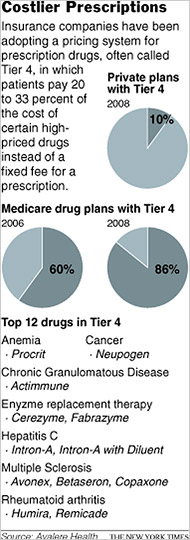
With the new pricing system, insurers abandoned the traditional arrangement that has patients pay a fixed amount, like $10, $20 or $30 for a prescription, no matter what the drug’s actual cost. Instead, they are charging patients a percentage of the cost of certain high-priced drugs, usually 20 to 33 percent, which can amount to thousands of dollars a month.
The system means that the burden of expensive health care can now affect insured people, too.

Daniel Rosenbaum for The New York Times
Robin Steinwand had been paying $20 a month for her
multiple sclerosis drug, which she keeps in the refrigerator.
When she went to pick up her prescription in January, it
cost $325.
No one knows how many patients are affected, but hundreds of drugs are priced this new way. They are used to treat diseases that may be fairly common, including multiple sclerosis, rheumatoid arthritis, hemophilia, hepatitis C and some cancers. There are no cheaper equivalents for these drugs, so patients are forced to pay the price or do without.
Insurers say the new system keeps everyone’s premiums down at a time when some of the most innovative and promising new treatments for conditions like cancer and rheumatoid arthritis and multiple sclerosis can cost $100,000 and more a year.
But the result is that patients may have to spend more for a drug than they pay for their mortgages, more, in some cases, than their monthly incomes.
The system, often called Tier 4, began in earnest with Medicare drug plans and spread rapidly. It is now incorporated into 86 percent of those plans. Some have even higher co-payments for certain drugs, a Tier 5.
Now Tier 4 is also showing up in insurance that people buy on their own or acquire through employers, said Dan Mendelson of Avalere Health, a research organization in Washington. It is the fastest-growing segment in private insurance, Mr. Mendelson said. Five years ago it was virtually nonexistent in private plans, he said. Now 10 percent of them have Tier 4 drug categories.
Private insurers began offering Tier 4 plans in response to employers who were looking for ways to keep costs down, said Karen Ignagni, president of America’s Health Insurance Plans, which represents most of the nation’s health insurers. When people who need Tier 4 drugs pay more for them, other subscribers in the plan pay less for their coverage.
But the new system sticks seriously ill people with huge bills, said James Robinson, a health economist at the University of California, Berkeley. “It is very unfortunate social policy,” Dr. Robinson said. “The more the sick person pays, the less the healthy person pays.”
Traditionally, the idea of insurance was to spread the costs of paying for the sick.
“This is an erosion of the traditional concept of insurance,” Mr. Mendelson said. “Those beneficiaries who bear the burden of illness are also bearing the burden of cost.”
And often, patients say, they had no idea that they would be faced with such a situation.
It happened to Robin Steinwand, 53, who has multiple sclerosis.
In January, shortly after Ms. Steinwand renewed her insurance policy with Kaiser Permanente, she went to refill her prescription for Copaxone. She had been insured with Kaiser for 17 years through her husband, a federal employee, and had had no complaints about the coverage.
She had been taking Copaxone since multiple sclerosis was diagnosed in 2000, buying a 30 days’ supply at a time. And even though the drug costs $1,900 a month, Kaiser required only a $20 co-payment.
Not this time. When Ms. Steinwand went to pick up her prescription at a pharmacy near her home in Silver Spring, Md., the pharmacist handed her a bill for $325.
There must be a mistake, Ms. Steinwand said. So the pharmacist checked with her supervisor. The new price was correct. Kaiser’s policy had changed. Now Kaiser was charging 25 percent of the cost of the drug up to a maximum of $325 per prescription. Her annual cost would be $3,900 and unless her insurance changed or the drug dropped in price, it would go on for the rest of her life.
“I charged it, then got into my car and burst into tears,” Ms. Steinwand said.
She needed the drug, she said, because it can slow the course of her disease. And she knew she would just have to pay for it, but it would not be easy.
“It’s a tough economic time for everyone,” she said. “My son will start college in a year and a half. We are asking ourselves, can we afford a vacation? Can we continue to save for retirement and college?”
Although Kaiser advised patients of the new plan in its brochure that it sent out in the open enrollment period late last year, Ms. Steinwand did not notice it. And private insurers, Mr. Mendelson said, can legally change their coverage to one in which some drugs are Tier 4 with no advance notice.
Medicare drug plans have to notify patients but, Mr. Mendelson said, “that doesn’t mean the person will hear about it.” He added, “You don’t read all your mail.”
Some patients said they had no idea whether their plan changed or whether it always had a Tier 4. The new system came as a surprise when they found out that they needed an expensive drug.
That’s what happened to Robert W. Banning of Arlington, Va., when his doctor prescribed Sprycel for his chronic myelogenous leukemia. The drug can block the growth of cancer cells, extending lives. It is a tablet to be taken twice a day — no need for chemotherapy infusions.
Mr. Banning, 81, a retired owner of car dealerships, thought he had good insurance through AARP. But Sprycel, which he will have to take for the rest of his life, costs more than $13,500 for a 90-day supply, and Mr. Banning soon discovered that the AARP plan required him to pay more than $4,000.
Mr. Banning and his son, Robert Banning Jr., have accepted the situation. “We’re not trying to make anybody the heavy,” the father said.
So far, they have not purchased the drug. But if they do, they know that the expense would go on and on, his son said. “Somehow or other, myself and my family will do whatever it takes. You don’t put your parent on a scale.”
But Ms. Steinwand was not so sanguine. She immediately asked Kaiser why it had changed its plan.
The answer came in a letter from the federal Office of Personnel Management, which negotiates with health insurers in the plan her husband has as a federal employee. Kaiser classifies drugs like Copaxone as specialty drugs. They, the letter said, “are high-cost drugs used to treat relatively few people suffering from complex conditions like anemia, cancer, hemophilia, multiple sclerosis, rheumatoid arthritis and human growth hormone deficiency.”
And Kaiser, the agency added, had made a convincing argument that charging a percentage of the cost of these drugs “helped lower the rates for federal employees.”
Ms. Steinwand can change plans at the end of the year, choosing one that allows her to pay $20 for the Copaxone, but she worries about whether that will help. “I am a little nervous,” she said. “Will the next company follow suit next year?”
But it turns out that she won’t have to worry, at least for the rest of this year.
A Kaiser spokeswoman, Sandra R. Gregg, said on Friday that Kaiser had decided to suspend the change for the program involving federal employees in the mid-Atlantic region while it reviewed the new policy. The suspension will last for the rest of the year, she said. Ms. Steinwand and others who paid the new price for their drugs will be repaid the difference between the new price and the old co-payment.
Ms. Gregg explained that Kaiser had been discussing the new pricing plan with the Office of Personnel Management over the previous few days because patients had been raising questions about it. That led to the decision to suspend the changed pricing system.
“Letters will go out next week,” Ms. Gregg said.
But some with the new plans say they have no way out.
Julie Bass, who lives near Orlando, Fla., has metastatic breast cancer, lives on Social Security disability payments, and because she is disabled, is covered by insurance through a Medicare H.M.O. Ms. Bass, 52, said she had no alternatives to her H.M.O. She said she could not afford a regular Medicare plan, which has co-payments of 20 percent for such things as emergency care, outpatient surgery and scans. That left her with a choice of two Medicare H.M.O’s that operate in her region. But of the two H.M.O’s, her doctors accept only Wellcare.
Now, she said, one drug her doctor may prescribe to control her cancer is Tykerb. But her insurer, Wellcare, classifies it as Tier 4, and she knows she cannot afford it.
Wellcare declined to say what Tykerb might cost, but its list price according to a standard source, Red Book, is $3,480 for 150 tablets, which may last a patient 21 days. Wellcare requires patients to pay a third of the cost of its Tier 4 drugs.
“For everybody in my position with metastatic breast cancer, there are times when you are stable and can go off treatment,” Ms. Bass said. “But if we are progressing, we have to be on treatment, or we will die.”
“People’s eyes need to be opened,” she said. “They need to understand that these drugs are very costly, and there are a lot of people out there who are struggling with these costs.”
WellPoint and UCLA privacy breaches
WellPoint probing data breach for 130,000 members
Reuters
April 9, 2008
Health insurer WellPoint Inc is investigating the cause of a breach involving protected health information for about 130,000 members, the company said on Wednesday.
The largest U.S. health insurer by membership said it recently discovered data became publicly available over the Internet in the past 12 months.
WellPoint, which offers an array of insurance through public and employer-sponsored plans, declined to identify which type of members were involved, or which states they were in, beyond saying they were in several.
http://www.reuters.com/article/domesticNews/idUSN0921842120080409
And…
Snooping in records has a history at UCLA
By Charles Ornstein
Los Angeles Times
April 11, 2008
Though UCLA Medical Center has portrayed recent privacy breaches as the rare actions of rogue employees, the hospital has known since at least 1995 that staffers were peeking into the medical records of such prominent patients as Tom Cruise and Mariah Carey — and even spying on one another’s medical care, according to records and interviews.
The stakes for hospitals grew in 2003 when a federal law, the Health Insurance Portability and Accountability Act, put in place criminal and civil sanctions for breaches of patient confidentiality.
It appears that UCLA has not gone as far as a major competitor — Cedars-Sinai Medical Center — in providing extra security for the files of high-profile patients.
UCLA officials said this week that every day they audit the medical records of 72 high-profile people who have been patients to monitor which employees view them. Cedars-Sinai reviews 10 times as many.
Only certain employees can access the records at Cedars-Sinai, and if an unauthorized user so much as attempts to get in, he or she can be fired.
Cedars-Sinai spokesman Richard Elbaum said the hospital also uses real-time alerts to signal inappropriate access of certain medical records. And the records of high-profile patients have a special on-screen warning that reads, “This patient record is restricted. All accesses are logged and audited. Inappropriate accesses are grounds for disciplinary action and/or dismissal.”
http://www.latimes.com/news/printedition/california/la-me-ucla11apr11,1,878793,full.story
Comment:
By Don McCanne, MD
Electronic medical records (EMRs) and integrated information technology systems (IT systems) will reduce health care costs in the future. At least that is what the politicians would have you believe, though the systems are expensive and will increase net costs since the expense and maintenance would more than offset any efficiency improvements.
Although EMRs and IT systems are helpful tools, they introduce exposure to privacy breaches that have implications far beyond those of paper records. Looking through a patient’s paper chart is one thing, but obtaining digital information that can be unleashed over the Internet for all the world to see, without any possibility of retracting the release of that information, is quite another.
Representatives of the IT industry claim that information is made secure through encryption. Even if the encryption involves a gazillion steps to access information, individuals such as physicians, nurses, pharmacists, billing administrators, and the patients themselves, who need that information, must be able to access it. It is impossible to create a security system that ensures appropriate access only to those with a need to know, while excluding access to every single other individual who has no right to that information.
Contrasting themselves with UCLA, the officials at Cedars-Sinai gloat that they have adopted extra measures to protect the information of high-profile patients. The implication is that the medical information about most of us does not warrant the same security level, and thus is more vulnerable to breaches. But even for the high-profile patients, many individuals would have legitimate access to those records. How can any administrator ever be certain that each individual with access would never abuse the responsibility that goes along with knowledge of patient’s most intimate medical history and findings? And there is no way to prevent others with nefarious intents (hackers) to access records if they really want the information.
The next politician who claims that we will control costs through EMRs and IT systems needs to be immediately confronted with this request. “Please explain precisely the technology that will be used to ensure that our private medical information can NEVER be unleashed on the Internet.” They will not have an answer, because it doesn’t exist.
Medical students rally for health care
By Jesse Muhammad
Staff Writer
HOUSTON (FinalCall.com)
Apr 10, 2008
Rallying for affordable health care for all, hundreds of medical students from around the country recently gathered at Houston City Hall in conjunction with the American Medical Student Association’s (AMSA) 58th Annual Convention. The group met at the Hyatt Regency Houston and marched to City Hall.
According to statistics, Texas has the largest uninsured population in the nation. Houston alone has 1.1 million uninsured people. Almost 40,000 are children.
“A person is a person; a child is a child; and there are no good moral, ethical, rational or medical reasons to ever exclude human beings from getting the health care they deserve,” said Flavio Casoy, AMSA’s Jack Rutledge Fellow and leader of the rally. “As future physicians, we declare that healthcare is a human right for all people, regardless of race, gender, sexual orientation or country of origin. We invite all Houston residents to join us in asking the 2008 presidential candidates to support a single, public, national health insurance program.”
Low-income workers affiliated with Service Employees International Union also spoke at the rally about their daily struggle to secure affordable health care for their families from their employers.
In addition to the rally, AMSA’s annual convention attracted more than 1,500 attendees, who attended workshops and seminars on issues such as pharmaceutical industry marketing, minority health, 2008 election issues, immigrant health, healthcare and the aging population, the AIDS epidemic and mental health.
“Students coming together like this sends a message to the next president of the United States, that we as young people can impact change,” said Dan Glickman, a medical student at Rutger Canden in New Jersey.
Bryan Boynton, a junior at the same school, added, “It’s all about the future. The main issues today are the economy and health care. This rally is critical.”
“As the future physicians, we see a broken system, so if there is going to be change then we are going to be apart of it,” said Laura Janneck of Case Western Reserve University.
Jamil Muhammad, a senior at Girls and Boys Preparatory Academy, came out to show his support. “I am here because healthcare for our families is critical. Most low- income families can’t afford it and young people are suffering from lack of medical check-ups. This was a powerful stance by young people today.”
The American Medical Student Association, with more than a half-century history of medical student activism, is the oldest and largest independent association of physicians-in-training in the United States. Founded in 1950, AMSA is a student-governed, non-profit organization committed to representing the concerns of physicians-in-training. With more than 68,000 members, including medical and premedical students, residents and practicing physicians, AMSA is committed to improving medical training as well as advancing the profession of medicine.
Health Policy Placebos
by DAVID U. HIMMELSTEIN & STEFFIE WOOLHANDLER
The Nation
April 14, 2008
We don’t administer useless nostrums for curable cancer–even when effective treatment is arduous. Yet Hillary Clinton and Barack Obama prescribe the health policy equivalent of placebos. (John McCain suggests arsenic, but more about him another time.)
The Democratic contenders proffer a superficially plausible reform model that has a long record of failure. Their proposals trace back to Nixon’s 1971 employer mandate scheme, concocted to woo moderate Republicans away from Ted Kennedy’s single-payer plan. Like mandate reforms subsequently passed (and failed) in Massachusetts (1988), Oregon (1989) and Washington (1993), Clinton’s and Obama’s plans would couple subsidies for the poor with a requirement that large employers foot part of the bill for employee coverage. These earlier reforms also required the self-employed to buy coverage, an individual mandate that Clinton (like the 2006 Massachusetts reform) would expand to virtually all; Obama limits his mandate to children. In both versions, a federal agency would serve as insurance broker, selling a new public plan and a menu of private ones–reprising the format of Medicare’s ongoing privatization, implemented through competition rigged to favor private plans [see Trudy Lieberman, “The Medicare Privatization Scam,” July 16/23, 2007].
The earlier state reforms foundered on the shoals of cost. As health spending soared, employers rebelled and legislators rescinded the mandates and subsidies. Massachusetts looks set to replay this experience; only 7 percent of those required to buy unsubsidized coverage have yet to sign up, while the state wrestles with massive cost overruns for subsidies.
Proposals that rely on private insurers can add coverage only by adding costs. Both Democrats promise savings from computerization, prevention and chronic disease-care management. Yet medical computing hasn’t yielded savings, despite thirty years of rosy promises. As for prevention, a raft of studies show that it saves lives but not money. And the Medicare Health Support program recently abandoned its care management project because it yielded no savings.
Both Democrats’ proposals forgo the administrative savings possible under single-payer national health insurance (NHI) such as that proposed by the Conyers/Kucinich bill (HR 676) and by Ralph Nader. Bureaucracy consumes 31 percent of US health spending, versus 17 percent in Canada. The difference translates into $350 billion frittered away annually here, where a million healthcare workers, as well as hundreds of thousands in the insurance industry, spend their days on useless paperwork.
This waste is a natural byproduct of private insurance. Private plan overhead is eleven times that of Canada’s NHI program. Each dollar spent on private premiums buys only 88 cents of care; the rest pays for insurers’ marketing, underwriting, utilization reviewers and profits–and for the billions paid to their CEOs. Fragmented coverage also means duplication of claims-processing facilities and mountains of paperwork for doctors and hospitals, which must deal with multiple insurance products each with its own eligibility rules, co-payments, referral networks, etc.–tasks that are absent in Canada. Our multiplicity of insurers also precludes the payment to hospitals of a global, lump-sum budget. In Canada global budgets obviate the need for most hospital billing and much of the internal accounting needed to attribute costs to individual patients and payers.
Clinton’s and Obama’s plans also lack credible means to redirect the hundreds of billions now wasted on overtreatment. Hospitals, doctors and equipment firms profit from investments in expensive high-tech care, encouraging the overuse of interventions that help some patients but harm others–for example, spine surgery, cardiac stents and CAT scans (which often deliver radiation equivalent to 500 chest X-rays). Insurers limit their outlays through intrusive case-by-case reviews or by raising co-payments. But they have little interest in systemwide cost control, so their efforts have mainly shifted costs to patients or other payers–the economic equivalent of squeezing a balloon. In contrast, NHI would allow explicit public decision-making about today’s capital investments that shape tomorrow’s care, and straightforward mechanisms to limit profit.
Without savings, the tax increases Obama and Clinton propose would be eaten up by subsidies for the uninsured, leaving nothing for the majority of Americans already covered but often unable to afford care. As we found in a 2005 study with Elizabeth Warren and Deborah Thorne, three-quarters of the 750,000 families driven to bankruptcy each year by illness or medical bills had coverage, though with unaffordable co-payments, deductibles and uncovered services. NHI would eliminate these gaps.
Private insurers caused the healthcare crisis. Yet both Democratic contenders advocate reforms that would fortify private plans, making government their debt collector. Their proposals, while palatable to the health industry–which supplies the Democrats with huge donations as well as key officials (DNC credentials committee co-chair James Roosevelt moonlights as an insurance company CEO)–cannot cure our healthcare crisis.
Nonetheless, we’re optimistic about the prognosis for healthcare reform. If you turn up the volume on C-SPAN you can hear the audience cheering whenever Clinton or Obama lets the words “single payer” slip out–a reflection of the fact that three-fifths of the general public, as well as the 124,000-member American College of Physicians, support NHI. As in the JFK era, a charismatic, if only tepidly liberal, candidate can help raise hopes and expectations, igniting a mass movement that pushes a progressive agenda further and faster than the candidate intends.
Obama speaks out on issues
KCPNews
KPC (questioners): Health care is an important issue for most voters. More and more physicians are turning to national health insurance as a solution to our health insurance coverage gaps. According to a survey reported last month by Indiana University, of more than 2,000 doctors surveyed, 59 percent said they support legislation to establish a national health insurance program such as “Medicare for all†to insure all Americans. Why do you think your plan which continues our current patchwork of both public and private insurance is better than expanding Medicare into a “Medicare for all†universal health insurance plan?
Obama: I have said in the past if I were designing a system from scratch I would probably prefer a single-payer system. I think the administrative advantages are significant and by having patients in a single system they are much more likely to benefit from preventive care because the person providing the care has an incentive (to keep people in the system well). There are significant advantages.
The problem is we are not starting from scratch. A sizable percentage of the population gets health insurance from their employers and I think we are going to have to see changed attitudes before we would see a single payer system. I also think there is some advantage to the marketplace being involved and increased competition. So I have said if you are in an employer based plan currently, then we will work with your employer to lower premiums. If you don’t have health insurance then you can buy into a plan that is similar to the plan I have as a member of Congress, and there won’t be exclusions for preexisting conditions. If you can’t afford the plan, then we will subsidize you.
There will be tight regulations on insurers to make sure that we are reimbursing for preventive services, that we are emphasizing the management of the care of the chronically ill more effectively and that we are investing in information technology to reduce bureaucracy, reduce error and improve quality. If we do all those things, we can save as much as $100 – $150 billion per year that we can then use to subsidize those currently without care. These principles have to be applied to Medicare and Medicaid, as well…
This is the most effective way to provide the help people need immediately, and I think this is something we can accomplish within my first term as president of the United States of America.
Health Care System Profiles
Author(s): Karsten Vrangbaek, Isabelle Durand-Zaleski, Reinhard Busse, Niek Klazinga, and Anders Anell
Commonwealth Fund
March 2008
The work of the Commonwealth Fund’s international program highlights the valuable lessons the U.S. can learn from the health care systems in other industrialized countries. These country profiles provide overviews of the health care systems of several countries, including Denmark, France, Germany, the Netherlands, Sweden, and the U.K. Each profile includes descriptions of how each country organizes, finances, and delivers health services and highlights quality, efficiency, and cost-controlling policy initiatives and reforms
Health Care Horror Stories
Paul Krugman
The New York Times
April 11, 2008
Not long ago, a young Ohio woman named Trina Bachtel, who was having health problems while pregnant, tried to get help at a local clinic.
Unfortunately, she had previously sought care at the same clinic while uninsured and had a large unpaid balance. The clinic wouldn’t see her again unless she paid $100 per visit — which she didn’t have.
Eventually, she sought care at a hospital 30 miles away. By then, however, it was too late. Both she and the baby died.
You may think that this was an extreme case, but stories like this are common in America.
Back in 2006, The Wall Street Journal told another such story: that of a young woman named Monique White, who failed to get regular care for lupus because she lacked insurance. Then, one night, “as skin lesions spread over her body and her stomach swelled, she couldn’t sleep.”
The Journal’s report goes on: “Mama, please help me! Please take me to the E.R.,” she howled, according to her mother, Gail Deal. “O.K., let’s go,” Mrs. Deal recalls saying. “No, I can’t,” the daughter replied. “I don’t have insurance.”
She was rushed to the hospital the next day after suffering a seizure — and the hospital spared no expense on her treatment. But it all came too late; she was dead a few months later.
How can such things happen? “I mean, people have access to health care in America,” President Bush once declared. “After all, you just go to an emergency room.” Not quite.
First of all, visits to the emergency room are no substitute for regular care, which can identify and treat health problems before they get acute. And more than 40 percent of uninsured adults have no regular source of care.
Second, uninsured Americans often postpone medical care, even when they know they need it, because of expense.
Finally, while it’s true that hospitals will treat anyone who arrives in an emergency room with an acute problem — and it’s wonderful that they will — it’s also true that hospitals bill patients for emergency-room treatment. And fear of those bills often causes uninsured Americans to hesitate before seeking medical help, even in emergencies, as the Monique White story illustrates.
The end result is that the uninsured receive a lot less care than the insured. And sometimes this lack of care kills them. According to a recent estimate by the Urban Institute, the lack of health insurance leads to 27,000 preventable deaths in America each year.
But are they really preventable? Yes. Stories like those of Trina Bachtel and Monique White are common in America, but don’t happen in any other rich country — because every other advanced nation has some form of universal health insurance. We should, too.
All of which makes the media circus of a few days ago truly shameful.
Some readers may already have recognized the story of Trina Bachtel. While campaigning in Ohio, Hillary Clinton was told this story, and she took to repeating it, without naming the victim, on the campaign trail. She used it as an illustration of what’s wrong with American health care and why we need universal coverage.
Then The Washington Post identified Ms. Bachtel, the hospital where she died claimed that the story was false — and the news media went to town, accusing Mrs. Clinton of making stuff up. Instead of being a story about health care, it became a story about the candidate’s supposed problems with the truth.
In fact, Mrs. Clinton was accurately repeating the story as it was told to her — and it turns out that while some of the details were slightly off, the essentials of her story were correct. After all the fuss, The Washington Post eventually conceded that “Bachtel’s medical tragedy began with circumstances very close to the essence” of Mrs. Clinton’s account.
And even more important, Mrs. Clinton was making a valid point about the state of health care in this country.
In other words, this was a disgraceful episode. It was particularly sad to see a number of Obama supporters (though not the Obama campaign itself) join enthusiastically in the catcalls against Mrs. Clinton’s good-faith effort to put a human face on the cruelty and injustice of the American health care system.
Look, I know that many progressives have their hearts set on seeing Barack Obama get the Democratic nomination. But politics is supposed to be about more than cheering your team and jeering the other side. It’s supposed to be about changing the country for the better.
And if being a progressive means anything, it means believing that we need universal health care, so that terrible stories like those of Monique White, Trina Bachtel and the thousands of other Americans who die each year from lack of insurance become a thing of the past.