MarketWatch
Wednesday, February 21, 2007
National health-care spending will double in the next 10 years, a study says. One out of every five dollars we spend will be for health care, and Uncle Sam will be footing more of the bill. Amy Scott reports.
KAI RYSSDAL: Check your economic calendars and you’ll see today’s the day we get one of those A-list indicators. The consumer price index came out this morning. Inflation by another name.
It’s not so bad. The core rate was up three-tenths of 1 percent last month. Mostly in a drop in energy prices. But get a load of some of the other details. Airline ticket prices were up. Hotels and rents were up. Tobacco was up. And medical care prices had their biggest jump in more than 15 years.
Knowing that, this next number shouldn’t come as too much of a shock. A study out today in the journal Health Affairs predicts national health care spending will double in the next 10 years. To more than $4 trillion. One out of every $5 we’ll spend will be for health care. And Marketplace’s Amy Scott reports Uncle Sam will be footing more of that bill.
AMY SCOTT: It’s no surprise that health care costs are rising. But the Health Affairs report suggests there’s another reason Americans are spending more.
John Poisal is the study’s co-author, and a deputy director with the Centers for Medicare and Medicaid Services. He says lately, people are earning more money.
JOHN POISAL: As incomes increase by 1 percentage point, typically expenditures for health care increase by 1.4 percentage points.
By 2016, Poisal says the federal and state governments will cover nearly half of all national medical expenses. That’s partly because Medicare began offering a prescription drug benefit last year, so the program’s costs have jumped. And the first wave of Baby Boomers will soon be eligible for Medicare.
Paul Ginsburg heads the nonprofit Center for Studying Health System Change.
PAUL GINSBURG: The government’s obligations for health care are growing faster than the revenue base. So ultimately, it’s going to mean higher taxes.
As the government covers more of the country’s medical bill, the kind of single-payer system some Democrats have been pushing doesn’t seem far off.
Don McCanne with Physicians for a National Health Program says when you include public employee health plans and tax subsidies, the government is already paying two-thirds of the nation’s health costs.
DON MCCANNE: And that’s about what most nations pay for their government-sponsored health care programs. So we’re paying for national health insurance, we’re just not receiving it.
If we were, McCanne says the government would save on the order of $350 billion a year in administrative costs. And a single payer could use its clout to negotiate lower prices.
In New York, I’m Amy Scott for Marketplace.
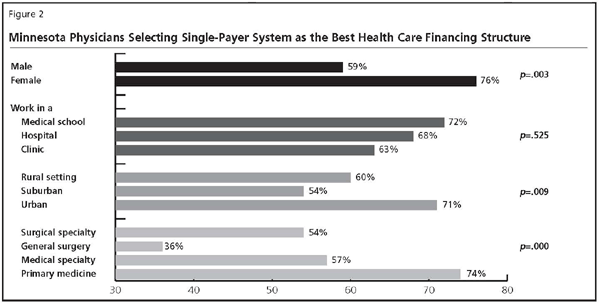 A single-payer system was favored by women physicians over men (female, 76%; male, 59%; p=.003); more male physicians than female preferred HSAs (male, 30%; female, 16%; p=.004). The percentage of male respondents who favored the current managed care system slightly exceeded that of female physicians (12% versus 9%; p=.553). Geographic setting was also significantly associated across the 3 choices. Urban physicians favored a single-payer system over their rural and suburban colleagues (71%, 60%, and 54%, respectively; p=.009). Rural physicians preferred HSAs over suburban and urban physicians (34%, 32%, 17%; p=.002). Managed care garnered less than 15% support overall, with 14% of suburban physicians, 12% of urban doctors, and 6% of rural respondents favoring it; p=.217). Thus, urban physicians had the most support for a single-payer system and the least for managed care. Rural physicians were relatively enthusiastic for HSAs but least supportive of managed care.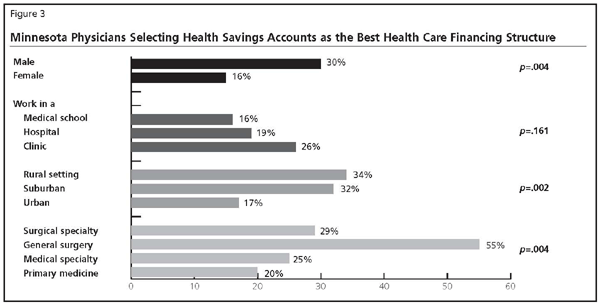
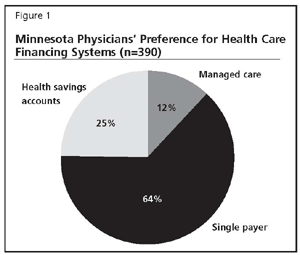
 When looking at physicians’ responses across medical specialty, those practicing primary medicine most favored a single-payer system (74%); general surgeons least favored such a system (36%). Conversely, general surgeons most favored HSAs (55%), and primary medicine physicians least favored them (20%). Managed care found greatest support among physicians who practiced a medical or surgical specialty (17% each) and the least among those who practiced primary medicine (6%). Of those who favored managed care, the significant split was specialists over generalists (17% and 7%; p=.001). Physicians also were asked who should be responsible for providing access to health care. Nearly all (86%) believed it is the responsibility of society through government to ensure access to good medical care for all, regardless of ability to pay. Only 41% held that the private insurance industry should continue to play a major role in medical care financing and delivery. Using a regression model, we found that physicians who agreed that it is the government’s responsibility to ensure access to medical care were significantly more likely to favor a single-payer financing system (OR 13.51; CI 2.85, 64.15; p=.001). Those who believed the private insurance industry should continue to play a major role in financing medical care were significantly less likely to favor a government-run system (OR 3.45; CI 1.35, 8.33; p=.009). Corroborating Results In order to corroborate our results about physicians’ preferences for various financing systems, we asked separate questions about their opinions of each of the 3 structures. We found 56% held a generally favorable view of single-payer systems, 46% of HSAs, and 20% of managed care systems in which physician groups compete for placement in cost-tiered networks. (The total exceeds 100% as some physicians were generally favorable toward more than 1 system.) Thus, more respondents said they preferred a single-payer system than held a favorable view of such a system. Among those with a favorable opinion of single-payer health care, 96% actually selected single payer as their preference for the way our health care system should be financed in the future; among those with a favorable view of HSAs, only 49% selected HSAs as their preferred model for a health care financing system. However, those who had a generally favorable opinion of competition based on price tiers split between their preference for a system based on managed care and one based on HSAs (36% and 39%); only 25% of those respondents said they preferred a single-payer system. Among those opposed to price-tier competition, 78% preferred a single-payer system and 18% preferred HSAs. Only 4% preferred managed care: Rejecting price-tier competition was largely co-extensive with rejecting managed care. Discussion Despite the prevalence of managed care in Minnesota, our study finds only 12% of sampled physicians favor such systems as a way to finance health care; 25% prefer HSAs, and 64% support a single-payer system. Eighty-six percent believe it is the responsibility of society through government to ensure access to good medical care for all. Only 41% say the private insurance industry should continue to play a major role in the financing and delivery of medical care, suggesting support for comprehensive public-sector initiatives rather than private-sector approaches. Stand-alone survey questions about various financing systems showed that nearly 56% of respondents had a generally favorable opinion of single-payer health care systems. Of all specialties, general surgeons had the lowest percentage of respondents who had a favorable view of such a system (36%). Forty-six percent thought favorably of HSAs, and 20% had a positive view of price-tiered competition. This suggests an unwillingness among physician groups to compete directly under managed competition. Yet 118,000 Minnesota state employees and as many as 150,000 employees whose coverage is obtained by a large, multiple-employer group purchaser are enrolled in such managed competition programs.20 Our findings are consistent with those of others who have seen a growing trend toward U.S. physicians saying they favor a single-payer health care system. In 1993, Millard et al. found only 25% of surveyed North Carolina physicians supported a single-payer system over managed competition.13 In 1996, Scanlan et al. compared the opinions of U.S. and Canadian physicians