Jonathan Oberlander on the prospect for single payer

NYT journalists discuss status of Obamacare

News About Obamacare Has Been Bad Lately. How Bad?

By Reed Abelson and Margot Sanger-Katz
The New York Times, April 13, 2016

Ever since passage of the Affordable Care Act, a fierce debate has been waged over whether the law would work as advertised. While advocates promised that the design of new insurance markets would transform the way consumers buy health insurance, critics warned that the new market would never succeed. Reed Abelson and Margot Sanger-Katz have had front-row seats to the debate, and the two reporters took a few minutes to discuss when — and if — the market would stabilize.

Margot Sanger-Katz
: Every time I write a story about the health law, I get comments and emails from people just above the income cutoff for subsidies. These are the people who have been most hurt by the health law. Plans on the exchanges are just really expensive for them, and often come with big deductibles, too. And if premiums keep rising, they’ll keep getting squeezed. Analysts from the Urban Institute have done the math and found that some of them are paying more than 25 percent of their income on health care now. Still, it is awfully hard to imagine Congress approving massive new spending to make Obamacare more generous. Hillary Clinton has some proposals about affordability, but they don’t include expanding subsidies.

Reed Abelson: One of the strengths of the law, and its main weakness, is its emphasis on keeping the status quo. While President Obama may have overpromised when he said you can keep your plan if you like it, the insurance isn’t radically different. The only way companies can seem to bring down prices is by narrowing networks of hospitals and doctors or hiking deductibles. While Bernie Sanders seems to be offering the most dramatic change by proposing that everyone switch to a government plan like Medicare, I’m still looking for a market response — some real change in how care is delivered that is much less expensive or at least more effective.

Margot Sanger-Katz: This is the thing I say whenever anyone asks me what I think about the health law. It basically baked in all of the complexity and dysfunction of the pre-existing American health care system.

Reed Abelson: We’re heading into the season when insurers and state regulators start talking about next year. Any thoughts on what we might expect?

Margot Sanger-Katz: I’m expecting them to ask for rate increases! The insurance companies are doing everything they can to broadcast their intentions to charge more. There are reasons we should expect the plans to do so even if the markets were already stable. Some of the early training-wheel programs set up by the law expire, which means the plans have to pay out more claims for really expensive patients.

http://www.nytimes.com/2016/04/14/upshot/news-about-obamacare-has-been-bad-lately-how-bad.html

Six years after the Affordable Care Act was signed into law we hear opinions ranging from what a phenomenal success it has been to what a miserable disaster it is. This brief excerpt from a discussion between two respected journalists who have followed the process closely, and who are well versed on the policy issues, provides us with a perspective on where we actually are on reform.

It is somewhat sobering. There have been some tradeoffs such as expanding nominally the numbers insured but with insurance products that further limit provider choice and shift more costs to the patients. Margot Sanger-Katz says that the health law “basically baked in all of the complexity and dysfunction of the pre-existing American health care system.”

Most of the system has remained about the same while the deficiencies introduced offset much of the gains. We are still left with tens of millions uninsured, tens of millions more who are underinsured, and costs that continue to increase in spite of the expansion of blunt financial barriers to beneficial health care services. Even employer-sponsored plans are beginning to deteriorate, especially because of higher deductibles and narrower networks.

Reed Abelson says that she is looking for “a market response — some real change in how care is delivered that is much less expensive or at least more effective.” Yet it has been confirmed over the last half century that markets do not work in controlling health care spending. Nothing in the Affordable Care Act will change that in spite of wishes that feeble policy measures such as ACA exchange competition, ACOs, shared shavings, bundling, wellness programs, meaningless rhetoric of quality over quantity, and other ACA concepts would revolutionize health care. The revolution is not happening.

So claims of phenomenal success or miserable disaster can be ignored since we really have not fundamentally changed the infrastructure of our system. But with that background, we actually have failed: We failed to enact an Improved Medicare for All which would have met our goals for reform. We can still do it, you know.

In medical research, financial conflicts of interest do matter

We don’t know whether conflicts of interest influence researchers, but we certainly know they might

By Marcia Angell, M.D.
Boston Globe, April 11, 2016

A front-page story by Charles Ornstein in the Globe reports increasing concern about editorial decisions at The New England Journal of Medicine (NEJM), one of which is to defend the practice of medical researchers having personal financial ties to drug companies whose products they are testing. The NEJM’s national correspondent referred to critics of such conflicts of interest as “pharmascolds.”

I was on the editorial staff of NEJM from 1979 until 2000, serving as executive editor from 1988 until 1999, and then as editor in chief before I stepped down in 2000. So I have firsthand knowledge of the evolution of its conflict-of-interest policies and the reasons for them.

In 1984, the NEJM became the first medical journal to require authors of papers submitted to it to disclose all financial ties to companies that could financially benefit from the results. The editor at the time, Arnold S. Relman, was concerned by the growing financial associations — in addition to research sponsorship — between drug companies and supposedly independent researchers, and by the influence of sponsoring companies on the way that research was conducted and reported.

For example, researchers increasingly served as paid consultants or members of speakers bureaus for the same companies whose products they were evaluating. Moreover, companies were asserting a right to be involved in all aspects of studies they sponsored, including writing the papers and deciding if, when, and where they would be published.

Within a few years, other major medical journals followed NEJM’s lead, and instituted similar disclosure policies. Six years later, Relman extended the policy by banning altogether any industry ties for authors of editorials and other opinion pieces, because these types of articles contain no data that readers can judge for themselves. Thus, by 1990, the NEJM had the most stringent conflict-of-interest policy of any medical journal. Relman’s successor, Jerome P. Kassirer, continued the policies, as did I. But with the arrival of the current editor in chief, Jeffrey M. Drazen, the outright ban was ended, and the days of the “pharmascolds” were over.

Financial conflicts of interest matter. They can best be defined as any financial association (or promise of one in the future) that would give researchers an incentive to distort their work. For example, if a researcher is doing a study comparing drug A with drug B, and has a large equity interest in company A, he or she would benefit if drug A is shown to be better. That doesn’t mean that the researcher would not be scrupulously honest, only that there would be an incentive to shade the work in favor of drug A.

So a conflict of interest is not synonymous with distorted work; it simply raises the question. But how are physicians who read a paper by authors with conflicts of interest supposed to know whether the work was disinterested or not? Unless bias is blatant, there is simply no sure way to tell. Adding to the difficulty is the fact that bias can be unconscious. The researcher may seek to rise above his or her financial interest, but it would be human nature to lean in the desired direction without meaning to. So we don’t know whether conflicts of interest influence researchers, but we certainly know they might.

Unfortunately, there is much evidence that financial conflicts of interest are in fact distorting medical research. Studies of drugs sponsored by manufacturers are more likely to conclude the drugs are beneficial than research sponsored by the National Institutes of Health. Worse, industry-sponsored research that does not show benefit is very often not published at all. For example, a review (published in NEJM, Jan. 17, 2008) of 74 company-sponsored clinical trials of antidepressants found that 37 of 38 positive studies — that is, studies that showed effectiveness — were published. But of the 36 negative studies — those that failed to show effectiveness — 33 were either not published, or published in a form that wrongly conveyed a positive outcome. The cumulative result of this sort of thing is that both the public and physicians come to believe that drugs are better and safer than they are.

Judges with equity interest in Company A would not hear a case involving a dispute between Company A and Company B. Similarly, a reporter for The Boston Globe would not be permitted to write a story about Company A if he or she had a financial interest in it. We instinctively know why that should be so. Why should it be different for medical researchers?

Marcia Angell, M.D., is former editor in chief of The New England Journal of Medicine and is on the faculty of Global Health and Social Medicine at Harvard Medical School.

https://www.bostonglobe.com/opinion/2016/04/11/medical-research-financial-conflicts-interest-matter/FfGc04GpdBXztO6m3kcT1I/story.html

Costs in individual insurance market skyrocketing

S&P Healthcare Claims Index Monthly Report

S&P Dow Jones Indices, April 2016

The “S&P Healthcare Claims Index Monthly Report” provides the latest results for the S&P Healthcare Claims Indices – a comprehensive measure of the change in U.S. healthcare costs based on actual expenses paid by consumers through their commercial health plans – with the goal of providing the public and policymakers with credible, timely and independent data on the cost of healthcare in the U.S.

This Report summarizes data from the October 2015 indices – the latest to be published.

October 2015 In-brief

  • National healthcare costs in the commercial market increased by 6.47% year/year
    • Medical services costs increased by 4.24%
      • Drug costs increased by 16.12%
      • Brand-name drug costs increased by 19.31%
      • Generic drug costs increased by 7.37%
  • Individual market costs increased by 27.41% year/year
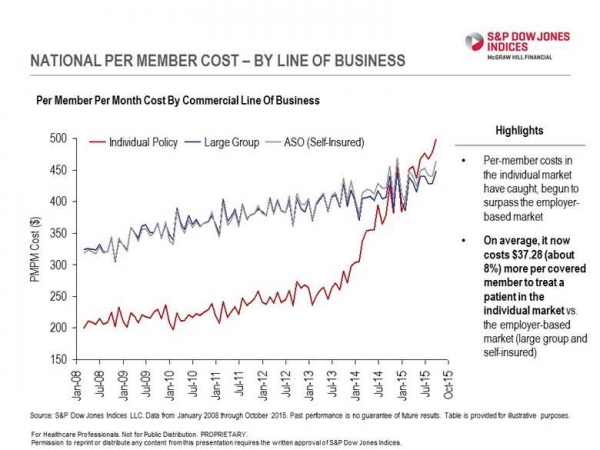
  • Monthly costs per covered member (PMPM costs) in the individual market reached an average of $497.55 – about 8.1% more than the employer-provided market (large group and ASO/self-insured)
  • Monthly costs per covered member in the individual market reached an average of $497.55 in October 2015 – $37.28 more on average than the $460.27 monthly cost of a covered member within the employer-provided healthcare market (large group and ASO/self-insured).

The graph below charts the PMPM (per member per month) cost by LOB (Lines of Business – individual; large group; and Administrative Services Only/self-insured). This graph demonstrates that PMPM healthcare costs in the individual market appear to have firmly caught up to per member costs in the employer-based market (large group and ASO/self-insured), a result widely anticipated with enactment of the Affordable Care Act (ACA). Whether individual market costs will begin tracking with the employer-based market, or instead continue their rise and diverge to a more costly plateau, is yet to be definitively seen. The next few months of data should be telling.

PMPH Chart

http://us.spindices.com/resource-center/index-policies/

***

Comment:

By Don McCanne, M.D.

The costs per enrollee in the individual health insurance plans are skyrocketing as a result of the enactment of the Affordable Care Act (ACA). This was expected since the plans could no longer reject individuals with preexisting conditions, and the required benefits are more comprehensive than they were previously.

ACA was designed to protect employer-sponsored plans – primarily large group insurance plans and self-insured (administrative services only) plans – which had been functioning well prior to reform. In order to keep premiums affordable, plans in the individual market frequently had skimpier benefits (excluding maternity benefits, mental health services, etc.), and excluded individuals with preexisting conditions. ACA, in correcting these deficiencies, brought costs in the risk pools for the individual plans up to the costs of the more comprehensive and inclusive employer-sponsored plans.

But look at what has happened. The cost trajectory for those covered in the individual plans shot upward and has now exceeded the cost for those in employer plans by 8 percent. This higher cost could be due to adverse selection – more people enrolling in the individual plans who already have health care needs, or because those declining to enroll are healthier individuals who would otherwise dilute the costs of the risk pools.

But there is one other possibility that may be an important factor why the costs in the individual market are higher. Enrolling individuals and families in plans selected from a marketplace requires greater administrative services than does wholesale enrollment of employees in a group plan (and much more administrative effort than with automatic, one-time, life-long enrollment in a program like Medicare).

Once the risk pools stabilize, it is likely that the curve for individual plans will parallel that of employer plans, but at a higher trajectory. Thus we will be spending more than that part of the market that was supposedly working well – the employer-sponsored plans. When our health care system is infamous for its profound administrative waste, we are adding even more waste through the provisions of ACA.

We can still fix this – with an improved Medicare for all.

Costs in individual insurance market skyrocketing

S&P Healthcare Claims Index Monthly Report

S&P Dow Jones Indices, April 2016

The “S&P Healthcare Claims Index Monthly Report” provides the latest results for the S&P Healthcare Claims Indices – a comprehensive measure of the change in U.S. healthcare costs based on actual expenses paid by consumers through their commercial health plans – with the goal of providing the public and policymakers with credible, timely and independent data on the cost of healthcare in the U.S.

This Report summarizes data from the October 2015 indices – the latest to be published.

October 2015 In-brief

  • National healthcare costs in the commercial market increased by 6.47% year/year
    • Medical services costs increased by 4.24%
      • Drug costs increased by 16.12%
      • Brand-name drug costs increased by 19.31%
      • Generic drug costs increased by 7.37%
  • Individual market costs increased by 27.41% year/year
  • Monthly costs per covered member (PMPM costs) in the individual market reached an average of $497.55 – about 8.1% more than the employer-provided market (large group and ASO/self-insured)
  • Monthly costs per covered member in the individual market reached an average of $497.55 in October 2015 – $37.28 more on average than the $460.27 monthly cost of a covered member within the employer-provided healthcare market (large group and ASO/self-insured).

The graph below charts the PMPM (per member per month) cost by LOB (Lines of Business – individual; large group; and Administrative Services Only/self-insured). This graph demonstrates that PMPM healthcare costs in the individual market appear to have firmly caught up to per member costs in the employer-based market (large group and ASO/self-insured), a result widely anticipated with enactment of the Affordable Care Act (ACA). Whether individual market costs will begin tracking with the employer-based market, or instead continue their rise and diverge to a more costly plateau, is yet to be definitively seen. The next few months of data should be telling.

QOTD Chart

http://us.spindices.com/resource-center/index-policies/

The costs per enrollee in the individual health insurance plans are skyrocketing as a result of the enactment of the Affordable Care Act (ACA). This was expected since the plans could no longer reject individuals with preexisting conditions, and the required benefits are more comprehensive than they were previously.

ACA was designed to protect employer-sponsored plans – primarily large group insurance plans and self-insured (administrative services only) plans – which had been functioning well prior to reform. In order to keep premiums affordable, plans in the individual market frequently had skimpier benefits (excluding maternity benefits, mental health services, etc.), and excluded individuals with preexisting conditions. ACA, in correcting these deficiencies, brought costs in the risk pools for the individual plans up to the costs of the more comprehensive and inclusive employer-sponsored plans.

But look at what has happened. The cost trajectory for those covered in the individual plans shot upward and has now exceeded the cost for those in employer plans by 8 percent. This higher cost could be due to adverse selection – more people enrolling in the individual plans who already have health care needs, or because those declining to enroll are healthier individuals who would otherwise dilute the costs of the risk pools.

But there is one other possibility that may be an important factor why the costs in the individual market are higher. Enrolling individuals and families in plans selected from a marketplace requires greater administrative services than does wholesale enrollment of employees in a group plan (and much more administrative effort than with automatic, one-time, life-long enrollment in a program like Medicare).

Once the risk pools stabilize, it is likely that the curve for individual plans will parallel that of employer plans, but at a higher trajectory. Thus we will be spending more than that part of the market that was supposedly working well – the employer-sponsored plans. When our health care system is infamous for its profound administrative waste, we are adding even more waste through the provisions of ACA.

We can still fix this – with an improved Medicare for all.

Luntz’s poll shows CEOs support affordable care for American families

Highlights of Luntz Poll of American CEOs Shows Broad Support for Progressive Policies

By Mary Bottari
The Center for Media and Democracy/PRWatch, April 4, 2016

When considering American CEOs as a category, “empathetic” is not the first word that comes to mind. Yet, the fact that these top executives have empathy for their workers is a major take-away from a closed-door webinar about a new poll taken by LuntzGlobal, the polling firm of prominent GOP pollster Frank Luntz.

The polled executives want to raise the wage, expand paid sick and maternity leave, and support predictive scheduling. Their desire to “keep health care costs low for American families” far outstrips their opposition to the Affordable Care Act.

CMD was provided with a copy of the poll which was shared with business lobbyists, who were instructed on how to manipulate the public debate over those policies rather than implement the views of the business executives who were polled.

The poll was commissioned by Council of State Chambers (COSC) is a little-known association that helps the top lobbyists for state chambers of commerce get on message about the national political agenda of the U.S. Chamber of Commerce, one of the largest and most influential lobbying forces in America.

There is no force in America that has spent more time and effort to keep wages low than the U.S. Chamber of Commerce and the state chambers that aggressively lobby against increasing the minimum wage.

Health Care

“Keeping health care costs low for American families” was a key concern for CEOs. Significantly, it far outstripped “replacing ACA” or “making health care affordable for small businesses” as a priority.

Empathy

A top take-away for the pollsters? CEOs have empathy for their workers and society as a whole.

Based on the directives to state chamber lobbyists in the webinar, COSC is eager to help chambers of commerce overcome that empathy and continue to oppose legal policies strongly supported by both the American people and the business executives the chambers tell the press and public that they represent.

http://www.prwatch.org/news/2016/03/13074/luntz-poll-american-ceos-shows-deep-support-progressive-policies

***

LuntzGlobal topline

Q19/20. All of these issues may be important, but when it comes to where an elected official stands, which issue is the MOST important to you as a business leader? [Combined]

36%  Economic development and tax incentives
32%  Workforce development and education issues relating to the availability of qualified workers
31%  Employer mandates such wages, paid leave, and predictive scheduling
25%  Finding state solutions to rising healthcare costs
20%  Civil rights issues such as non-discrimination acts and the Religious Freedom and Restoration Acts (RFRA)
19%  Climate issues such as environmental regulations and clean power
16%  The impact the legalization of marijuana has on employers maintaining a safe workplace
11%  Transportation issues including roads, infrastructure, and gas taxes
10%  State preemptions of local mandates

Q31/32. You said healthcare costs are most important. Which of the following issues do you care about the most? [Combined]

38%  Keeping healthcare costs low for American families
30%  Replacing the Affordable Care Act
29%  Giving employees more choices and control over their healthcare options
25%  Making healthcare costs more affordable for small businesses
20%  Finding state-based solutions to healthcare coverage issues
19%  Promoting innovation in the healthcare sector to reduce costs and save lives
18%  Expanding access and coverage to more people
10%  Reducing government regulation and red tape
10%  Freedom to decide whether to provide benefits like birth control

http://www.prwatch.org/files/cmd_prwatch_markup_of_01-05-16_state_chambers_topline_poll.pdf

***

FIX IT: Healthcare at the Tipping Point

A documentary produced by businessman Richard Master

This documentary takes an in-depth look into how our dysfunctional health care system is damaging our economy, suffocating our businesses, discouraging physicians and negatively impacting on the nation’s health, while remaining un-affordable for a third of our citizens.

Free internet access to the full 58 minute documentary is now available at this link:

http://fixithealthcare.com

***

Comment:

By Don McCanne, M.D.

This poll provides us with the reassuring (and not surprising) finding that CEOs of U.S. businesses “have empathy for their workers and society as a whole.” Regarding health care, they give the highest priority to “keeping health care costs low for American families.”

The poll was conducted by LuntzGlobal – the firm of Republican pollster and wordsmith Frank Luntz. It was commissioned by the Council of State Chambers to help state Chambers of Commerce get on message with the U.S. Chamber of Commerce. This is ominous.

In their new book, “American Amnesia,” Jacob Hacker and Paul Pierson describe how the U.S. Chamber of Commerce has been one of the most powerful organizations in suppressing the appropriate role of government in our mixed economy – an economy that functions best for the private sector when the government is doing what it does best though its services and regulations.

This poll does show that there is significant support for progressive policies amongst these empathetic business executives, including support for health care for American families. But what is really alarming is that the poll is not being used to advocate for the policies supported by these executives, rather it is being used “to help chambers of commerce overcome that empathy and continue to oppose legal policies strongly supported by both the American people and the business executives the chambers tell the press and public that they represent.” How nefarious.

American businesses would fare much better if we had a health care system that would ensure access and affordability for both their employees and their customers. Healthy employees and healthy customers who are not burdened by health care debt are key to business success. Businessman Richard Master has produced “FIX IT” – “a powerful new documentary that reaches across the political and ideological divide to expand support for major healthcare reform.” The documentary can be accessed for free at the link above.

So your homework assignment is to read “American Amnesia” and to view “FIX IT” if you have not yet done so. Doing one will get you a C- and doing both will qualify for a C+. For an A, you need to share these with as many individuals and organizations as possible. Not only will you receive an A, but finally our entire health care system will as well – and what greater reward could you ask?

Luntz’s poll shows CEOs support affordable care for American families

Highlights of Luntz Poll of American CEOs Shows Broad Support for Progressive Policies

By Mary Bottari
The Center for Media and Democracy/PRWatch, April 4, 2016

When considering American CEOs as a category, “empathetic” is not the first word that comes to mind. Yet, the fact that these top executives have empathy for their workers is a major take-away from a closed-door webinar about a new poll taken by LuntzGlobal, the polling firm of prominent GOP pollster Frank Luntz.

The polled executives want to raise the wage, expand paid sick and maternity leave, and support predictive scheduling. Their desire to “keep health care costs low for American families” far outstrips their opposition to the Affordable Care Act.

CMD was provided with a copy of the poll which was shared with business lobbyists, who were instructed on how to manipulate the public debate over those policies rather than implement the views of the business executives who were polled.

The poll was commissioned by Council of State Chambers (COSC) is a little-known association that helps the top lobbyists for state chambers of commerce get on message about the national political agenda of the U.S. Chamber of Commerce, one of the largest and most influential lobbying forces in America.

There is no force in America that has spent more time and effort to keep wages low than the U.S. Chamber of Commerce and the state chambers that aggressively lobby against increasing the minimum wage.

Health Care

“Keeping health care costs low for American families” was a key concern for CEOs. Significantly, it far outstripped “replacing ACA” or “making health care affordable for small businesses” as a priority.

Empathy

A top take-away for the pollsters? CEOs have empathy for their workers and society as a whole.

Based on the directives to state chamber lobbyists in the webinar, COSC is eager to help chambers of commerce overcome that empathy and continue to oppose legal policies strongly supported by both the American people and the business executives the chambers tell the press and public that they represent.

http://www.prwatch.org/news/2016/03/13074/luntz-poll-american-ceos-shows-deep-support-progressive-policies

***

LuntzGlobal topline

Q19/20. All of these issues may be important, but when it comes to where an elected official stands, which issue is the MOST important to you as a business leader? [Combined]

36%  Economic development and tax incentives
32%  Workforce development and education issues relating to the availability of qualified workers
31%  Employer mandates such wages, paid leave, and predictive scheduling
25%  Finding state solutions to rising healthcare costs
20%  Civil rights issues such as non-discrimination acts and the Religious Freedom and Restoration Acts (RFRA)
19%  Climate issues such as environmental regulations and clean power
16%  The impact the legalization of marijuana has on employers maintaining a safe workplace
11%  Transportation issues including roads, infrastructure, and gas taxes
10%  State preemptions of local mandates

Q31/32. You said healthcare costs are most important. Which of the following issues do you care about the most? [Combined]

38%  Keeping healthcare costs low for American families
30%  Replacing the Affordable Care Act
29%  Giving employees more choices and control over their healthcare options
25%  Making healthcare costs more affordable for small businesses
20%  Finding state-based solutions to healthcare coverage issues
19%  Promoting innovation in the healthcare sector to reduce costs and save lives
18%  Expanding access and coverage to more people
10%  Reducing government regulation and red tape
10%  Freedom to decide whether to provide benefits like birth control

http://www.prwatch.org/files/cmd_prwatch_markup_of_01-05-16_state_chambers_topline_poll.pdf

***

FIX IT: Healthcare at the Tipping Point

A documentary produced by businessman Richard Master

This documentary takes an in-depth look into how our dysfunctional health care system is damaging our economy, suffocating our businesses, discouraging physicians and negatively impacting on the nation’s health, while remaining un-affordable for a third of our citizens.

Free internet access to the full 58 minute documentary is now available at this link:

http://fixithealthcare.com

This poll provides us with the reassuring (and not surprising) finding that CEOs of U.S. businesses “have empathy for their workers and society as a whole.” Regarding health care, they give the highest priority to “keeping health care costs low for American families.”

The poll was conducted by LuntzGlobal – the firm of Republican pollster and wordsmith Frank Luntz. It was commissioned by the Council of State Chambers to help state Chambers of Commerce get on message with the U.S. Chamber of Commerce. This is ominous.

In their new book, “American Amnesia,” Jacob Hacker and Paul Pierson describe how the U.S. Chamber of Commerce has been one of the most powerful organizations in suppressing the appropriate role of government in our mixed economy – an economy that functions best for the private sector when the government is doing what it does best though its services and regulations.

This poll does show that there is significant support for progressive policies amongst these empathetic business executives, including support for health care for American families. But what is really alarming is that the poll is not being used to advocate for the policies supported by these executives, rather it is being used “to help chambers of commerce overcome that empathy and continue to oppose legal policies strongly supported by both the American people and the business executives the chambers tell the press and public that they represent.” How nefarious.

American businesses would fare much better if we had a health care system that would ensure access and affordability for both their employees and their customers. Healthy employees and healthy customers who are not burdened by health care debt are key to business success. Businessman Richard Master has produced “FIX IT” – “a powerful new documentary that reaches across the political and ideological divide to expand support for major healthcare reform.” The documentary can be accessed for free at the link above.

So your homework assignment is to read “American Amnesia” and to view “FIX IT” if you have not yet done so. Doing one will get you a C- and doing both will qualify for a C+. For an A, you need to share these with as many individuals and organizations as possible. Not only will you receive an A, but finally our entire health care system will as well – and what greater reward could you ask?

Jacob Hacker and Paul Pierson: American Amnesia

American Amnesia

How the War on Government Led Us to Forget What Made America Prosper

By Jacob S. Hacker and Paul Pierson

This book is about an uncomfortable truth: It takes government – a lot of government – for advanced societies to flourish.

But Americans have never been good at acknowledging government’s necessary role in supporting both freedom and prosperity. And we have become much less so over the last generation. We live in an era of profound skepticism about government. Contemporary political discourse portrays liberty and coercion as locked in ceaseless conflict. We are told that government is about “redistribution” and the private sector about “production,” as if government only reshuffles the economic deck rather than holding many of the highest cards. We are told “free enterprise” and “big government” are engaged in a fierce zero-sum battle (one side’s gain is the other’s loss), when, in fact, the modern partnership between markets and government may well be humanity’s most impressive positive-sum bargain (making both sides better off). We are told the United States got rich in spite of government, when the truth is closer to the opposite: The United States got rich because it got government more or less right.

We suffer, in short, from a kind of mass historical forgetting, a distinctively “American Amnesia.”

**

Like other advanced democratic nations, the United States has what economic analysts call a “mixed economy.” In this public-private arrangement, markets play the dominant role in producing and allocating goods and innovating to meet consumer demand. Apple brings us iPhones, and it earns sizable profits by doing so.

Alongside companies like Apple, however, government plays a dominant or vital role in the many places where markets fall short.

**

Although the modern robber barons can be found in many parts of our economy, three stand out: health care, finance, and energy. Other sectors have barons, but none rivals these big three in the scale of the tolls they extract or the scope of their political influence.

**

No doubt the United States is doing something with the extra trillions it has poured into the medical sector over the last few decades. On the available evidence, however, what it is mainly doing is paying higher tolls to the robber barons.

**

To reverse this spiral, we must reestablish a government with the capacity to foster broad prosperity. We need to ensure that ordinary voters and diffuse interests are capable of triumphing over concentrated interests, And we need to rescue the ideal of the mixed economy from the mists of American Amnesia. Many changes have swept the American economy since the 1970s. Yet our biggest problem is not a lack of attractive policy options. Our biggest problem is our politics. The mixed economy is as necessary as ever – indeed, in a world of increased interdependence and complexity, more than ever. And despite all the changes of recent decades, it is still within our grasp. We need better policies to restore its potential. But above all, we need a better politics.

**

But we should also recognize just how valuable the mixed economy is, how fundamental the role of government is within it, and how badly we are served by the misleading juxtapositions that dominate public debate: markets versus the state, freedom versus tyranny, free enterprise versus big government. From a more realistic and historically grounded starting point, we can have more vigorous, reasoned, fact-based debates that reflect the diversity of our values and priorities as well as the inevitable uncertainties about the best ways to tackle complex problems. We can seek positive-sum bargains and broad consensus about how to improve the mixed economy and address new challenges, learning over time how to adjust the nimble fingers of the market and the strong thumb of government to best grasp our future.

**

A government that effectively promotes human flourishing is a government worth fighting for. More than ever, the problems we face demand a sustained and principled defense of a vital proposition: The government that governs best needs to govern quite a bit. Americans must remember what has made America prosper.

**

Simon and Schuster
http://books.simonandschuster.com/American-Amnesia/Jacob-S-Hacker/9781451667820

Amazon
http://www.amazon.com/American-Amnesia-Government-America-Prosper/dp/1451667825

***

Comment:

By Don McCanne, M.D.

When you read this exceptional book by Jacob Hacker and Paul Pierson, it becomes clearer why we have such an expensive health care system that is only mediocre in its performance.

They remind us how half a century ago we had a well-functioning “mixed economy” wherein both the government and the private sector fulfilled their appropriate roles in facilitating a vibrant economy.

In recent decades there has been a shift toward believing that we need to cut back on big government and rely more on the marketplace. But in health care, the market works very well for the modern robber barons (higher costs) but not so well for patients (mediocrity). Conservatives, neoliberals and an accommodating press perpetuate the conviction that private insurers, private Medicare Advantage plans, and private Medicaid managed care plans all ensure better care than the government is capable of providing. Although the government still remains the largest source of health care funds, the “concentrated interests” (plutocracy) and their legislative lemmings place with the private sector much greater control on how those funds are spent.

As long as we have an imbalance in our mixed economy that disproportionately favors the private sector, while suppressing those functions provided well only by the government, we cannot expect to achieve the health care reform goals of true universal coverage, universal access, universal comprehensiveness, efficiency, and, most importantly, equity. Governments do these well, whereas the private sector acting alone does them poorly, if at all.

It is important to understand that the private sector performs better when the government is functioning well under a public-private partnership. To address our American amnesia, everyone should read this book. Liberals, progressives, and moderates will surely understand. Many conservatives in the business community will understand after this refresher course on why we do want the government involved in those activities that only the government does well. Hard Randians (amoral or cold-hearted libertarians) likely will not, but there is nothing we can say that would ever satisfy them since they are lost in their ill-conceived fictional utopia created by Ayn Rand.

Randians aside, we need to remember the words of the authors: “A government that effectively promotes human flourishing is a government worth fighting for.”

Jacob Hacker and Paul Pierson: American Amnesia

American Amnesia

How the War on Government Led Us to Forget What Made America Prosper

By Jacob S. Hacker and Paul Pierson

This book is about an uncomfortable truth: It takes government – a lot of government – for advanced societies to flourish.

But Americans have never been good at acknowledging government’s necessary role in supporting both freedom and prosperity. And we have become much less so over the last generation. We live in an era of profound skepticism about government. Contemporary political discourse portrays liberty and coercion as locked in ceaseless conflict. We are told that government is about “redistribution” and the private sector about “production,” as if government only reshuffles the economic deck rather than holding many of the highest cards. We are told “free enterprise” and “big government” are engaged in a fierce zero-sum battle (one side’s gain is the other’s loss), when, in fact, the modern partnership between markets and government may well be humanity’s most impressive positive-sum bargain (making both sides better off). We are told the United States got rich in spite of government, when the truth is closer to the opposite: The United States got rich because it got government more or less right.

We suffer, in short, from a kind of mass historical forgetting, a distinctively “American Amnesia.”

**

Like other advanced democratic nations, the United States has what economic analysts call a “mixed economy.” In this public-private arrangement, markets play the dominant role in producing and allocating goods and innovating to meet consumer demand. Apple brings us iPhones, and it earns sizable profits by doing so.

Alongside companies like Apple, however, government plays a dominant or vital role in the many places where markets fall short.

**

Although the modern robber barons can be found in many parts of our economy, three stand out: health care, finance, and energy. Other sectors have barons, but none rivals these big three in the scale of the tolls they extract or the scope of their political influence.

**

No doubt the United States is doing something with the extra trillions it has poured into the medical sector over the last few decades. On the available evidence, however, what it is mainly doing is paying higher tolls to the robber barons.

**

To reverse this spiral, we must reestablish a government with the capacity to foster broad prosperity. We need to ensure that ordinary voters and diffuse interests are capable of triumphing over concentrated interests, And we need to rescue the ideal of the mixed economy from the mists of American Amnesia. Many changes have swept the American economy since the 1970s. Yet our biggest problem is not a lack of attractive policy options. Our biggest problem is our politics. The mixed economy is as necessary as ever – indeed, in a world of increased interdependence and complexity, more than ever. And despite all the changes of recent decades, it is still within our grasp. We need better policies to restore its potential. But above all, we need a better politics.

**

But we should also recognize just how valuable the mixed economy is, how fundamental the role of government is within it, and how badly we are served by the misleading juxtapositions that dominate public debate: markets versus the state, freedom versus tyranny, free enterprise versus big government. From a more realistic and historically grounded starting point, we can have more vigorous, reasoned, fact-based debates that reflect the diversity of our values and priorities as well as the inevitable uncertainties about the best ways to tackle complex problems. We can seek positive-sum bargains and broad consensus about how to improve the mixed economy and address new challenges, learning over time how to adjust the nimble fingers of the market and the strong thumb of government to best grasp our future.

**

A government that effectively promotes human flourishing is a government worth fighting for. More than ever, the problems we face demand a sustained and principled defense of a vital proposition: The government that governs best needs to govern quite a bit. Americans must remember what has made America prosper.

**

Simon and Schuster
http://books.simonandschuster.com/American-Amnesia/Jacob-S-Hacker/9781451667820

Amazon
http://www.amazon.com/American-Amnesia-Government-America-Prosper/dp/1451667825

When you read this exceptional book by Jacob Hacker and Paul Pierson, it becomes clearer why we have such an expensive health care system that is only mediocre in its performance.

They remind us how half a century ago we had a well-functioning “mixed economy” wherein both the government and the private sector fulfilled their appropriate roles in facilitating a vibrant economy.

In recent decades there has been a shift toward believing that we need to cut back on big government and rely more on the marketplace. But in health care, the market works very well for the modern robber barons (higher costs) but not so well for patients (mediocrity). Conservatives, neoliberals and an accommodating press perpetuate the conviction that private insurers, private Medicare Advantage plans, and private Medicaid managed care plans all ensure better care than the government is capable of providing. Although the government still remains the largest source of health care funds, the “concentrated interests” (plutocracy) and their legislative lemmings place with the private sector much greater control on how those funds are spent.

As long as we have an imbalance in our mixed economy that disproportionately favors the private sector, while suppressing those functions provided well only by the government, we cannot expect to achieve the health care reform goals of true universal coverage, universal access, universal comprehensiveness, efficiency, and, most importantly, equity. Governments do these well, whereas the private sector acting alone does them poorly, if at all.

It is important to understand that the private sector performs better when the government is functioning well under a public-private partnership. To address our American amnesia, everyone should read this book. Liberals, progressives, and moderates will surely understand. Many conservatives in the business community will understand after this refresher course on why we do want the government involved in those activities that only the government does well. Hard Randians (amoral or cold-hearted libertarians) likely will not, but there is nothing we can say that would ever satisfy them since they are lost in their ill-conceived fictional utopia created by Ayn Rand.

Randians aside, we need to remember the words of the authors: “A government that effectively promotes human flourishing is a government worth fighting for.”

How effective has covering young adults on parents’ insurance been?

Young Adult Insurance Coverage And Out-Of-Pocket Spending: Long-Term Patterns

By Marc L. Berk and Zhengyi Fang
Health Affairs, April 2016

From the Abstract

The Affordable Care Act appears to have improved health insurance coverage for young adults (ages 18–30). But data from twenty national surveys conducted between 1977 and 2013 paint a more complex picture, showing coverage rates lower in 2013 than they were thirty-six years earlier.

http://content.healthaffairs.org/content/35/4/734.abstract

***

Comment:

By Don McCanne, M.D.

Although the provision in the Affordable Care Act (ACA) that allowed individuals up to age 26 to be covered through their parents’ insurance was partially effective, the rate of coverage for young adults was lower in 2013 than it had been 36 years earlier. Some progress!

The point is the ACA is a series of patches superimposed on our highly fragmented, dysfunctional health care financing system. This patch – extending family coverage into early adult years – fell far short of the one goal of insuring all young adults. In fact, all ACA patches combined are falling far short of our goals of universality, affordability and equity, and we are still left with a highly fragmented, dysfunctional health care financing system.

A improved Medicare that covered everyone would fix this.