• Skip to primary navigation
  • Skip to main content
  • Skip to primary sidebar
  • Skip to footer

PNHP

  • Home
  • Contact PNHP
  • Join PNHP
  • Donate
  • PNHP Store
  • About PNHP
    • Mission Statement
    • Local Chapters
    • Student chapters
    • Board of Directors
    • National Office Staff
    • Contact Us
    • Privacy Policy
  • About Single Payer
    • What is Single Payer?
    • How do we pay for it?
    • History of Health Reform
    • Conservative Case for Single Payer
    • FAQs
    • Información en Español
  • Take Action
    • The Medicare for All Act of 2025
    • Moral Injury and Distress
    • Medical Society Resolutions
    • Recruit Colleagues
    • Schedule a Grand Rounds
    • Letters to the Editor
    • Lobby Visits
  • Latest News
    • Sign up for e-alerts
    • Members in the news
    • Health Justice Monitor
    • Articles of Interest
    • Latest Research
    • For the Press
  • Reports & Proposals
    • Physicians’ Proposal
    • Medicare Advantage Equity Report
    • Medicaid Managed Care Report
    • Medicare Advantage Harms Report
    • Medicare Advantage Overpayments Report
    • Pharma Proposal
    • Kitchen Table Campaign
    • COVID-19 Response
  • Member Resources
    • 2025 Annual Meeting Materials
    • Member Interest Groups (MIGs)
    • Speakers Bureau
    • Slideshows
    • Newsletter
    • Materials & Handouts
    • Webinars
    • Host a Screening
    • Events Calendar
    • Join or renew your membership

Articles of Interest

Delaying Medicare eligibility is bad for health

Share on FacebookShare on Twitter

By Austin Frakt and Aaron Carroll
The Incidental Economist, June 10, 2011

By now most of the blogosphere has weighed in on Joe Lieberman’s idea of increasing Medicare eligibility from age 65 to 67 (see Frakt, Klein, Volsky, Drum, Krugman). Most of the focus has been on how the delayed eligibility will affect overall health costs. Though federal costs may go down, overall costs would not, because most would just be shifted to seniors themselves. Cost isn’t everything, though. There’s something else delay would do: harm health.

This is not guesswork on our part; there’s clear evidence in the literature. In several papers, Michael McWilliams and colleagues found that utilization, spending, and outcomes for age-eligible Medicare beneficiaries differed for those who had been uninsured prior to turning 65 vs. those who had been insured. Their work was based on survey data, sometimes merged with Medicare claims. This is a relatively strong analytic approach since it exploits a discontinuity in coverage that potentially applies to nearly all individuals: the vast majority of the population enrolls in Medicare at age 65.

The authors found that, relative to those with insurance before age 65, those without insurance prior to Medicare eligibility spent much more money on health care after they became Medicare eligible. In other words, people wait to get care until their Medicare kicks in.  This is bad both for health and for the federal government’s bottom line.

Delaying Medicare even longer would likely make this worse. People would forego care longer, health would suffer, and Medicare would pay for the consequences later.

Here’s the evidence in charts, extracted from McWilliams et al.’s papers (references listed at the end). First, from [1], we see that after age 65, uninsured adults with (chart A) and without (chart B) hypertension, heart disease, stroke, or diabetes all have a significant and improved change in trend in health status after obtaining Medicare. Insured adults, however, do not experience a change in trend. Medicare improved the health of the uninsured; delaying Medicare would delay that help.
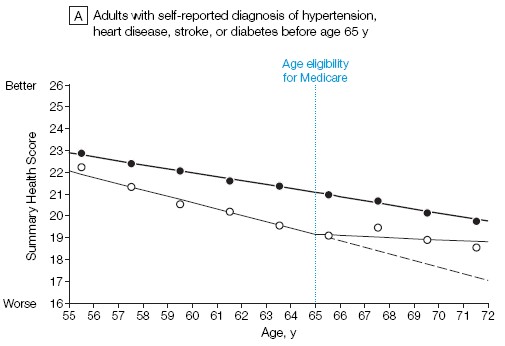
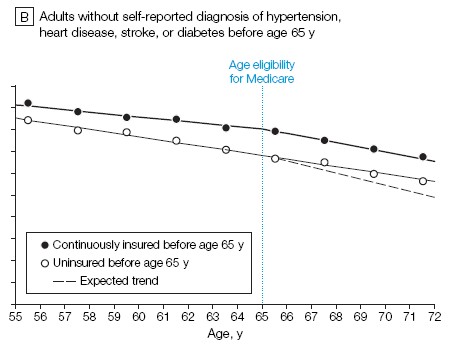
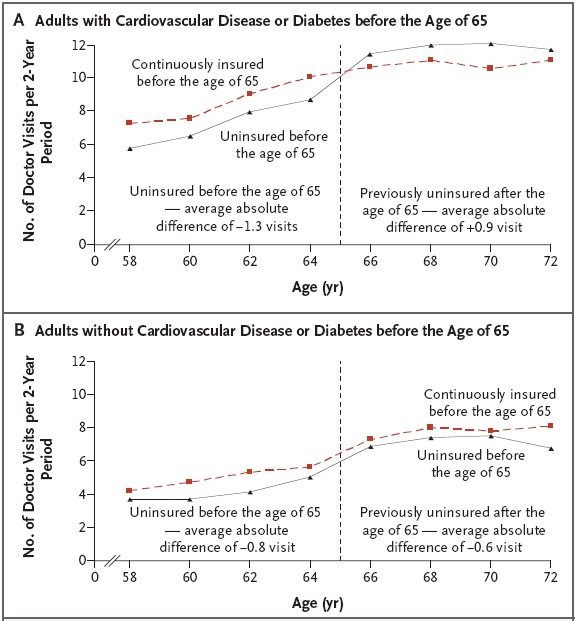
Next, from [2] we see a similar phenomenon in doctor visits. Relative to the insured, those uninsured prior to age 65 visit the doctor more after obtaining Medicare eligibility.
From the same paper ([2]), here are the results on hospital admissions.
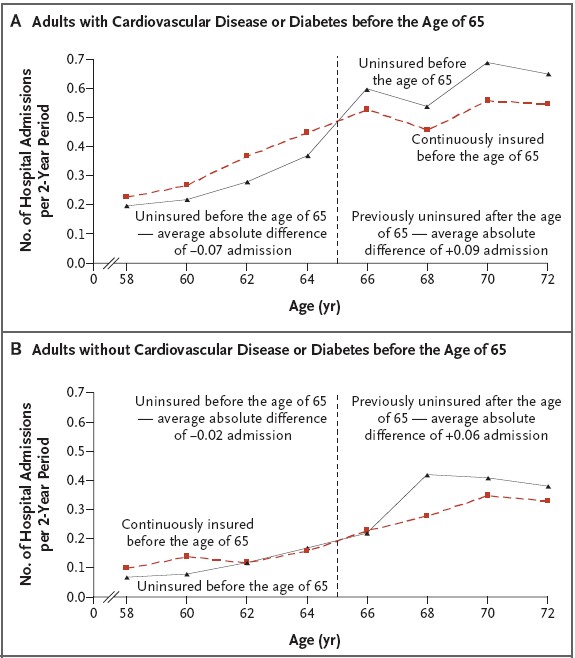
This shouldn’t surprise anyone. It makes sense. It’s hard to get affordable insurance as you approach age 65. If you’re lucky enough to have insurance, then you’re getting the care you need, so getting Medicare is nice, but not a huge change in your life. If you’re uninsured, though, then getting Medicare is a huge change. If you know you need care, and it’s expensive, then you will likely try and wait until the Medicare kicks in to get it. People do this all the time; the evidence above confirms it.

Raising the eligibility age will just force these people to wait longer.* If this somehow saved us money, then we suppose you could have a debate about its benefits and harms. Knowing that it will likely cost Medicare more, however, means that it’s entirely possible that delaying Medicare eligibility will cost more and lead to worse outcomes. That’s the worst of both worlds.

* McWilliams et al.’s analysis does not take into consideration the effect of health reform. Provided it stays on the books, the non-elderly will have different options in 2014. Still, the analysis shows the value of health insurance, and in particular of universal coverage.

References

[1] McWilliams JM, Meara E, Zaslavsky AM, Ayanian JZ. Health of previously uninsured adults after acquiring Medicare coverage. JAMA. 2007;298:2886-94.

[2] McWilliams JM, Meara E, Zaslavsky AM, Ayanian JZ. Use of health services by previously uninsured Medicare beneficiaries. N Engl J Med. 2007;357:143-53.

http://theincidentaleconomist.com/wordpress/delaying-medicare-eligibility-is-bad-for-health/

Media Coverage

Delaying Medicare eligibility is bad for health

Austin Frakt and Aaron Carroll , The Incidental Economist , Published: June 10, 2011

Read More

Primary Sidebar

Recent Articles of Interest

  • Universal Healthcare Will Save Lives...and Could Save the Democratic Party
  • Medicare for All Explained Podcast: Episode 128
  • Medicare for All Explained Podcast: Episode 127
  • Medicare Will Require Prior Approval for Certain Procedures
  • Trump’s Big Bill Will Make It Harder for Doctors to Give Patients the Care They Need
  • About PNHP
    • Mission Statement
    • Local Chapters
    • Student chapters
    • Board of Directors
    • National Office Staff
    • Contact Us
    • Privacy Policy
  • About Single Payer
    • What is Single Payer?
    • How do we pay for it?
    • History of Health Reform
    • Conservative Case for Single Payer
    • FAQs
    • Información en Español
  • Take Action
    • The Medicare for All Act of 2025
    • Moral Injury and Distress
    • Medical Society Resolutions
    • Recruit Colleagues
    • Schedule a Grand Rounds
    • Letters to the Editor
    • Lobby Visits
  • Latest News
    • Sign up for e-alerts
    • Members in the news
    • Health Justice Monitor
    • Articles of Interest
    • Latest Research
    • For the Press
  • Reports & Proposals
    • Physicians’ Proposal
    • Medicare Advantage Equity Report
    • Medicaid Managed Care Report
    • Medicare Advantage Harms Report
    • Medicare Advantage Overpayments Report
    • Pharma Proposal
    • Kitchen Table Campaign
    • COVID-19 Response
  • Member Resources
    • 2025 Annual Meeting Materials
    • Member Interest Groups (MIGs)
    • Speakers Bureau
    • Slideshows
    • Newsletter
    • Materials & Handouts
    • Webinars
    • Host a Screening
    • Events Calendar
    • Join or renew your membership

Footer

  • About PNHP
    • Mission Statement
    • Local Chapters
    • Student chapters
    • Board of Directors
    • National Office Staff
    • Contact Us
    • Privacy Policy
  • About Single Payer
    • What is Single Payer?
    • How do we pay for it?
    • History of Health Reform
    • Conservative Case for Single Payer
    • FAQs
    • Información en Español
  • Take Action
    • The Medicare for All Act of 2025
    • Moral Injury and Distress
    • Medical Society Resolutions
    • Recruit Colleagues
    • Schedule a Grand Rounds
    • Letters to the Editor
    • Lobby Visits
  • Latest News
    • Sign up for e-alerts
    • Members in the news
    • Health Justice Monitor
    • Articles of Interest
    • Latest Research
    • For the Press
  • Reports & Proposals
    • Physicians’ Proposal
    • Medicare Advantage Equity Report
    • Medicaid Managed Care Report
    • Medicare Advantage Harms Report
    • Medicare Advantage Overpayments Report
    • Pharma Proposal
    • Kitchen Table Campaign
    • COVID-19 Response
  • Member Resources
    • 2025 Annual Meeting Materials
    • Member Interest Groups (MIGs)
    • Speakers Bureau
    • Slideshows
    • Newsletter
    • Materials & Handouts
    • Webinars
    • Host a Screening
    • Events Calendar
    • Join or renew your membership
©2025 PNHP