By Aaron Carroll
The Incidental Economist, June 5, 2011
Paul Krugman has been on a tear the last few days with a number of posts defending Canada’s Medicare. This was all leading up to his latest column, where he questioned why Medicare should be unsustainable in this country, when it’s sustainable there.
I’m sure we’re going to now face the usual howls of protest, comparing Canada’s health care system to a death sentence. So let me summarize a few of my past posts to try and pre-empt some of the false rhetoric.
1) Doctors in Canada are not flocking to the US to practice
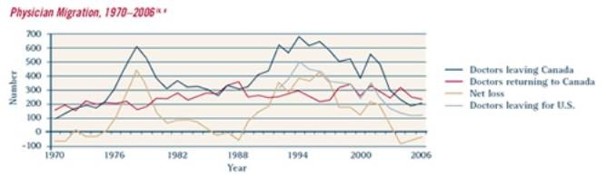
So when emigration “spiked,” 400-500 doctors were leaving Canada for the United States. There are more than 800,000 physicians in the U.S. right now, so I’m skeptical that every doctor knows one of those emigres. But I’d especially like you to pay attention to the yellow line, which is the net loss of doctors to Canada.
In 2003, net emigration became net immigration. Let me say that again. More doctors were moving into Canada than were moving out.
2) Canadians are not flocking here to get care
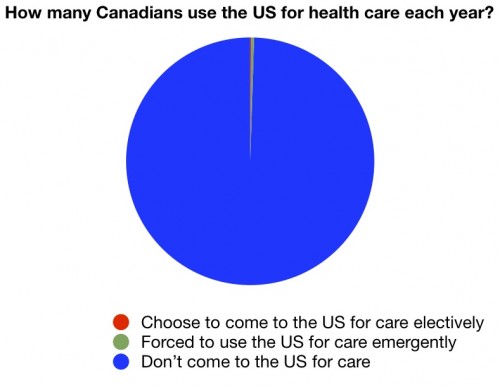
Look, I’m not denying that some people with means might come to the United States for care. If I needed a heart/lung transplant, there’s no place I’d rather be. But for the vast, vast majority of people, that’s not happening. You shouldn’t use the anecdote to describe things at a population level. This study showed you three different methodologies, all with solid rationales behind them, all showing that this meme is mostly apocryphal.
3) Doctors are not less satisfied practicing in Canada than the US
How satisfied are physicians with their practice? It’s not a perfect measure, but it’s an important one:
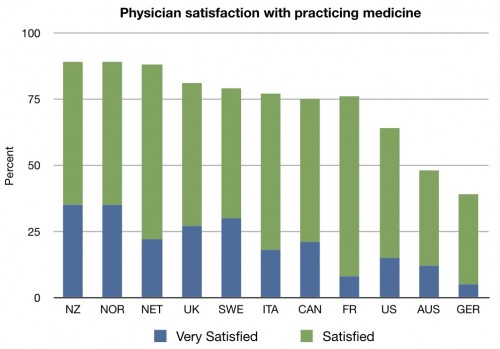
Given the rhetoric of how much physicians hate reform, you would think doctors were very happy before reform passed. You’d be wrong. With the exception of Austria and Germany, fewer doctors were satisfied with practicing medicine [in the US] than any other surveyed country.
When people want to demonize single payer systems, they always wind up going after rationing, and more often than you’d think with hip replacements…
It’s not true. They don’t deny hip replacements to the elderly. But there’s more.
Do you know who gets most of the hip replacements in the United States? The elderly.
Do you know who pays for care for the elderly in the United States? Medicare.
Do you know what Medicare is? A single-payer system.
5) Canada’s wait times aren’t due to its being a singe-payer system
The wait times that Canada might experience are not caused by its being a single payer system.
Do you know who pays for care for the elderly in the United States? Medicare.
Do you know what Medicare is? A single-payer system.
So our single-payer system manages not to have the wait times issue theirs does. There must be some other reason for the wait times. There is, of course. It’s this:
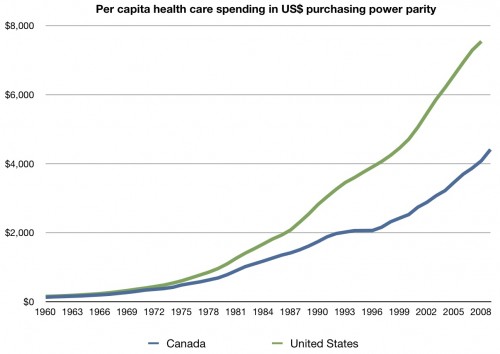
Canada isn’t some dictatorship. They aren’t oppressed. In 1966, the democratically elected government enacted their single-payer health care system (also known as Medicare). Since then, as a country, they have made a conscious decision to hold down costs. One of the ways they do that is by limiting supply, mostly for elective things, which can create wait times. Their outcomes are otherwise comparable to ours.
Please understand, the wait times could be overcome. They could spend more. They don’t want to. We can choose to dislike wait times in principle, but they are a byproduct of Canada’s choice to be fiscally conservative. They chose this. In a rational world, those who are concerned about health care costs and what they mean to the economy might respect that course of action. But instead, we attack.
6) Since Canada adopted their single payer system, infant mortality has dropped below that of the US
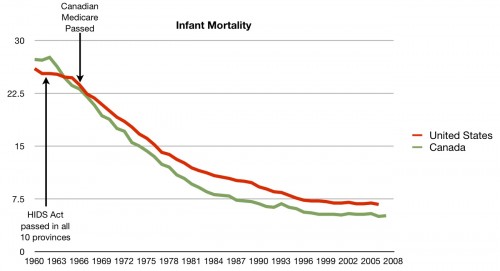
Many people have told me that infant mortality used to be higher in Canada than in the US, but since the passage of (Canadian) Medicare, that hasn’t been the case. The chart above, which I made from OECD data, would tend to agree.
I know the usual knocks against infant mortality as a population metric of quality. But I’d like to hear a good alternate explanation (if one exists) for the trend you see above. Links to evidence or data supporting your theory will get you extra points.

About one third of Americans report that they didn’t go to the doctor when sick, didn’t get recommended care when needed, did not fill
a prescription, or skipped doses of medications in the last year because of cost.
So feel free to have a discussion about the relative merits of the Canadian health care system compared to ours. Just keep it to facts.
http://theincidentaleconomist.com/wordpress/in-defense-of-canada/