By Kim Krisberg
AAMC Reporter, February 2015
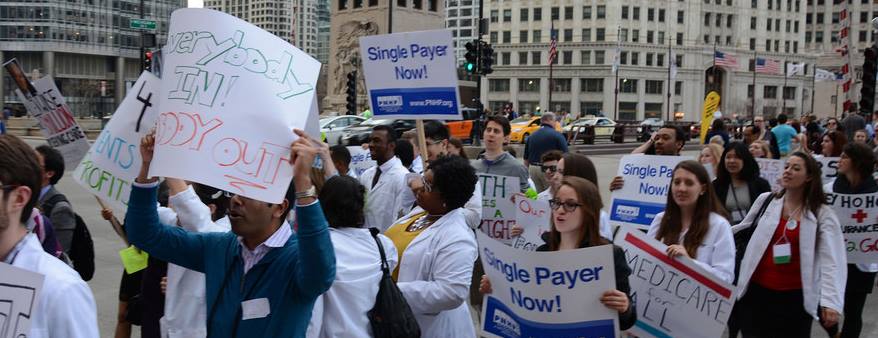
In early December, hundreds of medical students at schools nationwide donned their white coats and came together in protest after grand juries in Ferguson, Mo., and New York decided not to indict police officers in the deaths of unarmed black men. From Howard University College of Medicine in Washington, D.C., to the University of California, San Francisco, School of Medicine, medical students organized white coat “die-ins,” lying on the sidewalks and floors of their campuses en masse with signs that read “White Coats for Black Lives.”
“We believe health care is a human right and see health as fundamental in the exercise of all other rights,” said James Besante, a fourth-year student at the University of New Mexico School of Medicine. “When we say black lives matter, we mean that our fellow medical students and patients and families matter. These are our classmates; these are our patients.”
Besante is a student representative on the Board of Directors of Physicians for a National Health Program, whose student members and chapters took a leading role in organizing and promoting the white coat die-ins. In addition to protesting the jury decisions, Besante said the protests were designed to jumpstart conversations about institutional racism and bias. In a news release, the organization said, “We as medical students feel that this is an important time for medical institutions to respond to the violence and race-related trauma that affect our communities and the patients we serve.”
December’s protests are the most recent example of medical students stepping into the advocacy roles. For some time, medical students have used their budding expertise to head to the offices of elected officials to discuss issues like access to care, student debt, or climate change. And while being a public advocate certainly is not a requirement for physicians, “you’re a leader whether you know it or not or want it or not,” said Doug Skrzyniarz, MHSA, associate vice president of government affairs and an adjunct professor at Wayne State University School of Medicine in Detroit.
“When our students go to Lansing or Washington, and have their white coats on, they have a voice with legislators that other professionals, quite frankly, just don’t have,” Skrzyniarz said. “You’ll be treating thousands of people in your community, and in that role, people will look to you. Legislators know that.”
Skrzyniarz directs and teaches the school’s Medicine and Political Action in the Community elective, which provides information on health policy, advocacy, and leadership development to first- and second-year medical students. When the course began in 2009, there were 20 students enrolled; now there are 120. Skryzniarz said one of the course’s most popular activities is its lobby day during which students travel to Lansing and advocate directly to state legislators.
“Medical students have an extremely busy schedule, and so I try to avoid competing with the main part of their curriculum,” he said. “At the end of the day, I want them to develop the confidence to continue being advocates in the future.”
From an advocacy perspective, the authenticity of the medical student experience can be particularly compelling for policymakers, explained Atul Grover, M.D., Ph.D., AAMC chief public policy officer. “Students can help explain to members of Congress and their staff what [key issues] mean for their future patients,” he said. “It’s really about trying to break through some of the noise.”
Grover noted that while the AAMC typically has organized more grasstops advocacy by engaging deans and CEOs, the association recently launched a new grassroots effort to mobilize student voices in support of robust funding for graduate medical education (GME). Students who visit the new website, www.aamcaction.org, can sign up to receive issue updates and learn about opportunities to engage in direct advocacy with lawmakers. While the initial focus is GME funding, the AAMC hopes to bring the campaign’s voice to other topics, such as medical research funding.
At the American Medical Student Association (AMSA), advocacy comes with the territory, whether in support of medical education or nontraditional medical issues such as climate change, which scientists predict will have serious human health impacts. The association has about 38,000 members and more than 250 affiliated chapters at medical schools nationwide. Britani Kessler, D.O., the association’s national president, remembers her first AMSA convention in 2006 when she joined hundreds of medical students as they rallied on Capitol Hill for the reauthorization of the Children’s Health Insurance Program. The experience inspired her to continue speaking out when she began her medical education at Nova Southeastern University in Ft. Lauderdale, Fla., where she served as president of the AMSA chapter.
Kessler noted that effective advocacy is not confined to legislative offices. For example, her AMSA chapter helped organize a local health fair for the area’s large community of migrant farm workers, who face substantial barriers to care. “Bringing health care to your community—that’s a form of advocacy,” said Kessler, who will begin a pediatrics residency this summer.
Social determinants of health, such as access to regular care, are a common theme in medical student advocacy. In Health and Human Rights, an elective course at Tulane University School of Medicine, the goal is to remind students that biology is only one factor that influences a patient’s health, said Daniel Bausch, M.D., who developed and teaches the course. The curriculum requires student teams to present on a relevant topic. The only requirement is that teams also suggest policy solutions to the problem, noted Bausch, an associate professor in the Department of Tropical Medicine. Presentations have covered topics like human trafficking in India and prison conditions in Louisiana. Bausch expects police-community relations to be a popular topic in the coming year.
“It’s not about what’s right or wrong,” he said. “It’s about getting students to look inward and find what’s important to them and giving them some tools and inspiration to act externally.”
External action is central for medical students involved with Physicians for a National Health Program and its 35 student chapters. At the national level, the organization’s annual summit educates attendees on a single-payer health care system, offering workshops on topics such as advocacy, public speaking, and letter writing. According to Besante, students want to know more about policy and how to influence the process. “Students want to take an active role in the health justice movement,” he said. “The medical profession has lost a lot of ground in protecting the physician-patient relationship. We are the future of medicine, and we want to make it work not only for our patients, but also for ourselves.”
Aaron Fox, M.D., M.S., an assistant professor at Albert Einstein College of Medicine, said that as medical training focuses more on specialization, “we’re losing the idea that you can have a broader impact on health and wellness.” Fox directs the Research-Based Health Activism course and co-directs another course, Health Disparities: From Awareness to Action. During the research-based elective about policy and advocacy, students must develop a research project and a plan to disseminate the project’s findings to community stakeholders. In a 2006 Journal of General Internal Medicine article about the course, authors found the curriculum “represents a multidisciplinary model for developing physician activists.”
While Fox said he does not believe a majority of medical students are interested in advocacy work, “there is a small majority who do want these skills and they can have a large impact.” He added that students and physicians can be effective advocates without being health policy experts.
“I think what matters most are the stories,” Fox said. “If [students] can articulate how the social determinants of health, like poverty or racism, impact the health of individuals, they can be very effective.”
Kim Krisberg has written this article as a special to the Reporter.
https://www.aamc.org/newsroom/reporter/february2015/426086/advocacy.html