• Skip to primary navigation
  • Skip to main content
  • Skip to primary sidebar
  • Skip to footer

PNHP

  • Home
  • Contact PNHP
  • Join PNHP
  • Donate
  • PNHP Store
  • About PNHP
    • Mission Statement
    • Local Chapters
    • Student chapters
    • Board of Directors
    • National Office Staff
    • Contact Us
    • Privacy Policy
  • About Single Payer
    • What is Single Payer?
    • How do we pay for it?
    • History of Health Reform
    • Conservative Case for Single Payer
    • FAQs
    • InformaciĂłn en Español
  • Take Action
    • The Medicare for All Act of 2025
    • Moral Injury and Distress
    • Medical Society Resolutions
    • Recruit Colleagues
    • Schedule a Grand Rounds
    • Letters to the Editor
    • Lobby Visits
  • Latest News
    • Sign up for e-alerts
    • Members in the news
    • Health Justice Monitor
    • Articles of Interest
    • Latest Research
    • For the Press
  • Reports & Proposals
    • Physicians’ Proposal
    • Medicare Advantage Equity Report
    • Medicaid Managed Care Report
    • Medicare Advantage Harms Report
    • Medicare Advantage Overpayments Report
    • Pharma Proposal
    • Kitchen Table Campaign
    • COVID-19 Response
  • Member Resources
    • 2025 Annual Meeting
    • Member Interest Groups (MIGs)
    • Speakers Bureau
    • Slideshows
    • Newsletter
    • Materials & Handouts
    • Webinars
    • Host a Screening
    • Events Calendar
    • Join or renew your membership

Articles of Interest

Students Occupy for Health Justice

Share on FacebookShare on Twitter

By Danielle Alexander
AMSA On Call blog, Dec. 7, 2011

I met a patient last week who stopped taking her antidepressant medications because she had been denied long-term health insurance and thought it would improve her chances of eligibility. Unfortunately this obviously wasn’t in the best interest of her health.

I had another patient who presented to the emergency department with metastatic lung cancer. He had not been to the doctor in over 30 years because he couldn’t afford it. If he had sought treatment earlier he may have been cured.

Everywhere I look private health insurance companies are making our patients sicker.

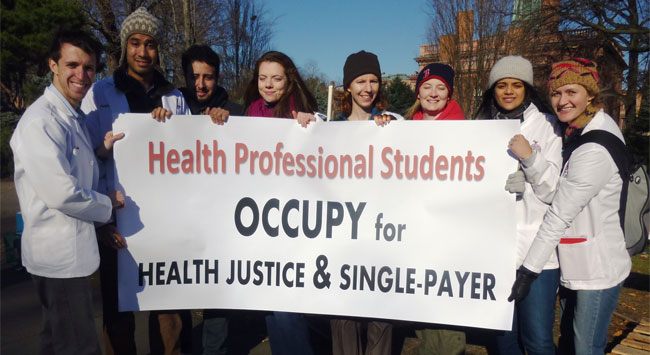
I was proud to be at in Lafayette Park in Albany, N.Y., last Sunday for the Health Professional Students Day of Action for the 99%. We carried a banner that said “Health Professional Students Occupy for Health Justice and Single Payer.”

I support the occupy movement because I feel that powerful and profiting insurance companies get in the way of my practice of medicine. Treatment should be the same high quality for everyone; instead, we have to consider what someone can afford.

It too often becomes treatment for the “haves” and neglect for the “have nots.” But the thing is, these days you may not know which group you fall into. Insurance plans are so spotty, with major gaps in coverage, that you don’t even realize it until you need medical attention, and you find your plan does not cover it.

I see it every day in the clinic – treatment is designed around what the insurance will pay (or not) instead of what is best for the patient first and foremost. It’s no fault of the medical team; we want to give the patients the best care, but the insurance industry has our hands tied.

Today’s future doctors realize that health care is more than physical health, social determinants of health are equally as important. The schools our kids attend, the neighborhoods we grow up in, the cleanliness of the environment, joblessness, and poverty all deeply impact our health.

A classmate said today, “There is so much inequity and injustice, it cuts into everything, including caring for patients. If you really want to care for patients you’ve got to care about everything, not just their liver.”

I asked some of the other attendees why they support the Occupy movement. “Health care is a fundamental human right and by increasing access to health care we can reduce some of the inequality,” said one medical student. Another classmate agreed: “We’re here for health care because you can’t do anything if you’re not healthy.” Yet another: “As a future physician, it’s disconcerting that patients can’t get into my exam room, and I want to change that.”

Even early in their medical careers, these students see that there are major problems with the health of our nation.

As I talked with my classmates, I found that we were all there for slightly different reasons. “I feel like too much of our country’s infrastructure has been diverted away from the important stuff like health and well-being,” said another student. His peer believes “the system is broken and change needs to start somewhere.”

The United States is the only industrialized country that does not provide health care to all its citizens regardless of employment status or economic class. Our profit-driven health care industry raises costs and inequality.

But our political system has been corrupted by corporate money and power, and the 1% have rejected evidence-based health policy that save lives and money, namely expanded and improved Medicare for all. We support Occupy Wall Street because economic and social inequality makes our patients sick.

Danielle Alexander is a medical student in Albany, N.Y.

http://www.amsa.org/AMSA/Homepage/TakeAction/AMSAOnCall/11-12-07/Students_Occupy_for_Health_Justice.aspx

Primary Sidebar

Recent Articles of Interest

  • Universal Healthcare Will Save Lives...and Could Save the Democratic Party
  • Medicare for All Explained Podcast: Episode 128
  • Medicare for All Explained Podcast: Episode 127
  • Medicare Will Require Prior Approval for Certain Procedures
  • Trump’s Big Bill Will Make It Harder for Doctors to Give Patients the Care They Need
  • About PNHP
    • Mission Statement
    • Local Chapters
    • Student chapters
    • Board of Directors
    • National Office Staff
    • Contact Us
    • Privacy Policy
  • About Single Payer
    • What is Single Payer?
    • How do we pay for it?
    • History of Health Reform
    • Conservative Case for Single Payer
    • FAQs
    • InformaciĂłn en Español
  • Take Action
    • The Medicare for All Act of 2025
    • Moral Injury and Distress
    • Medical Society Resolutions
    • Recruit Colleagues
    • Schedule a Grand Rounds
    • Letters to the Editor
    • Lobby Visits
  • Latest News
    • Sign up for e-alerts
    • Members in the news
    • Health Justice Monitor
    • Articles of Interest
    • Latest Research
    • For the Press
  • Reports & Proposals
    • Physicians’ Proposal
    • Medicare Advantage Equity Report
    • Medicaid Managed Care Report
    • Medicare Advantage Harms Report
    • Medicare Advantage Overpayments Report
    • Pharma Proposal
    • Kitchen Table Campaign
    • COVID-19 Response
  • Member Resources
    • 2025 Annual Meeting
    • Member Interest Groups (MIGs)
    • Speakers Bureau
    • Slideshows
    • Newsletter
    • Materials & Handouts
    • Webinars
    • Host a Screening
    • Events Calendar
    • Join or renew your membership

Footer

  • About PNHP
    • Mission Statement
    • Local Chapters
    • Student chapters
    • Board of Directors
    • National Office Staff
    • Contact Us
    • Privacy Policy
  • About Single Payer
    • What is Single Payer?
    • How do we pay for it?
    • History of Health Reform
    • Conservative Case for Single Payer
    • FAQs
    • InformaciĂłn en Español
  • Take Action
    • The Medicare for All Act of 2025
    • Moral Injury and Distress
    • Medical Society Resolutions
    • Recruit Colleagues
    • Schedule a Grand Rounds
    • Letters to the Editor
    • Lobby Visits
  • Latest News
    • Sign up for e-alerts
    • Members in the news
    • Health Justice Monitor
    • Articles of Interest
    • Latest Research
    • For the Press
  • Reports & Proposals
    • Physicians’ Proposal
    • Medicare Advantage Equity Report
    • Medicaid Managed Care Report
    • Medicare Advantage Harms Report
    • Medicare Advantage Overpayments Report
    • Pharma Proposal
    • Kitchen Table Campaign
    • COVID-19 Response
  • Member Resources
    • 2025 Annual Meeting
    • Member Interest Groups (MIGs)
    • Speakers Bureau
    • Slideshows
    • Newsletter
    • Materials & Handouts
    • Webinars
    • Host a Screening
    • Events Calendar
    • Join or renew your membership
©2025 PNHP