• Skip to primary navigation
  • Skip to main content
  • Skip to primary sidebar
  • Skip to footer

PNHP

  • Home
  • Contact PNHP
  • Join PNHP
  • Donate
  • PNHP Store
  • About PNHP
    • Mission Statement
    • Local Chapters
    • Student chapters
    • Board of Directors
    • National Office Staff
    • Contact Us
    • Privacy Policy
  • About Single Payer
    • What is Single Payer?
    • How do we pay for it?
    • History of Health Reform
    • Conservative Case for Single Payer
    • FAQs
    • Información en EspaƱol
  • Take Action
    • The Medicare for All Act of 2025
    • Moral Injury and Distress
    • Medical Society Resolutions
    • Recruit Colleagues
    • Schedule a Grand Rounds
    • Letters to the Editor
    • Lobby Visits
  • Latest News
    • Sign up for e-alerts
    • Members in the news
    • Health Justice Monitor
    • Articles of Interest
    • Latest Research
    • For the Press
  • Reports & Proposals
    • Physicians’ Proposal
    • Medicare Advantage Equity Report
    • Medicaid Managed Care Report
    • Medicare Advantage Harms Report
    • Medicare Advantage Overpayments Report
    • Pharma Proposal
    • Kitchen Table Campaign
    • COVID-19 Response
  • Member Resources
    • 2025 Annual Meeting Materials
    • Member Interest Groups (MIGs)
    • Speakers Bureau
    • Slideshows
    • Newsletter
    • Materials & Handouts
    • Webinars
    • Host a Screening
    • Events Calendar
    • Join or renew your membership

Quote of the Day

There is bipartisan agreement that our health care system has major problems

Seven in 10 Maintain Negative View of U.S. Healthcare System

Share on FacebookShare on Twitter

By Justin McCarthy
Gallup, January 14, 2019

Seventy percent of Americans describe the current U.S. healthcare system as being “in a state of crisis” or having “major problems.” This is consistent with the 65% to 73% range for this figure in all but one poll since Gallup first asked the question in 1994.

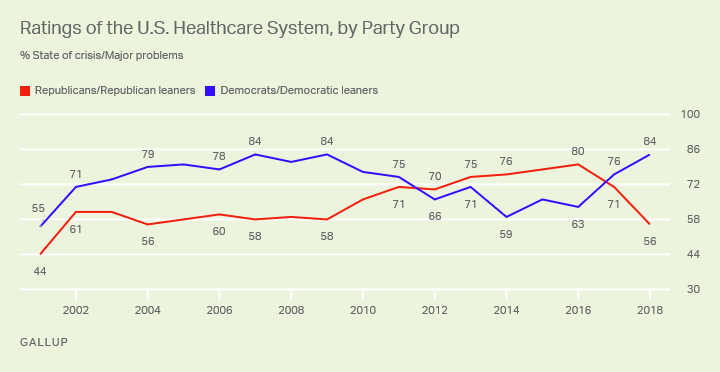
Although the percentage of Americans saying U.S. healthcare has major problems or is in crisis has been fairly flat over the past two decades, Democrats’ and Republicans’ views have changed within that time frame.

From 2001 to 2009, Democrats and Democratic-leaning independents were considerably more likely than Republicans and Republican-leaning independents to say healthcare had major problems or was in crisis. Democrats’ negative assessments then decreased in the rest of President Barack Obama’s first term, after passage of the Affordable Care Act (ACA) in 2010, at the same time that Republicans’ concerns mounted. By 2012, the lines crossed, so that during most of Obama’s second term, Republicans were significantly more likely than Democrats to perceive significant or critical problems in the healthcare system.

Now, with Republican President Donald Trump in office, partisan views have flipped again, with Democrats more likely to be concerned.

The difference between the two major parties on this measure was just five percentage points in 2017, Trump’s first year, when 76% of Democrats and 71% of Republicans said healthcare had major problems or was in crisis. This expanded to a 28-point gap in 2018, when 84% of Democrats and 56% of Republicans expressed these views — the largest partisan gap on this measure in Gallup’s trend since 2001.

The 2018 poll was conducted on the heels of last year’s midterm elections, in which Democratic candidates highlighted key problems with the healthcare system — especially coverage.
https://news.gallup.com…


Comment:

By Don McCanne, M.D.

Consistently since 1994 (except 9/11/2001) about seven-tenths of the nation has believed that the U.S. health care system is in a state of crisis or has major problems. That view persists today.

The intensity of this view has varied with the politics. During the administration of George W. Bush, the Democrats thought the system was worse than did the Republicans. Following the passage of the Affordable Care Act under Barack Obama, the Republicans thought the system was worse. At the time of the midterm elections last year, the opinions flipped again when the Democrats had campaigned on the need to fix our system with Medicare for All whereas the Republicans abandoned their attack on Obamacare and called only for guaranteed issue – not excluding people from insurance because of preexisting conditions.

Although political polarization is certainly a reality, we should temper our views on this particular difference. It should be noted that the graph is truncated – the bottom 30 percent is not included. It looks like the two sides switched positions two times, but, in fact, except for 2001, at all times the majority of both parties believed that health care was in a state of crisis or had major problems.

The point is that a majority of all Americans, regardless of party affiliation, believes that we have very serious problems with our health care system. The main difference is that the Republicans have failed to come up with any effective solutions and thus currently consider the crisis less pressing, whereas the Democrats are now more concerned, in spite of Obamacare, and thus many support a proven solution: Single Payer Medicare for All. It would fix the problems, and everyone, regardless of political affiliation, needs to understand that.

Stay informed! Visit www.pnhp.org/qotd to sign up for daily email updates.

Primary Sidebar

Recent Quote of the Day

  • John Geyman: The Medical-Industrial Complex...plus exciting changes at qotd
  • Quote of the Day interlude
  • More trouble: Drug industry consolidation
  • Will mega-corporations trump Medicare for All?
  • Charity care in government, nonprofit, and for-profit hospitals
  • About PNHP
    • Mission Statement
    • Local Chapters
    • Student chapters
    • Board of Directors
    • National Office Staff
    • Contact Us
    • Privacy Policy
  • About Single Payer
    • What is Single Payer?
    • How do we pay for it?
    • History of Health Reform
    • Conservative Case for Single Payer
    • FAQs
    • Información en EspaƱol
  • Take Action
    • The Medicare for All Act of 2025
    • Moral Injury and Distress
    • Medical Society Resolutions
    • Recruit Colleagues
    • Schedule a Grand Rounds
    • Letters to the Editor
    • Lobby Visits
  • Latest News
    • Sign up for e-alerts
    • Members in the news
    • Health Justice Monitor
    • Articles of Interest
    • Latest Research
    • For the Press
  • Reports & Proposals
    • Physicians’ Proposal
    • Medicare Advantage Equity Report
    • Medicaid Managed Care Report
    • Medicare Advantage Harms Report
    • Medicare Advantage Overpayments Report
    • Pharma Proposal
    • Kitchen Table Campaign
    • COVID-19 Response
  • Member Resources
    • 2025 Annual Meeting Materials
    • Member Interest Groups (MIGs)
    • Speakers Bureau
    • Slideshows
    • Newsletter
    • Materials & Handouts
    • Webinars
    • Host a Screening
    • Events Calendar
    • Join or renew your membership

Footer

  • About PNHP
    • Mission Statement
    • Local Chapters
    • Student chapters
    • Board of Directors
    • National Office Staff
    • Contact Us
    • Privacy Policy
  • About Single Payer
    • What is Single Payer?
    • How do we pay for it?
    • History of Health Reform
    • Conservative Case for Single Payer
    • FAQs
    • Información en EspaƱol
  • Take Action
    • The Medicare for All Act of 2025
    • Moral Injury and Distress
    • Medical Society Resolutions
    • Recruit Colleagues
    • Schedule a Grand Rounds
    • Letters to the Editor
    • Lobby Visits
  • Latest News
    • Sign up for e-alerts
    • Members in the news
    • Health Justice Monitor
    • Articles of Interest
    • Latest Research
    • For the Press
  • Reports & Proposals
    • Physicians’ Proposal
    • Medicare Advantage Equity Report
    • Medicaid Managed Care Report
    • Medicare Advantage Harms Report
    • Medicare Advantage Overpayments Report
    • Pharma Proposal
    • Kitchen Table Campaign
    • COVID-19 Response
  • Member Resources
    • 2025 Annual Meeting Materials
    • Member Interest Groups (MIGs)
    • Speakers Bureau
    • Slideshows
    • Newsletter
    • Materials & Handouts
    • Webinars
    • Host a Screening
    • Events Calendar
    • Join or renew your membership
©2025 PNHP