By Daniel Connolly
Memphis Commercial Appeal
February 23, 2007
Dr. Marcia Angell of Harvard Medical School was in Memphis on Thursday to continue her public criticism of big drug companies.
Angell, a former editor of the New England Journal of Medicine and author of the 2004 book, “The Truth About the Drug Companies: How They Deceive Us and What to Do About It,” has accused drug firms of abuses including price-gouging and running biased clinical trials.
She was in Memphis Thursday to speak at the Holiday Inn at the University of Memphis at an event organized by The Economic Club of Memphis.
“(Companies are) involved intimately in every detail of the research,” she said. “And they design the research so that their drugs look better than they really are.”
She has also called for the government to negotiate directly with drug companies for the Medicare Part D drug benefit and has said the current program was designed to help companies, not patients.
PHRMA, a national pharmaceutical industry group, has fired back. The group’s senior vice president, Ken Johnson, said Thursday that her position on Medicare is wrong.
“Marcia Angell’s misguided solution is to let government bureaucrats choose medicines for patients, instead of allowing patients and their doctors to determine the best course of treatment,” he wrote.
He also objected to a recent opinion article Angell wrote in the Boston Globe about PHRMA’s president and CEO Billy Tauzin, a former member of Congress.
Angell wrote that Tauzin sponsored the Medicare Pard D bill and left Congress almost immediately after the legislation passed.
“He was rewarded with a high-paying job as chief executive of the pharmaceutical industry’s trade association,” she wrote.
Johnson said Tauzin left Congress only after he was diagnosed with a deadly form of cancer and that he accepted the PHRMA job after a drug produced by one of the firms in the industry group helped him beat the cancer.
“This experience made him an advocate for researching and developing new medicines to fight diseases,” Johnson wrote.
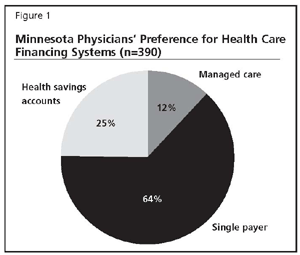
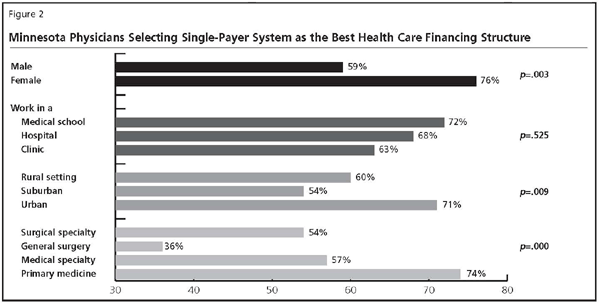 A single-payer system was favored by women physicians over men (female, 76%; male, 59%; p=.003); more male physicians than female preferred HSAs (male, 30%; female, 16%; p=.004). The percentage of male respondents who favored the current managed care system slightly exceeded that of female physicians (12% versus 9%; p=.553). Geographic setting was also significantly associated across the 3 choices. Urban physicians favored a single-payer system over their rural and suburban colleagues (71%, 60%, and 54%, respectively; p=.009). Rural physicians preferred HSAs over suburban and urban physicians (34%, 32%, 17%; p=.002). Managed care garnered less than 15% support overall, with 14% of suburban physicians, 12% of urban doctors, and 6% of rural respondents favoring it; p=.217). Thus, urban physicians had the most support for a single-payer system and the least for managed care. Rural physicians were relatively enthusiastic for HSAs but least supportive of managed care.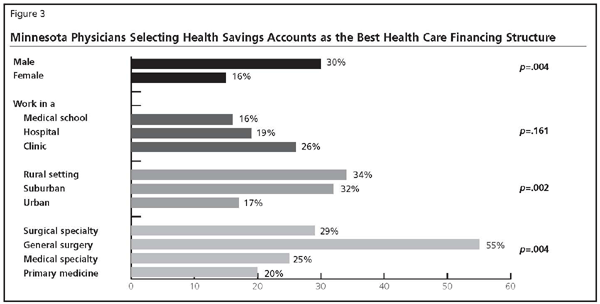
 When looking at physicians’ responses across medical specialty, those practicing primary medicine most favored a single-payer system (74%); general surgeons least favored such a system (36%). Conversely, general surgeons most favored HSAs (55%), and primary medicine physicians least favored them (20%). Managed care found greatest support among physicians who practiced a medical or surgical specialty (17% each) and the least among those who practiced primary medicine (6%). Of those who favored managed care, the significant split was specialists over generalists (17% and 7%; p=.001). Physicians also were asked who should be responsible for providing access to health care. Nearly all (86%) believed it is the responsibility of society through government to ensure access to good medical care for all, regardless of ability to pay. Only 41% held that the private insurance industry should continue to play a major role in medical care financing and delivery. Using a regression model, we found that physicians who agreed that it is the government’s responsibility to ensure access to medical care were significantly more likely to favor a single-payer financing system (OR 13.51; CI 2.85, 64.15; p=.001). Those who believed the private insurance industry should continue to play a major role in financing medical care were significantly less likely to favor a government-run system (OR 3.45; CI 1.35, 8.33; p=.009). Corroborating Results In order to corroborate our results about physicians’ preferences for various financing systems, we asked separate questions about their opinions of each of the 3 structures. We found 56% held a generally favorable view of single-payer systems, 46% of HSAs, and 20% of managed care systems in which physician groups compete for placement in cost-tiered networks. (The total exceeds 100% as some physicians were generally favorable toward more than 1 system.) Thus, more respondents said they preferred a single-payer system than held a favorable view of such a system. Among those with a favorable opinion of single-payer health care, 96% actually selected single payer as their preference for the way our health care system should be financed in the future; among those with a favorable view of HSAs, only 49% selected HSAs as their preferred model for a health care financing system. However, those who had a generally favorable opinion of competition based on price tiers split between their preference for a system based on managed care and one based on HSAs (36% and 39%); only 25% of those respondents said they preferred a single-payer system. Among those opposed to price-tier competition, 78% preferred a single-payer system and 18% preferred HSAs. Only 4% preferred managed care: Rejecting price-tier competition was largely co-extensive with rejecting managed care. Discussion Despite the prevalence of managed care in Minnesota, our study finds only 12% of sampled physicians favor such systems as a way to finance health care; 25% prefer HSAs, and 64% support a single-payer system. Eighty-six percent believe it is the responsibility of society through government to ensure access to good medical care for all. Only 41% say the private insurance industry should continue to play a major role in the financing and delivery of medical care, suggesting support for comprehensive public-sector initiatives rather than private-sector approaches. Stand-alone survey questions about various financing systems showed that nearly 56% of respondents had a generally favorable opinion of single-payer health care systems. Of all specialties, general surgeons had the lowest percentage of respondents who had a favorable view of such a system (36%). Forty-six percent thought favorably of HSAs, and 20% had a positive view of price-tiered competition. This suggests an unwillingness among physician groups to compete directly under managed competition. Yet 118,000 Minnesota state employees and as many as 150,000 employees whose coverage is obtained by a large, multiple-employer group purchaser are enrolled in such managed competition programs.20 Our findings are consistent with those of others who have seen a growing trend toward U.S. physicians saying they favor a single-payer health care system. In 1993, Millard et al. found only 25% of surveyed North Carolina physicians supported a single-payer system over managed competition.13 In 1996, Scanlan et al. compared the opinions of U.S. and Canadian physicians