• Skip to primary navigation
  • Skip to main content
  • Skip to primary sidebar
  • Skip to footer

PNHP

  • Home
  • Contact PNHP
  • Join PNHP
  • Donate
  • PNHP Store
  • About PNHP
    • Mission Statement
    • Local Chapters
    • Student chapters
    • Board of Directors
    • National Office Staff
    • Contact Us
    • Privacy Policy
  • About Single Payer
    • What is Single Payer?
    • How do we pay for it?
    • History of Health Reform
    • Conservative Case for Single Payer
    • FAQs
    • Información en Español
  • Take Action
    • The Medicare for All Act of 2025
    • Moral Injury and Distress
    • Medical Society Resolutions
    • Recruit Colleagues
    • Schedule a Grand Rounds
    • Letters to the Editor
    • Lobby Visits
  • Latest News
    • Sign up for e-alerts
    • Members in the news
    • Health Justice Monitor
    • Articles of Interest
    • Latest Research
    • For the Press
  • Reports & Proposals
    • Physicians’ Proposal
    • Medicare Advantage Equity Report
    • Medicaid Managed Care Report
    • Medicare Advantage Harms Report
    • Medicare Advantage Overpayments Report
    • Pharma Proposal
    • Kitchen Table Campaign
    • COVID-19 Response
  • Member Resources
    • 2025 Annual Meeting
    • Member Interest Groups (MIGs)
    • Speakers Bureau
    • Slideshows
    • Newsletter
    • Materials & Handouts
    • Webinars
    • Host a Screening
    • Events Calendar
    • Join or renew your membership

The official blog of PNHP

Letters to Elected Officials

June 23, 2004

Dear Senator Alpert,

I am writing today to express my strongest possible support for SB 921, the single payer health care initiative authored by Sheila Kuehl (D-23)

In January 2004, a committee of the National Academy of Sciences estimated
that every year, 18000 Americans die needlessly as a result of having
inadequate or no health insurance. To put that into perspective in the words
of our times, that is a new September 11th tragedy every two months. A tragedy
that is entirely self-inflicted, and persisting for as long as we don’t fix our broken health care ‘system.’ Roughly 10% of those people die in California, based on our percentage of the nation’s population.

It’s time for everyone to have healthcare, and SB 921 provides a solution. I ask you to do everything in your power to support this bill and to seek solutions to provide EVERY Californian with health care.

Sincerely,

Myles Sussman, PhD
Member, Physicians for a National Health Program
8840 Costa Verde Bl #3445
San Diego, CA 92122
858-546-1142

letters to the media

LETTER TO THE EDITOR (L.A. Times 05/24/04)
Broken Health Insurance System 
Re “No Insurance Doesn’t Mean No Healthcare,” Commentary, May 21: Conrad Meier’s misguided analysis of healthcare in this country is almost a joke. When he states that more people paying cash for services is a trend, it is not because they want to, it is because they can’t afford insurance. Even if you have insurance you do not necessarily get good healthcare. A friend can’t get her gynecologist to even return a call, much less make an appointment to see her. My wife, with an $8,000 insurance premium, waits over two weeks for approval of a radiological study to rule out a tumor. I was, unfortunately, in an auto accident. Hospitalized for 1 1/2 days, without any surgery, I was billed over $23,000 dollars, not including doctors’ fees and ambulance costs!

Who would elect to pay cash for this? Insurance companies make profits that do not contribute to services. Advertising takes dollars away from services. Jobs that do not provide insurance deprive millions of services. The system is broken. Just saying there are only 25 million people without health insurance instead of 44 million is not enough to make it better. We need universal healthcare — nothing less.

Leonard A. Zivitz MD
——————————————————————————————
I agree with a good bit of Robert L. Borosage’s advice to John Kerry on how to fill in the blanks.  But, I take issue with his anaemic recommendations on how to handle the health care crisis.  What he recommends is not much more inspiring than the poor excuse for a solution the senator is currently failing to arouse the electorate with.  The time has come when the entire progressive movement must speak with one loud, clear voice.  As I see it, the Nation is not, up until now, assuming the role on this issue that it should have taken on some time ago.  It is the opinion of Floridians for Health Care, a fighting grassroots group in Palm Beach County, Florida that single payer, medicare extended to everyone, is the only solution to the rapidly intensifying problem.  That is also the opinion of the 10,000 member physicians for a national health program.  It can be summed up in the words of one of their leaders, the distinguished former editor of the New England Journal of Medicine, Dr. Marcia Angell.  She said: “We can no longer afford not to have single payer universal health care.”  I urge Nation writers to take that stand forthrightly. Let’s start building the mass movement the situation is screaming for.
 
David Prensky, D.D.S.

————————————————————————————–
Margaret Warner
The News Hour
PBS

Dear Ms. Warner:
Thank you for trying to elicit from your guests tonight some comment about the political ramifications of the unacceptable new numbers of uninsured people. Timidly, neither offered any solution, or even seemed to understand some of your questions. Neither questioned the efficacy of the model of employment-based insurance plus an inadequate safety net that has brought us to this juncture. Neither questioned the legitimacy of the dominant for-profit model or the bureaucratic waste that leave our neighbors to their own devices when cancers appear on their skin.

As this issue develops, I hope you will seek out knowledgeable, forthright advocates for meaningful systemic reform, like Dr. Steffie Woolhandler or
Dr. Quentin Young of Physicians for a National Health Plan. An articulate and well-informed advocate and analyst from the perspective of those most excluded from the health care system, homeless people, is Jeff Singer, MSW, President and CEO of Health Care for the Homeless, Inc., in Baltimore and Chair of my organization’s Policy Committee. Any of these three visionary leaders will make a strong case for single payer health care (a word which you spoke and which neither of your guests tonight dared even comment on).

—
John N. Lozier, MSSW
Executive Director
National Health Care for the Homeless Council
PO Box 60427
Nashville TN 37206-0427
phone: 615/226-2292
fax: 615/226-1656
e-mail: jlozier@nhchc.org

Home

Why Students Should Care

The United States has a serious problem and it is one that affects the lives of all of us. That problem is our ailing healthcare system. We are going to be doctors in a few years and that means we are soon going to be advocates for our patients. Let’s start now. Why not be advocates for those patients who will suffer because the system does not allow you to give them the best care possible.

Here is the problem with healthcare in the United States: too many people are not getting any. Because of the profit-driven healthcare industry that exists today, many patients will not be able to reach us for the care they need. Something is blocking their access.

Does not everyone have the right to adequate healthcare in our society? Healthcare should not be a privilege as it is now, but rather the right of every citizen. How can we live in a society that only allows certain groups of people to see doctors while others cannot? In my opinion, that is discrimination. Not only is our system discriminatory, it is killing people. 44 million people in America are uninsured and almost 50 million are underinsured. That is almost 100 million people. Our country only holds 270 million people. Where have we gone wrong when every other industrialized nation recognizes the moral mandate for universal healthcare, offers it, and still spends a smaller percentage of their Gross Domestic Product on healthcare than the United States?

Here’s the deal. You need to decide whether you will become your patient’s advocate years from now, joining the frustrating struggle against managed care; or, will you become your patient’s advocate now by helping to change the scope of healthcare in America?

We need a new system. A system that embraces equity, choice, efficiency, quality, and continuity of care. We can only achieve these goals through a nationalized healthcare system – that is, a single-payer system. What does that mean in practical terms? It means easier access for patients. It means that no patient will be denied care. It means a healthier America.

Some people may tell you that this is socialized medicine. But they are misinformed. This would not be a system that controls the extent of the patient’s right to healthcare. On the contrary, it gives them all the right. A single-payer healthcare system provides for all people and leaves the medical decision making in the knowing hands of the physician. That’s going to be you and me in just a short while.

We need a new system, and the only way to achieve our goal is with your help. Instead of expressing shock each time we hear that the number of uninsured has gone up another million people, we can actually do something about it.

Join Physicians for a National Health Program in advocating universal healthcare access through a single-payer system.

Remember, insurance plans do not deliver healthcare, physicians do. Our patient advocacy needs to begin today because we want quality healthcare for all people in the United States.

Assaf Yosha
Albany Medical College, 2002

What Student PNHP Members Can Do

Invite a speaker to give a talk to medical students and/or faculty on health care reform. Visit the find a speaker page or call the national office at (312) 782-6006 for help in locating a speaker near you. PNHP has a slide show that has been used for talks to physicians and students and that has been very positively received. It is available to borrow or purchase from the national office.

# Host and evening pizza party with a local PNHP speaker for students interested in national health insurance.
# Arrange a session on health care reform at the next AMSA or other organization meeting.
# Post an article on a student bulletin board.
# Copy and distribute articles on national health insurance to students and faculty.
# Write an op-ed or letter to local papers, your school paper, or legislators.
# Network with students at other universities to discuss activities.
# Participate in meeting held by medical association, church groups, and other civic or student groups on health care reform.
# Let local press and other organizations working on health care reform know that you are willing to speak out about the flaws in the current system and the need for universal coverage and national health insurance.
# Form a student chapter of PNHP or get involved with another student group (such as AMSA) that supports national health insurance.
# Get in touch with the PNHP contact person in your area and attend a local chapter meeting.

PNHP Chapters

PNHP has chapters in nearly every state. One great way to get involved in national health care reform is to work with your PNHP chapter.

To email your chapter contact, simply select your state or nearest chapter from the dropdown list; your message will be sent and your chapter contact can respond with more information.

Please note: If you do not see your city or state listed, please contact the national office, as we have activists in many more locations even if we do not have an official PNHP chapter there.

Select Your State:
Your Chapter Contact Is:
Your Name:
Your Email Address:
Your Message:

PNHP Mission Statement

Physicians for a National Health Program (PNHP) advocates for universal, comprehensive single-payer national health insurance, and collaborates with others to fight racism and advance social justice.

PNHP believes that high-quality health care is a right of all people and should be provided equitably as a public service rather than bought and sold as a commodity.

PNHP’s mission is therefore to educate physicians, other health workers, and the general public on the need for a comprehensive, high-quality, publicly-funded health care program, equitably accessible to all residents of the United States.

Equitable access requires, in the view of PNHP, the removal of financial and other barriers to care currently faced by the uninsured, minority populations, documented and undocumented immigrants, and poor and working people of all backgrounds.

PNHP recognizes that a color-blind health care financing scheme alone will not fully address structural racism in medical care. We therefore advocate large-scale investments in hospitals and clinics in underserved communities, and a sharp and immediate increase in the training of minority health professionals—forms of medical reparations.

PNHP views the campaign for health care reform as part of the broader movement for social justice in the United States and globally, including efforts to protect the environment and workers’ safety; oppose militarism, war and xenophobia; and end inequality for communities that have been and are marginalized in health care, including inequalities based on economics, race, gender, sexuality, and disability.

PNHP opposes for-profit, corporate control of the health care system, and market-based health care policies that prioritize investors’ profits over health needs.

PNHP believes that a national health program should be democratically controlled, publicly administered, and funded by progressive taxes.

PNHP strives to restore advocacy for patients’ health as the primary mission of physicians.

PNHP is an independent and non-partisan professional organization. Its work is supported by members’ dues and contributions, and by grants from progressive foundations; it accepts no funding from pharmaceutical companies or other for-profit entities. PNHP organizes physicians, medical students, other health workers, and the public in support of this program, and advances health policy discourse in the U.S. through conferences, lectures, research, articles, and other methods.


PNHP Board of Directors Statements

Statement on mifepristone: “As Physicians for a National Health Program, we believe health care is a human right. This includes coverage of comprehensive reproductive health care, including abortion, contraception, pregnancy, and infertility care. We are deeply disappointed by the recent ruling attempting to revoke the FDA’s approval of mifepristone, a key component of the most effective regimen for medication abortion. By attempting to revoke this approval, access to mifepristone will be severely limited across the country. This ruling dismantles the doctor/patient relationship and threatens the freedom of access to proven effective and safe medical care. We stand with our colleagues advocating for equitable access to abortion care in speaking against this ruling and remain committed to fighting for equitable access to reproductive health care for all people living in the United States.” (approved April 13, 2023)

Statement on reproductive rights: “Physicians for a National Health Program supports full coverage of women’s health care services in the single payer plan that we advocate. This should include coverage for counseling regarding all family planning options, and free access to contraception, abortion and preventive cancer services for all residents of the United States.” (approved Jan. 18, 2017)

Statement on diversity: “Physicians for a National Health Program recognizes diversity as a crucial asset in the fight for single payer reform. A more diverse membership would foster innovation and bring new insights to improve PNHP’s outreach, messaging and strategy. Hence, we are committed to increasing diversity in PNHP’s membership, Board of Directors and student chapters.” (approved Jan. 18, 2017)

E-mail List servs

PNHP offers three email mailing lists:

* *Advocates* will receive PNHP press releases, action alerts, and other urgent health care updates (~5 messages per year)
* *Students* receive updates specifically to student activism, allowing students across the country to collaborate and share ideas (message volume varies)
* *Media* receives press releases and other newsworthy items from Physicians for a National Health Program (message volume varies). Please specify if you are with Print Media/Radio or TV

Additionally, you may be interested in several non-PNHP health care mailing lists:

* Quote of the Day, a daily Health Policy analysis from our President, Don McCanne
* Dennis Lazof’s (lazofd@earthlink.net) recent health care news items
* Robert Rochlin’s (bobrnjan@erols.com) national articles and news clips
* James Ramsell’s (ramselj@efn.org) health care articles and news
* MASSCARE’s Mailing List (MASSCARE@aol.com) Massachusetts updates

Find a Speaker in Your Area

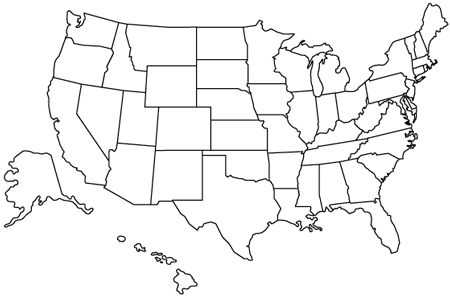
Click on your state to find a local speaker.

If you can’t find a local speaker, it doesn’t mean we don’t have one. Please contact us online or at (312) 782-6006.

Map of the US to find a speaker regionally

Other - (Hawaii and Alaska) Other - (Hawaii and Alaska) South US Southeast US Midwest US Northeast US
Region Speaker/Bio City/State
 
Midwest
  Elinor Christiansen Colorado
  Linda Farley Wisconsin
  Claudia Fegan Chicago
  Gordon Schiff Chicago
  Quentin Young Chicago
Northeast
  Olveen Carrasquillo New York City
  Oliver Fein New York City
  David Himmelstein Boston
  Martha Livingston New York City
  Alec Pruchnicki New York City
  Dan O’Connell New York City
  Deb Richter Vermont
  Jeffrey Scavron Boston
  Victor Sidel New York City
  Timothy Sullivan New York City
  Walter Tsou Philadelphia
  Steffie Woolhandler Boston
  Rudolph Mueller Western New York
South
  John Bower Mississippi
  Jerry Frankel Dallas
Southeast
  Jonathan Kotch North Carolina
West
  Don Beckler Oakland/Bay Area
  Jennifer Malin Los Angeles
  Don McCanne Southern California
  Carla Woodworth Oakland/Bay Area

Advocacy in Action

Physicians Take Action

12 Ways PNHP members can work toward a Single-Payer National Health Program:

* Write an op-ed or letter to your local newspaper.

* Write a letter to your medical specialty journal.

* Give Grand Rounds at your hospital on health care reform, or invite another PNHP member to speak at a Grand Rounds or other hospital forum. Call the national office at (312) 782-6006, or check out our Speakers Bureau.

* Present the PNHP Powerpoint slideshow.

* Arrange a session on health care reform at the next meeting of your medical society or specialty.

* Meet with your legislators.

* Meet with the editorial board of your local newspaper or TV station.

* Attend town hall meetings to discuss health care reform with legislators and the public.

* Inform other health care reform organizations that you are willing to speak about the benefits of the single-payer program.

* Offer to draft a proposal or testify in support of state single-payer legislation.

* Participate in forums held by medical associations, church groups, the League of Women Voters, and other civic groups.

* Form a PNHP Chapter, or get involved in the one nearest you.

* Invite your colleagues to join PNHP.

PAGEBREAK

Students Take Action

* Work as an intern with PNHP

* Form a PNHP student chapter or get involved on your campus with AMSA

* Invite a PNHP speaker to give a talk to medical students and faculty on single-payer.

* Organize a health care debate

* Write an article or op-ed for your school or local paper

* Volunteer at the national office (contact: padma@pnhp.org

The PNHP national office provides educational material, slide shows, and funds for ordering food for student gatherings and lectures.

PAGEBREAK

Patients and Communities Take Action

* Invite a PNHP speaker to give a talk to medical students and faculty on Single-Payer.

* Write an article or op-ed for your school or local paper

* Volunteer at the national office in Chicago (contact: padma@pnhp.org)

* Share your health care story with PNHP

PAGEBREAK

Business Leaders Take Action

Business Facts on Single-Payer

National health insurance would only cost families an average of 2% of income for complete coverage (this replaces all other health care bills). For the typical, middle-income household, the cost would only be $731. This is less than what most families are already paying for health care on top of their insurance.
Employers would pay only 7% of payroll to fund coverage for all their employees and dependents. This is less than what many businesses that provide coverage already pay.

Health economists internationally conclude that for-profit health care is less efficient than a national health insurance system. Cooperation (along with negotiated fees and budgets), not competition, is what works in health care.
For details, read Universal Coverage: How Do We Pay for It? Edie Rasell, M.D., Ph.D., Economic Policy Institute (June 17, 1998) and Achieving Long-Term Medicare Financial Stability: A Universal Health Care System is the Only Answer (June 9, 1997).

* Invite a PNHP speaker to give a talk about the benefits to business to your professional organization, union, alumni club or management team.

* Organize a Question/Answer session about Single-Payer with your board or management team.

* Write an article or op-ed about rising employee insurance costs in local paper

* Tell PNHP about the employee insurance challenges you face as a business leader

PAGEBREAK

Media Take Action

Members of the health care policy press should familiarize themselves with, and study, Single-Payer terms, data and research, to support the forthcoming health care policy coverage leading up to the 2004 elections.

PNHP Events

PNHP MEETINGS
PNHP’s Spring Meeting will be held in May; all other information is TBA.

PNHP’s Fall Meeting 2003 will be held in San Francisco, November 15, 2003.

SPEAKING EVENTS

Announcement of 2 New Jersey PNHP meetings (3/18 David Himmelstein. MD; 4/1 Joseph Heyman, MD, AMA and Oliver Fein, MD PNHP)

Summary of Leonard Rodberg, PhD talk for PNHP-NY Metro Chapter Feb 8 2003 forum “Paying for Single Payer: Where Will the Money Come From?”

RALLIES

Michigan State University health Care Rally April TK Dr John Ross on Single-Payer and Dr Green on TK April Tk 2003

DEBATES/FORUMS
Dr Quentin Young debates University of Chicago Professor Epstein

Tell Us Your Story

Please share your story, from the tragic to the tragic-comic, about our dysfunctional health system. PNHP collects these stories as “evidence” of our inherently-flawed health care system. Required fields are in red.

Name*
Email Address*
Phone
PNHP is sometimes contacted by the media looking for a specific health care story. May we share your story or contact information with a reporter or post it on our website?*
Yes, PNHP or a reporter can contact me about my story in further detail.
Yes, PNHP can post my story.
Your Story*

Organize a Town Hall Meeting

PREPARATION

* Reserve a rent-free hall that can seat a minimum of 250 people for the town hall meeting. The location will determine the type of audience you will attract.

* Organize six dedicated people who will be able to attend all planning meetings. Invite a doctor, a few nurses and some lay activists to be part of this planning team.

* Designate a health professional in this working group to screen the testimony.

* Limit the planning committee to 10 or 12 people for efficiency.

* Find an office location to do mailings and make phone calls.

* Hold a working meeting every two weeks to plan, coordinate, delegate responsibility and execute tasks.

* Do not discuss strategy or policy at these meetings.

PLANNING

* Allocate approximately $300 for flyers, business cards, mailings and sound equipment.

* Designate a health professional who can take calls from people who want to testify at the town hall meeting. It is best if this person is also on the planning committee.

* Select someone to be the master of ceremonies. This person will introduce the legislators and those people who are testifying.

AT EIGHT WEEKS

* Choose a topic for discussion for your hearing.

*Print at least 1,000 business cards. These should have the title, location, purpose of the event, and contact person’s phone number. The cards not only serve to advertise the event, but are great for health professionals to distribute at work to patients and colleagues who may want to testify.

* Start collecting stories from nurses, doctors, and health professionals from particularly hard-hit fields like psychiatry.

* Send out invitations to legislators. Invite city, county, state and federal legislators and the state attorney general to your meeting. Note the focus or topic for discussion.

AT SIX WEEKS

* Print flyers and begin posting them in hospitals, particularly in places where doctors and nurses will see them.

* Divide up the names of the legislators amongst your core group.

* Compile lists of names, addresses and phone numbers of all the legislators printed up for each committee member. Call each legislator to be sure that they received the invitations.

AT FOUR WEEKS

* Send a media advisory to all of the television, radio and newspapers in your area. This should include the who, what, when, where and why of your event.

* Continue to collect stories. You should limit testimony to five minutes maximum. Require written testimony from everyone in advance.

* Arrange for sound equipment. Reserve at least one microphone for the legislators, one for the master of ceremonies, and one for those testifying. You should also try to get someone to videotape and audiotape the event.

AT TWO WEEKS

* Send a press release and follow it up with a phone call. This serves two purposes: Getting the message out and free advertising. The press release should include the names of the legislators who have confirmed that they will attend. It is also effective to include little sound bites of the stories they will be hearing.

* Call any legislators to invite them again personally.

AT ONE WEEK

* Call those who have agreed to testify to remind them of the time, place, date, etc. Remind them of the time limit of five minutes for their testimony. If they haven’t already done so, get them to submit their testimony in writing.

* Contact the media outlets again to determine interest and remind them of the event.

NIGHT OF THE EVENT

* Arrive two hours ahead of time to prepare the room and receive attendees.
* Check sound.
* Set-up videocamera and conduct test run
* Enlist three people to sign-in attendees, greet media and welcome speakers.
* Set-up signage welcoming attendees
* Set-up table with educational literature
* Start event on time
* Reserve one hour at the end of meeting for discussion. Allow for questions and comments from the audience at this time.
*Optional: Host reception with lite food and drinks immediately following event to encourage continued informal discussion in lobby or common area

Let people know you are part of an ever-growing powerful grass roots movement. This is only the beginning for the Single-Payer movement in the United States.

Contributed by Dr. Deb Richter, Vermont

  • « Go to Previous Page
  • Page 1
  • Interim pages omitted …
  • Page 47
  • Page 48
  • Page 49
  • Page 50
  • Go to Next Page »

Primary Sidebar

  • About PNHP
    • Mission Statement
    • Local Chapters
    • Student chapters
    • Board of Directors
    • National Office Staff
    • Contact Us
    • Privacy Policy
  • About Single Payer
    • What is Single Payer?
    • How do we pay for it?
    • History of Health Reform
    • Conservative Case for Single Payer
    • FAQs
    • Información en Español
  • Take Action
    • The Medicare for All Act of 2025
    • Moral Injury and Distress
    • Medical Society Resolutions
    • Recruit Colleagues
    • Schedule a Grand Rounds
    • Letters to the Editor
    • Lobby Visits
  • Latest News
    • Sign up for e-alerts
    • Members in the news
    • Health Justice Monitor
    • Articles of Interest
    • Latest Research
    • For the Press
  • Reports & Proposals
    • Physicians’ Proposal
    • Medicare Advantage Equity Report
    • Medicaid Managed Care Report
    • Medicare Advantage Harms Report
    • Medicare Advantage Overpayments Report
    • Pharma Proposal
    • Kitchen Table Campaign
    • COVID-19 Response
  • Member Resources
    • 2025 Annual Meeting
    • Member Interest Groups (MIGs)
    • Speakers Bureau
    • Slideshows
    • Newsletter
    • Materials & Handouts
    • Webinars
    • Host a Screening
    • Events Calendar
    • Join or renew your membership

Footer

  • About PNHP
    • Mission Statement
    • Local Chapters
    • Student chapters
    • Board of Directors
    • National Office Staff
    • Contact Us
    • Privacy Policy
  • About Single Payer
    • What is Single Payer?
    • How do we pay for it?
    • History of Health Reform
    • Conservative Case for Single Payer
    • FAQs
    • Información en Español
  • Take Action
    • The Medicare for All Act of 2025
    • Moral Injury and Distress
    • Medical Society Resolutions
    • Recruit Colleagues
    • Schedule a Grand Rounds
    • Letters to the Editor
    • Lobby Visits
  • Latest News
    • Sign up for e-alerts
    • Members in the news
    • Health Justice Monitor
    • Articles of Interest
    • Latest Research
    • For the Press
  • Reports & Proposals
    • Physicians’ Proposal
    • Medicare Advantage Equity Report
    • Medicaid Managed Care Report
    • Medicare Advantage Harms Report
    • Medicare Advantage Overpayments Report
    • Pharma Proposal
    • Kitchen Table Campaign
    • COVID-19 Response
  • Member Resources
    • 2025 Annual Meeting
    • Member Interest Groups (MIGs)
    • Speakers Bureau
    • Slideshows
    • Newsletter
    • Materials & Handouts
    • Webinars
    • Host a Screening
    • Events Calendar
    • Join or renew your membership
©2025 PNHP