Conversations with Candidates 2024
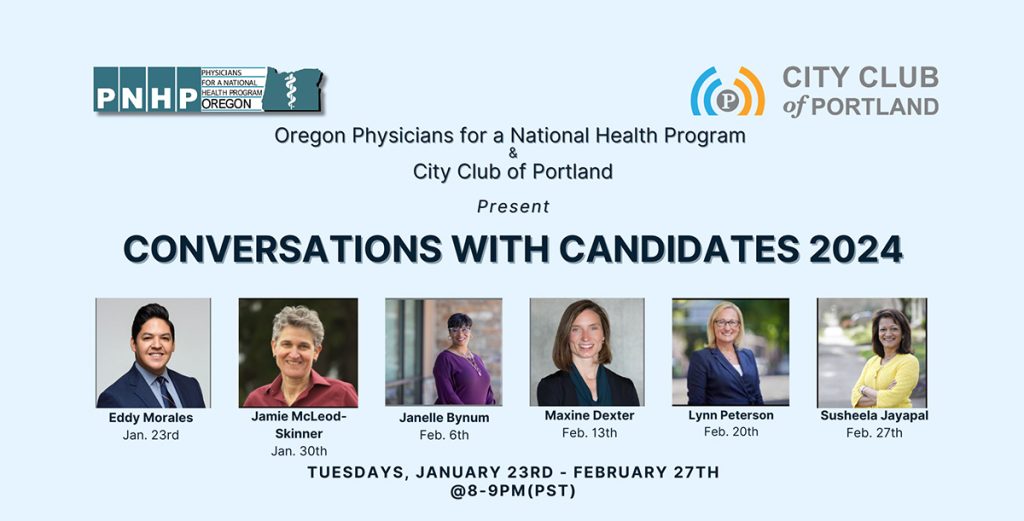
Mark your calendars now! And register today at http://tinyurl.com/bdhnw3nb.
Ahead of Oregon’s May 21 primary election you are invited to the “Conversations With Candidates” virtual video series—a collaboration between PNHP Oregon and the City Club of Portland.
- Jan. 23: Eddy Morales; candidate, Congress (CD-3)—recording HERE
- Jan. 30: Jamie McLeod-Skinner; candidate, Congress (CD-5)—recording HERE
- Feb. 6: Janelle Bynum; candidate, Congress (CD-5)—session cancelled
- Feb. 13: Maxine Dexter; candidate, Congress (CD-3)—recording HERE
- Feb. 20: Lynn Peterson; candidate, Congress (CD-5)—session cancelled, candidate no longer running
- Feb. 27: Susheela Jayapal; candidate, Congress (CD-3)—recording HERE
Donate to PNHP Oregon
Please click the donate link above to make a tax-deductible financial contribution to PNHP Oregon. Any amount is helpful, and recurring donations (monthly, every three months, or every six months) will help the chapter fund even more events and activities that stimulate further action toward health care for all.
Medicare for All Handbook
This single-payer handbook was prepared by Diane Lucas, M.D., Ph.D. in the fall of 2019, with the assistance of colleagues at the Portland, Ore. chapter of PNHP.
Download the handbook as a PDF file or as a Word document.
Media Contacts

Samuel Metz, MD, Vice President
s@samuelmetz.com
Samuel Metz is Mad As Hell because the United States provides an annual bailout of the health insurance industry to the amount of $320 billion. Meanwhile, Americans with and without health insurance lose their homes and their lives because they cannot afford medical care. There are solutions around the world and in our country. It’s time to put the medical health of 300 million Americans ahead of the financial well-being of 1,100 health insurance companies.

Mike Huntington, MD, Secretary/Treasurer
(541) 745-5635
mchuntington@gmail.com
Mike Huntington grew up in Southern California and attended Oregon State University and the University of Oregon Medical School, now Oregon Health Sciences University (OHSU). He was an Army flight surgeon in Viet Nam in 1969. He received his residency training at OHSU, was a Radiation Oncologist for 35 years, and was Medical Director of the Radiation Oncology Department at Samaritan Regional Cancer Center in Corvallis from 1984 to 2006.
Since his retirement he has joined with physicians and other activists in Corvallis and Oregon to engage colleagues and the public in discussion about the urgent need for health care reform. The group has co-sponsored public forums and given talks to civic groups in Corvallis over the past fourteen years. In 2007 this group became the Oregon Chapter of Physicians for a National Health Program. He was President of Health Care for All Oregon and the Health Care for All Oregon Education Fund in 2012.
Peter Mahr, MD, Past-President
(503) 988-5155
peter.n.mahr@gmail.com
Peter Mahr is a family physician who currently works at the Student Health and Counseling Center at Portland State University and is attending Portland State University’s Masters in Public Health program. He previously worked for 10 years at East County Health Center in Gresham, Ore., which is a primary care clinic run by Multnomah County that provides care for the under-served. He is dedicated to the care of the under-served and a strong proponent of a national, single-payer health program. He is a member of Physicians for a National Health Program (PNHP) and the president of the PNHP Portland chapter. He is also a clinical assistant professor at Oregon Health and Science University in the Department of Family Medicine. He graduated from Dartmouth Medical School in 1998 and finished his residency at Oregon Health and Science University in 2001.

Paul Gorman, MD
(503) 292-4669
gormanp@comcast.net
Dr. Paul Gorman, is Associate Professor in the department of Medical Informatics and Clinical Epidemiology (DMICE) at Oregon Health Sciences University (OHSU). He is a Fellow of the American College of Medical Informatics and a Fellow of the American College of Physicians. He is board certified in Internal Medicine, with Added Qualification in Geriatrics and is on the teaching faculty in at OHSU as well as at Providence Portland Medical Center. Currently, Dr. Gorman is co-investigator of an AHRQ funded systematic review of barriers to the use of health it by vulnerable populations, and as Principal Investigator of AHRQ funded research to improve medication safety, “RxSafe: Shared Medication Management and Clinical Decision Support for Rural Clinicians.”

Rick Staggenborg, MD
(541) 217-8044
rstaggenborg@live.com
Dr. Staggenborg is a psychiatrist who most recently worked at the VA outpatient clinic in North Bend, Oregon. Before that he worked at as the Medical Director at a community mental health clinic, providing care in both cases to under-served populations. He specializes in the non-pharmacological treatment of PTSD, using a combination of individual, group and family therapies. He ran for the US Senate in 2010 with a promise to introduce a constitutional amendment to abolish corporate personhood. He sees making corporate campaign contributions illegal as the only sure path to a national single payer health system.
Currently, he is working full time for the single payer, the end of the wars and other social justice causes.
On the Mad as Hell Doctors tour he said “I am mad as hell that our government puts the interests of corporations above those of the People.”

Paul Hochfeld, MD
Retired Emergency Physician
Corvallis, OR
Graduated UC San Diego School of Medicine, M.D. 1978
I’m Mad As Hell because we have a broken, non-system of health care in this country designed and implemented around profit, not people. It not only represents a health crisis, it is also a fiscal disaster that threatens the solvency of our government. Some form of Single Payer is the only solution.
Conversations with Candidates 2022
Ahead of Oregon’s May 17, 2022 primary election, PNHP Oregon hosted a series of “not to miss” one-on-one talks with candidates for state office (Governor) and for federal office (Congressional Districts 4, 5, 6):
- January 25: Bud Pierce, MD – candidate, Governor
- February 1: Andrew Kalloch – candidate, Congress (CD4)
- February 8: Doyle Canning – candidate, Congress (CD4)
- February 15: Sami Al-Abdrabbuh – candidate, Congress (CD4)
- February 22: Patrick Starnes – candidate, Governor
- March 1: Kathleen Harder, MD – candidate, Congress (CD6)
- March 8: Jamie McLeod-Skinner – candidate, Congress (CD5)
- March 15: Tina Kotek – candidate, Governor
- March 22: Ron Noble – candidate, Congress (CD6)
- March 29: Matt West – candidate, Congress (CD6)
- April 5: Tobias Read – candidate, Governor
- April 12: Andrea Salinas – candidate, Congress (CD6)
- April 19: Val Hoyle – candidate, Congress (CD4)
- April 26: Loretta Smith – candidate, Congress (CD6)
- May 3: George Carrillo – candidate, Governor
- May 10: Jim Moore, Ph.D. – Director of Political Outreach, Tom McCall Center for Civic Engagement
Each event ran about an hour, and was presented via Zoom Webinar format. To raise awareness and elevate the discussion surrounding health care access and delivery, PNHP Oregon is proud to offer this series on a complementary basis.
Local Unions Endorsing Single Payer
- Branch 82, National Association of Letter Carriers (NALC)
Contact Information
For information on rallies and upcoming events, please go to the Health Care for All Oregon website: http//www.hcao.org
To sign our statement of support for single-payer universal healthcare in Oregon please go to this link: http://pnhporegon.org/resolution/
Dr. Walter Tsou on health care as a public good
Join PNHP Oregon