Kitchen Table Campaign: Health Care Voters Guide
Each month during 2020, PNHP will focus on a specific, concrete “kitchen table” issue that requires fundamental reform (like single payer), not minor tweaks (like a public option). See below for materials related to this month’s issue, measuring candidate health plans, and scroll to the bottom for a list of additional topics.
Measuring candidate health plans (Fall 2020)
Every election season, candidates up and down the ballot offer up health plans to fix what most everybody agrees is a broken system. But how do these plans, slogans, and promises measure up? If a candidate’s plan doesn’t check all of the boxes on our checklist, then it’s not the reform we need.
We encourage you to share the materials below with your colleagues, family members, friends, and neighbors during the run-up to the 2020 general election; encourage them to take a hard look at what political candidates are promising…and to ask if those plans truly measure up.
Complete measuring health plans toolkit
- One-page checklist: Measuring candidate health plans
- Policy primer: Measuring candidate health plans
- Member guide: How to form a question for candidates
- Member guide: How to host a candidate forum
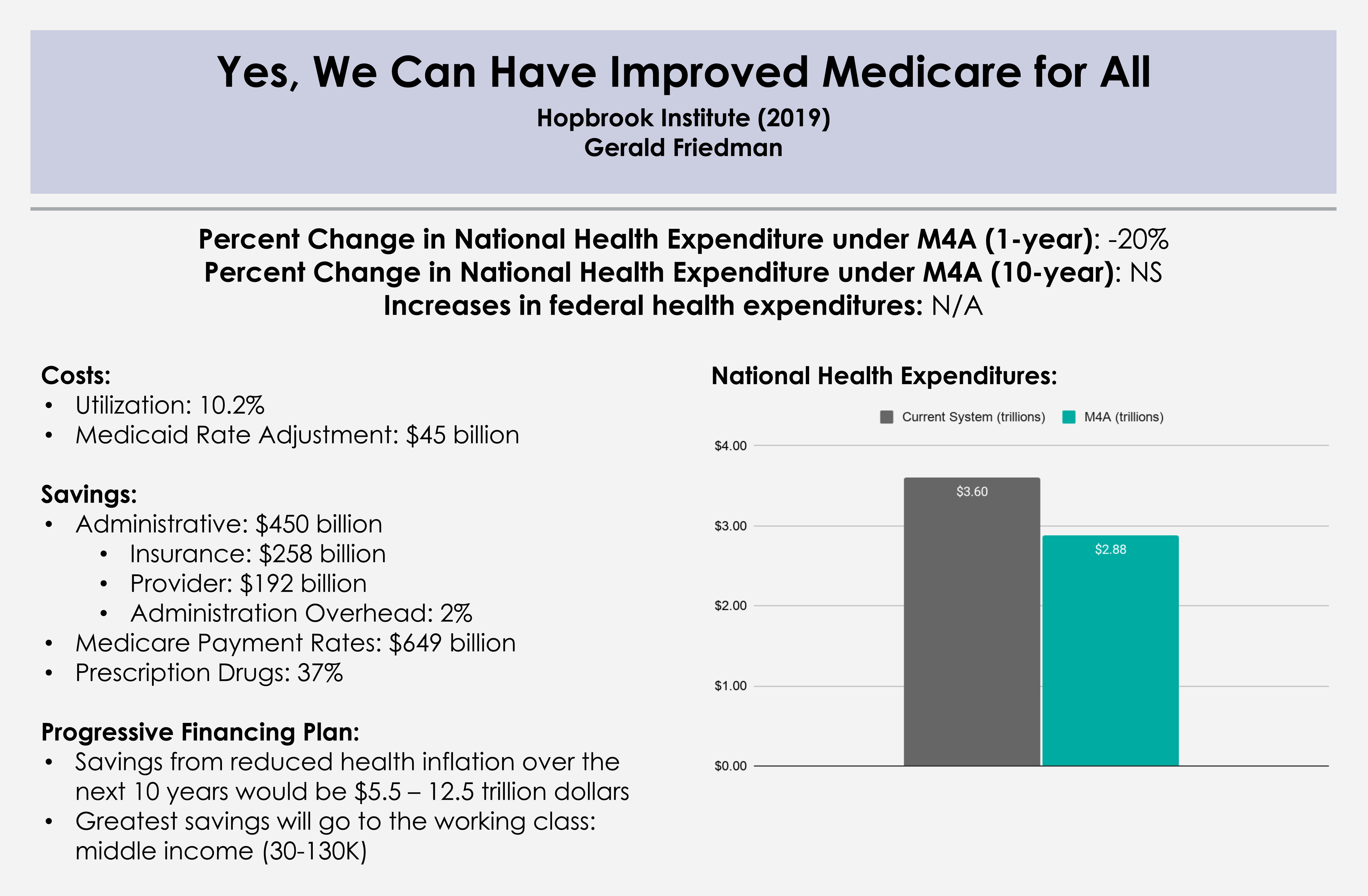
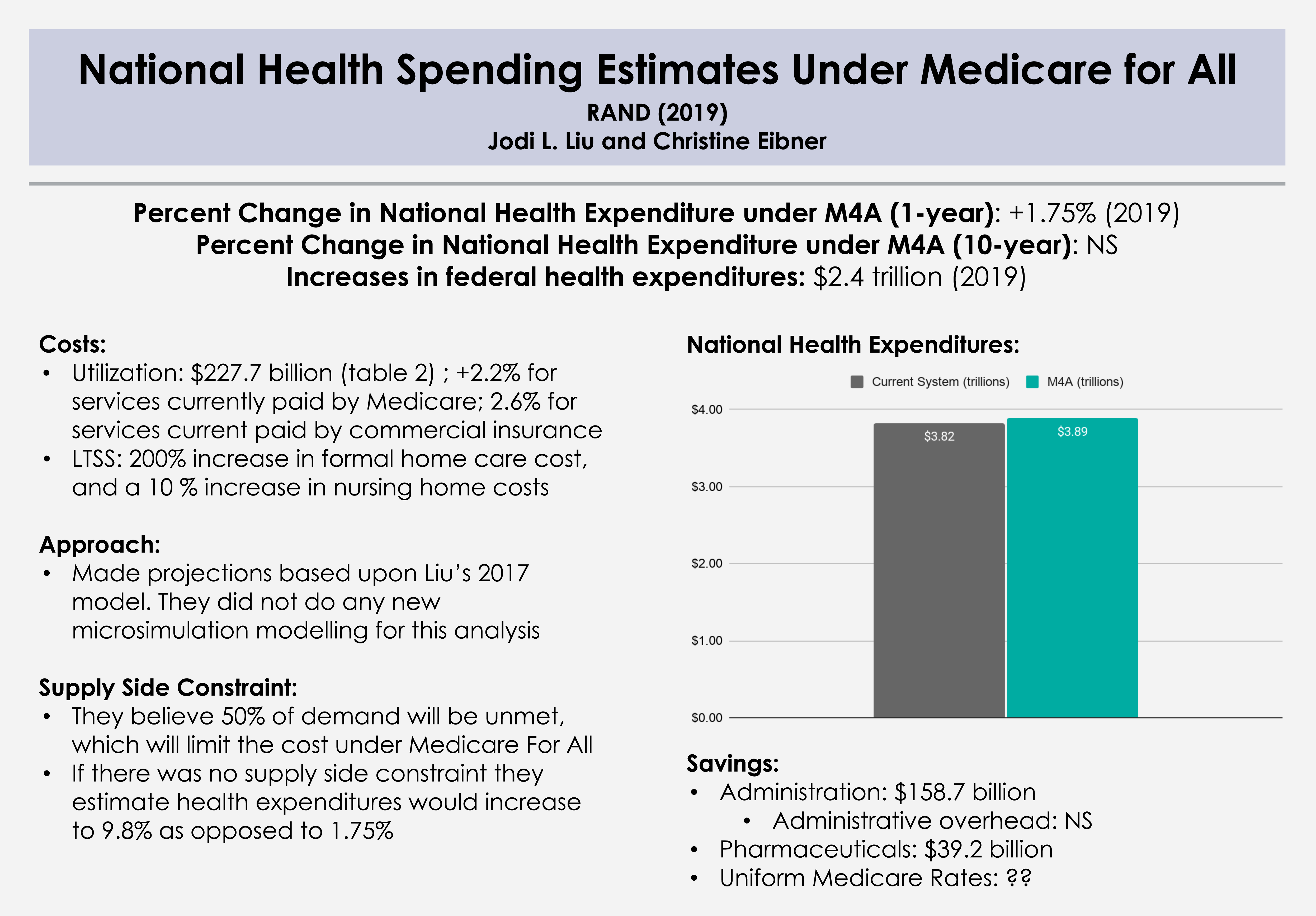
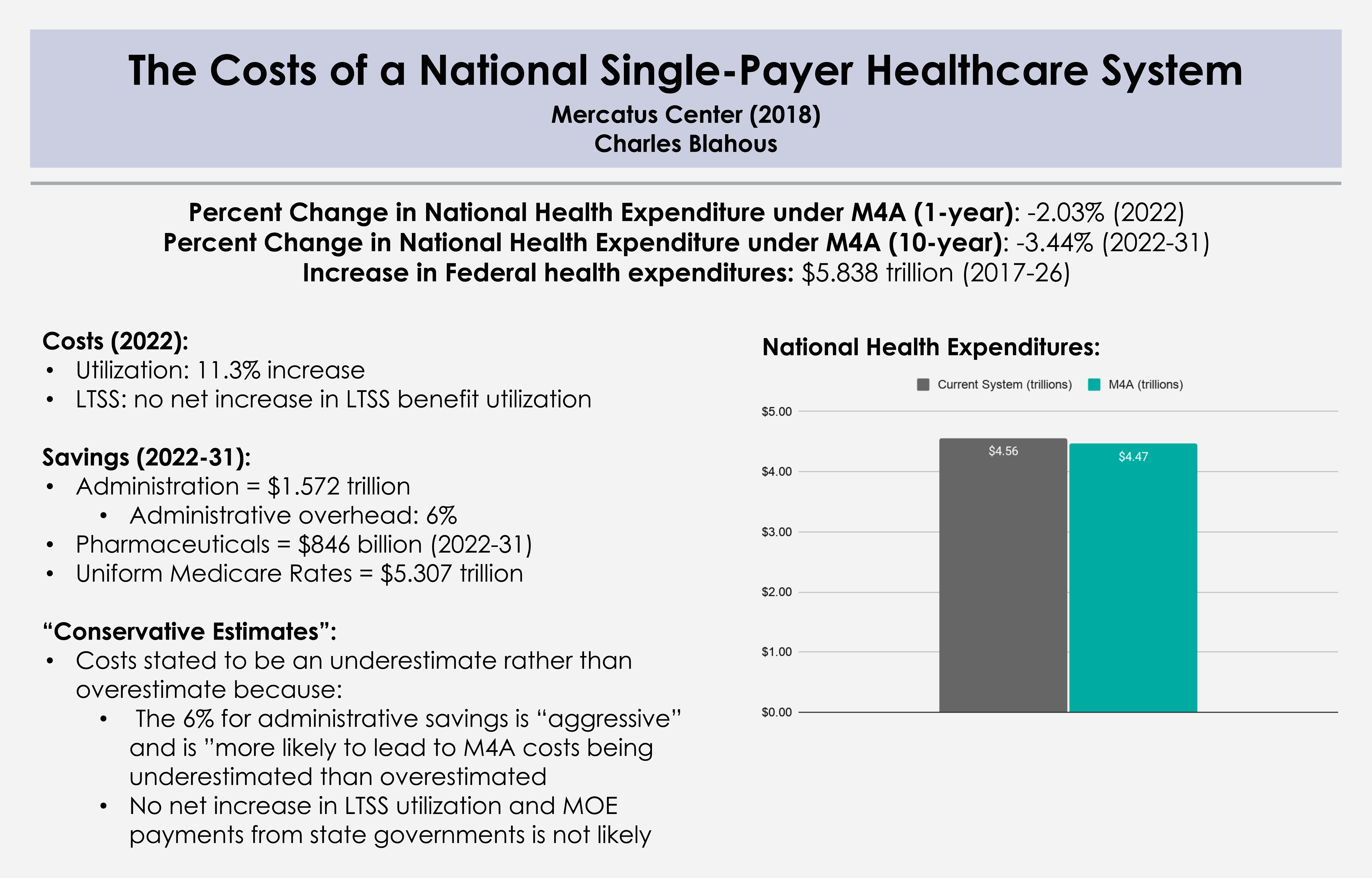
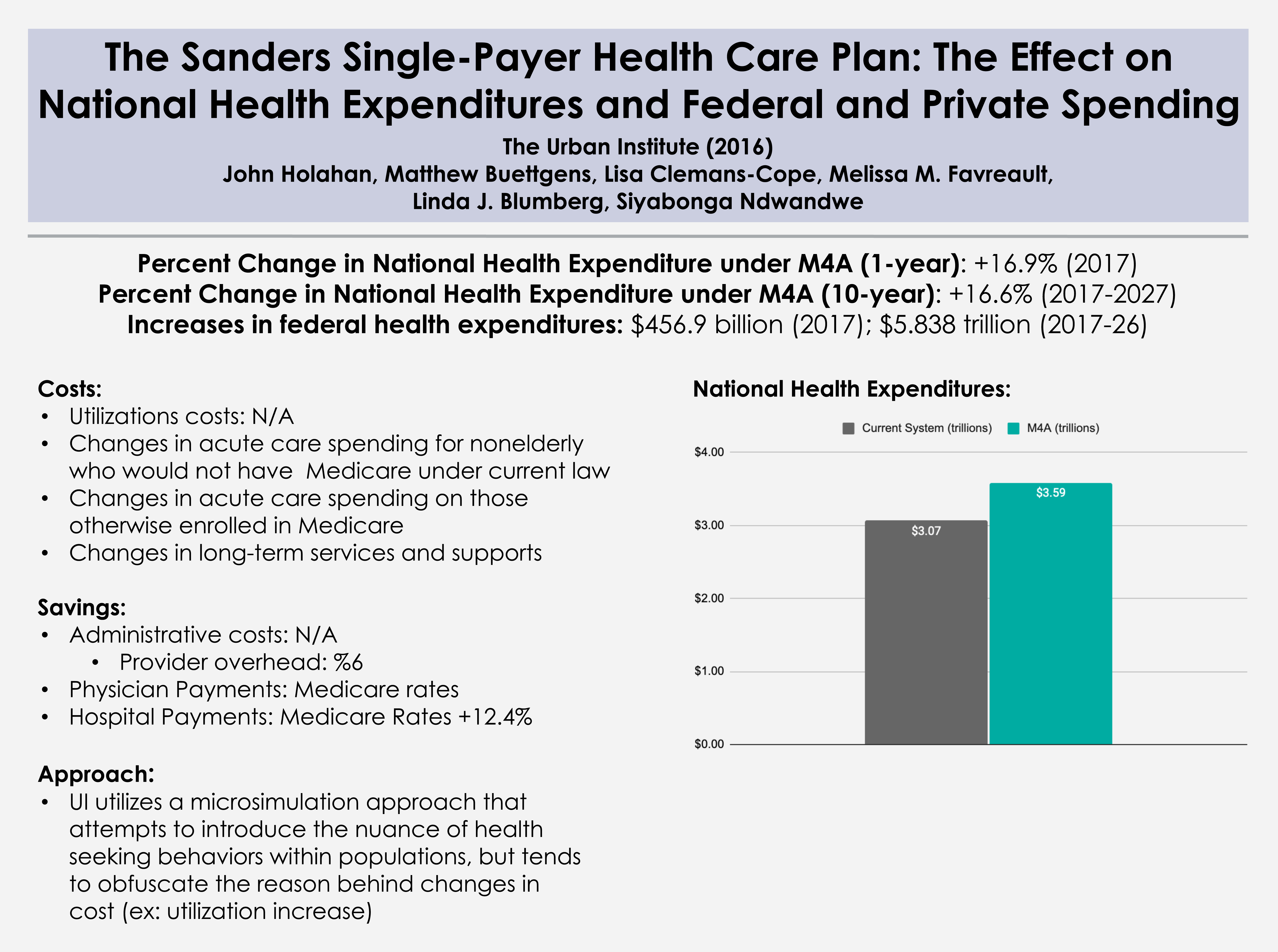
- PowerPoint slides: How Far From Perfect? Measuring the health plan proposals of 2020 political candidates and think-tank recommendations (by PNHP-MO chair Dr. Ed Weisbart)
- Webinar: Dr. Ed Weisbart on measuring candidate health plans
- Social media: Share on Facebook, Twitter, or Instagram
- Social media: Longer series of memes for Facebook, Twitter, or Instagram
- Podcast: Stephanie Kang (Health Policy Fellow for H.R. 1384 Lead Sponsor Rep. Pramila Jayapal) on “Why We Need the Medicare for All Act”
- Op-ed: “Ask Trump and Biden how they’d fix gross inadequacies of U.S. health care,” by Case Western Reserve University School of Medicine students Rohit Anand, Dhiksha Balaji, Aparna Narendrula and Jasmine Serpen, USA Today, Sept. 21, 2020
- Video: Health Care Voters Guide (featuring PNHP members detailing 10 must-haves for any health care proposal)
- Video: USA Health Care (Universal. Simple. Affordable.)
If you need assistance with events or actions, contact the PNHP organizing team at organizer@pnhp.org. For help with messaging materials, contact PNHP communications specialist Clare Fauke at clare@pnhp.org.
If you would like to provide expertise or help develop materials for future Kitchen Table topics, please contact PNHP president-elect Dr. Susan Rogers at s.rogers@pnhp.org.
Video: Health Care Voters Guide
Stephanie Kang on “Why We Need the Medicare for All Act”
Webinar: Dr. Ed Weisbart on measuring candidate health plans
Video: USA Health Care (Universal. Simple. Affordable.)
Social media memes
Additional topics
Review previous installments of the Kitchen Table Campaign, and stay tuned for additional topics throughout 2020:
- Surprise billing (January)
- Racial health inequities (February)
- Rural health (March)
- Pandemics and public health emergencies (Spring)
- COVID-19 and racial health inequities (Spring)
- COVID-19 endangers health care workers (July)
- Measuring candidate health plans (Fall)
Join or renew your membership in PNHP!
Physicians for a National Health Program is a powerful advocate for the reform that patients, doctors, and taxpayers so desperately need: single-payer Medicare for All. We invite you to join more than 20,000 physicians who are advocating for health care justice in the United States. Please join our fight by making a tax-deductible membership contribution today!
If you prefer to join via check, please mail your membership dues (payable to PNHP) to 29 E. Madison St., Ste. 1412, Chicago, IL 60602. PNHP is a 501(c)(3) nonprofit organization; our tax ID# is 04-2937697.
Annual physician membership: $250
Monthly sustaining membership: $25/mo
Medical and health professional students are making invaluable contributions to the single-payer movement. Membership in our student arm, Students for a National Health Program, is FREE. Please sign up today, and get connected to one of our many campus-based SNaHP chapters across the country.
Medical or health professional student membership: FREE
PNHP offers additional membership levels for early career physicians (1-3 years post-residency/fellowship), reduced-income physicians, residents and fellows, and health reform advocates inside and outside of the medical profession. Please choose the category that is right for you, and join PNHP with a tax-deductible membership contribution today!
Early career physician membership: $150
Reduced-income physician membership: $50
Resident/Fellow membership: $50
Health professional or ally membership: $50
Finally, please note that our membership levels above renew on an annual basis. If you are interested in joining PNHP or renewing with a monthly sustaining membership, please visit pnhp.org/monthlymembership.
Telling your COVID-19 story
As the COVID-19 pandemic continues to devastate communities across the United States, medical professionals find themselves in a unique position to shape the public dialogue around our failed response. Americans want to hear from doctors, nurses, medical students, and others who are fighting COVID-19 each and every day. PNHP encourages members to tell their story during this crucial time.
- Read our Kitchen Table Campaign organizing guide on telling your story;
- Read PNHP national board member Dr. Phil Verhoef’s compelling USA Today op-ed, “Coronavirus frightens me. It’s severe, unpredictable and it has no cure.” Think about how you can incorporate personal/patient stories into your advocacy;
- Interested in recording a video? Check out our guide here (video version) and here (PDF version);
- Interested in writing an op-ed or letter to the editor? Check out our guide here, and email PNHP communications specialist Clare Fauke at clare@pnhp.org for help with editing and placement.
See below for examples of videos and written testimonials submitted by PNHP members in response to COVID-19, and click here to read published member writing related to the pandemic.
Dr. Susan Rogers
Dr. Richard Bruno
Dr. George Bohmfalk
Dr. Anna Stratis
Dr. Phil Verhoef
Dr. Nahiris Bahamón
As a primary care physician in the southwest of Chicago, I have witnessed some of the major impact and suffering the COVID-19 pandemic has had in our communities. Many of my patients have been gravely ill and have lost family members and valued members of the community to this virus. But many of these outcomes are not caused by the novel coronavirus alone, they are also the result of major health inequities fueled by racism and a lack of a functioning universal health care system, such as an improved Medicare for All. An improved Medicare for all could guarantee access to quality health care to everyone in this country and prevent a lot of death and suffering by making health care more accessible, equitable, and just. (July 2020)
Como médico de atención primaria en el suroeste de Chicago, he sido testigo de algunos de los principales impactos y sufrimientos que la pandemia de COVID-19 ha tenido en nuestras comunidades. Muchos de mis pacientes han estado gravemente enfermos y han perdido miembros de la familia y miembros valiosos de la comunidad a causa de este virus. Pero muchos de estos resultados no son sólo causados por el nuevo coronavirus, sino que también son el resultado de importantes inequidades en la salud alimentadas por el racismo y la falta de un sistema de salud universal que funcione, como un Medicare Mejorado para Todos. Un Medicare Mejorado para Todos podría garantizar el acceso a una atención médica de calidad para todos en este país y evitar muchas muertes y sufrimiento al hacer que la atención médica sea más accesible, equitativa y justa. (Julio 2020)
Dr. Kathleen Healey
We physicians understand the challenges and frustrations of trying to obtain the best care for our patients given the restrictions of health insurance companies, and the costs that are passed on to them, both foreseen and unforeseen.
Just as the COVID-19 pandemic has grown uncontrollably, so have these financial burdens on our patients. From individual problems we have surged to a large scale national crisis. Families across the country are threatened with job loss, insurance loss, income loss, and the prospect of large medical bills despite insurance.
Unfortunately, I cannot relieve this anxiety or reassure my patients and their families. I look at Canada and other allies with universal coverage and know that it doesn’t have to be this way. Our people deserve much more, whether they are working or between jobs. No one should lose health care during a pandemic—or any other time. It is time for single payer / Medicare for All in America. (April 2020)
PNHP-CA Toolbox
Racial inequities and public emergencies
COVID-19 exacerbates racial inequities:
https://pnhp.org/kitchen-table-campaign-covid-19-and-racial-inequities/
Complete public health emergencies toolkit:
https://pnhp.org/kitchen-table-campaign-pandemics-and-public-health-emergencies/
Research
18.2 Million Individuals at Increased Risk of Severe COVID-19 Illness Are Un- or Underinsured:
https://pnhp.org/news/18-2-million-at-increased-risk-of-severe-covid-19-are-uninsured-or-underinsured-harvard-study/
COVID-19 and US Health Financing: Perils and Possibilities:
https://journals.sagepub.com/doi/full/10.1177/0020731420931431
COVID-19 and Mass Incarceration: Action Needed Now to Stem the Epidemic:
https://pnhp.org/news/covid-19-and-mass-incarceration-action-needed-now-to-stem-the-epidemic/
3.7 Million Frontline Health Workers Have Medical Problems That Raise Their Risk of Dying from COVID-19:
https://pnhp.org/news/study-3-7-million-frontline-health-workers-have-medical-problems-that-raise-their-risk-of-dying-from-covid-19/
Kitchen Table Campaign: COVID-19 and Racial Inequities
Throughout 2020, PNHP will focus on a specific, concrete “kitchen table” issue that requires fundamental reform (like single payer), not minor tweaks (like a public option). See below for materials related to our spring topic, COVID-19 and racial health inequities, and scroll to the bottom for a list of additional topics.
COVID-19 exacerbates racial inequities (Spring 2020)
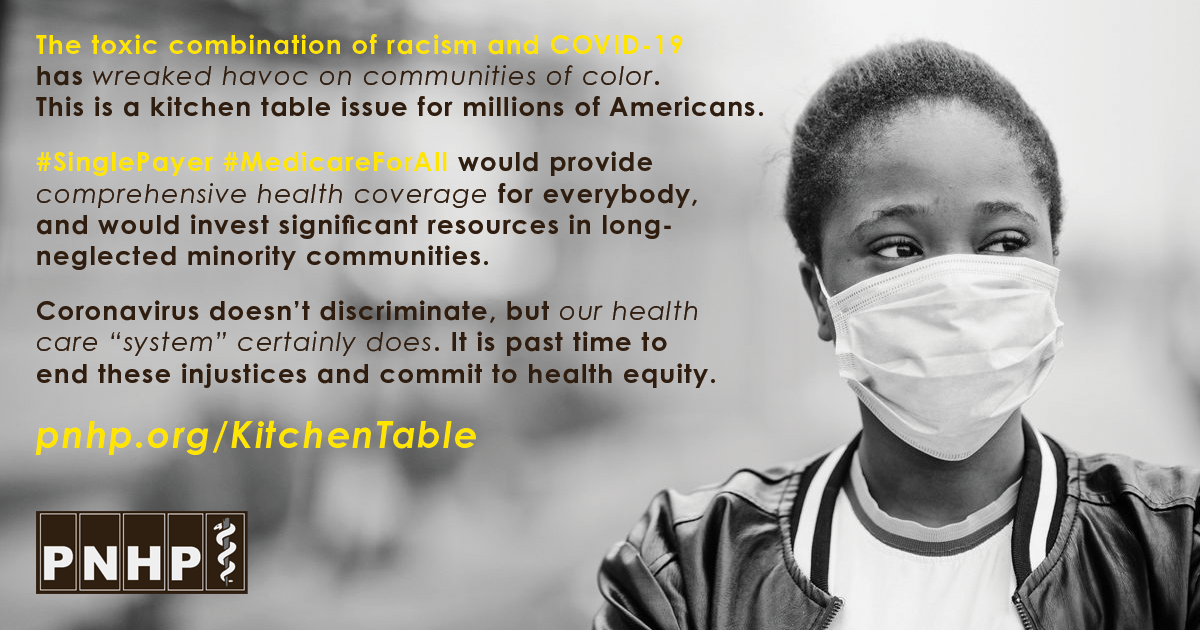
African Americans are dying at a disproportionately higher rate from COVID-19, tribal populations suffer from a lack of testing and treatment options, and many undocumented immigrants lack coverage or avoid medical care because of the fear of deportation. COVID-19 has exacerbated the racial inequities that have always plagued U.S. health care, and that demand an urgent and focused response.
We encourage you to share the materials below with your colleagues, family members, friends, and neighbors during the spring of 2020 to remind them that the racial inequities laid bare by COVID-19 are a kitchen table issue…and that Medicare for All is a necessary part of the solution.
Complete COVID-19 racial inequities toolkit
- One-page handout: COVID-19 exacerbates America’s health inequities
- PowerPoint slides: Racism and for-profit health care in pandemic response failures (by PNHP national coordinator Dr. Claudia Fegan)
- PowerPoint slides: Racism and COVID, and the case for single-payer Medicare for All (by PNHP New York Metro board member Dr. Steve Auerbach)
- Webinar: Role of racism and for-profit health care in pandemic response failures (organized by PNHP NY Metro and featuring PNHP national coordinator Dr. Claudia Fegan)
- Webinar: COVID-19 and racial disparities (hosted by ProPublica and featuring Dr. David Ansell)
- Webinar: Racism and COVID, and the case for single-payer Medicare for All (by PNHP New York Metro board member Dr. Steve Auerbach)
- Sign-on letter: Medical professionals in support of immigrants in light of COVID-19 (supported by numerous student medical organizations, including Students for a National Health Program)
- “Racial Health Disparities and Covid-19 — Caution and Context” Merlin Chowkwanyun, Ph.D., M.P.H., and Adolph L. Reed, Jr., Ph.D. caution that “disparity figures without explanatory context can perpetuate harmful myths and misunderstandings.”
- Social media: Share on Facebook, Twitter, or Instagram
If you need assistance with events or actions, contact the PNHP organizing team at organizer@pnhp.org. For help with messaging materials, contact PNHP communications specialist Clare Fauke at clare@pnhp.org.
If you would like to provide expertise or help develop materials for future Kitchen Table topics, please contact PNHP president-elect Dr. Susan Rogers at s.rogers@pnhp.org.
Webinar: Dr. Claudia Fegan on the roles of racism and for-profit health care in U.S. COVID-19 response
Webinar: Dr. David Ansell on COVID-19 and racial disparities
Webinar: Dr. Steve Auerbach on racism and COVID-19
Additional topics
Review previous installments of the Kitchen Table Campaign, and stay tuned for additional topics throughout 2020:
- Surprise billing (January)
- Racial health inequities (February)
- Rural health (March)
- Pandemics and public health emergencies (Spring)
- COVID-19 and racial health inequities (Spring)
- COVID-19 endangers health care workers (July)
- COVID-19 and delays for non-COVID care (future)
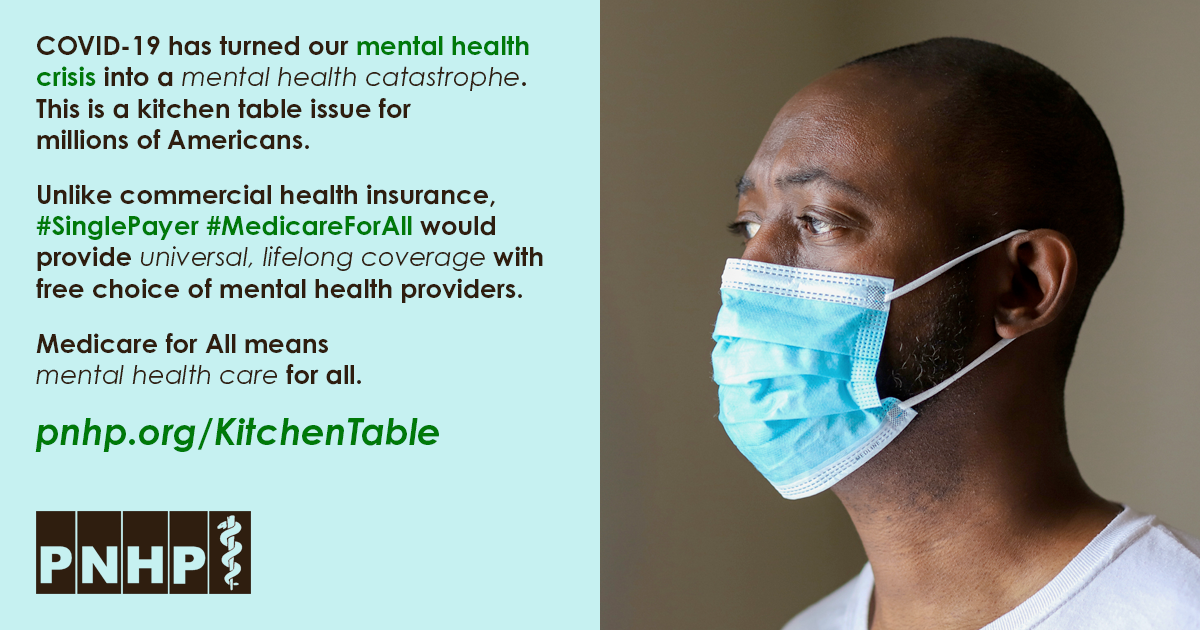
- COVID-19 and unmet mental health needs (future)
- High drug prices (future)
- Substance abuse and opioids (future)
- Maternal and reproductive health (future)
Kitchen Table Campaign: COVID-19 Endangers Health Workers
Each month during 2020, PNHP will focus on a specific, concrete “kitchen table” issue that requires fundamental reform (like single payer), not minor tweaks (like a public option). See below for materials related to this month’s issue, COVID-19 and frontline health care workers, and scroll to the bottom for a list of additional topics.
COVID-19 endangers frontline health workers (July 2020)
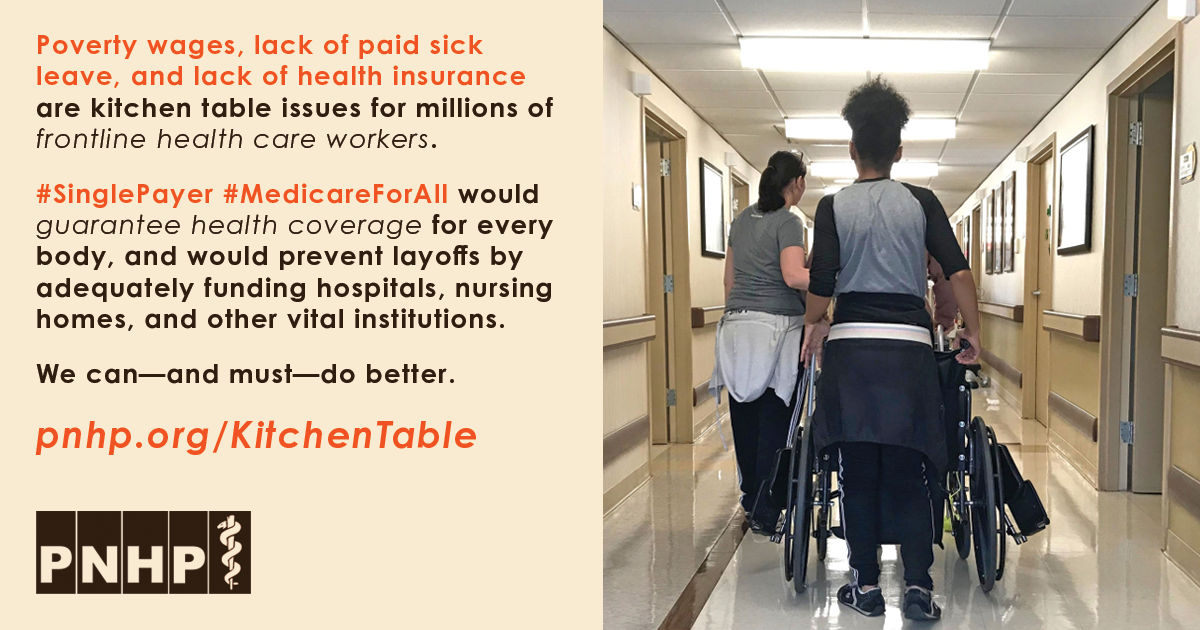
Health care workers are often hailed as heroes, but too many lack even the most basic protections as they work to care for patients suffering from COVID-19. Health care workers have been exposed to the virus; laid off or furloughed by the millions; and been denied living wages, paid sick leave, and even health coverage.
We encourage you to share the materials below with your colleagues, family members, friends, and neighbors during the month of July to remind them that badly needed worker protections are a kitchen table issue…and that Medicare for All is a necessary part of the solution.
Complete frontline health workers toolkit
- One-page handout: COVID-19 and frontline health care workers: We can do better
- PowerPoint slides: On the Front Line of Fighting COVID-19 (by PNHP-MO chair Dr. Ed Weisbart)
- Social media: Share on Facebook, Twitter, or Instagram
- Recent research: “Health Insurance Status and Risk Factors for Poor Outcomes with COVID-19 Among U.S. Health Care Workers: A Cross-Sectional Study” (by PNHP co-founders Drs. David Himmelstein and Steffie Woolhandler in the Annals of Internal Medicine)
- Organizing toolkit: Organizing in a pandemic (also available in PDF and Google Doc formats)
- Webinar: Dr. Raina Young on COVID-19 and frontline health workers
- Video: Stories from a COVID-19 ward (interview with a Minn. nurse, produced by PNHP-MN)
- Video: Cancel rent. Medicare for All. Nurse out. (testimonial from a New York nurse, produced by the Campaign for New York Health)
- Radio outreach: Talk radio call-in scripts
- Newspaper outreach: Sample letters to the editor
If you need assistance with events or actions, contact the PNHP organizing team at organizer@pnhp.org. For help with messaging materials, contact PNHP communications specialist Clare Fauke at clare@pnhp.org.
If you would like to provide expertise or help develop materials for future Kitchen Table topics, please contact PNHP president-elect Dr. Susan Rogers at s.rogers@pnhp.org.
Webinar: Dr. Raina Young on COVID-19 and frontline health workers
Video: Stories from a COVID-19 ward
Video: Cancel rent. Medicare for All. Nurse out.
TODAY 12PM: Join @nynurses Michelle at Virtual Rally to #PassNYHealth! @DickGottfried @NYSenatorRivera, @JumaaneWilliams, @KarinesReyes87 @thenyic, @CaringMajority, @northwestbronx, @LIActivist &more!
RSVP: https://t.co/S5pwz9uQg5
We need guaranteed care for all! #NYHealthAct pic.twitter.com/wE67qGrxEZ
— Campaign for New York Health 🍎 (@NYHCampaign) May 20, 2020
Additional topics
Review previous installments of the Kitchen Table Campaign, and stay tuned for additional topics throughout 2020:
- Surprise billing (January)
- Racial health inequities (February)
- Rural health (March)
- Pandemics and public health emergencies (Spring)
- COVID-19 and racial health inequities (Spring)
- COVID-19 endangers health care workers (July)
- COVID-19 and delays for non-COVID care (future)
- COVID-19 and unmet mental health needs (future)
- High drug prices (future)
- Substance abuse and opioids (future)
- Maternal and reproductive health (future)
Police violence is a public health emergency
Physicians for a National Health Program issued the following statement on June 2, 2020 in response to the continued and unrelenting violence, racism, and discrimination that Black Americans are subjected to in our criminal justice system, our health care system, and throughout society.
Our full statement can also be accessed as a printable PDF, here, with all reference links intact. We encourage PNHP members to read the statement in full, distribute it widely, and take concrete steps to address racism and racial inequity.
Protesting racism across the U.S.
Doctors, nurses, and other medical professionals (including many PNHP members) have participated in protests nationwide in the weeks following the murder of George Floyd. NYC Coalition to Dismantle Racism in the Health System co-founder Dr. Kamini Doobay spoke at one such rally on June 7, 2020.
(Footage of Dr. Doobay and additional footage from an earlier NYC rally courtesy of PNHP New York Metro board member Dr. Steve Auerbach.)
Police violence at anti-racism protests
Sadly, police departments across the U.S. have reacted to non-violent protests with abusive tactics that endanger the large crowds of people gathered to demand justice.
PNHP president Dr. Adam Gaffney, PNHP co-founders Drs. Steffie Woolhandler and David Himmelstein, and Dr. Danny McCormick decried the use of chemical irritants and kinetic impact projectiles, the corralling of crowds into confined areas, and the mass arrest of protesters, often for curfew violations. They published a June 19, 2020 piece in The Lancet calling for an end to these human rights abuses.
Student activism on racial inequity
PNHP’s student arm, Students for a National Health Program, posted the following graphic to social media on June 9, 2020, and its executive board has committed to developing a long-term strategy for supporting the anti-racism movement.
Also during the summer of 2020, PNHP intern Andrea Yeung created an important website focusing on prisons in the United States, which have served to accelerate many racial injustices (and which have posed a significant health risk to inmates and staff during COVID-19).
Andrea’s website includes full transcripts of seven interviews with individuals whose work and experience with incarcerated people can lead us towards a more just society, along with key takeaways and pages organized by topic.
Medical students have also been organizing for years with White Coats for Black Lives, whose mission is, “Eliminating racism in the practice of medicine and recognizing racism as a threat to the health and well-being of people of color.”
For more information, visit the White Coats for Black Lives website, follow their Facebook, Twitter, and Instagram accounts, and view an Ethics Talk interview with WC4BL leaders, Drs. Joniqua Ceasar and Dorothy Charles.
Racial inequities in U.S. health care
For additional context on how racism affects health and health care, see PNHP president-elect Dr. Susan Rogers’ keynote address to medical and health professional students at the 9th annual SNaHP Summit in Aurora, Colo. (February 15, 2020).
See also a panel discussion moderated by Dr. Rogers for DSA’s Black Health + Black Liberation webinar series: “Why do we have racial health inequities?” Panelists included PNHP national coordinator Dr. Claudia Fegan, former APHA president Dr. Linda Rae Murray, and former NYC Department of Health and Mental Hygiene commissioner Dr. Mary Bassett (September 14, 2020).
And note that recent research points to literal structural racism in U.S. health care. A June 2020 International Journal of Health Services study from Gracie Himmelstein and Dr. Kathryn EW Himmelstein, titled “Inequality Set in Concrete,” shows that hospitals serving the largest proportion of Black and Latinx patients have significantly lower capital assets and much smaller budgets for modernization and new equipment compared to other U.S. hospitals.
For a broader toolkit on racial health inequities, please see PNHP’s Kitchen Table Campaign from February 2020 at pnhp.org/RacialJustice. Members will find information on lack of coverage, lack of community health facilities, and significantly worse outcomes among people of color in the U.S., as well as information on how single-payer Medicare for All could begin to address these inequities.
PNHP also recognizes that the COVID-19 pandemic is especially dangerous for people of color in the U.S. due to systemic racism. We have therefore developed a toolkit for members to explore and address the ways in which COVID exacerbates racial inequities, which is available at pnhp.org/COVIDRacialInequity.
COVID-19 and Health Financing: Perils and Possibilities
This study, authored by PNHP president Adam Gaffney, M.D., M.P.H. and PNHP co-founders Steffie Woolhandler, M.D., M.P.H. and David Himmelstein, M.D. was published online in the International Journal of Health Services on June 9, 2020. Click HERE to read the study on the SAGE Journals website.
Abstract
While the COVID-19 pandemic presents every nation with challenges, the United States’ underfunded public health infrastructure, fragmented medical care system, and inadequate social protections impose particular impediments to mitigating and managing the outbreak. Years of inadequate funding of the nation’s federal, state, and local public health agencies, together with mismanagement by the Trump administration, hampered the early response to the epidemic. Meanwhile, barriers to care faced by uninsured and underinsured individuals in the US could deter COVID-19 care and hamper containment efforts, and lead to adverse medical and financial outcomes for infected individuals and their families, particularly for those from disadvantaged groups. While the US has a relatively generous supply of ICU beds and most other health care infrastructure, such medical resources are often unevenly distributed or deployed, leaving some areas ill-prepared for a severe respiratory epidemic. These deficiencies and shortfalls have stimulated a debate about policy solutions. Recent legislation, for instance, expanded coverage for testing for COVID-19 for the uninsured and underinsured, and additional reforms have been proposed. However comprehensive healthcare reform, e.g. via national health insurance, is needed to provide full protection to American families during the COVID-19 outbreak, and in its aftermath.
As of this writing, the United States is experiencing the world’s largest COVID-19 outbreak.1 Deaths are continuing to rise, and the hospital infrastructure of some cities has been severely strained. While every country faces unique challenges responding to this serious public health threat,2,3 the US’ underfunded public health infrastructure, fragmented medical care system, and paltry social protections have imposed particular impediments to control and mitigation of the epidemic.
As US policymakers contend with the widespread dissemination of COVID-19, addressing the structural weaknesses of the US public health and healthcare financing system — particularly for disadvantaged groups — must be a priority, both for this epidemic and the next. In this article, we explore how underfunding of the nation’s public health agencies impaired the early response to the epidemic; how financial barriers that obstruct care for many in the US healthcare system could hamper efforts to contain it moving forward; the adverse financial ramifications for patients from the outbreak; and potential policies to ameliorate health financing deficiencies in the months and years ahead.
1. Underfunded Public Health
Federal, state and local public health agencies are the frontline defense against novel epidemics. Years of inadequate funding of these agencies, however, has hampered the nation’s response to the outbreak.
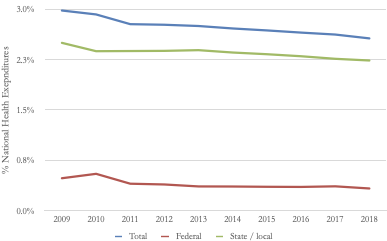
Despite nominal increases in public health spending over the past decade, there has been a progressive decline in such funding as a proportion of total health spending4 (Figure 1).5 Certain agencies and spending areas have seen particularly notable cuts. The budget of the Centers for Disease Control and Prevention (CDC), for instance, fell by about 10% (accounting for inflation) between 2010 and 2019, while CDC spending on state/local emergency preparedness fell by about a third from 2003 to 2019.6 The Prevention and Public Health Fund, a pool of public health funds established by the Affordable Care Act to help support state and local public health agencies, has seen multiple cuts since its creation.6 As budgets’ have grown tighter, state and local public health agencies have experienced a major decline in staffing, shedding some 50,000 personnel since 2008.7
Steps taken by the Trump administration further undercut the nation’s infectious disease readiness, including leaving some 700 staff position at the CDC unfulfilled during the 2017 hiring freeze8 and disbanding the office focused on federal pandemic preparedness.9 While the full story of the disastrous rollout of diagnostic testing has not yet been fully told, chronic underfunding of public health agencies appears to have left the nation ill-prepared for the arrival of the epidemic. For instance, case and contact tracing — measures that have been successfully deployed in nations such as Taiwan, South Korea, and Singapore,2,10 and that controlled the 2002-03 SARDS outbreak11-13 — were quickly abandoned in the US, as local health agencies became overwhelmed.14 Efforts to renew such efforts are currently underway in certain states, notably Massachusetts, but these are exceptions to the rule.
2. COVID-19 and Healthcare Affordability: Implications for Disease Control, Health, and Family Finances
In March 2020, as widespread dissemination of the novel coronavirus became obvious, case identification and contact tracing rapidly gave way to broad social distancing measures, including stay-at-home orders and closures of non-essential businesses, aimed at “flattening the epidemic curve.”3,15 Even if ultimately effective, epidemiologists predict that the outbreak will recrudesce once social distancing measures are eased, an eventuality that might be ameliorated or prevented through ramped up testing, case finding, and contact tracing. Such an intervention, however, requires a high-performing, and readily accessible, health system.2
Yet 30 million Americans, 9% of the population, had no health coverage before the epidemic,16 while 44 million more were underinsured — i.e. had coverage that required high copays, deductibles, or other out-of-pocket expenses.17 Overall, about a quarter of non-elderly adults were either uninsured, or avoided seeing a doctor in a given year because of costs, with (as shown in Figure 2) especially high rates in some states, such as Texas and Florida. As the economy spirals and millions of individuals are thrown out of work, the number of Americans uninsured or otherwise unable to afford care for COVID-19 will soar. News outlets carried stories early in the outbreak about patients with suspected coronavirus infections hit by “surprise” bills from hospitals, adding up to thousands of dollars.18-21 Although the widespread inaccessibility of coronavirus testing has thus far been the major bottleneck in the US, fear of costs could keep many infected patients from care in the future, hampering the case identification efforts needed to contain an outbreak. To address this likelihood, Congress passed the Families First Coronavirus Response Act, signed into law by President Trump on March 18. The law expands coverage of testing (and associated visits) both for the uninsured and those with copays and deductibles, which could alleviate such fears for some.
This measure, however, only covers the cost of testing — not treatment. As described in greater depth below, the Trump administration has also promised to use bailout funds to compensate hospitals for the costs of treated uninsured individuals with COVID-19. Such protection, however, is likely to be inadequate, and some individuals will no doubt still be deterred from obtaining medical care. Indeed, a poll conducted in early April found that 14% of Americans said they would avoid medical care due to cost if they developed symptoms consistent with COVID-19; the proportion was even higher among ethnic minorities and those with low incomes.22 Those who remain undiagnosed because they fear the financial consequences of a trip to the hospital may continue to go to work, attend school, or use public transportation, furthering spread. Lack of federally-mandated paid sick-leave is also likely to impede disease mitigations efforts. In 2019, about a quarter of civilian workers lacked paid sick leave, and the rate is substantially higher among those in service occupations.23 Staying home may not be financially tenable for some such individuals. As will be discussed later, new legislation expanded sick pay benefits for some American workers — but left millions out.
High healthcare costs could also threaten the health of patients infected with COVID-19. Fear of incurring out-of-pocket costs frequently deters patients from seeking urgently needed healthcare, even for “high-severity” conditions like acute asthma24 and myocardial infarction.25 Uninsured patients presenting to US emergency rooms with pneumonia or exacerbations of obstructive lung disease (potential COVID-19 symptoms) are more likely than those with insurance to be discharged home instead of admitted to hospital, likely reflecting patients’ desire to avoid ruinous bills and hospitals’ reticence to bear the costs of care.26 It is plausible that individuals with severe COVID-19 who nevertheless avoid medical care could suffer cardiopulmonary arrest in their homes. A surge in the number of patients found dead in their homes by paramedics in New York City during the outbreak suggests that many individuals with COVID-19 are dying before arriving to the hospital.27 However, it is unknown whether lack of healthcare access could have been a contributing factor in some or any of these deaths.
Yet even if inadequate coverage causes no physical harm, however, it can still inflict “financial toxicity.”28 For those with employer-sponsored insurance, the average cost of a hospitalization for pneumonia for patients with complications and co-morbidities was $20,292 in 2018, some of which may have to be paid out-of-pocket in the form of a deductible.29 Elderly patients with Medicare coverage, many on low fixed incomes, also face deductibles exceeding a $1,000 for a pneumonia hospitalization.30 Those facing severe protracted critical illness, however, may face even higher costs. A recent study found that out-of-pocket costs in the last year of life for the uninsured requiring ICU care averaged more than $26,000.31 Even for the insured these costs are often substantial, averaging $10,022 for those with private coverage.31 Such sums could be ruinous to the 4 in 10 US adults who are unable to cover even a $400 expense in the event of an emergency.32 Those unable to pay can face lawsuits, home foreclosure, and bankruptcy proceedings when hospitals seek to recover unpaid medical debts.33,34 And many individuals exposed to financial pressures from COVID-19-related medical costs may be forced to skimp on other important household expenses, such as rent or food, risking downstream deleterious health effects. For many, the financial harms of medical bills will be compounded by lost wages due to job loss, illness, or self-quarantine.
Epidemics tend also to have a disproportionate impact on oppressed populations.35 The H1N1 epidemic, for instance, led to higher hospitalization rates among racial/ethnic minorities relative to white populations,36,37 and a disproportionately high death rate among Hispanic children.37 Clear evidence is already mounting that Black and Hispanic are bearing the heaviest burden of severe COVID-19 disease and death as well.38,39 Yet Black and Hispanic Americans — and those with low-incomes more generally — are less likely to be insured,16 and have fewer household resources on average to cover the cost of copays and deductibles. At the same time, the Trump administration’s harsh anti-immigrant policies — including a recent rule change that deems immigrants to be “public charges” if they use public health programs, and hence potentially ineligible for upgrades in their immigration status — have sown fear in immigrant communities. These policies deter enrollment in health programs and could dissuade millions of immigrants from seeking care, including for COVID-19,40 despite the existence of an exemption for the care and treatment of communicable diseases.41 A 2018 survey, for instance, found that 13.7% of adults in immigrant families are avoiding participation in government benefit programs because they fear the consequences for their immigration status.42
Overall, the confluence of xenophobic policies, rising uninsurance, mass unemployment, and a major epidemic seems destined to exacerbate existing deep inequalities in health and healthcare.
3. COVID-19 and the Seriously Ill: Hospital Infrastructure and Affordability
The fragmented and privatized US healthcare financing system also has distinct implications for those who develop severe illness from COVID-19. While the US is unique among high-income nations in its lack of universal coverage, it is less of an outlier with respect to its healthcare infrastructure. Figure 3 displays hospital and ICU bed supply in 8 nations in North America and Europe. On the one hand, the US is towards the lower end of peer nations with respect to bed supply. It has similar beds per capita as four of the nations in this sample (the United Kingdom, Canada, the Netherlands, and Spain), but substantially less than three (France, Belgium, and Germany). On the other hand, the US has a relatively generous supply of ICUs, with more ICU beds per capita than every nation in the sample except Germany. US ICU density — about 25 beds per 100,000 population depending on how it is counted — is more than twice that of France and Canada, and many-fold higher than the United Kingdom’s.43-47 Patients in US ICUs have, historically, been on average less severely ill than those in other nations as a consequence of this more generous supply,44,45 suggesting more surge capacity.48
Such aggregate statistics, however, obscure three potential problems. First, a large epidemic (with a rapid peak) could overwhelm (or severely strain) the hospital and ICU infrastructure of any nation49 — as in Italy50, New York, and potentially other US cities in coming weeks. Second, while the US’ laissez-faire approach to financing healthcare infrastructure has led to marked growth in ICU infrastructure51.52, it has also led to arbitrary regional imbalances in supply. There is a six-fold difference in ICU beds per capita between the hospital referral region with the highest and the lowest bed density in the US.43 As Carr, Addyson, and Kahn note, geographic variation in ICU density in the US means that a pandemic “could quickly exceed critical care capacity in some areas while leaving resources idle in others,” a reality that “reflects the limitations of a private health system in which planning occurs primarily from the hospital perspective.”43 This distributive problem reflects larger imbalances in the availability of healthcare infrastructure that stem from a profit-driven financing system, exemplified by ongoing hospital expansion in healthcare-dense areas, and the simultaneous closure of hospitals in rural and poorer areas. Consequently, while supply may be ample in some areas, it is inadequate in others in the face of an epidemic. Moreover, there are no mechanisms to redeploy resources to where they are needed, or to shift patients to less-stressed areas.
A lack of health planning, in other words, has left the nation’s healthcare system ill-prepared for an emergency, whether with respect to the distribution of infrastructure, or the stockpiling of ventilators or personal protective equipment for healthcare workers. And with no unified governance, federal, state, and local governments continue to compete with hospitals for supplies.
4. Potential policy solutions
The challenge posed by COVID-19 in the context of these deficiencies in healthcare financing has prompted a range of reform proposals. The Table summarizes achieved and proposed reforms, as well as their benefits and limitations.
The Families First Coronavirus Response Act, signed into law by President Trump in March, provides coverage for the costs of diagnostic testing and related healthcare visits for the uninsured, as earlier noted.53 While this may encourage testing for such individuals, the law didn’t address the problem of high treatment costs (for instance, for those admitted to the hospital for COVID-19 pneumonia). The Act also required that all public and private insurers cover testing and related visits without cost-sharing,53 but, like the coverage of testing for the uninsured, does nothing to lower the far-higher out-of-pocket costs for treatment of COVID-19. Moreover, it’s unlikely to allay immigrants’ fears about enrolling in public health programs or seeking care.
Another initiative to cover the uninsured would allow uninsured individuals to purchase private plans outside of the typical “open enrollment” period, a step taken thus far by several states,54 although not yet by the federal government. Such a move might modestly increase insurance uptake, although coverage would remain unaffordable for many, including the millions of Americans rapidly joining the ranks of the uninsured.
A plan announced April 3 by the Trump administration would allocate a portion of the $100 billion in hospital relief provided by the Coronavirus Aid, Relief, and Economic Security (CARES) Act, passed in late March, to cover costs of COVID-19 treatment for the uninsured.55 However, this program offers incomplete protection to patients: coverage is contingent both on the availability of funds and the participation of providers.56
Other provisions have been aimed at reducing medical costs for those with insurance. An announcement from the Internal Revenue Service that some plans with high-deductibles will be permitted (but not required) to exempt COVID-19-related care from the plan deductible57 might reduce out-of-pocket costs for some, but will likely have a limited effect. Additionally, some, but not all insurers, have announced plans to eliminate cost-sharing for COVID-19 related treatment, but many individuals will remain exposed to such costs absent federal action. Moreover, neither of these reforms does anything to address the problem of medical costs for other conditions, which will be increasingly unaffordable as workers lose jobs, income, and insurance benefits as recession deepens.
Addressing the lack of paid sick leave is also a policy priority. The Families First Coronavirus Response Act requires employers to provide workers with about 10 days of emergency sick leave, but it exempts the largest employers from the requirement, allows small employers to apply for exemptions, applies only to COVID-19 affected individuals, and expires at the end of 2020.58,59 Due to the exemptions, it might cover as few as 20% of American workers.58,59
A variety of other health financing reforms have been achieved or proposed to deal with the COVID-19 crisis. In early March, for instance, President Trump signed into law an $8.3 billion bill that increases funding for state and local health departments, vaccine and treatment development, medical supply purchases, and community health centers (CHC), clinics that provide care for substantial numbers of uninsured individuals.60 While the additional research and development funds will be useful — and might speed the development of useful therapeutics — the law did little to guarantee the affordability of treatments that emerge from the publicly-funded research.60 The new law also allows Medicare to pay providers for “telehealth” services, enabling remote electronic health visits from doctors that might unburden emergency rooms and reduce the risk of nosocomial coronavirus transmission. (Private insurers are also expanding coverage for telehealth services).61 But the effects of this provision are likely to be modest, particularly for poor patients, many of whom lack adequate internet access.62 Moreover, telehealth does little to allay patients’ cost concerns. Indeed, as phone conversation with physicians are increasingly re-classified as telehealth visits, some patients are finding that they face copays or deductibles for what may have been a previously free telephone call.63
Meanwhile, mounting job losses instigated by the epidemic and the ongoing public health measures taken to control it look likely to lead to enormous losses in health coverage: an estimated 7.3 million workers could become uninsured by June 1 if predicted unemployment increases come to fruition.64 In response, lawmakers have proposed additional reforms to expand coverage to this population. A bill introduced by House Democrats in April 2020, for instance, would provide full subsidization of COBRA plans, which would allow many individuals to maintain their employer-sponsored health benefits after job loss. Such a reform, however, would exclude many of the uninsured, while doing nothing to protect out-of-work individuals form the high copays and deductibles imposed by many employer-sponsored private plans.
Others have proposed using the Medicare program to expand coverage during the crisis. In April, Representative Pramila Jayapal and Senator Bernie Sanders introduced the Health Care Emergency Guarantee Act, which would expand Medicare coverage to all the uninsured, and simultaneously provide wrap-around coverage of copays and deductibles for the insured. Later that month, Jayapal joined Massachusetts Representative Joseph Kennedy in introducing the Medicare Crisis program, a more limited bill that would provide Medicare coverage to the unemployed, bolster state Medicaid programs, and cover all COVID-19 related care costs. Both proposals, particularly the more comprehensive Health Care Emergency Guarantee Act, would realize major expansions of coverage, protecting millions of Americans from burdensome healthcare costs for the duration of the crisis.
While many of these proposals, especially the emergency Medicare expansions, could provide some aid to those affected by COVID-19, full protection, in the long-term, would require would systemic reform. Addressing financing dysfunctions on a disease-by-disease basis, after all, is neither efficient nor fair. The COVID-19 outbreak hence serves as a reminder of the benefits of a unified, national health program. A Medicare for All reform, much discussed in Democratic presidential primary debates, would achieve universal coverage and address the problem of underinsurance. Such a reform might have additional advantages specific to an outbreak of an infectious disease. For instance, it could provide public health authorities with novel tools to combat epidemics, such as Taiwan’s use of its national health insurance database for case finding early in the epidemic.10 A well-structured national health insurance reform would also facilitate moving to a more rational and equitable allocation of ICUs and other healthcare resources65 through health planning and the public-financing of hospital capital expansion. This could help ensure an adequate supply and distribution of resources in the face of future epidemics. At the same time, the nation needs to dramatically increase funding of its public health agencies. A doubling of funding — from around 2.5% of national health expenditures to 5.0% — will not end the current epidemic, but it could help ensure readiness for the next one.66
“Epidemics,” wrote the German pathologist Rudolf Virchow, “are like large sign-posts from which statesman of stature can read that a disturbance has occurred in the development of his [sic] nation.”67 (pp. 22) COVID-19 is such a sign-post. The outbreak has already exposed the multifold inadequacies of the US’ uniquely unequal, privatized and fragmented health financing system. It also illuminates other inequities — including exclusionary policies that deter immigrants from using social assistance programs, lack of universal paid sick leave, and inadequate protections for workers — that weaken our social fabric and endanger the public’s health. As of this writing, it is unclear how severe the COVID-19 outbreak will ultimately prove to be in the US, although the rapidly climbing death toll is already a tragedy. Whatever the future holds, however, the transformation of the nation’s healthcare system and social safety-net is urgently needed.
Table: Legislation, policies, and proposals to address health financing challenges related to COVID-19
Click HERE to view a high-res PDF of this table.
Figure 1: Public Health Spending as a Percent of National Health Expenditures: 2009 – 2018
Source of data: National Health Expenditures Accounts, 2009-2018.5
Figure 2: Inadequately insured non-elderly adults by state (%)
Source: Author’s analysis of the 2018 Behavioral Risk Factor Surveillance System. Inadequately insured include those who are uninsured, or those who are insured but failed to see a doctor when needed due to cost. Includes adults 18 – 64 years in age. Map created with Microsoft Excel. Inadequate insurance rate for states not shown: Hawaii – 14%; New Hampshire – 18%; Massachusetts — 16%; Connecticut – 17%; Rhode Island – 19%; New Jersey – 22%; Delaware – 22%; Maryland – 19%; District of Columbia – 13%.
Figure 3: Hospital and ICU Bed Supply in 8 Nations
Notes: Hospital beds / 10,000 population are from OECD74 (2016 for the US and 2017 for other nations). ICU beds for the United States is drawn from Wallace et al.47, who reported 77,809 beds in 2009; total population denominator for that year (306,771,529) is drawn from the US Census. ICU beds for Canada is for 2009-10 and is drawn from Fowler et al.; these beds only include those with capacity for mechanical ventilation.46 ICU beds for European nations are drawn from Rhodes et al., and reflect years 2010-11; they include “intermediate care beds” and hence may overstate capacity relative to the US and Canada.75 Of note, the ICU bed supply in these 8 nations were also studied by Wunsch et al., who found roughly similar figures for most nations in 2005 (albeit with a substantial increase over time in the UK);44 we selected these same nations for presentation here for consistency.
References
- Coronavirus COVID-19 Global Cases by the Center for Systems Science and Engineering (CSSE) at Johns Hopkins University (JHU). Johns Hopkins Coronavirus Resource Center. https://coronavirus.jhu.edu/map.html. Accessed April 5, 2020.
- Legido-Quigley H, Asgari N, Teo YY, et al. Are high-performing health systems resilient against the COVID-19 epidemic? The Lancet. March 2020. https://www.thelancet.com… Accessed March 7, 2020.
- Anderson R, Heestereek H, Klinkenberg D, Hollingsworth TD. How will country-based mitigation measures influence the course of the COVID-19 epidemic? The Lancet. 2020.
- Himmelstein DU, Woolhandler S. Public Health’s Falling Share of US Health Spending. Am J Public Health. 2016;106(1):56-57. doi:10.2105/AJPH.2015.302908
- Centers for Medicare & Medicaid Services. National Health Expenditures by type of service and source of funds, CY 1960-2018. https://www.cms.gov… Accessed April 2, 2020.
- The Impact of Chronic Underfunding of America’s Public Health System: Trends, Risks, and Recommendations, 2019. tfah. https://www.tfah.org… Accessed April 2, 2020.
- Leider JP, Coronado F, Beck AJ, Harper E. Reconciling Supply and Demand for State and Local Public Health Staff in an Era of Retiring Baby Boomers. Am J Prev Med. 2018;54(3):334-340. doi:10.1016/j.amepre.2017.10.026
- Sun L. Nearly 700 vacancies at CDC because of Trump administration’s hiring freeze. Washington Post. https://www.washingtonpost.com… Accessed April 2, 2020.
- Cameron B. President Trump closed the White House pandemic office. I ran it. The Washington Post. https://www.washingtonpost.com… Published March 13, 2020. Accessed April 2, 2020.
- Wang CJ, Ng CY, Brook RH. Response to COVID-19 in Taiwan: Big Data Analytics, New Technology, and Proactive Testing. JAMA. March 2020. doi:10.1001/jama.2020.3151
- Fraser C, Riley S, Anderson RM, Ferguson NM. Factors that make an infectious disease outbreak controllable. PNAS. 2004;101(16):6146-6151. doi:10.1073/pnas.0307506101
- Hellewell J, Abbott S, Gimma A, et al. Feasibility of controlling COVID-19 outbreaks by isolation of cases and contacts. The Lancet Global Health. 2020;0(0). doi:10.1016/S2214-109X(20)30074-7
- Wilder-Smith A, Chiew CJ, Lee VJ. Can we contain the COVID-19 outbreak with the same measures as for SARS? The Lancet Infectious Diseases. 2020;0(0). doi:10.1016/S1473-3099(20)30129-8
- Dolan J, Mejia B. L.A. County gives up on containing coronavirus, tells doctors to skip testing of some patients. Los Angeles Times. https://www.latimes.com… Published 2020. Accessed March 22, 2020.
- Parodi SM, Liu VX. From Containment to Mitigation of COVID-19 in the US. JAMA. March 2020. doi:10.1001/jama.2020.3882
- Cohen RA, Terlizzi EP, Martinez ME. Health Insurance Coverage: Early Release of Estimates From the National Health Interview Survey, 2018. National center for health statistics; 2019. https://www.cdc.gov… Accessed August 20, 2019.
- Collins SR, Bhupal HK, Doty MM. Health Insurance Coverage Eight Years After the ACA: Fewer Uninsured Americans and Shorter Coverage Gaps, But More Underinsured. Commonwealth Fund; 2019. https://www.commonwealthfund.org… Accessed November 25, 2019.
- Kliff S. Kept at the Hospital on Coronavirus Fears, Now Facing Large Medical Bills. The New York Times. https://www.nytimes.com… Published March 2, 2020. Accessed March 5, 2020.
- Conarck B. A Miami man who flew to China worried he might have coronavirus. He may owe thousands. Miami Herald. https://www.miamiherald.com… Published February 24, 2020. Accessed March 5, 2020.
- Abrams A. Total Cost of Her COVID-19 Treatment: $34,927.43. Time. https://time.com… Accessed March 22, 2020.
- Rosenthal E, Huetteman E. He Got Tested for Coronavirus. Then Came the Flood of Medical Bills. The New York Times. https://www.nytimes.com… Published March 30, 2020. Accessed March 31, 2020.
- Inc G. In U.S., 14% With Likely COVID-19 to Avoid Care Due to Cost. Gallup.com. https://news.gallup.com… Published April 28, 2020. Accessed April 28, 2020.
- Employee Benefits in the United States – March 2019. Bureau of Labor Statistics https://www.bls.gov… Accessed March 9, 2020.
- Wharam JF, Zhang F, Landon BE, Soumerai SB, Ross-Degnan D. Low-socioeconomic-status enrollees in high-deductible plans reduced high-severity emergency care. Health Affairs. 2013;32(8):1398-1406. doi:10.1377/hlthaff.2012.1426
- Smolderen KG, Spertus JA, Nallamothu BK, et al. Health care insurance, financial concerns in accessing care, and delays to hospital presentation in acute myocardial infarction. JAMA : the journal of the American Medical Association. 2010;303(14):1392-1400. doi:10.1001/jama.2010.409
- Venkatesh AK, Chou S-C, Li S-X, et al. Association Between Insurance Status and Access to Hospital Care in Emergency Department Disposition. JAMA Intern Med. April 2019. doi:10.1001/jamainternmed.2019.0037
- Winter T. “Cardiac calls” to 911 in New York City surge, and they may really be more COVID cases. NBC News. https://www.nbcnews.com… Accessed April 29, 2020.
- Zafar SY, Peppercorn JM, Schrag D, et al. The financial toxicity of cancer treatment: a pilot study assessing out-of-pocket expenses and the insured cancer patient’s experience. The oncologist. 2013;18(4):381-390. doi:10.1634/theoncologist.2012-0279
- Potential costs of coronavirus treatment for people with employer coverage. Peterson-Kaiser Health System Tracker. https://www.healthsystemtracker.org… Accessed March 22, 2020.
- Damico A, 2020. How Much Could Medicare Beneficiaries Pay For a Hospital Stay Related to COVID-19? The Henry J Kaiser Family Foundation. March 2020. https://www.kff.org… Accessed April 2, 2020.
- Khandelwal N, White L, Curtis JR, Coe NB. Health Insurance and Out-of-Pocket Costs in the Last Year of Life Among Decedents Utilizing the ICU. Critical Care Medicine. 2019;47(6):749. doi:10.1097/CCM.0000000000003723
- Board of Governors of the Federal Reserve System. Report on the Economic Well-Being of U.S. Households in 2018.; 2019:64. https://www.federalreserve.gov… Accessed March 4, 2020.
- Lucas JH Elizabeth. ‘UVA Has Ruined Us’: Health System Sues Thousands Of Patients, Seizing Paychecks And Claiming Homes. Kaiser Health News. September 2019. https://khn.org… Accessed November 22, 2019.
- Himmelstein DU, Lawless RM, Thorne D, Foohey P, Woolhandler S. Medical Bankruptcy: Still Common Despite the Affordable Care Act. Am J Public Health. 2019;109(3):431-433. doi:10.2105/AJPH.2018.304901
- DeBruin D, Liaschenko J, Marshall MF. Social justice in pandemic preparedness. Am J Public Health. 2012;102(4):586-591. doi:10.2105/AJPH.2011.300483
- Information on 2009 H1N1 Impact by Race and Ethnicity. Centers for Disease Control and Prevention; 2010. https://www.cdc.gov… Accessed March 3, 2020.
- Dee DL, Bensyl DM, Gindler J, et al. Racial and ethnic disparities in hospitalizations and deaths associated with 2009 pandemic Influenza A (H1N1) virus infections in the United States. Ann Epidemiol. 2011;21(8):623-630. doi:10.1016/j.annepidem.2011.03.002
- Radio BF Nashville Public. Long-Standing Racial And Income Disparities Seen Creeping Into COVID-19 Care. Kaiser Health News. April 2020. https://khn.org… Accessed April 6, 2020.
- Garg S. Hospitalization Rates and Characteristics of Patients Hospitalized with Laboratory-Confirmed Coronavirus Disease 2019 — COVID-NET, 14 States, March 1–30, 2020. MMWR Morb Mortal Wkly Rep. 2020;69. doi:10.15585/mmwr.mm6915e3
- Zallman L, Finnegan KE, Himmelstein DU, Touw S, Woolhandler S. Implications of Changing Public Charge Immigration Rules for Children Who Need Medical Care. JAMA Pediatr. July 2019:e191744-e191744. doi:10.1001/jamapediatrics.2019.1744
- U.S. Citizenship and Immigration Services. Public Charge. USCIS. https://www.uscis.gov… Published March 13, 2020. Accessed March 15, 2020.
- Bernstein H, Gonzalez D, Karpman M, Zuckerman S. One in Seven Adults in Immigrant Families Reported Avoiding Public Benefit Programs in 2018. Urban Institute. https://www.urban.org… Published May 20, 2019. Accessed August 13, 2019.
- Variation in Critical Care Beds Per Capita in the United States: Implications for Pandemic and Disaster Planning. JAMA. 2010;303(14):1371-1372. doi:10.1001/jama.2010.394
- Wunsch H, Angus DC, Harrison DA, et al. Variation in critical care services across North America and Western Europe. Crit Care Med. 2008;36(10):2787-2793, e1-9. doi:10.1097/CCM.0b013e318186aec8
- Wunsch H, Angus DC, Harrison DA, Linde-Zwirble WT, Rowan KM. Comparison of Medical Admissions to Intensive Care Units in the United States and United Kingdom. American Journal of Respiratory and Critical Care Medicine. 2011;183(12):1666-1673. doi:10.1164/rccm.201012-1961OC
- Fowler RA, Abdelmalik P, Wood G, et al. Critical care capacity in Canada: results of a national cross-sectional study. Crit Care. 2015;19:133. doi:10.1186/s13054-015-0852-6
- Wallace DJ, Angus DC, Seymour CW, Barnato AE, Kahn JM. Critical Care Bed Growth in the United States. A Comparison of Regional and National Trends. Am J Respir Crit Care Med. 2014;191(4):410-416. doi:10.1164/rccm.201409-1746OC
- Wunsch H, Wagner J, Herlim M, Chong DH, Kramer AA, Halpern SD. ICU occupancy and mechanical ventilator use in the United States. Crit Care Med. 2013;41(12):2712-2719. doi:10.1097/CCM.0b013e318298a139
- Toner E, Waldhorn R. What Hospitals Should Do to Prepare for an Influenza Pandemic. Biosecurity and Bioterrorism: Biodefense Strategy, Practice, and Science. 2006;4(4):397-402. doi:10.1089/bsp.2006.4.397
- Remuzzi A, Remuzzi G. COVID-19 and Italy: what next? The Lancet. doi:10.1016/S0140-6736(20)30627-9
- Halpern NA, Pastores SM. Critical care medicine in the United States 2000-2005: an analysis of bed numbers, occupancy rates, payer mix, and costs. Critical care medicine. 2010;38(1):65-71. doi:10.1097/CCM.0b013e3181b090d0
- Halpern NA, Pastores SM, Greenstein RJ. Critical care medicine in the United States 1985-2000: an analysis of bed numbers, use, and costs. Critical care medicine. 2004;32(6):1254-1259.
- Adler MF Christen Linke Young, and Loren. What are the health coverage provisions in the House coronavirus bill? Brookings. March 2020. https://www.brookings.edu… Accessed March 15, 2020.
- McIntire ME, Clason L. States reopen insurance enrollment as coronavirus spreads. Roll Call. https://www.rollcall.com… Accessed March 15, 2020.
- Stephanie A. Trump Administration to Pay Hospitals to Treat Uninsured Coronavirus Patients; Hospitals would have to agree not to bill patients or issue unexpected charges – ProQuest. Wall Street Journal. https://search-proquest-com… Published April 3, 2010. Accessed April 5, 2020.
- Update on COVID-19 Funding for Hospitals and Other Providers. The Henry J Kaiser Family Foundation. April 2020. https://www.kff.org… Accessed April 28, 2020.
- IRS: High-deductible health plans can cover Coronavirus costs. Internal Revenue Service. https://www.irs.gov… Accessed March 11, 2020.
- Board TE. Opinion. There’s a Giant Hole in Pelosi’s Coronavirus Bill. The New York Times. https://www.nytimes.com… Published March 14, 2020. Accessed March 15, 2020.
- Lowey NM. Text – H.R.6201 – 116th Congress (2019-2020): Families First Coronavirus Response Act. https://www.congress.gov… Published March 14, 2020. Accessed March 15, 2020.
- 6 things to know about the coronavirus funding package. POLITICO. https://www.politico.com… Accessed March 9, 2020.
- Cohen JK. New telemedicine strategies help hospitals address COVID-19. Modern Healthcare. https://www.modernhealthcare.com… Published March 6, 2020. Accessed March 10, 2020.
- Drake C, Zhang Y, Chaiyachati KH, Polsky D. The Limitations of Poor Broadband Internet Access for Telemedicine Use in Rural America: An Observational Study. Ann Intern Med. 2019;171(5):382. doi:10.7326/M19-0283
- Hancock J. Telehealth Will Be Free, No Copays, They Said. But Angry Patients Are Getting Billed. Kaiser Health News. April 2020. https://khn.org… Accessed April 28, 2020.
- Woolhandler S, Himmelstein DU. Intersecting U.S. Epidemics: COVID-19 and Lack of Health Insurance. Ann Intern Med. April 2020. doi:10.7326/M20-1491
- Gaffney A, Waitzkin H. Policy, Politics, and the Intensive Care Unit. In: Civetta, Taylor & Kirby’s Critical Care. Fifth.; :11.
- Gaffney A, Physicians for a National Health Program. Eight Needed Steps in the Fight Against COVID-19. Boston Review. http://bostonreview.net… Published April 2, 2020. Accessed April 6, 2020.
- Virchow R. Collected Essays on Public Health and Epidemiology. Vol 1. (Rather LJ, ed.). Canton, MA: Science History Publications, U.S.A.; 1985.
- Dawson L, Long M, Mar 23 KPP, 2020. The Families First Coronavirus Response Act: Summary of Key Provisions. The Henry J Kaiser Family Foundation. March 2020. https://www.kff.org… Accessed April 2, 2020.
- H.R. 6201, Families First Coronavirus Response Act: Title-By-Title Summary. https://appropriations.house.gov…
- Simmons-Duffin S. Some Insurers Waive Patients’ Share Of Costs For COVID-19 Treatment. NPR.org. https://www.npr.org… Accessed April 28, 2020.
- The Worker Health Coverage Protection Act. Committee on Education & Labor Summary. https://edlabor.house.gov… Accessed April 28, 2020.
- Himmelstein DU, Campbell T, Woolhandler S. Health Care Administrative Costs in the United States and Canada, 2017. Ann Intern Med. January 2020. doi:10.7326/M19-2818
- Crowley R, Daniel H, Cooney TG, Engel LS, for the Health and Public Policy Committee of the American College of Physicians. Envisioning a Better U.S. Health Care System for All: Coverage and Cost of Care. Ann Intern Med. 2020;172(2_Supplement):S7. doi:10.7326/M19-2415
- OECD Statistics: Health Care Resources. https://stats.oecd.org… Accessed March 7, 2020.
- Rhodes A, Ferdinande P, Flaatten H, Guidet B, Metnitz PG, Moreno RP. The variability of critical care bed numbers in Europe. Intensive Care Med. 2012;38(10):1647-1653. doi:10.1007/s00134-012-2627-8
Physicians tell their COVID-19 stories
Text explaining storytelling and linking to toolkit
Dr. Susan Rogers
Dr. George Bohmfalk
Dr. Kathleen Healey
We physicians understand the challenges and frustrations of trying to obtain the best care for our patients given the restrictions of health insurance companies, and the costs that are passed on to them, both foreseen and unforeseen.
Just as the COVID-19 pandemic has grown uncontrollably, so have these financial burdens on our patients. From individual problems we have surged to a large scale national crisis. Families across the country are threatened with job loss, insurance loss, income loss, and the prospect of large medical bills despite insurance.
Unfortunately, I cannot relieve this anxiety or reassure my patients and their families. I look at Canada and other allies with universal coverage and know that it doesn’t have to be this way. Our people deserve much more, whether they are working or between jobs.
No one should lose health care during a pandemic–or any other time. It is time for single payer/Medicare for all in America.
Emergency COVID-19 Legislation
As millions of American workers lose their jobs (and their employer-sponsored health benefits) during the COVID-19 pandemic, the demand is growing for Congress to guarantee health coverage for everybody in the U.S.
Two distinct visions of an emergency response have emerged, one that builds on the proven success of existing public programs like Medicare and one that subsidizes the commercial health insurance industry and large corporations that self insure by paying for outrageously expensive (and generally insufficient) COBRA policies. These approaches are reflected in a number of bills currently before Congress:
- The Health Care Emergency Guarantee Act, H.R. 6906, would empower Medicare to cover all medically necessary care during the pandemic. (Bill summary HERE; bill summary, text, and co-sponsors HERE.)
- The Medicare Crisis Program, H.R. 6674, would cover many of the newly uninsured under Medicare. (Bill summary, text, and co-sponsors HERE.)
- The Worker Health Coverage Protection Act, H.R. 6514, would subsidize COBRA for some of the uninsured. (Bill summary, text, and co-sponsors HERE.)
Comparison chart
(Note: Subsequent to the above bills being introduced in Congress, Sens. Bernie Sanders, Ed Markey, and Kirsten Gillibrand introduced the “Make Billionaires Pay Act,” which would impose a 60% tax on billionaires’ wealth gains made during the pandemic. This would generate over $420 billion in revenue, which would allow Medicare to cover out-of-pocket health care expenses for every American for one year.)
Contact your members of Congress
PNHP welcomes both the Health Care Emergency Act and the Medicare Crisis Program as emergency measures that would save lives during the immediate COVID-19 crisis. But Congress also needs to pass and implement a single-payer national health program to cover all Americans, prioritize public health spending, and allow for a coordinated response to future pandemics.
Please contact your representative and both of your senators by calling (202) 224-3121 TODAY. Ask them to support the more comprehensive Health Care Emergency Guarantee Act, as well as the Medicare for All Act of 2019 (H.R. 1384 in the House and S. 1129 in the Senate).
Looking for guidance on what to say to your elected officials? PNHP has developed phone and email scripts related to the Health Care Emergency Guarantee Act. You can also email your representative and senators directly using our simple webform (click below).
COBRA subsidies are not the answer
Unfortunately, powerful interests are lining up behind COBRA subsidies as a means of covering the newly uninsured. But this policy would be both outrageously expensive and woefully incomplete. It would not cover workers who did not have access to employer-based plans before losing their jobs, nor would it cover the approximately 30 million Americans who lacked health insurance prior to the pandemic.
Webinar and slide set
Interested in presenting a comprehensive overview of emergency health coverage legislation to your local PNHP chapter or community group? Consider a webinar using this slide set, which was developed by PNHP-MO chair Dr. Ed Weisbart. Or share the video below, which was recorded by Ian O’Connor, a medical student in South Carolina and a member of Students for a National Health Program.
Webinar: Emergency response in the pandemic
Public Citizen hosted a webinar on April 29, 2020 to discuss legislative and other responses to the loss of employer-sponsored health coverage. Public health expert (and PNHP member) Karen Palmer offered her perspective from Canada. Other guests included Rep. Joe Kennedy and Stephanie Kang, health policy advisor to Rep. Pramila Jayapal.
Media coverage
The need for universal health care has never been more obvious
By Pamella Gronemeyer, M.D.
St. Louis Post-Dispatch, May 14, 2020
The pandemic has wrought pain and death on our neighbors, friends and coworkers and has hurt the economic well-being of Americans. In addition, it has demonstrated the frailty and inadequacy of our current patchwork health care system. Continue reading…
Rising to the moment COVID demands: How to insure all Americans in pandemic times
By Isabel Ostrer and Chris Cai
KevinMD.com, April 30, 2020
The COVID-19 pandemic has led to unprecedented upheaval of the U.S. health care system. For decades the United States has stood out among peer nations as the only country with no universal health care system. Continue reading…
Here’s How to Cover Uninsured Americans During the Pandemic
By Sen. Bernie Sanders
POLITICO, April 28, 2020
As the coronavirus continues to spread, and the United States climbs closer to 1 million cases and nearly 60,000 deaths, we face an unprecedented economic and health care crisis that demands an unprecedented response. Continue reading…
COVID-19 in the News
As the COVID-19 pandemic wreaks physical and financial havoc across the United States, PNHP members have been writing op-eds and letters to the editor demanding long overdue single-payer reform. Members have also been appearing on television programs, radio shows, online video segments, and podcasts.
Interested in developing your own letter or op-ed? See our detailed suggestions on writing and submitting, or contact PNHP communications specialist Clare Fauke at clare@pnhp.org.
Television and radio segments
Coronavirus and Health Inequities
Interview with former APHA president Dr. Linda Rae Murray
JAMA Live, June 19, 2020
“We’re going to be dealing with Coronavirus for a while”
Interview with PNHP-MO chair Dr. Ed Weisbart
KTRS Radio, June 10, 2020
Millions of out-of-work Americans lose their health insurance
Featuring PNHP president Dr. Adam Gaffney and Dr. Victoria Dooley
CBC News, The National, May 15, 2020
How America’s Health Workers Lack Adequate Health Care
Interview with PNHP co-founder Dr. Steffie Woolhandler
Rising Up With Sonali, April 29, 2020
Coronavirus: One thing that makes job loss in U.S. so painful
Featuring PNHP co-founder Dr. Steffie Woolhandler
BBC News, April 28, 2020
13 Million will be added to the list of uninsured by June
Interview with PNHP co-founder Dr. Steffie Woolhandler
WORT Community Radio (Madison, Wisc.), April 15, 2020
Coronavirus Triggered Unemployment Leads to Massive Loss of Health Insurance Coverage
Interview with PNHP co-founder Dr. Steffie Woolhandler
Between the Lines, April 15, 2020
The Folly of Employer-based Health Insurance with 47 Million Unemployed
Interview with PNHP co-founder Dr. Steffie Woolhandler
Background Briefing with Ian Masters, April 9, 2020
The impact of Coronavirus on public health, and the need for Medicare for All
Interview with PNHP-MO chair Dr. Ed Weisbart
KTRS Radio, April 7, 2020
Meet This Moment With Medicare For All
Interview with PNHP national board member Dr. Paul Song and Business for Medicare for All president Wendell Potter
The Robust Opposition, April 6, 2020
Coronavirus could hit low-income, minority communities harder due to health care disparities
Interview with PNHP national coordinator Dr. Claudia Fegan and PNHP president-elect Dr. Susan Rogers
WGN News, April 1, 2020
‘Everyone is afraid’ as Illinois virus cases spike
Interview with PNHP national coordinator Dr. Claudia Fegan
PBS NewsHour, March 30, 2020
Behind the News Podcast: COVID-19
Featuring PNHP co-founder Dr. David Himmelstein (at 7:20)
Jacobin Radio, March 25, 2020
The Issue Is: Coronavirus
Interview with PNHP national board member Dr. Paul Song
The Issue Is, March 21, 2020
Biden Is Wrong—Single-Payer Healthcare Does Help Fight Pandemics
Interview with Dr. James Kahn
The Real News Network, March 19, 2020
Roundtable: Coronavirus Shows the Need for Medicare for All
Featuring PNHP co-founder Dr. Steffie Woolhandler
Democracy Now, March 5, 2020
Coronavirus Spread and the Urgent Need for Medicare for All
Interview with PNHP national board member Dr. Paul Song
Rising Up With Sonali, February 26
News and opinion pieces
U.S. health insurers doubled profits in second quarter amid pandemic
Quotes PNHP co-founder Dr. Steffie Woolhandler
The Guardian, August 14, 2020
The enormous medical response in America to the coronavirus pandemic has not put a drain on US health insurers, which doubled profits in the second quarter of 2020 compared with the same time last year. Continue reading…
US doctor in Canada: Medicare for All would have made America’s COVID response much better
By Dr. Khati Hendry
USA Today, August 5, 2020
I’m a family physician who moved to Canada from California 14 years ago, largely because of Canadian Medicare, the country’s national health insurance program. I’ve been much happier practicing medicine where my patients have universal coverage. Continue reading…
More people called out sick in April than at any time on record. Was it COVID-19?
Quotes PNHP president Dr. Adam Gaffney
McClatchy News Service, July 28, 2020
When the novel coronavirus planted its feet firmly in American soil around March, the amount of people calling out sick from work grew to the highest number since at least 1976, according to new research, suggesting the number of COVID-19 cases is far greater than reported. Continue reading…
Record-Breaking Number of Americans Called Out Sick From Work in April, Study Finds
Quotes PNHP president Dr. Adam Gaffney
Gizmodo, July 27, 2020
New research out Monday may provide more insight into how many Americans were sickened by covid-19 during the earliest days of the pandemic, when access to testing was extremely limited. Continue reading…
Pandemic reveals big need for universal health care
By Erica Heiman, M.D.; Jack Bernard; and Henry Kahn, M.D.
The (Jacksonville) Florida Times-Union, July 14, 2020
COVID-19 has stolen the lives of over 130,000 Americans so far with many more to come. We think that universal health insurance coverage — such as expanded, improved Medicare for All — would have lessened the pandemic’s impact on our nation. Continue reading…
Our Health Care Is ‘Market Chaos’
Interview with PNHP president Dr. Adam Gaffney
Democracy, Voices of the Virus, June 26, 2020
There’s no question that the epidemic intensified the debate about health-care reform in this country. It clearly laid bare many of the dysfunctions and the injustices of the U.S. way of paying for health care. Continue reading…
Pandemic response shows glaring health care finance inequities
By PNHP board adviser Dr. Robert Stone
The (Fort Wayne, Ind.) Journal Gazette, June 25, 2020
Follow the money. The coronavirus spread like wildfire across the United States. New York City hospitals were quickly overwhelmed with sick and dying patients. Everywhere, hospitals scrambled to create more ICU beds and find more ventilators. Continue reading…
Millions at high risk of severe COVID-19 outcomes lack coverage to cover costs
Quotes PNHP president Dr. Adam Gaffney
Modern Healthcare, June 10, 2020
More than 18 million people who were most at risk of experiencing severe outcomes from COVID-19 at the start of the outbreak had the least access to healthcare because they were either uninsured or underinsured. Continue reading…
18 Million Americans Lack Adequate Health Insurance While Facing Greater Risk of Severe Coronavirus, Study Finds
Quotes PNHP president Dr. Adam Gaffney and PNHP co-founder Dr. Steffie Woolhandler
Newsweek, June 10, 2020
More than 18 million Americans, most of whom are minorities and low-income individuals, are uninsured or underinsured while also being at increased risk of developing severe cases of COVID-19. Continue reading…
The other epidemic: Lack of health insurance for all Americans
By Health Care Justice—NC chair Dr. Jessica Schorr Saxe
The Charlotte Post, May 27, 2020
Rapidly and predictably following the onset of the pandemic, many Americans are victims of an epidemic of uninsurance, which will also predictably lead to suffering and death. Continue reading…
The Coronavirus Isn’t the Only American Health Epidemic
By Dr. Augie Lindmark
The Nation, May 21, 2020
Lately my work in the hospital consists of two activities. Admit patients with Covid-19, and, if lucky, discharge patients with Covid-19. Continue reading…
COVID-19 and Medicare for All
By Drs. Ashley Duhon and Sara Robicheaux
The Lens, May 21, 2020
Last week, we officially began our careers as physicians in the middle of a global pandemic and public health crisis. Continue reading…
Best of times, worst of times
By Dr. Robert S. Kiefner
Concord (N.H.) Monitor, May 16, 2020
With the opening paragraph of “The Tale of Two Cities,” Charles Dickens provided an overview of our new reality; our lives in the time of COVID-19. Continue reading…
Inmates and Staff Fearful as Coronavirus Strikes Prisons, Jails
Quotes PNHP co-founder Dr. Steffie Woolhandler
MedPage Today, April 30, 2020
Coronavirus outbreaks in prisons and jails across the country have the potential to cripple any gains made by local communities in curbing the pandemic. “They’re not some isolated spot where you can just stick people.” Continue reading…
In U.S., more than 1 in 4 healthcare workers lack paid sick leave – study
Quotes PNHP co-founders Drs. David Himmelstein and Steffie Woolhandler
Reuters, April 29, 2020
Many U.S. healthcare workers on the front lines in the COVID-19 pandemic lack basic health insurance and more than 1 in 4 have no paid sick leave, increasing the risk that they will show up for work even if they are infected with the coronavirus. Continue reading…
Coronavirus throws spotlight on American health care
By Dr. Mary Ganguli and Judith R. Lave
Pittsburgh Post-Gazette, April 29, 2020
The coronavirus pandemic has spread across the world. Watching the news shows us how this health care crisis is playing out in different countries with their different political systems and health care financing systems. Continue reading…
COVID-19 crisis bring light to insurance disparities
By Columbia (Mo.) health care providers
The Missourian, April 21, 2020
Millions of Americans rely on employment-based health insurance, but problems caused by the linkage of insurance to employment are increasingly evident. Continue reading…
Early pandemic health lessons
By Dr. James G. Fieseher
SeacoastOnline.com, April 17, 2020
Much will be written about the lessons learned from the COVID-19 pandemic. Here are a few I have observed at this time in the process. Continue reading…
Profit over people, cost over care: America’s broken healthcare exposed by virus
Quotes PNHP president Dr. Adam Gaffney
The Guardian, April 16, 2020
With over 30,900 people dead and more than a 639,000 infected with the coronavirus in the US the last question on a person’s mind should be how they will pay for life-saving treatment. Continue reading…
U.S. for-profit health care sector cuts thousands of jobs as pandemic rages
Quotes PNHP co-founder Dr. David Himmelstein
The Guardian, April 14, 2020
Maureen Zeman was a registered nurse for 29 years at a hospital in San Jose, California, before she was laid off with dozens of other nurses despite the coronavirus pandemic. Continue reading…
As economy sheds jobs, bring on Medicare for all the unemployed
By Dr. George Bohmfalk
The Charlotte Observer, April 13, 2020
As a result of the coronavirus pandemic, millions of U.S. workers who were satisfied with and didn’t want to give up their employer-provided health insurance are losing both their jobs and the associated insurance. Continue reading…
Employer-based insurance is a crumbling defense against a global pandemic
By Jordan Rook, Alec Feuerbach, and Jake Fox
The Colorado Sun, April 13, 2020
The losses inflicted by SARS-Cov-2, the novel coronavirus that causes COVID-19, have been staggering. In the U.S., over 555,000 have fallen ill, more than 22,000 have perished, and even our most optimistic models suggest… Continue reading…
The health-care pandemic
By PNHP past president Dr. Johnathon Ross
The Toledo (Ohio) Blade, April 10, 2020
For centuries, public health experts have known that contagious, deadly diseases like measles, polio, hepatitis, HIV, tuberculosis, flu — and now coronavirus — are much more difficult and expensive to treat than to prevent. Continue reading…
“This Is A World-Changing Event”
Interview with PNHP past president Dr. Andy Coates
WAMC, The Roundtable, April 10, 2020
I guess I’m losing track of the weeks, two or three, four weeks. There has been an eerie calm with the command for social distancing. Continue reading…
In Chicago, 70% of COVID-19 Deaths Are Black
Quotes former APHA president Dr. Linda Rae Murray
WBEZ, April 5, 2020
The COVID-19 virus is killing black residents in Cook County at disproportionately high rates, according to early data analyzed by WBEZ. While black residents make up only 23% of the population in the county, they account for 58% of the COVID-19 deaths. Continue reading…
How a pandemic makes the most compelling case for ‘Medicare for All’
Quotes Drs. Marcia Angell and Donald Moore
Well + Good, April 3, 2020
Medicare for All has been shoved front and center as public support for universal health care surges amid the COVID-19 pandemic. In the last two weeks, millions of Americans have lost their jobs—and with them, their health insurance. Continue reading…
Hospitals Got $100 Billion in the Stimulus Package. But A Lot of That Could Go Toward Administrative Costs
Quotes PNHP co-founder Dr. Steffie Woolhandler
TIME, April 1, 2020
Hospitals have spent the past few weeks racing to respond to the growing COVID-19 crisis, supplementing shortages of equipment, calling back retired personnel, and transforming entire hospital wings to care for infected patients. Continue reading…
Universal health care would benefit state amid COVID-19
By Dr. Samuel Metz
Portland (Ore.) Tribune, April 1, 2020
Oregon’s Universal Health Care task force, charged by our Legislature to design a statewide health care insurance plan, canceled its first meeting when COVID-19 spread across the state. Continue reading…
ICU doctor: Coronavirus frightens me. It’s severe, unpredictable and it has no cure.
By PNHP national board member Dr. Phil Verhoef
USA Today, March 26, 2020
The shift from trying to contain the illness to treating those who have been infected, one at a time, is eye opening and heart rending. What do you do when there are vastly more sick patients than you can care for? Continue reading…
US private health insurance companies clog system amid Covid-19 pandemic
Quotes former SNaHP board member Dr. Augie Lindmark
The Guardian, March 26, 2020
As Augie Lindmark, a resident physician at Yale University prepared for an onslaught of Covid-19 patients last week, he noticed something at his hospital: there were still patients without the virus, completely stable, in the beds. Continue reading…
Why are we waiting for Medicare for All?
By F. Douglas Stephenson, LCSW, BCD
The Gainesville (Fla.) Sun, March 23, 2020
An old social justice chant, “Why are We Waiting,” is sung to the tune of the beautiful and inspiring Christmas carol, “O Come All Ye Faithful.” The lyrics apply to the situation today. Continue reading…
America’s extreme neoliberal healthcare system is putting the country at risk
By PNHP president Dr. Adam Gaffney
The Guardian, March 21, 2020
At the final debate of the Democratic presidential primary on Sunday, Senator Bernie Sanders and Joe Biden clashed on the coronavirus. Sanders contended the pandemic laid bare “the incredible weakness and dysfunctionality” of the US healthcare system, and called for single-payer reform. Continue reading…
Why the U.S. failed the coronavirus test
By former New England Journal of Medicine editor-in-chief Dr. Marcia Angell
Santa Fe New Mexican, March 21, 2020
The coronavirus pandemic is the best argument for “Medicare for All.” As it stands, most Americans get health care only if we have insurance that will pay for it. If we don’t or we can’t afford the deductibles and copayments, too bad. Continue reading…
COVID-19 pandemic proves need for Medicare for all
By PNHP Cincinnati co-founder Dr. James Binder
The Cincinnati Inquirer, March 20, 2020
I am one of the 23,000 members of the Physicians for a National Health Program (PNHP) who advocate for Medicare for all. Our current health crisis provides strong evidence that we indeed do need a Medicare for all system in this country. Continue reading…
Masks, Gowns, and Medicare For All
By Jonathan Michels
Piedmont Left Review, March 20, 2020
If patients want to support healthcare workers on the frontlines of the coronavirus pandemic, they should join us in calling for a universal, single-payer healthcare system. Continue reading…
Coronavirus: A strong argument for Medicare for All
By Dr. Alice Rothchild
The Seattle Times, March 18, 2020
COVID-19 has laid bare the weaknesses in our system and the urgent need for Medicare for All. We cannot nationally isolate or personally buy our way out of this outbreak. Continue reading…
Public Health Experts: Single-Payer Systems Coping With Coronavirus More Effectively Than For-Profit Model
Quotes PNHP co-founder Dr. David Himmelstein
Common Dreams, March 16, 2020
As the coronavirus pandemic places extraordinary strain on national health care systems around the world, public health experts are making the case that countries with universal single-payer systems have thus far responded more efficiently and effectively to the outbreak than nations like the United States. Continue reading…
Love in the time of coronavirus
By Dr. Dipesh Navsaria
Madison (Wisc.) State Journal, March 16, 2020
Universal health care is a form of love for others as well — not only does it speak to a societal belief that we all deserve to be healthy, but it ensures that a lack of health coverage doesn’t result in greater spread of disease due to delayed diagnosis. Continue reading…
Surprise medical bills, coronavirus and bad insurance: 3 arguments for Medicare for All
By PNHP national board member Dr. Phil Verhoef
USA Today, March 9, 2020
Working in various hospitals across the country, I have met so many patients who delay or avoid needed care for fear of surprise bills and financial catastrophe. That’s risky for them and, in the face of a threat like coronavirus, for all of us. Continue reading…
Letters to the editor
Covid-19 pandemic demands better health care coverage
By Dr. Robert Milch
The Buffalo News, August 4, 2020
While the pandemic rages, our President touts a questionable mortality rate under 2% as some perverse indicator, 136,000 deaths later, that “things are under control.” Continue reading…
Medicare for All amid a pandemic
By George Bohmfalk, M.D.
The Charlotte Observer, Letters, July 27, 2020
Until now, rationing has only been a scare tactic in criticisms of Medicare for All. Our free-market, capitalistic, for-profit health care system promised to spare us from socialist disasters like rationing. Continue reading…
What the C.D.C. Did Wrong, and Why
By Drs. Malini DeSilva, Philip Lederer, and Brian Yablon
New York Times, June 4, 2020
The C.D.C. is a leading international public health entity, its programs and projects drive health policy, and it responds to outbreaks of public health significance worldwide. Despite all of this, the agency, along with state and local health departments, has been underfunded and neglected for decades. Continue reading…
COVID-19 exposes flaws of employer-based health insurance
By Jack Bernard, former Director of Health Planning for the state of Georgia
Modern Healthcare, May 16, 2020
Before the COVID-19 pandemic, the U.S. was the worst-performing developed nation regarding health insurance coverage, with 45% underinsured or uninsured despite the Affordable Care Act. Continue reading…
The coronavirus highlights Obamacare’s glaring shortcomings
By Dr. Jay D. Brock
Washington Post, May 12, 2020
Defending the ACA is ultimately an exercise in futility because the ACA will not fix the two glaring problems besetting health insurance today: lack of universal coverage and affordability. Continue reading…
Time for single-payer health care
By Sachin Jindal
The (Toledo, Ohio) Blade, May 9, 2020
To prepare for a future pandemic, it is clear that the United States must transition to a federally funded single-payer health-care system. Continue reading…
Crisis highlights need for universal health care
By Dr. Robert Blake
St. Louis Post-Dispatch, May 3, 2020
Millions of Americans depend on employment-based health insurance, but problems caused by the linkage of insurance to employment are increasingly evident. Continue reading…
COVID-19’s impact on health insurance
By Dr. Kathleen Healey
Napa Valley (Calif.) Register, April 28 2020
Millions in our nation have just lost their jobs and their family’s health insurance in the middle of a COVID-19 pandemic. These families not only face the prospect of illness, but enormous medical expenses. Continue reading…
Hospital cutbacks amid coronavirus accentuate the flaws in our health care system
By former SNaHP board member Jonathan Michels
Raleigh News & Observer, April 10, 2020
The coronavirus pandemic lays bare the ways in which our expensive, inefficient and profit-driven health care system has left our communities defenseless against public health crises. Continue reading…
Protect workers, provide health coverage
By Joyce Schlag, CCW
Pittsburgh Post-Gazette, Letters, March 19, 2020
We are all connected, a community of people experiencing vulnerability in the face of the coronavirus which threatens us, our families, neighbors and friends. We are becoming aware of how the well being of one person can affect the well being of many. Continue reading…
Everyone must take this virus seriously
By Dr. George Bohmfalk
The Charlotte Observer, Letters, March 16, 2020
Fellow citizens, please take this seriously. Even young, healthy people can die from this. You can carry it to your elderly parents and grandparents. Stay home unless absolutely necessary. Keep your distance in public. Wash those hands, often. Use common sense for everyone’s sake. Continue reading…
Improved Medicare for All will keep us safer
By Bill Semple, board chair, Colorado Foundation for Universal Health Care
Daily Camera (Boulder, Colo.), Letters, March 13, 2020
Our current patchwork of health care coverage, with its gaps, bureaucratic obstacles, high deductibles, co-pays, surprise billings, prior authorizations, claims denials, stagnant wages and narrow networks of providers leave us vulnerable. Continue reading…
Americans need a fully funded health care program
By PNHP Western Pennsylvania co-founder Dr. Judy Albert
Pittsburgh Post-Gazette, Letters, March 9, 2020
The coronavirus has arrived in the U.S. and it’s only a matter of time before it reaches Western Pennsylvania. The American public copes with fear of infection by stockpiling hand sanitizer, rather than considering how this epidemic demonstrates the unavoidable connection we have with one another and with all living things on the planet. Continue reading…
Support Medicare for All
By Dr. Kathleen Healey
San Francisco Chronicle, Letters, March 9, 2020
Americans are threatened by a COVID-19 pandemic and over 27 million of us have no health insurance. What could possibly go wrong? During an outbreak of a communicable disease we are all safer if everyone around us has access to health care. Continue reading…
Quote of the day
For more recent entries (after June 30, 2020) please see the QOTD page on our website. You may also wish to subscribe to the QOTD mailing list to receive daily emails.
Americans want the option of a government-regulated and -subsidized health plan
Comment by Dr. Don McCanne
Quote of the Day, June 23, 2020
Although most of the questions in this latest poll were about job loss and insurance coverage, plus some questions about public policies during the COVID pandemic, the question above stood out. Continue reading…
Hannity’s downplaying of COVID-19 threat increased deaths
Comment by Dr. Don McCanne
Quote of the Day, June 22, 2020
Do television hosts have a responsibility when they disseminate misinformation that results in adverse consequences on the viewing audience? Continue reading…
V. Fuchs: We may now have the dynamic for political change in health reform
Comment by Dr. Don McCanne
Quote of the Day, June 15, 2020
For decades, Victor Fuchs has been telling us, “National health insurance will probably come to the United States after a major change in the political climate — the kind of change that often accompanies a war, a depression, or large-scale civil unrest.” Continue reading…
COVID-19 crisis comes with financial toxicity
Comment by Dr. Don McCanne
Quote of the Day, June 12, 2020
As Steffie Woolhandler states, “Medicare for All is the long-term answer.” Continue reading…
COVID-19 and Health Financing: Perils and Possibilities
Comment by Dr. Don McCanne
Quote of the Day, June 10, 2020
Although we have the most expensive health care system in the world, the COVID-19 pandemic provides stark evidence that our health care financing system is highly dysfunctional, wasting tremendous resources while impairing health care access. Continue reading…
Hospital CEOs paid millions while many workers furloughed
Comment by Dr. Don McCanne
Quote of the Day, June 8, 2020
Billions of dollars of taxpayer funds have been paid out to some of the nation’s largest and most successful hospital chains, supposedly to prevent job losses of health care workers, though tens of thousands have instead received pay cuts or have even been furloughed. Continue reading…
Challenging inequality through the ‘civil rights of health’
Comment by Dr. Don McCanne
Quote of the Day, June 4, 2020
We have read much about the social determinants of health and the social and economic inequities that lead to unjust health disparities. As these authors state, “justice makes us healthy and injustice makes us ill.” Continue reading…
China’s delay, WHO’s frustration, and US’s abdication
Comment by Dr. Don McCanne
Quote of the Day, June 2, 2020
President Trump has recently condemned both China and the World Health Organization for their alleged delays and mismanagement of the COVID-19 pandemic. Continue reading…
AMA statement on Trump severing ties with WHO
Comment by Dr. Don McCanne
Quote of the Day, June 1, 2020
President Trump’s effort to sever ties with the World Health Organization during this horrendous pandemic seems like it screams out for nonviolent resistance. Continue reading…
Bailout funds go to the wealthiest hospitals
Comment by Dr. Don McCanne
Quote of the Day, May 26, 2020
Compared to our highly dysfunctional, fragmented system of financing health care, heavily dependent on private health insurance, a single payer model of an improved Medicare program that covered everyone would be vastly superior. Continue reading…
COVID-19 vaccine as a ‘global public good’
Comment by Dr. Don McCanne
Quote of the Day, May 21, 2020
At the virtual meeting of the World Health Organization this week, China expressed its intent to produce a much needed COVID-19 vaccine as a “global public good.” Continue reading…
Balanced budget requirements threaten Medicaid program
Comment by Dr. Don McCanne
Quote of the Day, May 19, 2020
The COVID-19 pandemic combined with a major economic downturn, massive loss of employment, often with the loss of health insurance, has resulted in much greater demand for enrollment in the Medicaid program. Continue reading…
What should we do about the payer-provider disconnect?
Comment by Dr. Don McCanne
Quote of the Day, May 15, 2020
The current pandemic certainly demonstrates the payer-provider disconnect in health care. The private insurers are doing spectacularly well whereas the players in the health care delivery system – many hospitals and especially physicians – are facing a financial crisis. Continue reading…
Rich hospitals get government handouts
Comment by Dr. Don McCanne
Quote of the Day, May 14, 2020
Private insurers generally pay hospitals at twice the rate that Medicare pays and at an even greater multiple than what Medicaid pays. Continue reading…
Why would states deny retroactive eligibility for Medicaid?
Comment by Dr. Don McCanne
Quote of the Day, May 13, 2020
In the absence of a universal health care financing program it is inevitable that many will remain uninsured because they do not qualify for whatever programs are available, or they simply cannot afford them. Continue reading…
Is it time to nationalize hospitals?
Comment by Dr. Don McCanne
Quote of the Day, May 12, 2020
The combination of a health crisis plus an economic crisis that has disrupted the lives of everyone of us certainly lays fertile ground for reassessing our health care system and its financing. Continue reading…
Get sick now; Insurer fee waivers for COVID-19 treatment may expire by June 1
Comment by Dr. Don McCanne
Quote of the Day, May 8, 2020
The nation’s private health insurers now have a chance to prove to us that they are worthy of controlling our health expenditures. During the worst pandemic in a century, combined with a catastrophic economic downturn, what are they offering us? Continue reading…
WFTU on business games related to the COVID-19 vaccine
Comment by Dr. Don McCanne
Quote of the Day, May 7, 2020
Pretty strong statement. But, you know, we’ve been speaking for decades about the terrible deficiencies in our health care financing system. Continue reading…
Frank talk about the need for Medicare for All
Comment by Dr. Don McCanne
Quote of the Day, May 5, 2020
Sometimes it just needs to be said. Continue reading…
Covid-19 and Hospital Inequality
By Richard N. Gottfried, author of the New York Health Act
Quote of the Day, May 4, 2020
This article on hospital inequality in the COVID-19 epidemic is an excellent analysis by Barbara Caress, a long-standing keen analyst of our health care system. Continue reading…
Our safety net is a sieve with large rents
Comment by Dr. Don McCanne
Quote of the Day, May 1, 2020
The COVID-19 pandemic is bringing home the reality that it is imperative that our government always be at the ready to provide safety net functions in times of need, whether individual or societal. Continue reading…
‘Alliance to Fight for Health Care’ plans to defeat Medicare for All
Comment by Dr. Don McCanne
Quote of the Day, April 29, 2020
One of the painful lessons of the tragic Covid-19 pandemic is that we see how terrible the functioning of our health care financing system is, as if it weren’t already obvious before the pandemic arrived. Continue reading…
U.S. will not take part in WHO global drugs, vaccine initiative launch
Comment by Dr. Don McCanne
Quote of the Day, April 27, 2020
Talk about a time that we need to join together in international cooperation; we have a pandemic that has already caused over 200,000 deaths and economic disruption throughout the world. Continue reading…
Austerity and the Americanization of health care was Italy’s problem
Comment by Dr. Don McCanne
Quote of the Day, April 24, 2020
Italy’s lesson? Austerity kills. Continue reading…
Pandemic brings fallacy of insurance choice into focus
Comment by Dr. Don McCanne
Quote of the Day, April 21, 2020
The COVID-19 pandemic has certainly captured the attention of the media, and everyone else. How could it not, considering the dramatic adverse impact it has had on each of us? Continue reading…
What would Jonas Salk say?
Comment by Dr. Don McCanne
Quote of the Day, April 20, 2020
Understandably, much is being written about the lessons of the COVID-19 pandemic, particularly on how important it would be to have had in place an efficient and effective universal health program such as single payer Medicare for All. Continue reading…
Private agent vs. social planner in COVID-19 mitigation
Comment by Dr. Don McCanne
Quote of the Day, April 16, 2020
These two timely papers on the coronavirus pandemic should be of interest to single-payer supporters. Continue reading…
ACO wonks stumbling through the pandemic
Comment by Dr. Don McCanne
Quote of the Day, April 15, 2020
Earlier this week the National Association of ACOs released the results of a survey indicating that “a large portion of risk-based ACOs are likely to quit over concerns about COVID-19.” Continue reading…
Financial Times on the social contract
Comment by Dr. Don McCanne
Quote of the Day, April 14, 2020
It has become obvious to many of us that the government must play a greater role in establishing policies that allow us to advance a social contract that benefits everyone. Continue reading…
COVID-19: The swan song of ACOs
Comment by Dr. Don McCanne
Quote of the Day, April 13, 2020
Accountable Care Organizations (ACOs) were established on the theory that by making providers accountable for the health care they were providing, you could improve quality while lowering costs. Continue reading…
Malcolm Gladwell: The lesson of the COVID-19 pandemic
Comment by Dr. Don McCanne
Quote of the Day, April 10, 2020
“You know who should be leading the conversation about the health of our population? The public health people. They’re the ones. They have the most important lessons to teach us.” Continue reading…
COVID-19 pandemic and the loss of health insurance
Comment by Dr. Don McCanne
Quote of the Day, April 7, 2020
“National health insurance will probably come to the United States after a major change in the political climate — the kind of change that often accompanies a war, a depression, or large-scale civil unrest.” Continue reading…
Fate of commercial insurance under the COVID-19 pandemic
Comment by Dr. Don McCanne
Quote of the Day, April 6, 2020
Although we already have an inequitable, fragmented, dysfunctional health care financing system, in spite of the highest per capita health care spending of all nations, the current COVID-19 pandemic crisis is revealing the severe instability in our health care financing infrastructure. Continue reading…
Another gift of COVID-19: Medical bankruptcy
Comment by Dr. Don McCanne
Quote of the Day, April 1, 2020
As of 2020, our national health expenditures are $4 trillion, or $12,118 per capita. Considering that we are already spending that much, you would think that everyone could receive health care without experiencing financial hardship. Continue reading…
Saez and Zucman explain how we can protect our health and save our economy
Comment by Dr. Don McCanne
Quote of the Day, March 31, 2020
Much has been written about how having an equitable, efficient, comprehensive national health program (i.e., single payer Medicare for All) would have been extremely helpful combating illnesses caused by the coronavirus pandemic. Continue reading…
You don’t need a pandemic to lose your health plan at work
Comment by Dr. Don McCanne
Quote of the Day, March 27, 2020
A well designed single payer model of an improved Medicare for All would meet the health care financing needs of everyone forever while being affordable for each of us based on our ability to pay. Continue reading…
Emergency coronavirus funds for American Indians languish in bureaucratic limbo
Comment by Dr. Don McCanne
Quote of the Day, March 20, 2020
The Trump administration has held up $40 million in emergency aid Congress approved earlier this month to help American Indians combat the coronavirus. Continue reading…
GOP-led states diverge on easing Medicaid access during COVID-19
Comment by Dr. Don McCanne
Quote of the Day, March 19, 2020
You would think that the COVID-19 pandemic would provoke state administrators to look for ways of reducing barriers to health care. Expanding Medicaid coverage for low-income individuals would seem to be a logical step. Continue reading…
Can we put partisan politics aside during the pandemic?
Comment by Dr. Don McCanne
Quote of the Day, March 18, 2020
Unfortunately, President Trump did not get off to a sterling start in his response to the coronavirus crisis. He first wanted to minimize it so as to not distract from his campaign for reelection, and then when it appeared to be a more serious problem, he seemed more concerned about its impact on the economy rather than the potentially disastrous consequences that it would have on the health of the people. Continue reading…
Pandemics and Medicare for All
Comment by Dr. Don McCanne
Quote of the Day, March 17, 2020
Two issues were appropriately conflated during the Biden/Sanders debate. One is that nations must be prepared at all times to address current and future public health crises, and the other is that the United States needs to reform its health care financing infrastructure to make it work well for everyone. Continue reading…
Taiwan’s COVID-19 lesson for us
Comment by Dr. Don McCanne
Quote of the Day, March 13, 2020
Taiwan has a single payer national health program. The United States does not. Both nations now face the COVID-19 pandemic. “Taiwan is an example of how a society can respond quickly to a crisis and protect the interests of its citizens. (JAMA)” Yet in the United States, “The federal response really has been a fiasco. (Jha)” Continue reading…
With Coronavirus, ‘Health Care for Some’ Is a Recipe for Disaster
Comment by Dr. Don McCanne
Quote of the Day, March 12, 2020
Why should we have “a safety net big enough, and strong enough, for everyone” only during an epidemic? Every day people face potential financial hardship, suffer from injury and illness and perhaps die prematurely. Continue reading…