• Skip to primary navigation
  • Skip to main content
  • Skip to primary sidebar
  • Skip to footer

PNHP

  • Home
  • Contact PNHP
  • Join PNHP
  • Donate
  • PNHP Store
  • About PNHP
    • Mission Statement
    • Local Chapters
    • Student chapters
    • Board of Directors
    • National Office Staff
    • Contact Us
    • Privacy Policy
  • About Single Payer
    • What is Single Payer?
    • How do we pay for it?
    • History of Health Reform
    • Conservative Case for Single Payer
    • FAQs
    • Información en Español
  • Take Action
    • The Medicare for All Act of 2025
    • Moral Injury and Distress
    • Medical Society Resolutions
    • Recruit Colleagues
    • Schedule a Grand Rounds
    • Letters to the Editor
    • Lobby Visits
  • Latest News
    • Sign up for e-alerts
    • Members in the news
    • Health Justice Monitor
    • Articles of Interest
    • Latest Research
    • For the Press
  • Reports & Proposals
    • Physicians’ Proposal
    • Medicare Advantage Equity Report
    • Medicaid Managed Care Report
    • Medicare Advantage Harms Report
    • Medicare Advantage Overpayments Report
    • Pharma Proposal
    • Kitchen Table Campaign
    • COVID-19 Response
  • Member Resources
    • 2025 Annual Meeting Materials
    • Member Interest Groups (MIGs)
    • Speakers Bureau
    • Slideshows
    • Newsletter
    • Materials & Handouts
    • Webinars
    • Host a Screening
    • Events Calendar
    • Join or renew your membership

The official blog of PNHP

America: equity and equality in health

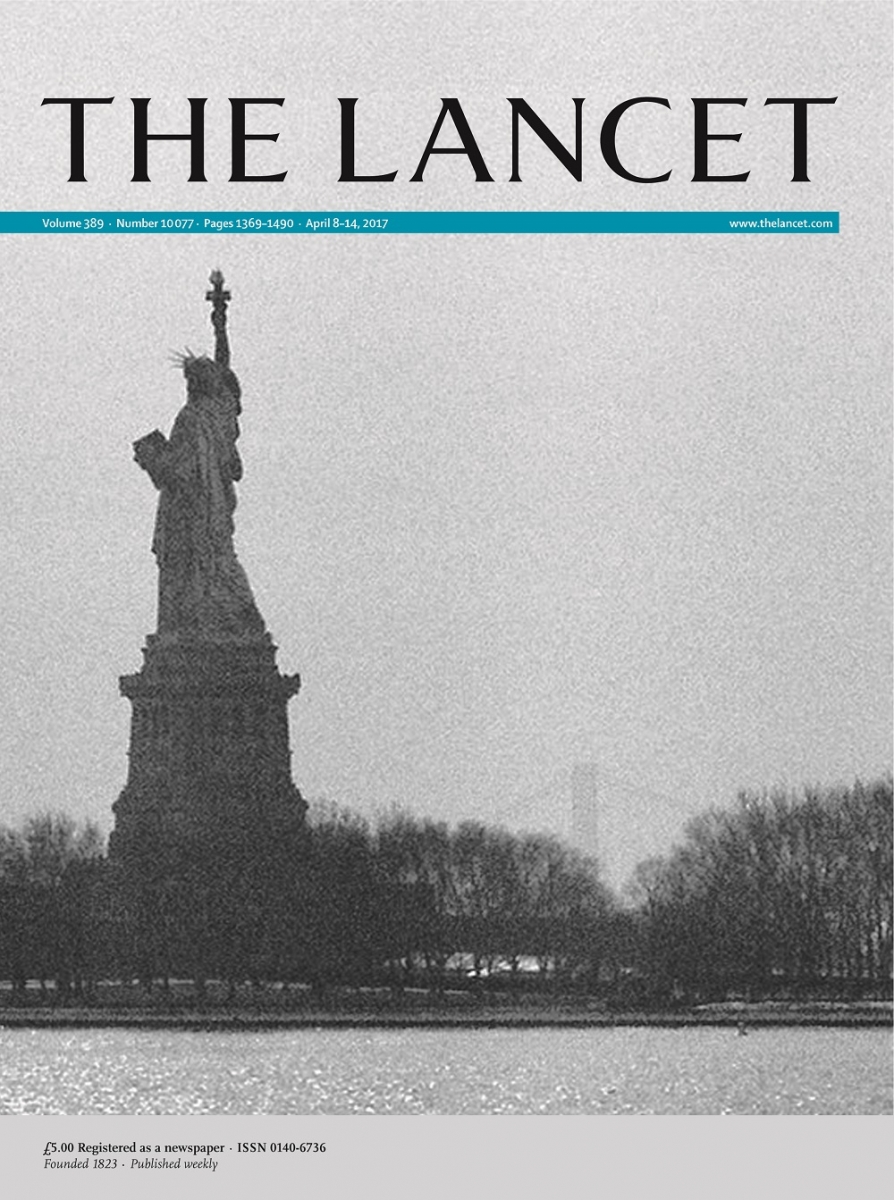
Lancet_CoverThe Lancet devotes special issue to growing U.S. health inequality

Leading British medical journal The Lancet has published a series of papers exploring persistent and growing health inequality in the United States. The series was published in the April 8, 2017 issue of The Lancet, and was curated by PNHP co-founders Drs. David Himmelstein and Steffie Woolhandler, along with Dr. Samuel Dickman.

“America: equity and equality in health” explores the effects of racial segregation, mass incarceration, economic inequality, and a lack of universal health care in the U.S. It comes at an important time in the national health care debate, as policymakers are grappling with the failure of the GOP “repeal and replace” bill, the American Health Care Act, and citizens are demanding a better health care system; one that addresses the gaps that remain after implementation of the Affordable Care Act.

Below, you can access links to the series papers; various interviews and events; national media coverage of the series; and an extensive infographic.

To read PNHP’s news release on the series, click here. The full series can be accessed for free (registration required) at thelancet.com/us-health.

***

Series Papers

Paper 1: Inequality and the health-care system in the USA
By Samuel L. Dickman, M.D., David U. Himmelstein, M.D., and Steffie Woolhandler, M.D., M.P.H.
http://thelancet.com…

Paper 2: The Affordable Care Act: implication for health-care equity
By Adam Gaffney, M.D. and Danny McCormick, M.D.
http://www.thelancet.com…

Paper 3: Structural racism and health inequities in the USA: evidence and interventions

By Zinzi D. Bailey, Sc.D., Nancy Krieger, Ph.D., Madina Agénor, Sc.D., Jasmine Graves, M.P.H., Natalia Linos, Sc.D., and Mary T. Bassett, M.D.
http://www.thelancet.com…

Paper 4: Mass incarceration, public health, and widening inequality in the USA

By Christopher Wildeman, Ph.D. and Emily A. Wang, M.D.
http://www.thelancet.com…

Paper 5: Population health in an era of rising income inequality in the USA: 1980-2015
By Jacob Bor, Sc.D., Gregory H. Cohen, M.Phil., and Sandro Galea, M.D.
http://www.thelancet.com…

Editorial: America, all things not being equal
By The Lancet
http://www.thelancet.com…

Comment: An agenda to fight inequality
By Sen. Bernie Sanders
http://www.thelancet.com…

***

Interviews & Events

Lancet Podcast: America, equity and equality in health
Interview with David Himmelstein, M.D. and Steffie Woolhandler, M.D., M.P.H.
http://www.thelancet.com…

Lancet Podcast: America, equity and equality in health
Interview with Samuel L. Dickman, M.D.
http://usa.thelancet.com…

Symposium: Income Inequality and Health in America
Boston University School of Medicine, April 10, 2017
Panel featuring Zinzi D. Bailey, Sc.D., Jacob Bor, Sc.D., Samuel L. Dickman, M.D., Adam Gaffney, M.D., and Steffie Woolhandler, M.D., M.P.H.
https://livestream.com…

Symposium: Inequality and Health in the U.S.
Harvard Medical School, April 24, 2017
Panel featuring Adam Gaffney, M.D., Samuel L. Dickman, M.D., Jacob Bor, Sc.D., Christopher Wildeman, Ph.D., and Mary T. Bassett, M.D., M.P.H. Panel moderated by Joan Reede, Harvard Medical School. Virtual welcome and remarks by Sen. Elizabeth Warren.
https://hms.mediasite.video.harvard.edu…

Symposium: Equity and Equality in Health
Roosevelt House, Public Policy Institute at Hunter College, May 1, 2017
Program featuring Mary T. Bassett, M.D., M.P.H., Paul Krugman, Ph.D., and David Himmelstein, M.D. Discussion moderated by Lilliam Barrios-Paoli, Ph.D.
http://www.roosevelthouse.hunter.cuny.edu…

***

Media Coverage

Inequality is a life and death matter
By Steffie Woolhandler, M.D., M.P.H. and David Himmelstein, M.D.

HuffPost, May 8, 2017
The Republican effort to gut the Affordable Care Act threatens a health care catastrophe. But blocking a backward move isn’t enough. The overall U.S. death rate is rising. The survival gap between rich and poor is widening. Continue reading…

The cost of economic inequality to the nation’s physical health
By Jacob Bor, Sc.D. and Sandro Galea, M.D.
The Boston Globe, April 25, 2017
After its unsuccessful push to reconfigure the U.S. health care system, the Trump administration has signaled that it will turn its attention to tax reform. While the details of the administration’s plan are still unclear, President Trump has indicated in the past a willingness to embrace measures that would greatly favor the wealthy. Continue reading…

Rich Americans live up to 15 years longer than poor peers, studies find
By Jessica Glenza
The Guardian, April 6, 2017
You can’t buy time – except, it seems, in America. Increasing inequality means wealthy Americans can now expect to live up to 15 years longer than their poor counterparts, reports in the British medical journal the Lancet have found. Continue reading…

Rich Americans Live 15 Years Longer Than Poo
r Counterparts: Study
By Anthony Cuthbertson

Newsweek, April 7, 2017
Wealth and health are intrinsically linked in the United States, with rich Americans living between 10 to 15 years longer than their poor counterparts, a study has found. A series of five papers published in the medical journal The Lancet found that a widening income gap, structural racism and mass incarceration are fueling growing health inequalities. Continue reading…

The Richest Americans Live 10 Years Longer than the Poorest
By Alice Park

Time Magazine, April 6, 2017
Money may not buy you happiness, but it may help buy you health, and ultimately a longer life. Researchers analyzing data on income disparities and health outcomes in the U.S. found that health gaps between the rich and poor are widening, and that’s translating to bigger differences in how long people live. Continue reading…

Want to Live Longer? Be Rich
By Jesse Singal

New York Magazine, April 7, 2017
You probably already know that health care in the United States is a bit of a disaster. That’s one of the primary reasons a single piece of bad luck can be ruinous for so many Americans. Continue reading…

Three Insights About Inequality in American Health Care
By Jesse Singal

New York Magazine, April 11, 2017
Lately, it has felt like the debate over Obamacare has masked some of the bigger questions swirling around the U.S. health system. Obamacare is important, yes, but America’s issues on this front run much, much deeper than the presence or absence of that one law. Continue reading…

What we know about the 30 million Americans who are still uninsured
By Julia Belluz

Vox, April 7, 2017
The size of the uninsured group is well-known, but less clear is what this group looks like. A new series in the Lancet on health inequality paints a pretty good picture. People who go without insurance in America are not refusing coverage for ideological reasons: They simply can’t afford to pay. Continue reading…

Lancet series puts spotlight on health inequity in the U.S.

By Paige Minemyer
Fierce Healthcare, April 7, 2017
Societal issues in the U.S., including systemic racism, poverty and mass incarceration, contribute to health inequity, a new series of studies has found. The Lancet released a five-part look at health inequity in the U.S., titled the “United States of Health.” Continue reading…

You Can Thank Racism, Mass Incarceration, and Our Health System for the Survival Gap Between the Rich and Poor
By Nick Keppler

Vice News, April 11, 2017
The United States’ for-profit healthcare system not only fails miserably to offer the same life-extending treatments to the poor as it does the rich, but it also reinforces racial and socioeconomic disparities, according to a wide-ranging five-part series published in the medical journal The Lancet. Continue reading…

The Prison-Health Paradox
By Olga Khazan

The Atlantic, April 7, 2017
A recent review of the impacts of incarceration on health published Thursday in The Lancet hints at a surprising upshot: Getting out of jail can be miserable, but going to jail can temporarily protect health—at least for some men. Continue reading…

When a man goes to prison, his children’s health suffers, too, study finds
By Max Blau

STAT, April 6, 2017
Researchers found that children of incarcerated men have higher rates of asthma, obesity, substance misuse, and behavioral and mental health problems. And the impact can linger for years, even into their adulthood. Continue reading…

Children Of Incarcerated Fathers Often Suffer Health Issues That Can Last Through Adulthood
By Cameron Norsworthy

Romper, April 6, 2017
Incarceration affects families emotionally and socially, and new research shows that there are long-lasting physical complications as well. According to a recent study, the children of incarcerated fathers often suffer health issues to intense degrees, and these health issues are often chronic conditions that can last all the way through adulthood. Continue reading…

Rich black people have worse health than rich white people
By Jessica Hamzelou
New Scientist, April 6, 2017
America’s health is in poor shape. The health gap between the rich and poor is now far bigger than the difference in income – that’s one of the messages from a series of papers published in The Lancet today. But wealth is only part of the problem. Continue reading…

***

Infographic

Lancet_Infographic

2017 SNaHP Summit Materials

See below for a selection of slideshows from the 2017 SNaHP Summit. Photos have been posted to our Flickr page here, and our group Facebook Live video can be viewed below. To read an excellent Philadelphia Inquirer article about the Summit, click here.

Single Payer Update
Slideshow by Anand Saha and Bryant Shuey

Single Payer 101
Slideshow by Andy Hyatt

Fighting for Single Payer in the Time of the ACA

Slideshow by Ebiere Okah and Lily Ostrer

Deep Canvassing
Slideshow by Shruthi Bhuma and Swathi Bhuma

Legislative Advocacy at the Nexus of Primary Care and Public Health

Slideshow by Richard Bruno, M.D.

From the Hospital to the Streets to the Interwebz: Using Twitter as a (Future) Physician-Activist
Slideshow by Dorothy Charles

Legislative Power Mapping
Slideshow by Shruthi Bhuma and Swathi Bhuma

Intersections Between the Movement for a National Health Program and the Fight for Racial Justice
Slideshow by Ebiere Okah and Lily Ostrer

Writing for Single Payer
Slideshow by Emily Kirchner

Effective Strategies for Building and Maintaining a Successful SNaHP Chapter

Slideshow by Bryant Shuey and Reuben Baker

#SinglePayer: Advancing Health Justice through Social Media
Slideshow by Augie Lindmark and Dixon Galvez-Searle

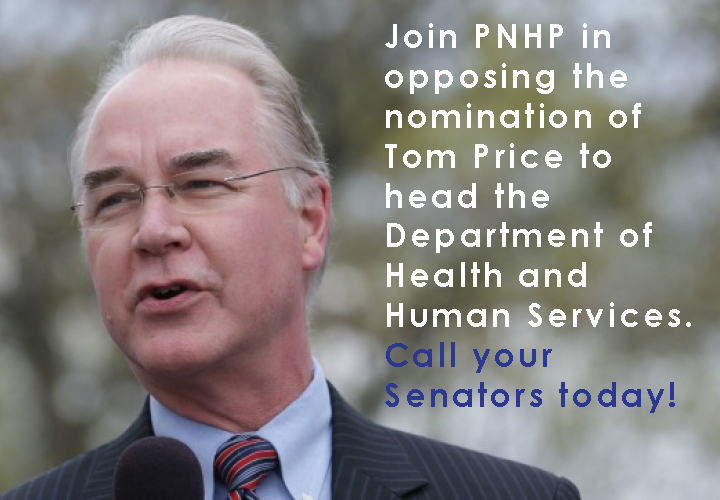
Trump's HHS Pick: A Price We Can't Afford

Stop Tom Price

In late November, president-elect Donald Trump named Rep. Tom Price (R-GA) as the man he wanted to head the Department of Health and Human Services. If confirmed by the Senate, Price’s record suggests that he would be a disaster for patients, doctors, and anyone who cares about health justice in the United States. Consider the following:

* As a member of Congress, Price introduced the Empowering Patients First Act, intended to replace the Affordable Care Act. This bill relies on discredited policies such as high-risk pools, individual tax credits, and allowing insurers to sell bare-bones policies. If signed into law, it would eliminate coverage for millions of Americans.

* Together with House Speaker Paul Ryan, Price has pushed for “premium support” (i.e. vouchers) for Medicare. This would threaten traditional Medicare, increase out-of-pocket costs, and bolster the profits of the private insurance and financial services industries.

* Together with Centers for Medicare and Medicaid Services nominee Seema Verma, Price has voiced support for converting Medicaid into block grants. This would allow states to introduce cruel, counterproductive policies that compromise the health of their poorest residents. (Verma’s health savings accounts in Indiana are a prime example.)

* Price has proven hostile to family planning, and has endorsed policies that would place millions of women at risk. His extreme views include opposition to abortion under almost all circumstances, a preference for “religious freedom” over access to contraception, and an obsession with eliminating federal funding for Planned Parenthood.

* Price has a long history of opposing LGBT rights. As HHS secretary, he may decline to enforce nondiscrimination provisions of existing laws. Furthermore, his preferred Medicaid policies would restrict access to HIV/AIDS treatment for the most vulnerable patients.

This is precisely the wrong direction for our health care system. The last thing we need are policies that further deny access to care and that concentrate even more power in the hands of corporate interests. What we do need, now more than ever, is a single-payer national health program – an improved Medicare for all.

We encourage you to contact your senators today and voice your opposition to the nominations of Tom Price (HHS) and Seema Verma (CMS). And while you’re at it, press them to support single-payer legislation in the Senate that would, at long last, provide Americans with universal access to quality health care.

To contact your senators, simply call the U.S. Capitol switchboard at (202) 224-3121. You can also click here for senator-specific contact information (direct phone numbers and email submission forms).

You may also wish to sign the National Physicians Alliance online petition opposing Price’s nomination, which can be endorsed by NPA members and non-members alike. Click here to access the petition, which will be submitted to Congress in the near future.

More on the Price and Verma nominations:

Price contradicts himself on the supposed virtues of high-deductible health plans:
https://www.youtube.com…

PNHP calls on Trump to rescind the Price and Verma nominations:
https://pnhp.org…

SNaHP takes medical societies to task for their endorsements of Price:
https://pnhp.org…

Dr. Don McCanne envisions trouble ahead with the nominations of Price and Verma:
https://pnhp.org…

Dr. Don McCanne decries Verma’s push for “skin in the game” for Medicaid beneficiaries:
https://pnhp.org…

Dr. Adam Gaffney says Price would be a “horrible choice” for health secretary:
http://inthesetimes.com…

RoseAnn DeMoro of NNU critiques Price’s promise of universal “access”:
http://www.alternet.org…

The New York Times reports on opposition to the Price nomination among physicians:
http://www.nytimes.com…

The Wall Street Journal reports on Price’s financial conflicts of interest:
http://www.wsj.com…

ScienceBlogs reveals Price’s membership in an anti-science fringe group:
http://scienceblogs.com…

2016 Annual Meeting Materials

Highlights are available here.

Find below a selection of slideshows and handouts from PNHP’s 2016 Annual Meeting.
Photos from the Annual Meeting are available here.

Grand Rounds Morning Presentation
By David Himmelstein, M.D., and Steffie Woolhandler, M.D., M.P.H.
Download slideshow here

Grand Rounds (Alternate Visuals)
By Ed Weisbart, M.D.
Download slideshow here

The 2016 Election: Implications for Healthcare
By Michael Lighty, National Nurses United
Download slideshow here

Health Equity After 2016
By Mary T. Bassett, M.D., M.P.H.
Download slideshow here

Organizing in your Specialty and Medical Society
By Andrea DeSantis, D.O., Richard Bruno, M.D., and Michael Kaplan, M.D.
Download slideshow here

Unions: A Response to Profit-Driven Medicine
By Roona Ray, M.D., M.P.H., A.A.H.I.V.S.
Download slideshow here

Minnesota Single Payer Report
By Rose Roach, Minnesota Nurses Association
Download slideshow here

Oregon Single Payer Report
By Mike Huntington, M.D.
Download slideshow here

Building Support for Single Payer Legislation in Congress
By Danielle Alexander, M.D.
Download slideshow here

Turning Threats to Medicare and Medicaid Into Organizing Opportunities
By Ed Weisbart, M.D., and MN state Sen. John Marty
Download slideshow here

Abortion Access and PNHP
By Linda Prine, M.D., and Diljeet Singh, M.D., Dr.P.H.
Download slideshow here

The Physicians Proposal for a National Pharmaceutical Program
By Adam Gaffney, M.D., David Himmelstein, M.D., Joel Lexchin, M.D., Gordy Schiff, M.D., and Steffie Woolhandler, M.D., M.P.H.
Download slideshow here

Universal, Quality, Lifetime and Affordable Health Insurance: A Roadmap that Won’t Bankrupt Us (Leadership Training)
By Robert Zarr, M.D.
Download slideshow here

Creating and Delivering Compelling Presentations on Single Payer (Leadership Training)
By Ed Weisbart, M.D., and Claudia Fegan, M.D.
Download slideshow here

A Beginner’s Guide to Media Outreach (Leadership Training)
By Jessica Schorr Saxe, M.D.
Download slideshow here

Building Successful Social Media Campaigns (Leadership Training)
By Bryant Shuey (adapted from Dustin Calliari’s 2015 presentation)
Download slideshow here

2016 SNaHP Summit Materials

Highlights are available here.

Find below a selection of slideshows and handouts from the 2016 SNaHP Summit.
Photos from the SNaHP Summit are available here.

Single Payer 101
Slideshow by Anand Saha and Mitch Hayes

Writing for Single Payer
Slideshow by Emily Kirchner (additional content here and here)

What Can Healthcare Providers-in-Training do to Address Bias?
Slideshow by Tehreem Rehman

Mental Health Disparities Among Marginalized Populations
Slideshow by Shruti Revankar and Jerome Jeevarajan

The Intersections of Universal Coverage and Public Health
Slideshow by Ashley Cobb and Swathi Damodaran

Legislative Power Mapping
Slideshow by Swathi and Shruthi Bhuma

Health Disparities and the Need for Single-Payer Healthcare in Rural America
Slideshow by Liberty Foye and Annie Kolarik

Intersections Between the Health Justice and Racial Justice Movements
Slideshow by Lily Ostrer, Charlotte Austin, Ebiere Okah, and Salman Ashan

Trauma Informed Care for All: ACES and Single Payer
Slideshow by Amanda Malik (additional content here)

Training for Civil Disobedience
Slideshow by Scott Goldberg and Katie Robbins (additional content here)

Answering Difficult Questions About Single Payer

Slideshow by Xin Guan and Josh Faucher (additional content here)

Starting and Sustaining Your SNaHP Chapter

Slideshow by Vanessa Van Doren

Putting Single Payer at the Forefront of the 2016 Elections
Slideshow by Andy Hyatt and Janine Petito

Birddogging Presidential Candidates
Slideshow by Andy Hyatt and Janine Petito

Lobbying 101
Slideshow by Swathi and Shruthi Bhuma

2015 Annual Meeting Materials

Highlights are available here.

Find below a selection of slideshows and handouts from PNHP’s 2015 Annual Meeting.
Photos from the Annual Meeting are available here.

Grand Rounds Morning Presentation
By David Himmelstein, M.D., and Steffie Woolhandler, M.D., M.P.H.
Download slideshow here

Grand Rounds (Alternate Visuals)

By Ed Weisbart, M.D.
Download slideshow here

Single Payer and Quality: PNHP Quality Proposal Turns 20
By Gordon Schiff, M.D.
Download slideshow here

A Sickly Democracy: Money Politics, Healthcare, and the Presidential Campaign
By Robert Weissman, Public Citizen
Download slideshow here

The Struggle for Health Care for Undocumented Immigrants

By Angelica Ramirez, Paul Song, M.D., and Beatrix Hoffman, Ph.D.
Download slideshow here

Corporate Corruption in Medicine
By Roy Poses, M.D., F.A.C.P. and Wally Smith, M.D.
Download slideshow here

How Obamacare Fails the Mentally Ill
By Stephen Kemble, M.D. and J. Wesley Boyd, M.D., Ph.D.
Download slideshow here

Universal Health Coverage vs. Health Care for All
By Howard Waitzkin, M.D., Ph.D.
Download slideshow here

White Coat Conversations: Talking “Single Payer” on the Wards
By Anna Zelivianskaia, M4 and Rebecca Commito, M3
Download slideshow here

Good Pharma / Bad Pharma: a Single Payer Alternative to Corporate R&D
By Donald W. Light, Ph.D.
Download slideshow here

So, Why Single Payer? (Leadership Training)

By Susan Rogers, M.D., F.A.C.P.
Download slideshow here

Creating and Delivering Compelling Presentations (Leadership Training)

By Ed Weisbart, M.D.
Download slideshow here

2015 Annual Meeting Materials

Highlights are available here.

Find below a selection of slideshows and handouts from PNHP’s 2015 Annual Meeting.
Photos from the Annual Meeting are available here.

Grand Rounds Morning Presentation
By David Himmelstein, M.D., and Steffie Woolhandler, M.D., M.P.H.
Download slideshow here

Grand Rounds (Alternate Visuals)

By Ed Weisbart, M.D.
Download slideshow here

Single Payer and Quality: PNHP Quality Proposal Turns 20
By Gordon Schiff, M.D.
Download slideshow here

A Sickly Democracy: Money Politics, Healthcare, and the Presidential Campaign
By Robert Weissman, Public Citizen
Download slideshow here

The Struggle for Health Care for Undocumented Immigrants

By Angelica Ramirez, Paul Song, M.D., and Beatrix Hoffman, Ph.D.
Download slideshow here

Corporate Corruption in Medicine
By Roy Poses, M.D., F.A.C.P. and Wally Smith, M.D.
Download slideshow here

How Obamacare Fails the Mentally Ill
By Stephen Kemble, M.D. and J. Wesley Boyd, M.D., Ph.D.
Download slideshow here

Universal Health Coverage vs. Health Care for All
By Howard Waitzkin, M.D., Ph.D.
Download slideshow here

White Coat Conversations: Talking “Single Payer” on the Wards
By Anna Zelivianskaia, M4 and Rebecca Commito, M3
Download slideshow here

Good Pharma / Bad Pharma: a Single Payer Alternative to Corporate R&D
By Donald W. Light, Ph.D.
Download slideshow here

So, Why Single Payer? (Leadership Training)

By Susan Rogers, M.D., F.A.C.P.
Download slideshow here

Creating and Delivering Compelling Presentations (Leadership Training)

By Ed Weisbart, M.D.
Download slideshow here

Why the ‘public option’ is not a real solution to our health care woes

Public Option 2016

During the 2009 debate that resulted in passage of the Affordable Care Act, some policymakers and elected officials called for a “public option” to provide an additional source of coverage and competition. Although this provision was dropped from the final legislation, it has resurfaced periodically as premiums and deductibles have spiked, provider networks have narrowed, and insurers have quit various state exchanges.

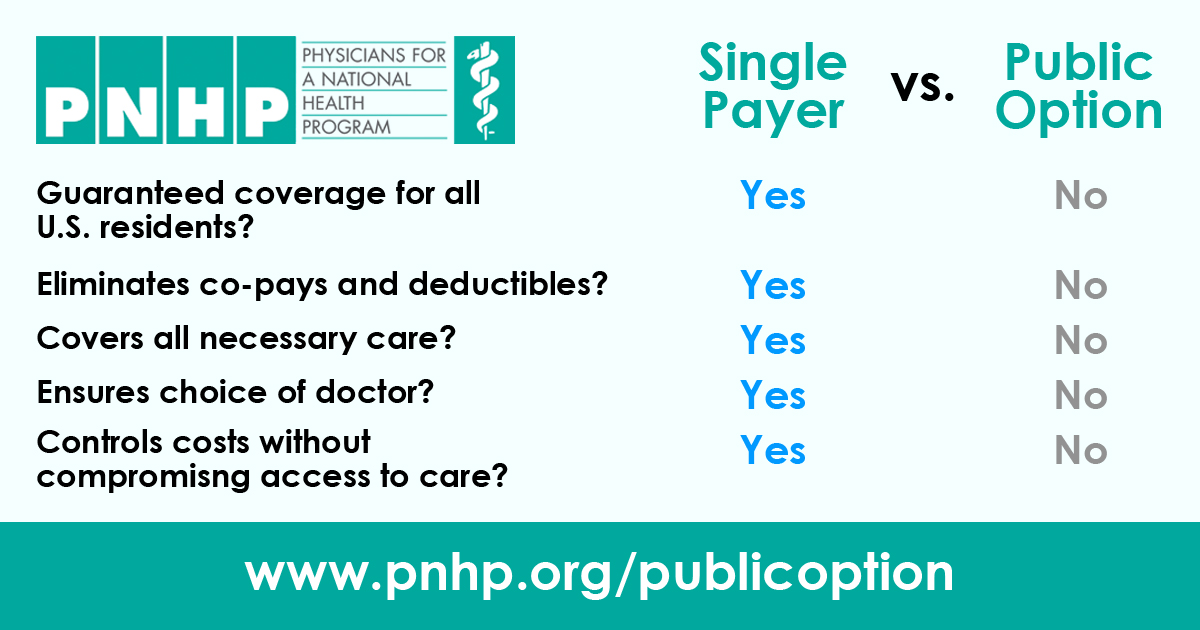
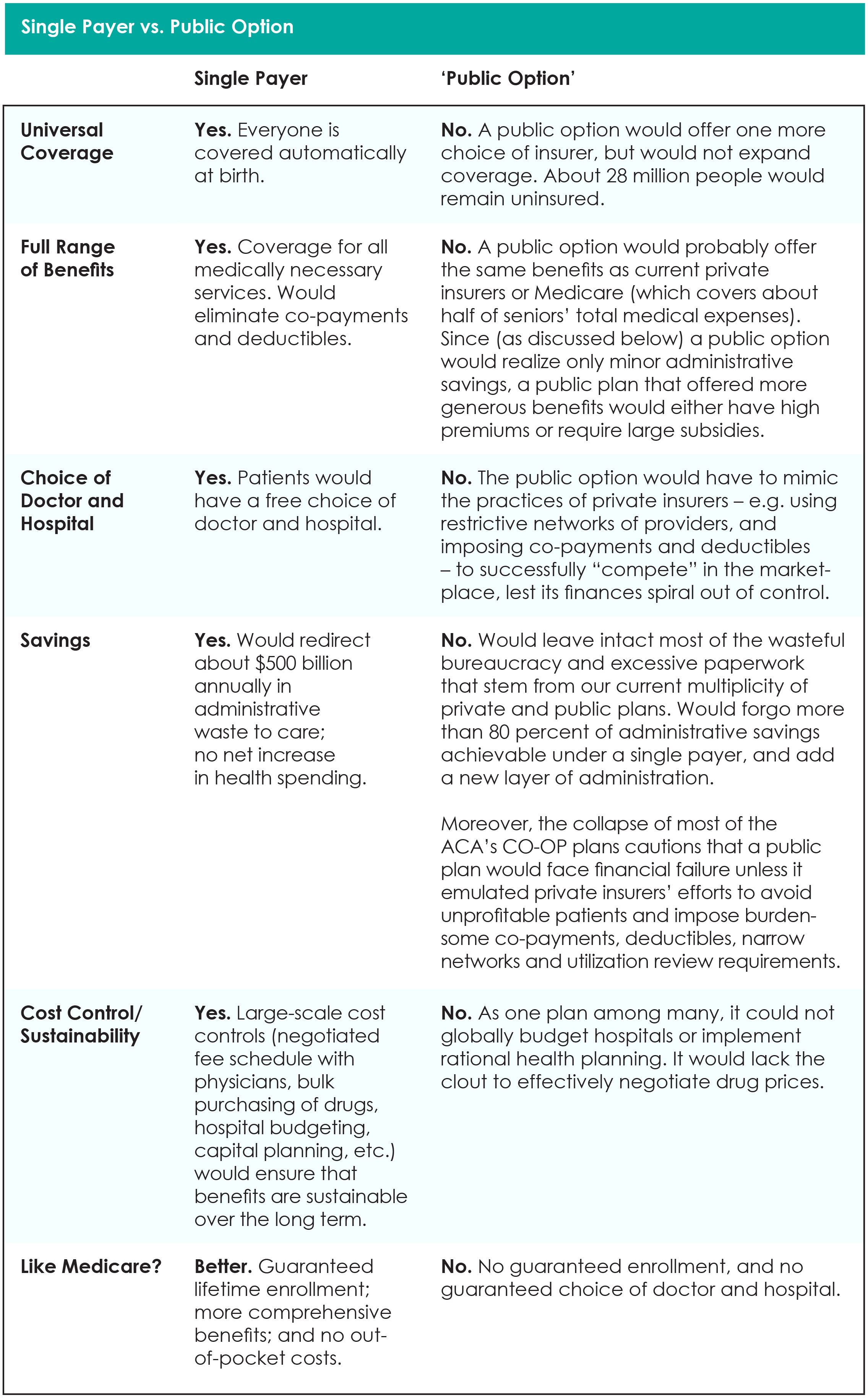
A public option may sound appealing as a means of checking commercial health insurers, but in reality it would be a very limited policy that would offer no genuine fix for what ails our current health care system.

PNHP co-founders Drs. Steffie Woolhandler and David Himmelstein argued that “The ‘Public Option’ on Health Care Is a Poison Pill” in The Nation, predicting that it would function in much the same way that Medicare Advantage does, with commercial insurers pushing sicker and costlier patients onto the public plan and policymakers favoring the insurance industry at every turn.

PNHP’s senior health policy fellow, Dr. Don McCanne, also wrote a detailed account of why advocates should temper their enthusiasm for the public option. And PNHP has developed a table, below, that contrasts the public option with single payer. (This table can also be viewed as a PDF, here.)

Other noted health policy experts have weighed in on the insufficiency of a public option, including former Centers for Medicare and Medicaid Services Administrator Dr. Don Berwick, who testified before Congress as part of a June 2019 hearing on universal health coverage. He explained how a public option that covered only the sickest patients would be a gift to commercial health insurers.

The Affordable Care Act, despite its gains, is clearly insufficient to address our most urgent health care needs, and adding yet another layer to our already fragmented system is not the answer. To learn more about a system that would improve efficiency, equity, and affordability – a single-payer national health program – please click here.

Uwe Reinhardt: “It is hard to see a way out of this dilemma”

TPP and the Dire Threat to Affordable Drug Prices

The Health Insurance Industry’s Last Ditch Holdup

Is National Health Insurance (Medicare For All) Socialized Medicine?

  • « Go to Previous Page
  • Page 1
  • Interim pages omitted …
  • Page 10
  • Page 11
  • Page 12
  • Page 13
  • Page 14
  • Interim pages omitted …
  • Page 50
  • Go to Next Page »

Primary Sidebar

  • About PNHP
    • Mission Statement
    • Local Chapters
    • Student chapters
    • Board of Directors
    • National Office Staff
    • Contact Us
    • Privacy Policy
  • About Single Payer
    • What is Single Payer?
    • How do we pay for it?
    • History of Health Reform
    • Conservative Case for Single Payer
    • FAQs
    • Información en Español
  • Take Action
    • The Medicare for All Act of 2025
    • Moral Injury and Distress
    • Medical Society Resolutions
    • Recruit Colleagues
    • Schedule a Grand Rounds
    • Letters to the Editor
    • Lobby Visits
  • Latest News
    • Sign up for e-alerts
    • Members in the news
    • Health Justice Monitor
    • Articles of Interest
    • Latest Research
    • For the Press
  • Reports & Proposals
    • Physicians’ Proposal
    • Medicare Advantage Equity Report
    • Medicaid Managed Care Report
    • Medicare Advantage Harms Report
    • Medicare Advantage Overpayments Report
    • Pharma Proposal
    • Kitchen Table Campaign
    • COVID-19 Response
  • Member Resources
    • 2025 Annual Meeting Materials
    • Member Interest Groups (MIGs)
    • Speakers Bureau
    • Slideshows
    • Newsletter
    • Materials & Handouts
    • Webinars
    • Host a Screening
    • Events Calendar
    • Join or renew your membership

Footer

  • About PNHP
    • Mission Statement
    • Local Chapters
    • Student chapters
    • Board of Directors
    • National Office Staff
    • Contact Us
    • Privacy Policy
  • About Single Payer
    • What is Single Payer?
    • How do we pay for it?
    • History of Health Reform
    • Conservative Case for Single Payer
    • FAQs
    • Información en Español
  • Take Action
    • The Medicare for All Act of 2025
    • Moral Injury and Distress
    • Medical Society Resolutions
    • Recruit Colleagues
    • Schedule a Grand Rounds
    • Letters to the Editor
    • Lobby Visits
  • Latest News
    • Sign up for e-alerts
    • Members in the news
    • Health Justice Monitor
    • Articles of Interest
    • Latest Research
    • For the Press
  • Reports & Proposals
    • Physicians’ Proposal
    • Medicare Advantage Equity Report
    • Medicaid Managed Care Report
    • Medicare Advantage Harms Report
    • Medicare Advantage Overpayments Report
    • Pharma Proposal
    • Kitchen Table Campaign
    • COVID-19 Response
  • Member Resources
    • 2025 Annual Meeting Materials
    • Member Interest Groups (MIGs)
    • Speakers Bureau
    • Slideshows
    • Newsletter
    • Materials & Handouts
    • Webinars
    • Host a Screening
    • Events Calendar
    • Join or renew your membership
©2025 PNHP