• Skip to primary navigation
  • Skip to main content
  • Skip to primary sidebar
  • Skip to footer

PNHP

  • Home
  • Contact PNHP
  • Join PNHP
  • Donate
  • PNHP Store
  • About PNHP
    • Mission Statement
    • Local Chapters
    • Student chapters
    • Board of Directors
    • National Office Staff
    • Contact Us
    • Privacy Policy
  • About Single Payer
    • What is Single Payer?
    • How do we pay for it?
    • History of Health Reform
    • Conservative Case for Single Payer
    • FAQs
    • Información en Español
  • Take Action
    • The Medicare for All Act of 2025
    • Moral Injury and Distress
    • Medical Society Resolutions
    • Recruit Colleagues
    • Schedule a Grand Rounds
    • Letters to the Editor
    • Lobby Visits
  • Latest News
    • Sign up for e-alerts
    • Members in the news
    • Health Justice Monitor
    • Articles of Interest
    • Latest Research
    • For the Press
  • Reports & Proposals
    • Physicians’ Proposal
    • Medicare Advantage Equity Report
    • Medicaid Managed Care Report
    • Medicare Advantage Harms Report
    • Medicare Advantage Overpayments Report
    • Pharma Proposal
    • Kitchen Table Campaign
    • COVID-19 Response
  • Member Resources
    • 2025 Annual Meeting
    • Member Interest Groups (MIGs)
    • Speakers Bureau
    • Slideshows
    • Newsletter
    • Materials & Handouts
    • Webinars
    • Host a Screening
    • Events Calendar
    • Join or renew your membership

The official blog of PNHP

Protected: 2021 Annual Meeting Materials

Our live sessions took place October 22-23, 2021. For those who did not register in advance, we are offering $10 tickets that include a password for post-meeting access to archived content; click HERE to purchase.

This content is password protected. To view it please enter your password below:

PNHP Newsletter: Fall 2021

Table of contents

Click the links below to jump to different sections of the newsletter. To view a PDF version of the shorter print edition of the newsletter, click HERE.

If you wish to support PNHP’s outreach and education efforts with a financial contribution, click HERE.

If you have feedback about the newsletter, email info@pnhp.org.

PNHP News and Tools for Advocates

  • PNHP launches Medical Society Resolutions campaign
  • New Kitchen Table Campaign highlights America’s maternal mortality crisis
  • Meet PNHP’s newly elected board members

Research Roundup

  • Data Update: Health care crisis by the numbers
    • Health Costs
    • Health Inequities
    • Coverage Matters
    • Commercial Insurance: A Hazardous Product
    • Privatizing Medicare
    • Health Care for Profit
    • Pharma
  • Studies and analysis of interest to single-payer advocates
  • Commentary

PNHP Chapter Reports

  • California
  • Illinois
  • Kentucky
  • Maine
  • Minnesota
  • New Jersey
  • New York
  • North Carolina
  • Oregon
  • Pennsylvania
  • Tennessee
  • Vermont
  • Washington
  • West Virginia

PNHP in the News

  • News Articles Quoting PNHP Members
    • Chapters in Action
    • Health Policy and Research
  • Opinion: Op-eds and Guest Columns
  • Opinion: Letters to the Editor

PNHP News and Tools for Advocates


PNHP launches Medical Society Resolutions campaign

Moving organized medicine to Medicare for All should be a top priority

Members of PNHP’s new West Virginia Chapter recruit colleagues at a meeting of the WV State Medical Association.

Polling shows that a majority of physicians support single-payer reform, with even stronger support among medical students and early-career physicians. Unfortunately, the vast majority of professional associations that claim to represent physicians do not support Medicare for All, and in some cases actively oppose it.

The lack of support by organized medicine is a huge problem for the Medicare-for-All movement. Medical societies have enormous influence over health care policy at the federal and state level. With the insurance, pharma, and investor-owned hospital industries spending millions each year lobbying against single-payer reform, the Medicare-for-All movement needs the full force of organized medicine fighting back.

As the only physician organization dedicated to single-payer reform, PNHP has a unique responsibility to move the medical profession to support Medicare for All. We’re meeting that challenge by launching the Medical Society Resolutions campaign.

“We can no longer ignore the elephant in the room — the powerful medical societies standing in the way of Medicare for All,” said PNHP president Dr. Susan Rogers. “As physicians, we are the only ones who can organize our colleagues for change.”

What is the Medical Society Resolutions (MSR) Campaign?

Virtually every physician is a member of a local, state, or specialty medical society, and is therefore in a position to propose resolutions that determine what policies their society will support (or oppose). The goal of the MSR campaign is to organize colleagues in the medical profession by passing Medicare-for-All resolutions in every medical society in the U.S.

The MSR campaign follows two years of unprecedented movement towards Medicare for All within organized medicine. In 2019, the American Medical Association only narrowly rejected a student-led pro-single payer resolution, opening the door for future support. Under pressure from activists, the AMA then resigned from the anti-single payer Partnership for America’s Health Care Future. In January 2020, the 159,000-member American College of Physicians — the largest medical specialty society and second-largest physician group after the AMA —  announced its endorsement of Medicare for All, along with a “universal public choice” reform model. The 3,300-member Society of General Internal Medicine followed suit by formally endorsing the ACP’s position.

At the state level, the Vermont Medical Society overwhelmingly endorsed a single-payer resolution in November 2020, becoming the second state society to do so after Hawaii.

All the major associations representing medical students and new physicians have endorsed Medicare for All, including the American Medical Students Association; the AMA Medical Student Section; the Student National Medical Association (representing medical students of color); and the Committee of Interns and Residents.

How to participate in the MSR campaign

Every physician member of PNHP can participate in the MSR campaign by visiting medicalsocietyresolutions.org, where they can see if other PNHP members are actively organizing single-payer resolutions in their state, national, or specialty societies; download and edit a sample resolution; and watch recorded workshops on the nuts and bolts of passing resolutions. Interested members can contact organizer@pnhp.org to get started and connect with other PNHP members in their societies.

back to table of contents

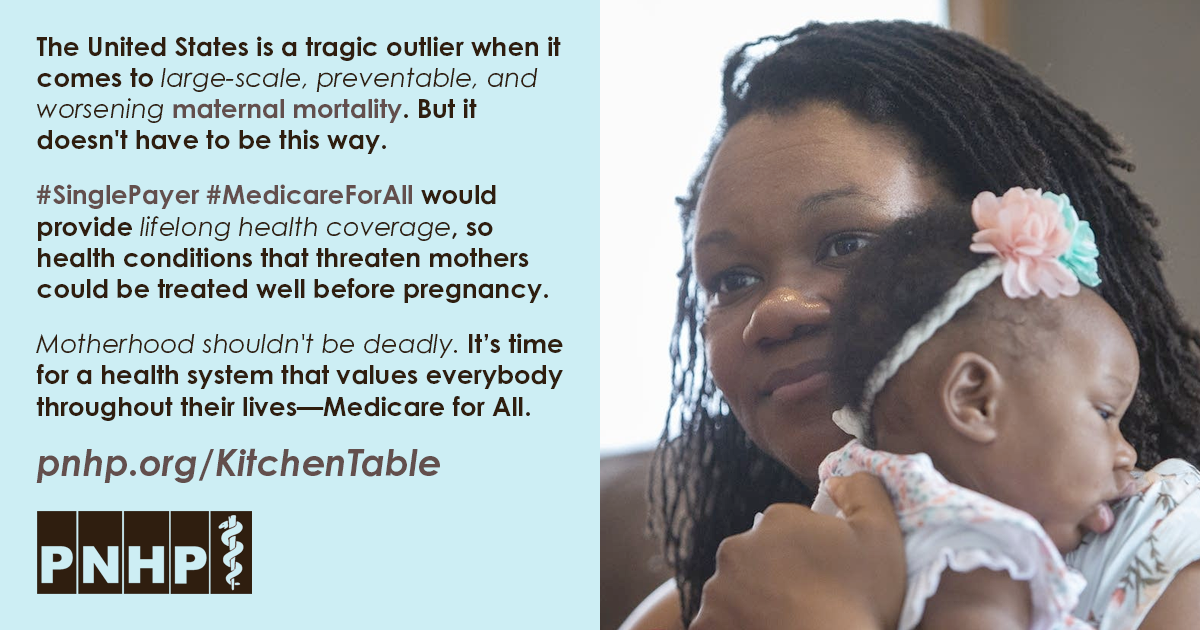
New Kitchen Table Campaign highlights America’s maternal mortality crisis

The U.S. is facing a crisis in maternal mortality. The rate of pregnancy-related deaths in the U.S. has nearly tripled in the past 30 years. Besides the U.S., the only other countries with rising maternal mortality rates are Afghanistan and Sudan. Our maternal mortality rate is more than double that of other high-income nations, and our infant mortality rate is 71% higher. Indigenous mothers are twice as likely — and Black mothers 2.5 times more likely — to die from pregnancy complications compared to white mothers.

The most frustrating aspect of this crisis is that these deaths are mostly preventable. Not with high-tech interventions, but with routine primary care. A majority of pregnancy-related complications and deaths are caused by health conditions that can be identified, managed, or even eliminated with regular preventive care, such as diabetes, heart disease, and hypertension. But addressing these conditions before pregnancy requires a lifetime of regular care, which is out of reach for many Americans — especially people of color — because of costs and insurance barriers.

We won’t solve this crisis with band-aid approaches. Even Medicaid — which now finances nearly half the births in the U.S. — only starts after a person discovers they are pregnant, and in many states ends soon after birth, limiting access to critically important prenatal and postpartum care.

By providing lifelong coverage for all medically necessary health services, including primary care; mental health; contraception and abortion; and pregnancy, childbirth, and postpartum care — Medicare for All is the only plan that would empower patients to prevent, identify, and treat the chronic health conditions that increase risk of pregnancy-related complications and death.

Visit pnhp.org/maternalmortality to explore the full toolkit on America’s maternal mortality crisis, which includes talking points and handouts, a slide set and webinar, videos and podcasts, and a new interactive quiz to test your knowledge of this crisis. Please use these materials in your own advocacy and share with your colleagues and communities. To learn more about PNHP’s Kitchen Table Campaign, contact clare@pnhp.org.

back to table of contents

Meet PNHP’s newly elected board members

At Large Members

Sanjeev Sriram, M.D., M.P.H. has been a PNHP member since 2018. Dr. Sriram completed his medical degree and residency at UCLA, his masters in public health at Harvard, and now practices pediatrics in Maryland. He founded the “All Means All” campaign to center racial equity in single payer, and promotes Medicare for All and health equity in national publications and as “Dr. America” for act.TV. As a board member, Dr. Sriram will urge PNHP to collaborate with racial justice organizations on strategies to broaden single-payer activism, and expand mentorship and professional development opportunities for our student members.

Philip Verhoef, M.D., Ph.D. has been a PNHP member since 2006. Dr. Verhoef received his medical degree and a Ph.D. in pharmacology from Case Western Reserve University, followed by med-peds residency at UCLA. He joined the faculty at the University of Chicago after a fellowship in adult and pediatric critical care, while serving as the president of the Illinois Single Payer Coalition and co-president of PNHP-Illinois. In 2019, Dr. Verhoef moved to Kaiser Permanente in Hawaii, where he serves as an adult/pediatric intensivist and hospitalist and as the associate program director for the internal medicine residency program. As a continuing board member, he plans to develop strategies for physician engagement, including messaging, programming, development, and recruitment, with a specific focus on diverse and underserved communities.

Continuing at-large member: Stephen Chao, M.D. (Texas)

North East Region

Scott Goldberg, M.D. has been a PNHP member since 2009. Dr. Goldberg earned his medical degree at University of Chicago Pritzker School of Medicine (where he launched a SNaHP chapter in 2012) and completed residency in 2019 in internal medicine-primary care at UCSF. He serves as an attending physician at Montefiore Medical Center in the Bronx where he supervises residents in the Primary Care/Social Internal Medicine program, and an assistant professor at the Albert Einstein College of Medicine. As a board member, Dr. Goldberg plans to expand PNHP’s fundraising and membership efforts, with the goal of building the power necessary to shape the culture of organized medicine around single payer.

Continuing North East board members: Mary O’Brien, M.D. (New York) and Janine Petito, M.D. (Massachusetts)

South Region

Ed Weisbart, M.D. has been a PNHP member since 1996. He completed his medical degree at the University of Illinois and family medicine residency at Michigan State University. Dr. Weisbart practiced family medicine for 20 years, served as CMO of Express Scripts from 2003-2010, and retired clinically in 2021. He serves as the chair of the Missouri chapter of PNHP, where he has delivered more than 600 public presentations and published dozens of pieces on single payer. As a board member, Dr. Weisbart will help PNHP increase its influence within the health care policy debate, and strengthen its relationships with adjacent advocacy organizations.

Continuing South Region board member: Jessica Schorr Saxe, M.D. (North Carolina)

North Central Region

Judith Albert, M.D.> has been a PNHP member since 2017. She received her medical degree from the University of Cincinnati, completed residency in obstetrics and gynecology at the University of Pittsburgh and fellowship in reproductive endocrinology at the University of Pennsylvania. Dr. Albert recently retired from having practiced in academic and private practice settings for over 30 years in Pittsburgh. She co-founded a PNHP chapter in western Pennsylvania where she has been involved in anti-racist organizing for several years. As a board member, Dr. Albert hopes to grow the single-payer movement by strengthening PNHP chapters in the region, and building coalitions with anti-racist, fair housing and anti-poverty organizations, as well as labor unions.

Continuing North Central Region board member: Joshua J. Faucher, M.D., J.D. (Illinois)

West Region

Kathleen Healey, M.D. has been a PNHP member since 2018. Dr. Healey completed her medical degree at University of Colorado School of Medicine and her residency at the Naval Medical Center in Oakland. She is an otolaryngologist whose career ranged from military service as a flight surgeon, to solo and group practices. Now retired, Dr. Healey serves as co-chair of PNHP-Napa County and PNHP-California. As a board member, Dr. Healey will work to bring more physicians into our movement, and increase PNHP’s involvement in organized medicine at all levels.

Stephen Kemble, M.D. has been a PNHP member since 1989. Dr. Kemble attended medical school at University of Hawaii and Harvard, and completed residencies in both internal medicine (Queen’s Medical Center) and psychiatry (Cambridge Health Alliance). He is now semi-retired, working part-time in a primary care clinic. Dr. Kemble is past president of both the Hawaii Psychiatric Medical Association and the Hawaii Medical Association, and also served on the Hawaii Health Authority board. As a board member, Dr. Kemble will continue to chair the newly formed PNHP Policy Committee, and help PNHP fight the power of the insurance industry with ongoing public education and community organizing.

Continuing West Region board member: Eve Shapiro, M.D., M.P.H. (Arizona)

back to table of contents


Research Roundup


Data Update Fall 2021

Health Costs

Both the insured and uninsured struggle with medical costs. Nearly one in four (38%) adults had medical bill or debt problems in the last year, including 46% of those on individual/marketplace plans, 34% of those on employer plans, 55% of Black people, and 47% of low-income people; a third of those with debt said they were paying off $4,000 or more. Among those with medical debt problems, 35% used up all or most of their savings, 35% took on credit card debt, 27% had been unable to pay for basic necessities like food or rent, 23% delayed education or career plans, and 43% received a lowered credit score. Although uninsured people reported medical bill problems at the highest rates, 64% of those with a medical bill or debt problem said they had been insured at the time. Collins et al., “As the pandemic eases, what is the state of health care coverage and affordability in the U.S.? Findings from the Commonwealth Fund health care coverage and Covid-19 survey, March–June 2021,” Commonwealth Fund, 7/16/2021

Even high-income Americans have trouble paying for care. In the past year, nearly one in four Americans (38%) said they had trouble accessing health care because of cost, including 27% of high-income earners; 36% skipped health or dental care because of cost, including 21% of high-income earners; 34% said their insurance denied payment for medical care; 22% had serious problems paying or were unable to pay medical bills; and 44% had out-of-pocket medical expenses exceeding $1,000. Schneider et al., “Mirror, Mirror 2021 — Reflecting poorly: Health care in the U.S. compared to other high-income countries,” Commonwealth Fund, 8/4/2021

Americans’ medical debt reaches record levels. An estimated 17.8% of individuals in the U.S. had medical debt in collections in June 2020, for care provided prior to the pandemic. Collection agencies held $140 billion in unpaid medical bills, up from an estimated $81 billion in 2016. Between 2009 and 2020, unpaid medical bills became the largest source of debt that Americans owed to collection agencies. Residents of states that did not expand Medicaid owed an average of $375 more compared to those in expansion states, roughly a 30% increase from the year before Medicaid expansion. People living in the lowest-income ZIP codes owed an average of $677, compared to $126 in the highest-income ZIP codes. Kluender et al., “Medical debt in the U.S., 2009-2020,” JAMA, 7/20/2021

Providing medications for free leads to greater adherence and cost savings. In a study of patients in Ontario who reported cost-related non-adherence to medications, providing those medications for free increased patient adherence by 35% and reduced total health spending, including hospitalization, by an average of $1,222 per patient per year. Persaud et al., “Adherence at two years with distribution of essential medicines at no charge: The CLEAN Meds randomized clinical trial,” PLOS Medicine, 5/21/2021

back to table of contents

Health Inequities

U.S. life expectancy drops most for people of color. Life expectancy in the U.S. decreased by nearly two years between 2018 and 2020, down to 76.9 at the end of 2020 from 78.7 in 2018. However, the declines were more pronounced among Black people, whose life expectancy decreased by 3.3 years, and Latinx/Hispanic people, whose life expectancy decreased by 3.9 years. By comparison, among a group of 16 peer countries, the average decline in life expectancy was 0.22 years (about two-and-a-half months). Woolf et al., “Effect of the Covid-19 pandemic in 2020 on life expectancy across populations in the USA and other high-income countries: Simulations of provisional mortality data,” BMJ, 5/24/2021
Life expectancy gap widens between urban and rural communities. In 2019, the mortality rate in urban areas of the U.S. was nearly 665 deaths per 100,000 people, but in rural areas was 834 deaths per 100,000 people. Over the past 20 years, the life expectancy gap between rural and urban areas grew by 172%. Cross et al., “Rural-urban disparity in mortality in the U.S. from 1999 to 2019,” JAMA Network, 6/8/2021

Latinx/Hispanic children in the U.S. are twice as likely to be uninsured. The uninsured rate for Latinx/Hispanic children in the U.S. reached 9.3% in 2019, compared to an uninsured rate of 4.4% for non-Latinx/Hispanic youth. There is considerable variation in the uninsured rate based on state, ranging from 1.8% uninsured in Massachusetts to 19.2% in Mississippi. The uninsured rate for Latinx/Hispanic children in states that had not expanded Medicaid by 2019 was more than 2.5 times higher than expansion states (14.9% vs. 5.8%). Whitener and Corcoran, “Getting back on track: A detailed look at health coverage trends for Latino children,” Georgetown University Center for Children and Families, 6/8/2021 

U.S. health spending goes disproportionately to white patients. The U.S. spends about 15% more on health services for white people than for people of color. Per-person spending for white people averaged $8,141, compared to $7,361 for Black people, $6,025 for Latinx/Hispanic people, and $4,692 for Asian, Native Hawaiian, and Pacific Islander people. Spending also differed by types of care. For example, compared to the national average, Black people accounted for 26% less spending on outpatient services, but 12% more on emergency or inpatient care, suggesting they are treated for illnesses at more advanced stages. Dieleman et al., “U.S. health care spending by race and ethnicity, 2002-2016,” JAMA Network, 8/17/2021

back to table of contents

Coverage Matters

Low-cost care improves colon cancer survival rates, especially for Black patients. Between 1987 and 2013, colon cancer patients in the U.S. Military Health System (MHS) — where care is provided with few or no financial barriers — had an 18% lower risk of death, and were 10% less likely to be diagnosed in a later phase of the disease, compared to similar patients in the general population. The better survival rates were also more evident among Black patients in the MHS, who were 26% less likely to die of colon cancer than those in the general population. Lin et al., “Comparison of survival among colon cancer patients in the U.S. Military Health System and patients in the Surveillance, Epidemiology, and End Results (SEER) Program,” Cancer Epidemiology, Biomarkers & Prevention, 6/23/2021

Medicare coverage reduces racial disparities in coverage and care. Eligibility for Medicare coverage was associated with reductions in racial and ethnic disparities in insurance coverage, access to care, and self-reported health, benefiting Black and Latinx/Hispanic people the most. Medicare eligibility shrank disparities in insurance coverage by 53% between Black and white people, and 51% between Latinx/Hispanic and white people. Insurance coverage for Latinx/Hispanic people rose from 77.4% prior to the age of 65 to 91.3% after 65; for Black people, it rose from 86.3% to 95.8%. The proportion of Black and Latinx people who self-reported their health as poor also dropped significantly after they became eligible for Medicare. Wallace et al., “Changes in racial and ethnic disparities in access to care and health among U.S. adults at age 65 years,” JAMA Internal Medicine, 7/26/2021

Workplace “wellness” programs are no substitute for actual health care. A controlled study of workplace wellness programs — which included modules on nutrition, physical activity, and stress reduction — found that employees at the wellness program worksites had better self-reported health behaviors (such as attempting to manage their weight), but found no significant differences in self-reported health, clinical markers of health, health care spending or use, absenteeism, tenure, or job performance. A three-year follow up did not yield detectable improvements in clinical, economic, or employment outcomes. Song and Baicker, “Health and economic outcomes up to three years after a workplace wellness program: A randomized controlled trial,” Health Affairs, June 2021

back to table of contents

Commercial Insurance: A Hazardous Product

High-deductible health plans (HDHP) now the norm. The majority (51%) of private-sector employees are now enrolled in HDHPs, defined as having a deductible of $1,350 for an individual and $2,700 for a family in 2018. HDHP enrollment has grown by 43% over the past five years. “State health compare,” State Health Access Data Assistance Center, Health Policy and Management Division of the School of Public Health at the University of Minnesota, accessed August 2021

High cost-sharing has potentially deadly consequences for lower-income patients. Among patients who had been forced to switch from a low-deductible to a high-deductible health plan (HDHP), researchers found that patients from low-income neighborhoods had fewer emergency department visits or hospitalizations for nonspecific chest pain, but had more hospitalizations for myocardial infarction (heart attack) after ED diagnosis of nonspecific chest pain. Researchers conclude that HDHPs’ higher out-of-pocket costs lead to potentially negative health implications for lower-income populations. Chou et al., “Impact of high-deductible health plans on emergency department patients with nonspecific chest pain and their subsequent care,” Circulation, June 2021

Patients again saddled with Covid care cost-sharing burden. Despite record profits and a recent surge in Covid cases, insurers are dropping their Covid-19 cost-sharing waivers. Across the two largest health plans in each state, 72% are no longer waiving out-of-pocket costs for Covid-19 treatment, with another 10% phasing out their waiver policies by the end of October. Almost half these plans ended cost-sharing waivers in April 2021, citing vaccine availability. Ortaliza et al., “Most private insurers are no longer waiving cost-sharing for Covid-19 treatment,” Kaiser Family Foundation, 8/19/2021

Those with commercial insurance face worse access, higher costs than those in public plans. Compared to people on Medicare, those with employer-sponsored or “marketplace” plans were less satisfied with their care, less likely to have a personal physician, and more likely to report instability in insurance coverage and difficulty receiving medical care or prescriptions due to cost. Reports of medical debt were more common among people who had employer-sponsored coverage (23.4%) and those with individual commercial plans (22.3%) than individuals covered by Medicare (15.6%) or Medicaid (18.3%). Wray et al., “Access to care, cost of care, and satisfaction with care among adults with private and public health insurance in the U.S.,” JAMA, 6/1/2021

Commercial plans save money by denying patient claims. Insurers offering individual ACA “marketplace” plans denied about 17% of in-network claims (40.4 million) in 2019. Patients almost never appeal claim denials: 0.2% of patients appealed their denials, vs. 99.8% that did not appeal. When patients did appeal, insurers upheld 60% of those denials. Even though patients have the right to request an external review after a claims appeal is denied by the insurer, fewer than one in 20,000 denied claims made it to external review. Pollitz and McDermott, “Claims denials and appeals in ACA Marketplace plans,” Kaiser Family Foundation, 1/20/2021

Insurers’ “utilization management” schemes cost the health care system $93 billion per year, with patients paying most of the cost. Insurers are restricting drug formularies, requiring more stringent prior authorizations, and raising patient cost-sharing requirements for prescriptions. These so-called “utilization management” schemes cost the U.S. health system approximately $93.3 billion each year for implementing, contesting, and navigation. Insurers spend approximately $6.0 billion administering utilization management, and drug companies spend approximately $24.8 billion subsidizing patient copays. However, the biggest costs are borne by patients and doctors: Physicians waste $26.7 billion on time spent navigating utilization management, and patients spend $35.8 billion in drug cost sharing, even after copay coupons from manufacturers and charities. The study did not measure the health effects of these schemes, but notes that approximately 20% of prescriptions in the U.S. are never filled. Howell et al., “Quantifying the economic burden of drug utilization management on payers, manufacturers, physicians, and patients,” Health Affairs, August 2021

Insurers gobble up provider practices and keep more of patients’ premiums. Some commercial insurers are expanding aggressively into care delivery, and get to keep more of the premiums they collect when they also own the providers. Federal law limits insurers’ profits to 15-20% of collected premiums, but puts no limits to how much profit a provider can keep. So if an insurer directs enrollees to insurer-owned providers, the company is able to keep more premium dollars. UnitedHealth, for example, owns commercial insurance plans but also operates Optum-branded surgery centers, physician practices, and specialty pharmacies. In 2021, UnitedHealth expects to earn $91 billion in “eliminations,” an accounting term for revenues that stay within the company, a fourfold increase from 10 years ago. Herman, “Profits swell when insurers are also your doctors,” Axios, 7/16/2021

Not all surprise medical bills come from the hospital. Among large employer health plans in 2018, about half (51%) of emergency and 39% of non-emergency ground ambulance rides included an out-of-network charge for ambulance services, sticking patients with surprise bills. Ambulances bring 3 million privately insured people to an emergency room each year. Amin et al., “Ground ambulance rides and potential for surprise billing,” Peterson-Kaiser Family Foundation Health System Tracker, 6/24/2021

Commercial insurers continue pandemic profit streak. At the mid-point of 2021 — as the U.S. entered another wave of Covid hospitalizations and death —  commercial insurers posted massive profits. UnitedHealth led the way with second quarter net profits of $4.3 billion; CVS Health (Aetna), $2.8 billion; Anthem, $1.8 billion; Cigna, $1.5 billion; and Humana, $588 million. Herman, “The vaccine wave kept health care as profitable as ever,” Axios, 8/30/2021

back to table of contents

Privatizing Medicare

Medicare Advantage drives up Medicare spending. Medicare spending for enrollees on privatized Medicare Advantage (MA) plans was $321 higher per person in 2019 than it would have been if enrollees had been covered by traditional Medicare, raising overall Medicare spending by $7 billion. Between 2021 and 2029, federal spending on payments to MA plans is projected to increase by $316 billion, from $348 billion to $664 billion. Biniek et al., “Higher and faster growing spending per Medicare Advantage enrollee adds to Medicare’s solvency and affordability challenges,” Kaiser Family Foundation, 8/17/2021

Medicare Advantage plans find ways to dump dying patients. Commercial Medicare Advantage (MA) plans are finding ways to avoid paying the high costs of end-of-life care. As a result, MA beneficiaries in the last year of life disenrolled to join traditional Medicare at more than twice the rate (5%) of all other MA beneficiaries (2%) in 2017. The U.S. Government Accountability Office found that beneficiaries in the last year of life disenroll because of limitations accessing specialized (and expensive) care under MA. Because Medicare pays MA a fixed fee per enrollee, MA enrollees who switched to traditional fee-for-service Medicare in their last year of life increased Medicare’s costs by $490 million in 2017. “Medicare Advantage: Beneficiary disenrollments to fee-for-service in last year of life increase Medicare spending,” U.S. Government Accountability Office, 6/28/2021

Medicare enrollees face cost problems, but fare better in traditional Medicare than Medicare Advantage. The rate of cost-related problems was lower among beneficiaries in traditional Medicare (TM) (15%) than among those enrolled in Medicare Advantage (MA) (19%) plans. Those with TM plus supplemental coverage (80% of those in TM) had the lowest cost-related problems (12%), but among the remaining 20% of TM enrollees without supplemental coverage, 30% reported cost-related problems. Among Black beneficiaries, those in TM had lower cost problems (24%) than those in MA (32%). Across all plans, the rate of cost-related problems was twice as high among Black beneficiaries compared to white beneficiaries (28% vs. 14%), three times higher among beneficiaries in fair or poor self-reported health than among those good health (34% vs. 11%), and 3.5 times higher among beneficiaries under age 65 with long-term disabilities than among those ages 65 and older (42% vs. 12%). Biniek et al., “Cost-related problems are less common among beneficiaries in traditional Medicare than in Medicare Advantage, mainly due to supplemental coverage,” Kaiser Family Foundation, 6/25/2021

back to table of contents

Health Care for Profit

Despite the pandemic, health industry CEOs have big paydays. The CEOs of 178 health care companies collectively made $3.2 billion in 2020, 31% more than 2019. The CEOs of the six biggest commercial health insurers (Anthem, Centene, Cigna, CVS Health, Humana, UnitedHealth Group) made a combined $236 million in 2020, a 45% increase over 2019. Herman, “Health care executive pay soars during pandemic,” Axios, 6/14/2021

High-revenue hospitals more likely to sue their patients. More than a quarter of the 100 U.S. hospitals with the highest revenues sued patients over unpaid medical bills between 2018 and mid-2020, filing nearly 39,000 court actions (which is likely an undercount since many court records are inaccessible), including lawsuits, wage garnishments, and personal property liens. McGhee and Chase, “How America’s top hospitals hound patients with predatory billing,” Axios, 6/14/2021

Investor-owned hospitals more likely to inflate prices. Most hospitals charge more for a procedure than what it costs them, but for-profit facilities take this markup to extremes. The top 100 revenue-generating hospitals charged patients seven times the cost of service, and for-profit hospitals averaged a nearly 12-fold markup. Nine of the 10 top-markup hospitals were investor owned. While these charges are almost never the actual price paid by insurers, they are used to charge uninsured patients. McGhee and Chase, “How private hospitals make their money: Massive markups,” Axios, 6/14/2021

Investors are cashing in on trauma centers. Investor-owned hospital firms like HCA are rapidly opening “trauma centers,” which treat injuries from events like car crashes, falls, or gunshot wounds. Trauma centers were once operated mainly by established teaching hospitals, but investor-owned HCA has opened trauma centers in 90 of its hospitals and now operates one out of every 20 trauma centers in the country. Once a hospital has a trauma designation, it can charge patients special “trauma team activation” fees of as much as $50,000 per patient for the same care provided in a regular emergency department. Hancock, “In alleged health care ‘money grab,’ nation’s largest hospital chain cashes in on trauma centers,” Kaiser Health News, 6/14/2021

Independent physician practices are now the minority. By the end of 2020, hospitals and corporations owned half of America’s physician practices; nearly 70% of U.S. physicians are now employed by hospitals or corporations like private equity firms and health insurers. In 2019 and 2020, 48,000 physicians quit private practice; of those, more physicians moved to corporate entities than to hospitals. Corporate entities now employ an estimated 20% of all physicians, a 31% increase in the percentage of corporate-employed physicians over two years. “COVID-19’s impact on acquisitions of physician practices and physician employment 2019-2020,” Avalere Health, June 2021

back to table of contents

Pharma

Drug prices are rising at twice the rate of inflation. While the 2020 rate of inflation was 1.3%, the price of a group of 260 widely used prescription drugs rose by nearly 3% overall since 2019. Over the past 15 years, the price of 65 regularly used brand name drugs rose by nearly 280%, while inflation only rose by 32%. Purvis and Schondelmeyer, “Rx price watch report: Trends in retail prices of brand name prescription drugs widely used by older Americans, 2006 to 2020,” AARP Public Policy Institute, June 2021
Medicare drug spending spikes due to prices, not volume. The amount Medicare spent on drugs dispensed at pharmacies increased 26% from 2013 through 2018. The Medicare Payment Advisory Commission attributed nearly all of the growth in spending to higher prices charged by pharmaceutical firms rather than an increase in the number of prescriptions filled by beneficiaries. “Report to the Congress: Medicare and the health care delivery system,” The Medicare Payment Advisory Commission, June 2021

Direct advertising leads to increases in Medicare spending on expensive drugs. Pharma manufacturers spend about $6 billion each year on consumer advertising. The highest ad spenders were AbbVie’s rheumatoid arthritis drug Humira at $1.4 billion; Pfizer’s neuropathic pain drug Lyrica at $913 million; and Eli Lilly’s Type 2 diabetes drug Trulicity at $655 million. Between 2016 and 2018, nearly 60% of Medicare Parts B and D beneficiary spending ($324 billion) went to drugs the industry advertised directly to consumers. Advertised drugs accounted for 8% of total Medicare Part D drugs used but 57% of drug spending. Among the top 10 drugs with the highest Medicare expenditures, four were also among the top 10 drugs in advertising spending in 2018. “Prescription drugs: Medicare spending on drugs with direct-to-consumer advertising,” Government Accountability Office Report to U.S. Senate Committee on the Judiciary, May 2021

Pharma payments to doctors are associated with increased prescribing of more expensive insulin. An analysis of Medicare claims found that more than 51,800 physicians received industry payments worth $22.3 million in 2016. The following year, those physicians wrote, on average, 135 prescriptions for more expensive long-acting insulin, compared with 77 prescriptions written by doctors who did not receive industry payments. The larger number of prescriptions resulted in an average Medicare Part D claim of $300, which was $71 more than claims generated by doctors who did not receive payments. Inoue et al., “Association between industry payments and prescriptions of long-acting insulin: An observational study with propensity score matching,” PLOS Medicine, 6/1/2021

Pharma spends more on dividends and stock buybacks than research and development. The 14 largest drugmakers spent $577 billion on stock buybacks and dividends from 2016 through 2020, which was $56 billion more than was spent on R&D during the same time. In fact, some of the spending categorized as “research and development” was spent “researching” ways to suppress competition — especially from generics — such as filing hundreds of new but very minor patents on older drugs. “Drug pricing investigation: Industry spending on buybacks, dividends, and executive compensation,” U.S. House of Representatives Committee on Oversight and Reform, July 2021

Some of the biggest patient advocacy groups take millions from drug companies, but hide those relationships. All but one of the 15 most prominent patient advocacy organizations — including the American Cancer Society, American Diabetes Association, American Heart Association, and American Lung Association — fail to fully disclose the amount of drug industry funding they receive, and 12 of the 15 leading groups also have representation from the pharmaceutical industry on their boards. One of the groups, the International Myeloma Foundation, received 57% of its funding ($11.5 million) from just two pharmaceutical companies. Researchers found that many of these same groups “appear unable or unwilling to take positions on consumer issues such as lowering prescription drug prices that might anger their drug corporation funders.” “The hidden hand: Big pharma’s influence on patient advocacy groups,” Patients for Affordable Drugs, 6/30/2021

Pharma keeps prices high by buying off lawmakers. Nearly every attempt to lower drug prices at the state level has failed. Not surprisingly, more than one-third of state legislators in the U.S. (at least 2,467) took pharmaceutical industry campaign contributions in the last two years. In Louisiana 84% of lawmakers took cash from pharma during the 2020 election cycle; in California it was 82%; in Illinois, 76%; and in Oregon, 66%. The industry spent slightly more on Democrats ($4.5 million) than on Republicans ($4.4 million). Facher, “Pharma funded more than 2,400 state lawmaker campaigns in 2020, new STAT analysis finds,” STAT, 6/9/2021
Pharma throws cash at Dems who fight Medicare drug negotiations. In early May, Rep. Scott Peters (D-Calif.) led a group of nine centrist Democrats attempting to block Rep. Nancy Pelosi’s bill allowing Medicare to negotiate drug prices. Over the next two days, Rep. Peters received $19,600 from the pharmaceutical industry, including $5,800 from Pfizer CEO Albert Bourla, $5,000 from Eli Lilly CEO David Ricks, $2,900 from Bristol Myers Squibb CEO Giovanni Caforio, $2,900 from Merck CEO Ken Frazier, and three $1,000 checks from three separate PhRMA lobbyists. In total, Rep. Peters took in $66,400 from the pharmaceutical industry between May 4 and June 30. Cohrs, “Pharma CEOs, lobbyists showered Democrat with cash after his attempt to torpedo Pelosi’s drug pricing bill,” STAT, 7/20/2021

back to table of contents


Studies and analysis of interest to single-payer advocates

“Racial Justice Report Card, 2020-2021,” White Coats for Black Lives, September 1, 2021. The goal of the Racial Justice Report Card is to document the racism that continues to permeate our nation’s leading medical institutions, highlight best practices, and encourage academic medical centers to direct their considerable power and resources toward addressing the needs of patients and colleagues of color. The Report Card consists of metrics that evaluate medical institutions’ curriculum and climate, student and faculty diversity, policing, racial integration of clinical care sites, treatment of workers, and research protocols. All of the schools received mostly failing grades.

“Medical debt in the U.S., 2009-2020,” Raymond Kluender, Ph.D.; Neale Mahoney, Ph.D.; Francis Wong, Ph.D.; Wesley Yin, Ph.D.; JAMA Network, July 20, 2021. Between 2009 and 2020, unpaid medical bills became the largest source of debt that Americans owe collections agencies; by 2020, these agencies held $140 billion in unpaid medical bills. That amount only measures debts that have been sold to collectors and does not count all medical bills owed to health care providers. An estimated 17.8% of individuals in the U.S. had medical debt in collections in June 2020, reflecting care provided prior to the Covid-19 pandemic. Medical debt was highest among individuals who lived in the South and in ZIP codes in the lowest income deciles, and was most concentrated in lower-income communities in states that did not expand Medicaid.

“Medical uninsurance and underinsurance among U.S. Children: Findings from the National Survey of Children’s Health, 2016-2019,” Adam Gaffney, M.D., M.P.H.; Samuel Dickman, M.D.; Christopher Cai, M.D.; Danny McCormick, M.D., M.P.H.; David U. Himmelstein, M.D.; Steffie Woolhandler, M.D., M.P.H.; JAMA Pediatrics, August 23, 2021. Researchers found that between 2016-19, the number of uninsured children rose from 5.9 million to 6.3 million, and the number of children with inadequate coverage increased from 16.2 million to 18.1 million. The proportion of children with inadequate insurance (either uninsured or underinsured) was lower in Medicaid expansion states (30.9%) than in non-expansion states (35.3%). Underinsurance was more common among privately-insured (34.8%) than publicly-insured (17.5%) children, likely reflecting the high copayments and deductibles in many private plans. The researchers also found that nearly one in three children with serious chronic illnesses or impairments were inadequately insured.

“Association between high-deductible health plans and cost-related non-adherence to medications among Americans with diabetes: An observational study,” Charlotte Rastas, M.D., M.Sc.; Drew Bunker, M.D.; Vikas Gampa, M.D.; John Gaudet, M.D.; Shirin Karimi, M.D.; Ariel Majidi, M.P.; Gaurab Basu, M.D., M.P.H.; Adam Gaffney, M.D., M.P.H.; and Danny McCormick, M.D., M.P.H.; Journal of General Internal Medicine, July 29, 2021. For Americans with diabetes, being enrolled in a high-deductible health plan (HDHP) substantially increases the risk of not taking prescribed medications due to cost. The study found that among all patients with diabetes, 20% of those enrolled in a HDHP reported forgoing medications due to cost, compared with 16% of those in a traditional commercial plan — a 28% higher rate of missing medication for those with a high deductible. Among patients specifically taking insulin for diabetes, 25% of HDHP enrollees were unable to afford their medication, compared with 19% of those in a traditional plan — a 31% higher rate of missing medications. Researchers also found that among the diabetic patients they studied, those who could not take their medication as prescribed because they could not afford it were more likely to have one or more emergency department visits, and potentially more hospitalizations per year, than patients who were not forced to skip their medications.

“Socioeconomic inequality in respiratory health in the U.S. from 1959 to 2018,” by Adam Gaffney, M.D., M.P.H.; David U. Himmelstein, M.D.; David C. Christiani, M.D., M.S., M.P.H.; Steffie Woolhandler, M.D., M.P.H.; JAMA Internal Medicine, May 28, 2021. This new study suggests that poor lung health and higher rates of respiratory problems may have left lower-income Americans susceptible to the pneumonia often caused by the coronavirus. From 1959 to 2018, socioeconomic disparities in respiratory symptoms, lung disease prevalence, and pulmonary function mostly persisted — and in some instances appeared to widen — despite improvements in air quality and tobacco use, suggesting that the benefits of these improvements have not been equitably enjoyed. Researchers conclude that social class may function as an independent determinant of lung health.

“Racial and ethnic disparities in outpatient visit rates across 29 specialties,” Christopher Cai, M.D.; Adam Gaffney, M.D., M.P.H.; Alecia McGregor, Ph.D.; Steffie Woolhandler, M.D., M.P.H.; David U. Himmelstein, M.D.; Danny McCormick, M.D., M.P.H.; Samuel Dickman, M.D. JAMA Internal Medicine, July 19, 2021. Researchers found that people of color are underrepresented in the outpatient practices of most specialist physicians, including surgical specialists such as orthopedists and medical subspecialists such as pulmonary (lung) specialists. Disparities persisted even after accounting for patients’ insurance, income, education, and health status. For example, Black patients’ visit rates to orthopedic surgeons, urologists, pulmonologists, and cardiologists were 59%, 62%, 63%, and 81% those of white individuals, respectively. Notably, nephrologists — who care for patients with end-stage kidney disease, almost all of whom are covered by Medicare, and many of whom are people of color — provided significantly more care to minority groups than to whites. In contrast, primary care physicians saw patients of color and white patients at roughly equal rates.

“States’ performance in reducing uninsurance among Black, Hispanic, and low-income Americans following implementation of the Affordable Care Act,” Gregory Lines, Kira Mengistu, Megan Rose, Carr LaPorte, Deborah Lee, Lynn Anderson, Daniel Novinson, Erica Dwyer, Sonja Grigg, Hugo Torres, Gaurab Basu, and Danny McCormick, Health Equity, July 21, 2021. Gains in health insurance coverage under the Affordable Care Act (ACA) were small for Black, Hispanic and low-income Americans in many states. This study found dramatic variation in states’ performance in expanding insurance coverage to these populations that have historically had low coverage rates. While the best performing states were able to reduce rates of uninsurance among Black, Hispanic and low-income adults by approximately 60%, the worst performing states reduced uninsurance by less than 10%, a six-fold difference. The study also found that, two years after ACA implementation, in six states one quarter of Black adults remained without insurance coverage; in 20 states, one quarter of low-income adults continued to lack coverage; in 13 states, over 40% of Hispanic adults lacked coverage.

“Changes in racial and ethnic disparities in access to care and health among U.S. adults at age 65 years,” Jacob Wallace, Ph.D.; Karen Jiang, B.A.; Paul Goldsmith-Pinkham, Ph.D.; Zirui Song, M.D., Ph.D.; JAMA Internal Medicine, July 26, 2021. Immediately after age 65 years — the age at which all adults are eligible for Medicare coverage — disparities between white and Black adults and between white and Hispanic adults sharply decrease. After age 65, there were marked reductions in the share of the population that was uninsured, without a usual source of care, unable to see a physician in the past year owing to cost, and in poor self-reported health.

“Promise vs. Practice: The actual financial performance of Accountable Care Organizations,” James G. Khan, M.D., M.P.H. and Kip Sullivan, J.D., Journal of General Internal Medicine, August 13, 2021. The authors collect and compare financial performance data from all four CMS Accountable Care Organization (ACO) programs from 2005 to 2018, examining net CMS cost (gross savings in medical billings minus “bonus” payments to ACOs). They found that overall, ACO programs roughly broke even — from the CMS perspective. That is, when bonuses CMS paid to ACOs are subtracted from gross savings, the programs lost money or saved no more than a few tenths of a percent.

back to table of contents


Commentary

“We can heal from hate crimes by practicing solidarity,” by Christopher Cai, M.D., JAMA Network, June 21, 2021. Former SNaHP leader Dr. Chris Cai reflects on the experience of being a young Asian-American physician. He suggests that Asian- American physicians can heal from recent hate crimes by advocating for policies that dismantle structural racism in medicine and broader society.

“How would Medicare for All affect physician revenue?” by Christopher Cai, M.D., Journal of General Internal Medicine, July 8, 2021. Dr. Cai explains that the available evidence suggests physicians would prosper under single-payer reform. By supporting Medicare for All, physicians — and organized medicine — can both advocate for physicians’ self-interest while advancing legislation that would be enormously beneficial to patients.

“Financial profit in medicine: A position paper from the American College of Physicians,” Ryan Crowley, B.S.J.; Omar Atiq, M.D.; David Hilden, M.D.; Annal of Internal Medicine, September 7, 2021. In this position paper following the group’s endorsement of single-payer reforms, the ACP explains that profit motive in medicine may contribute to a bloated, complex, and fragmented health care system. “In recent years, we have seen health care become increasingly business-oriented with more for-profit entities and private equity investments,” said Thomas G. Cooney, M.D., chair of ACP’s Board of Regents. “We need to be sure that profits never become more important than patient care in the practice of medicine.”

back to table of contents


PNHP Chapter Reports


California

In California, four physician members met with state Senator Monique Limon in July, sharing stories about patients who could have been helped by a single-payer plan. Sen. Limon is a member of the senate health committee. PNHP-CA members participated in several actions this summer, including a rally at the state capitol in support of the Healthy California Now bill, a rally demanding Gov. Newsom lead the way on single payer, a delegation to the national March for Medicare for All in Los Angeles, and an event celebrating Medicare’s birthday and demanding Medicare for All. To get involved in California, contact Dr. Kathleen Healey at khealey.ent@gmail.com.

PNHP-CA members rally for single payer at the state capitol in June.

Illinois

Many Illinois members have been giving interviews and speeches about Medicare for All.  Shannon Rotolo, PharmD, a leader in the Illinois Single-Payer Coalition and founder of Pharmacists for Single Payer, discussed pharmacy issues on a Healthcare-NOW! podcast, and was quoted in the Journal of the American Pharmacists Association. Co-president Dr. Pam Gronemeyer spoke about Medicare for all on a podcast with Chicago journalist Ben Joravsky, and at the Chicago March for Medicare for All. Dr. Anne Scheetz spoke to the LaSalle Democratic Central Committee and on a panel sponsored by Chicago Jobs with Justice and Illinois Single Payer Coalition. The chapter also participated in several other events this summer, including a Chicago vigil for global vaccine access; a rally for Medicare for All at the office of Rep. Raja Krishnamoorthi; and a campaign by the Chicago-based Jesse Brown VA Medical Center’s Clinical Committee for Black Lives, urging the VA to discontinue the use of race-based algorithms in kidney function calculations. To get involved in Illinois, contact Dr. Anne Scheetz at annescheetz@gmail.com. 

Kentucky

In Kentucky, Kentuckians for Single Payer Health Care found that many seniors who switch back to Traditional Medicare from a commercial Medicare Advantage plan are not protected from being denied a Medigap plan, or charged more, because of pre-existing conditions such as age, health status, claims experience, or medical condition. Dr. Eugene Shively proposed and successfully passed a resolution at the August meeting of the Kentucky Medical Association calling on the state legislature to end Medigap discrimination. In addition to their work on Medigap plans, chapter members helped to organize the Louisville March for Medicare for All in July, earning local media coverage. To get involved in Kentucky, contact Kay Tillow at nursenpo@aol.com.

Maine

Maine’s legislature passed the Maine Health Care Act, authorizing the state to request waivers from the federal government to implement a state universal health program, and requiring that 60 days after the implementation of such waivers, the governor appoint a board to design the state plan. The bill is a result of hundreds of volunteer hours, including testimony, meetings, and the production of educational materials for legislators. PNHP members also participated in the March for Medicare for All in Portland, earning media coverage from one TV station and two of Maine’s largest newspapers.    PNHP’ers in Maine are also gathering signatures for a ballot initiative directing the state legislature to establish a universal health care system in the state. To get involved in Maine, contact Dr. Henk Goorhuis at henk@maineallcare.org.

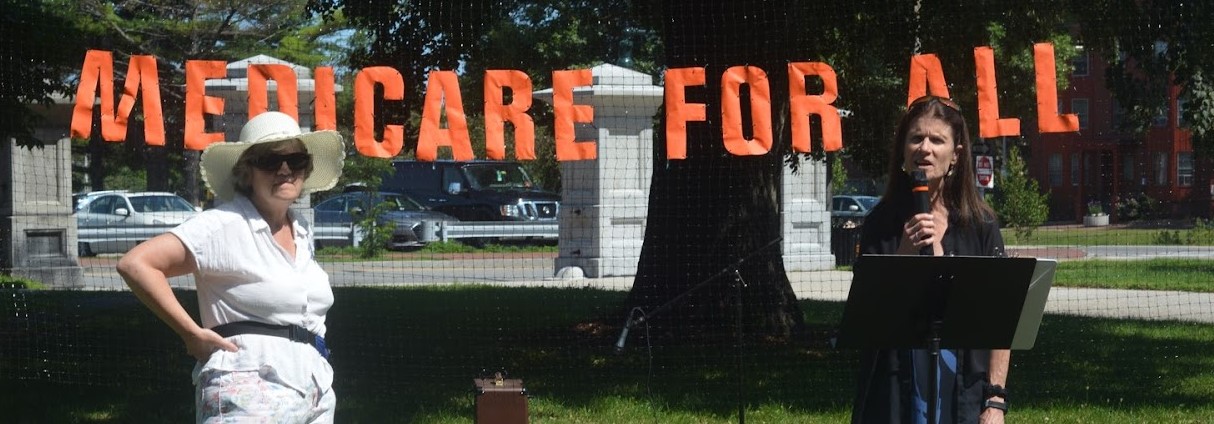
Dr. Julie Pease and state Rep. Poppy Arford speak at a Medicare for All rally in Portland, Maine.

Minnesota

PNHP-Minnesota hosted a workshop in July on passing local government resolutions in support of Medicare for All. Participants heard from health care activists around the state working on active resolution campaigns, as well as those looking to start new campaigns. To get involved in Minnesota, contact pnhpminnesota@gmail.com.

New Jersey

PNHP’s New Jersey chapter hosted a planning session in June to discuss organizing strategies to win national Medicare for All. Speakers included U.S. Rep. Bonnie Watson Coleman, who is vice-chair of the Congressional Progressive Caucus. To get involved in New Jersey, contact Dr. William Thar at wethar@gmail.com.

New York

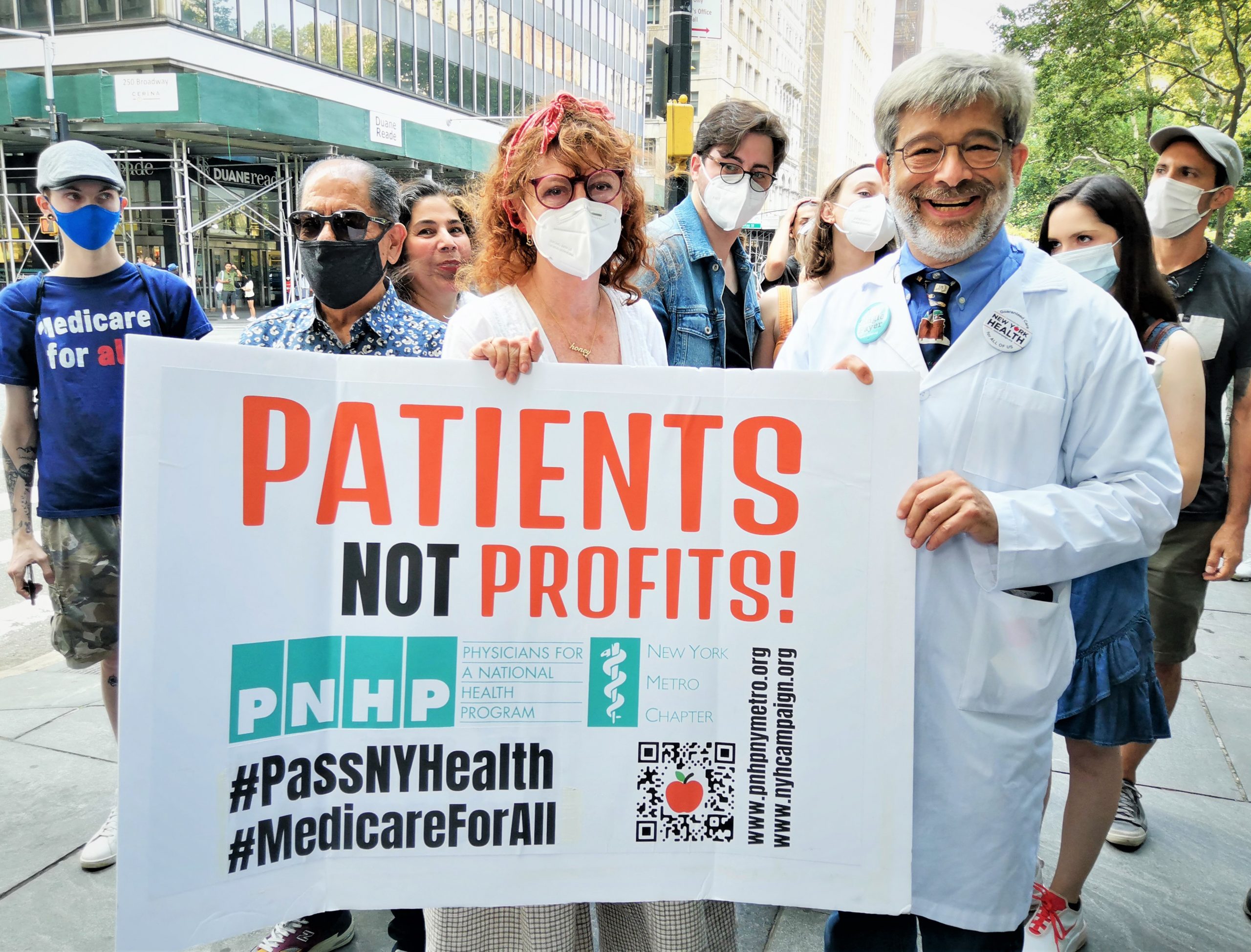
Actor Susan Sarandon and PNHP-NY Metro board member Dr. Steve Auerbach march for Medicare for All in July.

In New York, PNHP’s NY-Metro chapter is continuing to focus on organizing around the New York Health Act, which was introduced this year with majority support in both the Assembly and the Senate. Organizing tactics included social media campaigns, as well as a series of in-person rallies outside of the offices of targeted legislators, along with a large rally and “die-in” civil disobedience outside of the state capitol building. This spring and summer, the chapter also focused on fighting a move by New York City to shift its public union retirees over to a Medicare Advantage plan. PNHP-NY Metro and the NY Statewide Senior Action Council worked with concerned union members, providing them with tools to coordinate the larger group of retirees interested in the fight, and by hosting two informational forums about the proposed change and how it would affect retirees. To get involved in New York, contact NY Metro Executive Director Bob Lederer at info@pnhpnymetro.org.   

North Carolina

In North Carolina, board members of Health Care Justice NC — PNHP’s chapter in Charlotte — led several presentations on the topic of the pandemic, health inequities, and Medicare for All to the Atrium Health System pediatric residents, the staff of the Charlotte Center for Legal Advocacy, and to Duke University’s African-American Covid Taskforce Meeting on July 20. After a vote by the board, chapter members have been contacting their elected representatives to advocate for improvements to traditional Medicare, including lowering eligibility age to 60, coverage for dental, vision, and hearing care, a cap on out-of-pocket expenses, and allowing Medicare to negotiate drug prices. To get involved in Health Care Justice NC, contact Dr. Jessica Schorr Saxe at jessica.schorr.saxe@gmail.com.

Board members of Health Care Justice NC hold a farewell dinner for graduating SNaHP leaders from University of North Carolina and Queens University of Charlotte.

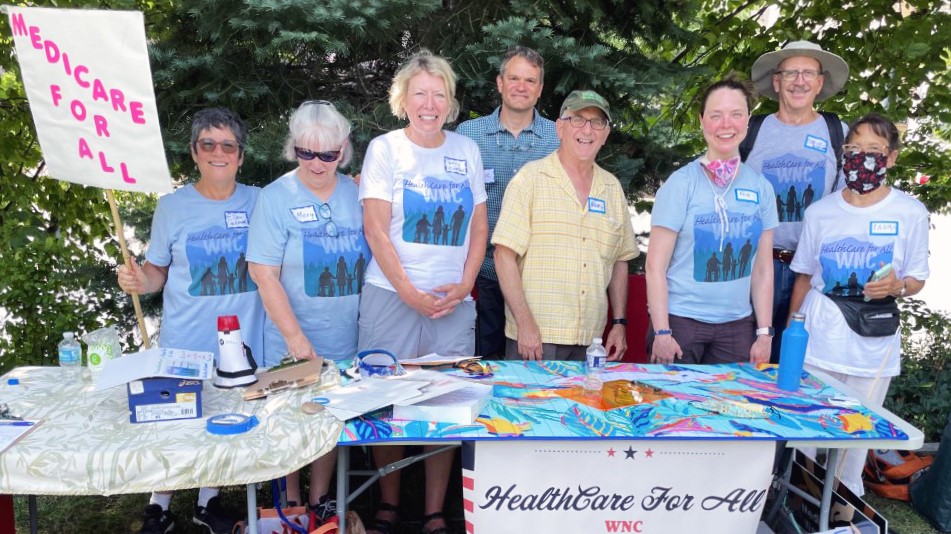
Members of Health Care for All Western North Carolina (HCFA-WNC) in Asheville presented a Medicare for All resolution to the Asheville City Council and the Buncombe County Commission. Members also picketed in solidarity with NNU nurses Mission Hospital, who were organizing for a new contract. HCFA-WNC joined with six other organizations to plan and sponsor a March for Medicare for All which attracted more than 100 marchers. To get involved in HCFA-WNC, contact Terry Hash at theresamhash@gmail.com.

Health Care for All Western NC members help lead the March for Medicare for All in Asheville.

Health Care for All-NC co-hosted a teach-in with the Freelance Solidarity Project, a division of the National Writers Union, about why Medicare for All matters to all freelance workers, and how they can support it. Panelists included Rhiannon Duryea, the national coordinator for the Labor Campaign for Single Payer; Natalie Shure, a writer for The New Republic; and Dominic Harris, president of UE Local 150 in Charlotte and chair of UE 150’s Medicare for All campaign. PNHP is working with the writers’ union leadership to draft a resolution in support of Medicare for All. To get involved in Health Care for All NC, contact Jonathan Michels at jonscottmichels@gmail.com.

Health Care for All-NC joined with union allies to host a teach-in for freelance writers about why Medicare for All matters and how they can fight for it.

Oregon

Members of PNHP Oregon helped to organize a March for Medicare for All rally in July. The chapter has also joined PNHP’s Medical Society Resolutions Campaign, with the goal of passing resolutions in local chapters of internal medicine and pediatrics specialty societies. Dr. Paul Gormann is helping to organize a new chapter of Students for a National Health Program at Oregon Health and Science University. To get involved in Oregon, contact Dr. Peter Mahr at peter.n.mahr@gmail.com.

Pennsylvania

Dr. Judy Albert speaks at the March for Medicare for All in Pittsburgh.

In Pennsylvania, members of PNHP’s Philadelphia chapter met with the chief of staff of Rep. Dwight Evans to learn why he is hesitant to support H.R. 1976, even though he endorsed previous single-payer bills. The chapter will use his response to strategize next steps in their campaign to win support from all members of the area’s Congressional delegation. To get involved in Philadelphia, contact Dr. Walter Tsou at walter.tsou@verizon.net. 

PNHP’s Western Pennsylvania chapter continues to ally with the local labor movement, and recently visited striking members of the United Steelworkers to build solidarity. The chapter also sponsored the Pittsburgh March for Medicare for All in July, which attracted about 100 single-payer activists. To get involved in Western PA, contact Dr. Judy Albert at jalbertpgh@gmail.com.

Tennessee

In Tennessee, PNHP’s State of Franklin chapter (which includes easternmost Tennessee and southwest Virginia) holds monthly Zoom meetings focused on developing single-payer messaging that will appeal to more conservative friends, family and neighbors. In the past year, guest speakers included PNHP past president Dr. Carol Paris and former insurance executive Wendell Potter. Members have also published multiple op-eds and letters to editors in local media, and joined in coalition with other non-physician groups fighting for Medicare for All. To get involved in Tennessee, contact Dr. Bob Funke at r_funke@charter.net or Dr. Robin Feierabend at robin@firerobin.net.

Vermont

PNHP chapters in Vermont and New Hampshire completed their sixth annual summer internship program in July, with 14 rising second-year medical students. Because this year’s internship was online, students could hear from speakers across the country and globe. Topics included the market failures of health policy, the history of the U.S. health care system, the business model of the private insurance industry, and the history and potential of the Medicare, Medicaid and other public programs. The internship also included sessions on advocacy, such as organizing physicians and chapters, educating medical students, utilizing  traditional and social media, and messages for legislators and the general public. To get involved in Vermont, contact Dr. Betty Keller at bjkellermd@gmail.com.

PNHP summer interns enjoy a night together in New York.

Washington

In Washington state, PNHP members held a session on the pros and cons of incremental change in the struggle for single payer. The chapter helped organize the March for Medicare for All in Seattle, and facilitated an opening greeting from Medicare for All lead sponsor Rep. Pramila Jayapal. Members hung Medicare for All banners over Seattle freeways on several occasions. To get involved in Washington, contact Dr. McLanahan at mcltan@comcast.net.

West Virginia

PNHP welcomes its first chapter in West Virginia, which formed in January 2021. The new chapter has been busy crafting by-laws, creating a 12-member board, and launching the first SNaHP chapter in the state. The chapter’s first project is a “55 strong” organizing campaign to recruit a PNHP member in each of the 55 counties of the mainly rural state. They are also actively recruiting in the West Virginia State Medical Association and working on Medicare for All municipal resolutions. To get involved in West Virginia, contact Dr. Daniel Doyle at doyledan348@gmail.com.

back to table of contents


PNHP in the News


News Articles Quoting PNHP Members

Chapters in Action:

“Demonstrators push for ‘Medicare for All’ at west Toledo rally,” WTOL Ch. 11 News, May 22, 2021 [Ohio Chapter]

“Demonstrators in Louisville join nationwide Medicare for All March,” Spectrum News 1 (Louisville), July 24, 2021 [Kay Tillow and Dr. Garrett Adams]

“Thousands march to demand Medicare for All,” Free Speech TV/Rising up with Sonali, July 28, 2021 [Dr. Paul Song]

  • “Dozens turn out for Lakewood SPAN Ohio Healthcare Justice Walk,” Cleveland Plain Dealer, May 24, 2021 [Ohio Chapter]
  • “In New York City, retirees brace for switch to privatized health care,” The Intercept, August 23, 2021 [Len Rodberg, Ph.D and PNHP NY-Metro Chapter]
  • “Pharmacy Benefit Managers: The mystery bureaucrats managing your prescription drugs,” Rhode Island Uprise, August 25, 2021 [Linda L Ujifusa, J.D. and Dr. J. Mark Ryan]
  • “Unions should support health care reform, but many aren’t,” Riverdale Press (NYC), July 18, 2021 [Dr. Len Rodberg]

Health Policy and Research:

“Un-vaxxed tax: Should the unvaccinated have to pay more for health insurance?” MSNBC: All in with Chris Hayes, August 12, 2021 [Dr. Adam Gaffney]

  • “Pragmatic Advocacy: Advancing racial equity in physician associations,” Health Affairs, July 16, 2021 [PNHP]
  • “Many hit hard by pandemic now swamped by medical debt,” U.S. News and World Report/Healthday, July 19, 2021 [Dr. Susan Rogers]
  • “Physicians supporting single payer urge medical societies to join effort,” Inside Health Policy, July 19, 2021 [Dr. Susan Rogers]
  • “Texas’ Abortion Law Could Worsen the State’s Maternal Mortality Rate,” TIME, September 22, 2021 [Dr. David Eisenberg]
  • “Poor Americans more likely to have respiratory problems, study finds,” New York Times, May 28, 2021 [Drs. Adam Gaffney and Steffie Woolhandler]
  • “Rural Tennessee is losing more hospitals than anywhere in the country, but Covid-19 isn’t fully to blame,” The Daily Yonder, July 28, 2021 [Dr. Raymond Feierabend]
  • “You want me to be blind and toothless?” The Indypendent, July 31, 2021 [Dr. Susan Rogers]
  • “When deductibles rise, more diabetes patients skip their meds,” U.S. News and World Report/Healthday, July 30, 2021 [Dr. Danny McCormick]
  • “Minorities less likely to receive specialist care,” Reuters/Medscape, July 21, 2021 [Dr. Chris Cai]
  • “Why Nevada’s modest public option bill is getting heavy attention,” Nevada Current, May 24, 2021 [Dr. Adam Gaffney]
  • “Prescription for health care,” WFHB News, September 9, 2021 [Dr. Ed Weisbart]
  • “Concerns mount over looming surge in bankruptcy as COVID medical debt soars,” Newsweek, June 14, 2021 [Dr. David Himmelstein]
  • “Patients of color less likely to get specialist care than white patients,” Health Day, July 26, 2021 [Dr. Steffie Woolhandler]

back to table of contents

Opinion: Op-eds and Guest Columns

  • “Texas’ uninsured situation is at a crisis point,” by Jack Bernard, The Caller Times (Corpus Christi, TX), May 28, 2021
  • “Memorialize those we lost to COVID. Pass the NY Health Act Now,” by Dr. Duncan Maru, The Queens Daily Eagle, June 3, 2021
  • “Health care for all works,” by Prof. Ellen Oxfeld, Rutland Herald (Vermont), June 16, 2021
  • “Single Payer: A sane, accessible, and affordable health care system,” by Dr. Wayne Strouse, The Chronicle Express (New York), June 21, 2021
  • “The COVID-19 case for Medicare for All,” by Drs. Jeanne Corwin, Jim Binder, and Donald Rucknagel (PNHP members among many co-signers), Cincinnati Enquirer, June 23, 2021
  • “Improved Medicare for All: simple, universal, affordable,” by Bill Semple, LCSW, Boulder Weekly (Colorado), July 1, 2021
  • “Henry Kaiser was right, single-payer health care better for the nation,” by Dr. Samuel Metz, Sandy Post (Oregon), July 6, 2021
  • “Doctor: Voting rights are health care rights,” by Dr. Susan Rogers, Common Dreams, July 7, 2021
  • “When will U.S. healthcare finally be fixed?” by Jack Bernard, Caller Times (Texas), July 16, 2021
  • “Happy birthday, Medicare: You showed that public, universal health insurance is superior,” by F. Douglas Stephenson, LCSW, Common Dreams, July 25, 2021
  • “North Carolina, U.S. health care are not the worst but certainly not the best,” by Jack Bernard, Fayetteville Observer, July 30, 2021
  • “For its 56th birthday, let’s improve Medicare,” by Dr. George Bohmfalk, Aspen Daily News, July 31, 2021
  • “The other pandemic is underinsurance,” by Dr. Marvin Malek, Vermot Digger, August 15, 2021
  • “An Oregon physician on why single payer health care honors key conservative tenets,” by Dr. Samuel Metz, Portland Business Journal, August 18, 2021
  • “Accountable care organizations don’t cut costs. It’s time to stop the managed care experiment,” by Dr. Jim Kahn and Kip Sullivan, STAT, August 23, 2021
  • “Single-payer health care system will improve U.S. health,” by Mary Rossillo (NYU medical student), Albany Times Union, September 8, 2021

back to table of contents

Opinion: Letters to the Editor

  • “Stop hesitating on Health Act,” by Helen Meltzer-Krim, Riverdale Press (New York), May 18, 2021
  • “In support of Medicare for All,” by Dr. George Bohmfalk, The Aspen Times, June 2, 2021
  • “California can have single-payer healthcare right now,” by Dr. Jerome Helman, Los Angeles Times, June 16, 2021
  • “Demand Medicare for All,” by Dr. George Bohmfalk, The Aspen Times, June 21, 2021
  • “Tell legislators to support amendment,” by Dr. Michael Huntington, Corvallis Gazette Times (Oregon), June 25, 2021
  • “We cannot rely on charities; U.S. must overhaul system of health care and how we pay for it,” by Dr. Raymond Feierabend, The Herald Courier (Tennessee), June 27, 2021
  • “New rules are nice, but a new program would be better,” by Ken Lefkowitz, The Washington Post, July 8, 2021
  • “ACRA, ICHRA and CEOs,” by Dr. George Bohmfalk, The Aspen Times, July 21, 2021
  • “Local fight shows need for health care reform,” by Dr. Jay Brock, Fredericksburg Free-Lance Star, July 29, 2021
  • “Vote in support of Medicare for All,” by Tanvee Varma (Yale medical student), New Haven Register, July 30, 2021
  • “Medicare for All saves lives and $$,” by Dr. Justin Paglino, New Haven Independent, July 30, 2021
  • “Health care is a human right,” by Dr. Judy Albert, Pittsburgh Post-Gazette, August 4, 2021
  • “Happy birthday, Medicaid! Expand other health care to cover us all,” by Bob Krasen, Columbus Dispatch, August 8, 2021
  • “Single-payer is much better system,” by Dr. Kathleen Healey, Napa Valley Register, August 26, 2021
  • “Universal health care is solution,” by Dr. Rick Staggenborg, Corvallis Gazette Times (Oregon), August 27, 2021
  • “Health care focus,” by Dr. G. Richard Dundas, Rutland Herald (Vermont), September 2, 2021
  • “Improved Medicare for All is the answer,” by Dr. G. Richard Dundas, Vermont Digger, September 10, 2021
  • “Medicare for All Is the ticket to good health care,” by Dr. Jay Brock, New York Times, September 17, 2021

back to table of contents

PNHP Board Elections 2021: Candidate Biographies


Please click HERE to vote by August 29, 2021


Board Candidate Forum


At-large delegates (2 seats open)

At-large board member not up for election: Stephen Chao, MD (Texas)

Pam Gronemeyer, MD (Illinois)

Biographical statement: I am a board-certified anatomic and clinical pathologist in Glen Carbon, Illinois, near St. Louis. I received a biology degree from Washington University in St. Louis; attended Tufts University School of Medicine; and completed pathology residencies in Boston and St. Louis. I founded SEMC Pathology, which provides services to seven critical access hospitals in southwestern Illinois.

Statement describing your history of involvement with PNHP and/or single-payer advocacy: I’ve been a member of PNHP for 15 years and have attended almost all of the yearly meetings and trainings. I am co-president of PNHP-IL, board member of Missourians for Single-Payer, and founding member of the Illinois Single Payer Coalition. I have given talks to many groups including business women groups, local progressive groups, the NOW and Healthcare NOW! national meetings.

Statement describing what you would like to contribute to PNHP’s Board of Directors: I could add specialty diversity as a pathologist with experience in small metropolitan and rural hospitals. As a business owner of a  pathology service, I have provided platinum healthcare plans to my employees and their dependents. I was a delegate for Bernie Sanders in 2016 and 2020, and on the platform committee in 2016. I am a hard worker and complete the tasks that I am assigned. I have a good working knowledge of the Internet and social media.

What do you see as the most significant challenge for PNHP now and in the future? As a member of PNHP’s Board, how would you address this issue?  PNHP has to expand the base of individuals who will work for the cause. Currently, our elected officials turn a deaf ear to what the majority of people want. We need a grassroots effort and doctors are integral to the process. People trust their providers and know that the provider is speaking from experience. However, it is only by increasing the number of advocates that we can make Congress and the President listen! We must educate and organize.

Member since: 2005

Sanjeev Sriram, MD, MPH (Maryland)

Biographical statement: I founded the “All Means All” campaign to center racial equity in single payer. I am “Dr. America” for act.TV, write in national publications, and was a Bernie Sanders surrogate in 2020. I completed my MD and residency at UCLA, MPH at Harvard, and now practice pediatrics in Maryland.

Statement describing your history of involvement with PNHP and/or single-payer advocacy: After coming to terms with the ACA’s insufficiencies, I joined the single-payer movement in 2017. Shortly afterward, I joined PNHP. With help from Social Security Works, I founded the “All Means All” campaign to center racial equity in single-payer because there can be no health justice without racial justice.

Statement describing what you would like to contribute to PNHP’s Board of Directors: If elected to PNHP’s Board of Directors, my goals would be to strengthen our commitment to single-payer as a source of racial equity. I want our Board to collaborate with racial justice organizations on strategies to broaden single-payer activism. In addition to these efforts, I will seek more structured mentorship and professional development of our SNaHP allies, in order to build and sustain new generations of physician activists for single-payer.

What do you see as the most significant challenge for PNHP now and in the future? As a member of PNHP’s Board, how would you address this issue? We face challenges in cultural arenas about who is worthy of health care. People of color, particularly those with low incomes, undocumented immigrants, and/or identifying as LGBTQIA, are used as pawns by our opposition. Reproductive health faces similar obstacles. We must collaborate with activists from these communities and strengthen cultures of solidarity. Mothers Against Drunk Driving didn’t just change traffic laws. They made drinking and driving a cultural taboo. PNHP has similar work ahead.

Member since: 2018

Philip Verhoef, MD, PhD (Hawaii)

Biographical statement: I received my PhD in Pharmacology and MD from Case Western Reserve University, followed by med-peds residency at UCLA. I joined the faculty at the University of Chicago after a fellowship in adult and pediatric critical care. In 2019, I moved to Kaiser Permanente in Hawaii, where I work as an adult/pediatric intensivist and hospitalist and serve as the Associate Program Director for the Internal Medicine residency program.

Statement describing your history of involvement with PNHP and/or single-payer advocacy: I joined PNHP in 2006 as a resident. When I moved to Chicago in 2009, I joined the Illinois Single Payer Coalition (president from 2015-2018) and PNHP-Illinois (co-president in 2014). I was faculty sponsor for one of the first SNaHP chapters and have served on the PNHP Board as an advisor from 2012-2016 and board member since 2017.

Statement describing what you would like to contribute to PNHP’s Board of Directors: My contributions will reflect the perspectives brought by my unique attributes: I am an active community physician, working as a subspecialist within an integrated health system; I have extensive research experience, with expertise in health care disparities and hospital-based medicine; I have published numerous op-eds and given dozens of academic presentations on single payer and health care reform to medical audiences; and I have organizational experience at a variety of levels, within nonprofit organizations and academia.

What do you see as the most significant challenge for PNHP now and in the future? As a member of PNHP’s Board, how would you address this issue? PNHP’s most significant challenge is to determine how best to activate physicians to mobilize for single payer. Even while surveys indicate >50% support among active practicing physicians for single payer, our active membership constitutes less than 0.5% of those physicians. As a member of PNHP’s board, I will continue to develop strategies for physician engagement, including messaging, programming, development, and recruitment, with a specific focus on expanding our reach to diverse and underserved communities.

Member since: 2006

North East Region (1 seat open)

Board members in this region not up for election: Mary O’Brien, MD (New York) and Janine Petito, MD (Massachusetts)

Douglas DeLong, MD (New York)

Biographical statement: I am a general internist in upstate New York. I have served in many capacities within the American College of Physicians and am emeritus chair of the ACP Board of Regents. I live with my wife Lynn on a 250-acre farm and love Nordic skiing, sailing, and good eats.

Statement describing your history of involvement with PNHP and/or single-payer advocacy: I have been a longtime dues-paying member of PNHP, attended one Annual Meeting and attempted to start a local chapter. My largest contributions have been my advocacy within the ACP. I am proud that it was during my time as Chair of the Board of Regents that the College passed the New Vision statements.

Statement describing what you would like to contribute to PNHP’s Board of Directors: I would bring with me a 43-year history of putting patients first, coupled with a fair understanding of the complexities of the U.S. health care “system”, knowledge regarding advocacy at both state and national levels, experience on working as a board member/leader, and a large network of fellow internists across the country.

What do you see as the most significant challenge for PNHP now and in the future? As a member of PNHP’s Board, how would you address this issue? We are truly living through a historical time and the greatest challenge will be competition with other high-priority issues. Given the existential threat of climate change, worsening wealth inequality, structural racism, etc., it will be difficult to not be overwhelmed by competing priorities. The solution is for PNHP to leverage each of those issues back into the health care debate emphasizing both the fiscal and social determinant arguments.

Member since: 2008

Scott Goldberg, MD (New York)

Biographical statement: I am an attending physician at Montefiore Medical Center in the Bronx, where I supervise and teach residents in the Primary Care/Social Internal Medicine program, and an Assistant Professor at the Albert Einstein College of Medicine. I graduated with honors from the University of Chicago Pritzker School of Medicine and completed residency in 2019 in Internal Medicine-Primary Care at UCSF.

Statement describing your history of involvement with PNHP and/or single-payer advocacy: I started a chapter of SNaHP in 2012 and joined the PNHP Board as a student delegate in 2013. I worked with other students to create an annual student meeting and implement a national student-led day of action for single payer. I remained on the board as a resident until 2019. I have represented PNHP/SNaHP at medical conferences including the Society of General Internal Medicine and the American Osteopathic Association.

Statement describing what you would like to contribute to PNHP’s Board of Directors: As a PNHP board member, I would like to contribute to the fundraising and membership efforts.

What do you see as the most significant challenge for PNHP now and in the future? As a member of PNHP’s Board, how would you address this issue? The greatest challenge for PNHP is increasing the membership and financial resources of the organization to build real power; power that can shape the culture of organized medicine around single payer and, subsequently, undercut the influence of the health insurance lobby. Board members should be responsible for raising a specific amount of money each year or be asked to abandon their seats. PNHP should set the goal of contacting every U.S. physician, and board members should head up specific regional groups to undertake this endeavor.

Member since: 2009

Marvin Malek, MD, MPH (Vermont)

Biographical statement: After completing my internal medicine residency at Cook County Hospital, I’ve spent my career in community medicine, serving as founding medical director of two community health centers in Vermont. For the last five years, I’ve worked at Springfield Hospital, a safety net hospital for a poor rural community in southeastern Vermont. I’ve worked in ER medicine, primary care, and hospital medicine.

Statement describing your history of involvement with PNHP and/or single-payer advocacy: I have been an active member of PNHP since 1988, writing numerous op-eds and giving talks to church groups, Rotary Clubs, and others. I served as president of the Vermont chapter for eight of the last 12 years, helping develop our summer internship program for medical students. From 2001–2008, I hosted and co-produced Public Health Radio, which explored a variety of public health issues. I ran for both State Representative and for Lieutenant Governor as a candidate of the Progressive Party in Vermont, highlighting single payer reform as the best option.

Statement describing what you would like to contribute to PNHP’s Board of Directors: PNHP could expand its activities with more funding. I would like to step up to support existing efforts and work with other preceptors to cultivate additional fundraising strategies to support the summer internship program, possibly even creating fundraising videos (hopefully with student involvement!). Expanding PNHP’s educational offerings through paid CME events, similar to the one offered at last year’s annual meeting, could serve the dual function of educating the membership and generating funds for the organization.

What do you see as the most significant challenge for PNHP now and in the future? As a member of PNHP’s Board, how would you address this issue? A concern for PNHP is the aging of our active membership, including our leadership. This is somewhat unsurprising given the often heavy workload of mid-career physicians, who often face child care demands at the same time. I will continue to work on our summer internship program to cultivate future leadership. Offering online educational events may be a useful strategy to help chapter leaders draw in more of their membership.

Member since: 1988

Wayne Strouse, MD, FAAFP (New York)

Biographical statement: I’ve practiced for more than 20 years in Upstate NY in a solo practice. I’ve worked in socialized medicine (US Navy), and in a single-payer system (New Zealand), so I have firsthand experience of the benefits of these systems over the current U.S. system.

Statement describing your history of involvement with PNHP and/or single-payer advocacy: I have written multiple single-payer resolutions that have been passed by the NY State Academy of Family Physicians and presented nationally. I have lobbied for single payer during our organization’s Lobby Day and written multiple Op-Ed pieces in my local paper. I’ve staffed the PNHP table at various events as well.

Statement describing what you would like to contribute to PNHP’s Board of Directors: Having worked in a single-payer system, I have personally experienced what it is like to provide and receive care under such a system. Thus, I have a unique perspective and can give the Board “real world” advice regarding what works and what may cause problems from an “in the trenches” viewpoint. I work in a very conservative area, and have discussed single payer with my patients. I understand how to win over this group.

What do you see as the most significant challenge for PNHP now and in the future? As a member of PNHP’s Board, how would you address this issue? Education. Neither physicians nor the public understand what single payer means. We must win the information/misinformation battle. The rest of the world has figured this out, the U.S. cannot. Why is there such inertia for something we all hate? Let’s arm our members with the points/counterpoints, and have a media blitz for a better health system. Let’s provide “off the shelf” Op-Ed pieces that can be easily personalized.

Member since: 2006

South Region (1 seat open)

Board member in this region not up for election: Jessica Schorr Saxe, MD (North Carolina)

Ed Weisbart, MD (Missouri)

Biographical statement: I chair the Missouri chapter of PNHP. I practiced family medicine for 20 years, served as CMO of Express Scripts from 2003-2010, and retired clinically in 2021. I completed my medical degree at the University of Illinois and family medicine residency at Michigan State University.

Statement describing your history of involvement with PNHP and/or single-payer advocacy: Single-payer advocacy has been my core focus since organizing the MO chapter of PNHP in 2012. Since then, I’ve delivered more than 600 public presentations and published dozens of pieces on single payer. My PowerPoint presentations are widely used by single payer advocates across the country.

Statement describing what you would like to contribute to PNHP’s Board of Directors: I would like to help the PNHP board continue to develop, clarify its role, increase its influence, and strengthen its relationships with adjacent advocacy organizations. Like all other board members, I bring a background, skill set, and perspective that should both fit with and enhance the board’s functioning.

What do you see as the most significant challenge for PNHP now and in the future? As a member of PNHP’s Board, how would you address this issue? PNHP must continue its strong commitment to single payer while also making itself more thoughtful about political realities. We should embrace proposals that make meaningful progress towards our goal, even when not our ideal solution. For example: policies that improve and/or expand Medicare should be evaluated and, if found favorable on balance, endorsed by PNHP, not dismissed for apparent imperfections. By holding proposals to a purity test, PNHP grows increasingly irrelevant to important allies.

Member since: 1996

North Central Region (1 seat open)

Board member in this region not up for election: Joshua J. Faucher, MD, JD (Illinois)

Judith Albert, MD (Pennsylvania)

Biographical statement: I am a retired physician in Pittsburgh, PA, having practiced in academic and private practice settings for over 30 years. I received my medical degree from the University of Cincinnati, completed residency in Obstetrics and Gynecology at the University of Pittsburgh and fellowship in Reproductive Endocrinology at the University of Pennsylvania.

Statement describing your history of involvement with PNHP and/or single-payer advocacy: I became involved with PNHP in 2017 when I co-founded a new chapter in Western Pennsylvania. Having participated in anti-racist organizing for several years, I was looking for a way to blend anti-racist advocacy with my medical experience. The fight for Medicare for All is uniquely suited to this purpose.

Statement describing what you would like to contribute to PNHP’s Board of Directors: My goal as a board member is to establish working relationships with PNHP chapters in the North Central region to review strategies and combine tactics for coalition building and community engagement. PNHP members have great strength as educators and our mission aligns very well with anti-racist, fair housing and anti-poverty organizations, as well as labor unions. My aim is to listen and learn from these groups so that we can grow the Single Payer movement.

What do you see as the most significant challenge for PNHP now and in the future? As a member of PNHP’s Board, how would you address this issue? PNHP’s most significant challenge is to amplify the popular support for single payer. Aggressive negative media campaigns by the health care industry and the failed leadership of elected officials continue to obscure the fact that the majority of the public wants universal health care. As a board member, I want to participate in the development of broad citizen outreach to counter the message from corporate entities, exposing the truth about the failed model of for profit insurance.

Member since: 2017

John Crosson, MD (Minnesota)

Biographical statement: I completed my residency in internal medicine at Hennepin County Medical Center, followed by a pathology residency and 35 years on staff at HCMC and as faculty member at the University of Minnesota. During my time at the main safety net hospital in Minnesota, I saw how so many patients suffered because of a lack of readily available, affordable health care.

Statement describing your history of involvement with PNHP and/or single-payer advocacy: I started working for single-payer health care over 25 years ago, initially by contributing money, then joining the PNHP-MN board in the mid-2000s. I am co-chair of the board and am the faculty in charge of eight medical student interns. I will continue to work for M4A until it gets passed.

Statement describing what you would like to contribute to PNHP’s Board of Directors: My major contribution to the board would be my passion to see M4A the law of the land and everyone accessing health care when they need to at an affordable price. I have years of experience in administrative roles and committee work in various organizations, during which time I have introduced many new concepts. Of course, I would continue to contribute financially.

What do you see as the most significant challenge for PNHP now and in the future? As a member of PNHP’s Board, how would you address this issue? Movements require a strong grassroots effort, but people must first be educated about the issue. The biggest challenge facing PNHP is the need to educate health care workers and also the general public about M4A. Health care workers have very little time for issues other than professional responsibilities. Our interns are developing social media connections and brief documents to reach younger health care workers. I will be able to bring these ideas to the board.

Member since: 2010

West Region (2 seats open)

Board member in this region not up for election: Eve Shapiro, MD, MPH (Arizona)

Hugh Foy, MD (Washington)

Biographical statement: After completing residency in general surgery and burn surgery at UW in Seattle, I worked at Pacific Medical Center (former USPHS) and then at Harborview, the regional trauma center. Focusing on education, I served as a residency program director and leader of one of UW School of Medicine’s Colleges.

Statement describing your history of involvement with PNHP and/or single-payer advocacy: I am a co-founder of PNHP Washington state chapter (2005), where I have also served as a board member and vice president. In 2003, I participated in a Global Exchange Tour to Cuba. I’ve spoken at many events, including the PNHP Western Washington Annual Meeting, UWSOM SNHaP Chapter, King County Democratic Party, Seattle-King County EMS CME, March for Medicare for All and Bannering for Medicare for All.

Statement describing what you would like to contribute to PNHP’s Board of Directors: My background in trauma surgery and medical education would bring a perspective gained from care of the underserved. It is essential that we plan the training of the next generation to assure a stable flow of medical providers in an appropriate proportion to meet the needs of universal access.

What do you see as the most significant challenge for PNHP now and in the future? As a member of PNHP’s Board, how would you address this issue? We need to reach out to practicing physicians, providers, and trainees more effectively to build a vocal grassroots support for meaningful health care reform. We need to strengthen our ties with existing health care reform organizations, professional organizations, elected representatives, and media outlets and develop better connections to the media to get our word out to the general public.

Member since: 2003

Kathleen Healey, MD (California)

Biographical statement: I am a board-certified otolaryngologist whose career ranged from military service as a flight surgeon, to solo and group practices. My leadership roles included serving as hospital chief of staff and medical director of a multispecialty group. Now retired, I serve as co-chair of PNHP-Napa County and PNHP-California.

Statement describing your history of involvement with PNHP and/or single-payer advocacy: When I retired three years ago, I joined PNHP and helped form our Napa County chapter in California. In 2019, I became co-chair of our state chapter, PNHP-CA. As a member of our Executive Committee, I chair our state’s monthly Steering Committee of regional chapter representatives.

Statement describing what you would like to contribute to PNHP’s Board of Directors: I would collaborate with the PNHP Board of Directors to develop strategies and tactics for increasing our membership among health professionals, increasing our influence in our medical organizations, partnering with businesses to expand our legislative influence and fundraising, and refining our messaging. I want to ensure good two-way communication between the western region and the national office, keeping our members and chapters apprised of issues and decisions, and bringing local concerns to the board.

What do you see as the most significant challenge for PNHP now and in the future? As a member of PNHP’s Board, how would you address this issue? As the premier physicians’ group dedicated to single payer, one of PNHP’s primary challenges is to bring more physicians into our movement. Increasing our involvement in organized medicine at all levels should increase our membership and our legislative influence. Having our new physicians join these organizations will change the composition of these groups over time. Invite all new PNHP and SNaHP members to join their local medical societies, become delegates, network, and form a single payer “caucus.”

Member since: 2018

Stephen Kemble, MD (Hawaii)

Biographical statement: I attended medical school at University of Hawaii and Harvard, and trained in both internal medicine and psychiatry. I am now semi-retired, working part-time in a primary care clinic. I am past president of both the Hawaii Psychiatric Medical Association and the Hawaii Medical Association. I was appointed to the Hawaii Health Authority in 2011, charged with overall health planning and with designing a universal health system. I  joined PNHP in 1989 and currently serve on the board.

Statement describing your history of involvement with PNHP and/or single-payer advocacy: I have a longstanding interest in social justice, health policy, and health care reform. I have written and spoken extensively on single-payer and health policy. I am an active member of One Payer States, an organization working to win single payer at the state level, pending passage of a national single-payer bill. I chair the OPS Policy Work Group, and have contributed to papers on principles for cost-effective single-payer reform, optimizing payment of hospitals and doctors for a single-payer system, plus a paper on the danger of “Trojan Horses” in single-payer bills that allow perpetuation of the competitive insurance business model.

Statement describing what you would like to contribute to PNHP’s Board of Directors: Dr. Rogers has asked me to chair the newly formed PNHP Policy Committee, and I feel that would be the area where I can contribute the most to the organization.

What do you see as the most significant challenge for PNHP now and in the future? As a member of PNHP’s Board, how would you address this issue? The most significant challenge for PNHP is the entrenched money and power of the private health insurance industry, whose relationship to health care has become largely parasitic. We will need sustained public education and community organization and mobilization to overcome the power of the insurance industry and to achieve the goal of eliminating the private insurance business model from health care.

Member since: 1989

Kitchen Table Campaign: Maternal Mortality

PNHP is committed to focusing on specific “Kitchen Table” issues, to show how single-payer Medicare for All would address Americans’ most pressing health care problems. See below for materials related to our Summer 2021 issue, America’s maternal mortality crisis, and scroll to the bottom for a list of additional topics.

America’s maternal mortality crisis (Summer 2021)

The United States is a tragic outlier among virtually all nations when it comes to large-scale, preventable, and worsening maternal mortality. This crisis is especially acute for Black and Indigenous mothers, and could be significantly reduced by meeting basic health needs through readily accessible, lifelong, and culturally competent care.

We encourage you to share the materials below with your colleagues, family members, friends, and neighbors during the summer of 2021 to remind them that our maternal mortality crisis is a kitchen table issue…and that Medicare for All is a necessary part of the solution.

Complete maternal mortality toolkit

  • One-page talking points handout: America’s maternal mortality crisis and Medicare for All
  • Comparison chart: America’s maternal mortality crisis: Current system vs. Medicare for All
  • PNHP Policy Primer: America’s maternal mortality crisis and Medicare for All
  • PowerPoint slides: Our maternal mortality is a solvable problem
  • Webinar: Dr. Beth Pineles on maternal mortality
  • Test your knowledge: Take PNHP’s interactive quiz on America’s maternal mortality crisis
  • Podcast: Dr. Ashley Duhon on reproductive justice and Medicare for All
  • Social media: Share on Facebook, Twitter, or Instagram

Webinar: Dr. Beth Pineles on maternal mortality

Quiz: Test your knowledge of U.S. maternal health

If you need assistance with events or actions, contact the PNHP organizing team at organizer@pnhp.org. For help with messaging materials, contact PNHP communications specialist Clare Fauke at clare@pnhp.org.

If you would like to provide expertise or help develop materials for future Kitchen Table topics, please contact PNHP president Dr. Susan Rogers at s.rogers@pnhp.org.

Additional topics

Review previous installments of the Kitchen Table Campaign, and stay tuned for additional topics in the future:

  • Surprise billing (January 2020)
  • Racial health inequities (February 2020)
  • Rural health (March 2020)
  • Pandemics and public health emergencies (April 2020)
  • COVID-19 and racial health inequities (Spring 2020)
  • COVID-19 endangers health care workers (Summer 2020)
  • Measuring candidate health plans (Fall 2020)
  • Mental health care (Spring 2021)
  • Maternal mortality (Summer 2021)

2021 Annual Meeting

Due to the ongoing surge of the Covid-19 Delta variant, PNHP decided to host our 2021 Annual Meeting in a virtual online format. As much as we wanted to gather in person, we felt that moving the event online was the right thing to do for the health of our members, staff, guests, and the patients that we see everyday in our communities.

Our live sessions took place October 22-23, but we are offering $10 tickets providing post-meeting access to archived content; click HERE to purchase.

Annual Meeting agenda

Friday, Oct. 22

  • 8:00-9:00 p.m. Eastern: Labor leader Jose La Luz discussed the role of workers in the Medicare-for-All movement with PNHP board member Dr. Scott Goldberg and PNHP national coordinator Dr. Claudia Fegan.
  • 9:00-9:30 p.m. Eastern: “Medicare for All on Capitol Hill” panel; Dr. Rachel Madley, Legislative Assistant to Rep. Pramila Jayapal, and Amirah Sequeira, Legislative Director for National Nurses United, provided the latest updates from Capitol Hill and discussed the current political landscape for Medicare for All

Saturday, Oct. 23

  • 11:00 a.m. – 12:00 p.m. Eastern: Health policy and data update from PNHP’s immediate past president Dr. Adam Gaffney
  • 12:30-1:30 p.m. Eastern: “The Future of Medicare for All Physician Activism” panel; Dr. Abdul El-Sayed, co-author of “Medicare for All: A Citizen’s Guide,” spoke on the future of physician activism, and PNHP board members Dr. Phil Verhoef and Dr. Judy Albert, along with SNaHP executive board member Marysol Encarnación, discussed strategies and priorities for the coming year, including medical society resolutions, fighting Medicare privatization, and recruiting more physicians into the movement.
  • 2:00-3:00 p.m. Eastern: Keynote address from Dr. Rupa Marya, an Associate Professor of Medicine at UCSF and faculty director of the Do No Harm Coalition, an organization of health workers committed to structural change to address health problems. Dr. Marya’s research interests include investigating the health effects of police violence on communities, and the impact of urban regenerative agriculture on the health of historically oppressed people. She is also a member of the Healthy California for All Commission, where she brings her perspectives on equity to the dialogue around single-payer health care in California.

Pre-conference learning and leadership opportunities

Registered attendees were invited to participate in interactive and recorded sessions each day of the week preceding the Annual Meeting (Monday, Oct. 18 – Thursday, Oct. 21):

  • Lunch bites: mid-day posting of a 15-minute pre-recorded webinar
  • Leadership Training (LT): interactive skill-building workshop
  • Member Interest Groups (MIG): interactive session where members convened around topics of mutual interest

Monday, Oct. 18

  • Lunch bite: How a Medicare-for-All bill becomes law, with Eagan Kemp
  • 7:00-8:00 p.m. Eastern, MIG: Reproductive Health, led by Dr. Diljeet Singh
  • 8:00-9:00 p.m. Eastern, LT: Moving Media, with Clare Fauke
  • 9:00-10:00 p.m. Eastern, MIG: Research Guild, led by Dr. Jim Kahn & Dr. Danny McCormick

Tuesday, Oct. 19

  • Lunch bite: Medicare privatization and DCEs, with Dr. Ana Malinow
  • 2:00-3:00 p.m. Eastern, MIG: Retired Physicians, led by Dr. Kathleen Healey & Dr. Carol Paris
  • 8:00-9:00 p.m. Eastern, LT: Moving Legislators, with Public Citizen & Municipal Resolutions
  • 9:00-10:00 p.m. Eastern, MIG: Pediatricians, led by Dr. Eve Shapiro

Wednesday, Oct. 20

  • Lunch bite: Modern Monetary Theory, with Dr. Philip Verhoef
  • 10:30-11:30 a.m. Eastern, MIG: Resolutions, led by Dr. Wayne Strouse
  • 8:00-9:00 p.m. Eastern, LT: Moving Medicine, with Dr. Jane Katz Field & Kevin Rymut

Thursday, Oct. 21

  • Lunch bite: Hospital closures and public health, with Dr. Walter Tsou
  • 7:00-8:00 p.m. Eastern, MIG: Rural Health, led by Dr. Betty Keller
  • 8:00-9:00 p.m. Eastern, LT: Moving Unions, with the Committee of Interns and Residents (CIR)
  • 9:00-10:00 p.m. Eastern, MIG: Young Physicians, led by Dr. Scott Goldberg

Student scholarships

Medical and health professional students are invited to REGISTER for post-meeting access to the conference videos and other materials free of charge. Please spread the word to any and all medical and health professional students who may wish to sign up.

Physician members who want to support the future of our movement can DONATE to the Nicholas Skala Student Activist Scholarship Fund, which makes it possible to offer free online access to student members, and which will fund travel and lodging expenses for students to attend our next in-person meeting.

2020 Annual Meeting

Looking for archival video and other materials from our recent virtual conferences? Click HERE for materials from our (fall) 2020 Annual Meeting and HERE for materials from our (spring) 2021 Leadership Training.

PNHP Newsletter: Summer 2021

Table of contents

Click the links below to jump to different sections of the newsletter. To view a PDF version of the shorter print edition of the newsletter, click HERE.

If you wish to support PNHP’s outreach and education efforts with a financial contribution, click HERE.

If you have feedback about the newsletter, email info@pnhp.org.

PNHP News and Tools for Advocates

  • PNHP celebrates new Medicare for All legislation, H.R. 1976
    • What’s new in the 2021 bill?
    • What’s next for the Medicare for All bill?
    • Learn more about H.R. 1976
    • Take action
  • Kitchen Table Campaign
  • 2021 Virtual Leadership Training
  • 2021 Annual Meeting: Oct. 22-24
  • Medicare for All Financing: How will we pay for it?
  • Welcome to PNHP’s new executive director
  • Chapter Event Calendar
  • Board nominations

Research Roundup

  • Data Update: Health care crisis by the numbers
    • Costs of Care
    • Drug Prices
    • Coverage Saves Lives and Money
    • Health Inequities
    • Veteran’s Health
    • Health Care for Profit
    • Commercial Health Insurance: A Dangerous and Defective Product
    • Medicare Advantage & Medicaid Managed Care
    • Dark Money in Health Care
    • Public Support for Reform
  • Featured Report: The Lancet Commission on public policy and health in the Trump era
  • Studies and analysis of interest to single-payer advocates

PNHP Chapter Reports

  • California
  • Colorado
  • Illinois
  • Kentucky
  • Maine
  • Minnesota
  • Missouri
  • New Hampshire
  • New York
  • North Carolina
  • Oregon
  • Pennsylvania
  • Vermont
  • Washington State

PNHP in the News

  • News Articles Quoting PNHP Members
  • TV and Video
  • Radio and Podcasts
  • Opinion: Op-eds and Guest Columns
  • Opinion: Letters to the Editor

PNHP News and Tools for Advocates


PNHP celebrates new Medicare for All bill in the House

On March 17, Reps. Pramila Jayapal (D-Wa.), Debbie Dingell (D-Mich.), and 110 original co-sponsors introduced the Medicare for All Act of 2021 (H.R. 1976). Like previous versions of the Medicare for All Act, H.R. 1976 closely mirrors PNHP’s Physicians’ Proposal for Single-Payer Health Care Reform. It would establish a national health program to cover everybody living in the U.S. for all medically necessary care, including hospitalization and doctor visits; dental, vision, hearing, mental health, and reproductive care, including abortion; long-term care services and supports; ambulatory services; and prescription drugs. Patients could visit the doctor or hospital of their choice, without copays or deductibles. The program would pay independent and small group practice providers on a fee-for-service basis, and fund hospitals and other large facilities with yearly global operating budgets; separate funds would be used for capital improvements. By eliminating the profiteering and waste of commercial insurance, Medicare for All would save $600 billion per year while expanding coverage to all.

What’s new in the 2021 bill?

After months of dialogue with health justice advocates, Rep. Jayapal made some significant new improvements to this year’s bill. H.R. 1976 would:

  • Protect the national health program by preventing any future administration from reducing or eliminating existing benefits;
  • Establish an Office of Health Equity to monitor and eliminate health disparities, and promote primary care;
  • Increase access to mental health care by including Licensed Marriage and Family Therapists and Licensed Mental Health Counselors in the list of covered providers;
  • Improve health services for indigenous peoples by providing additional funding for the Indian Health Service;
  • Expand support for disabled Americans by expanding eligibility for long-term care supports and services;
  • Respond to future public health crises by automatically increasing hospitals’ global budgets during pandemics or other public health emergencies.

What’s next for the Medicare for All bill?

H.R. 1976 has gained three more co-sponsors since its introduction in March, but needs much more support in Congress to move forward. PNHP members can help by educating themselves and their colleagues about the bill, and then urging lawmakers to sign on. The following resources can help advocates get started.

Learn more about H.R. 1976:

  • One-page summary covering major features of the bill;
  • Comparison chart contrasting Medicare for All with commercial insurance;
  • PowerPoint slides from Dr. Ed Weisbart offering a primer on the bill;
  • Full text of H.R. 1976

Take action:

  • Send an email to your representative or call them at (202) 224-3121 and ask them to co-sponsor the bill. If your representative is already a co-sponsor, thank them for their support and ask them to push for hearings in Congress. Click HERE for a list of current co-sponsors;
  • Schedule an in-person meeting with your representative or a health policy staffer at their district office. These meetings are a crucial part of building a relationship with lawmakers.
  • Get active with the PNHP chapter in your city or state. If you don’t live near a PNHP chapter, use THIS LIST of more than 300 groups that endorsed H.R. 1976 to find an allied organization in your area.

back to table of contents

2021 Kitchen Table Campaign

PNHP’s Kitchen Table Campaign (KTC) was launched in January of 2020, just as the presidential candidates were fiercely debating their health care proposals. With so many different plans in the mix — from the public option to “Medicare Advantage for All” —  PNHP wanted to show voters how single-payer Medicare for All would address the urgent problems that families discussed around the kitchen table. Each KTC toolkit was designed for a general audience, and included handouts, slide shows, webinars, podcasts, videos, social media posts, and sample letters-to-the-editor.

The first phase of KTC focused on surprise billing, racial health inequities, and rural health. During Covid-19, the campaign pivoted to the topics of Medicare for All and public health emergencies, and the pandemic’s impact on health care workers and racial health inequities. Ahead of the 2020 elections in November, the KTC issued a Health Care Voters Guide, with a checklist for evaluating candidates’ health plans.

PNHP re-launched the KTC in 2021 with a focus on America’s mental health crisis. The campaign explained the ways that commercial insurers discriminate against mental health care, by underpaying mental health professionals, limiting patients’ choice of provider, and denying coverage for treatments like medication, therapy, and hospitalization. By contrast, Medicare for All would provide comprehensive mental health coverage with free choice of provider.

This summer, the KTC will explore reproductive health, highlighting the barriers that patients face in our fractured health system, and how Medicare for All could remove them. PNHP members who wish to get involved in the Kitchen Table Campaign should contact clare@pnhp.org.

back to table of contents

Spring 2021 Virtual Leadership Training

PNHP hosted its first-ever virtual Leadership Training in late April. While there’s no substitute for gathering in person, the program provided activists with a combination of skill-building, strategy, and networking opportunities. All programs were recorded and are available to view online:

  • “Physician Advocacy & Local Organizing” presented by PNHP-IL Co-President Dr. Monica Maalouf
  • “Organizing a Summit” presented by SNaHP leader Robertha Barnes
  • “Talking about Health Insurance 101” presented by PNHP Board Adviser Dr. Diljeet Singh
  • “Organizing a Webinar” presented by Healthcare-NOW! Director of Communications Stephanie Nakajima (with additional reference materials HERE)
  • “Building Relationships with Elected Officials” presented by PNHP National Coordinator Dr. Claudia Fegan
  • “Building Bridges across Generations, from Medical Students to Retired Physicians” panel discussion featuring SNaHP leaders Alankrita Siddula and Ashley Lewis in conversation with PNHP leaders Dr. Richard Bruno and Dr. Daniel Lugassy

The Leadership Training keynote address was made by legendary public health advocate Dr. Linda Rae Murray, who reminded activists that the core skills needed to practice medicine are also the skills needed to be effective advocates for health justice. Dr. Murray explained that advocates must always listen, seek new information, and “connect the dots” between different forms of injustice. Physicians in particular must truly understand the medical system and all its dysfunction before they can work to change it. PNHP members can view and share Dr. Murray’s presentation HERE.

back to table of contents

Save the date for our 2021 Annual Meeting

back to table of contents

New toolkit on Medicare for All financing: How will we pay for it?

When advocating for Medicare for All, PNHP members are often asked how the country could afford universal coverage. The short answer is, “We’re already spending enough to provide comprehensive coverage to all — we’re just not getting our money’s worth.”

But to provide the “long” answer, PNHP-Minnesota interns Conor Nath and Preethiya Sekar, along with advisors John A. Nyman, Ph.D., Gordon Mosser, M.D., and Kenneth Englehart, M.D., analyzed a decade’s worth of post-ACA financing studies. They determined that Medicare for All could provide universal coverage without an increase in national health spending by controlling health costs in the long term.

The team’s findings can be found on PNHP’s dedicated single-payer financing page, pnhp.org/PayingForIt. The page includes detailed infographics, a PowerPoint presentation, and a policy primer on the data, as well as links to the original studies, older (pre-ACA) studies, and studies of state single-payer plans. PNHP will continue to update the page as new studies become available.

back to table of contents

PNHP welcomes new executive director

On May 1, PNHP welcomed Ken Snyder as executive director. In this role, Ken will work closely with PNHP leaders to grow our membership, increase fundraising, and expand our organizing and communications capacity. Ken brings more than 20 years of experience working for social change within a variety of organizations, including grassroots community groups, labor unions, and legislative campaigns. His organizing expertise will be invaluable as PNHP redoubles its efforts to organize physicians in support of single payer and to strengthen the capacity of PNHP and SNaHP chapters at the local level — all while advancing PNHP’s role as a leader in developing evidence-based health policy.

PNHP members can reach Ken at ken@pnhp.org. PNHP’s previous executive director Matthew Petty will assume the role of deputy director and continue to oversee many of our administrative, management, and fundraising functions (matt@pnhp.org). The rest of the PNHP staff team includes national organizer Kaytlin Gilbert (kaytlin@pnhp.org) and communications specialists Dixon Galvez-Searle (dixon@pnhp.org) and Clare Fauke (clare@pnhp.org).

back to table of contents

New Chapter Events National Calendar

Many PNHP and SNaHP chapters have found creative ways to continue their outreach and education efforts during the pandemic, including webinars and online public forums. Because these online events are open to anyone regardless of location, they provide an opportunity to reach advocates across the nation. In order to facilitate broader participation, PNHP created a Chapter Events National Calendar, a tool that allows chapters and coalition partners to share their online events with other members. Chapter leaders are encouraged to submit their virtual events to the PNHP organizing team at: organizer@pnhp.org.

back to table of contents

PNHP Board Nominations Open

Nominations for PNHP’s Board of Directors are now open, with seats up for election in all regions and for at-large representation. In order to promote an open and transparent process, the Board has not slated candidates in advance, and invites nominations and applicants from members interested in contributing to a diverse Board of Directors.

The following seats are up for election for 2-year terms:

  • At-large (2 seats)
  • North East region (1 seat)
  • South region (1 seat)
  • North Central region (1 seat)
  • West region (2 seats)

Nominations and inquiries can be sent to Matt Petty at matt@pnhp.org by July 15, 2021. Ballots for electronic voting will be circulated in Summer 2021; be sure your current email address is on file with PNHP’s office.

back to table of contents


Research Roundup


Data Update Spring 2021

Costs of Care

Nearly one-fifth (18%) of U.S. adults and 35% of low-income earners say they did not seek treatment for a health problem in the last year due to cost. An equal number say that if they needed some form of health care today they would not be able to afford it. This current measure of health care unaffordability runs considerably higher among Black adults (29%) and somewhat higher for Hispanic adults (21%) than for white adults (16%). In order to pay for health care in the past year, 12% of Americans have cut back on spending on food; 11% cut back on over-the-counter drugs; and 35% reduced spending on recreational activities, including 21% of those in households earning at least $180,000 per year. Witters, “In U.S., an estimated 46 million cannot afford needed care,” Gallup, 3/31/2021

Total costs for ACA marketplace plans were 83% higher compared to Medicaid. For patients, out-of-pocket spending was 10 times higher in marketplace plans vs. Medicaid: $20.29 vs. $2.80 for office visits, $106.21 vs. $7.27 for emergency visits, and $6.82 vs. $2.40 for prescriptions — even after accounting for federal cost-sharing reductions. Allen et al., “Comparison of utilization, costs, and quality of Medicaid vs. subsidized private health insurance for low-income adults,” JAMA Network Open, 1/5/2021

Cancer care is increasingly unaffordable due to rising out-of-pocket expenses imposed by commercial insurers. In 2018, patients paid a combined $5.6 billion in out-of-pocket cancer costs. These costs vary substantially based on a patient’s insurance plan: When premiums, deductibles, copays and coinsurance were calculated, cancer patients with ACA-compliant plans paid between $5,000 and $12,000 out-of-pocket. Those in short-term limited duration plans spent a staggering $52,000 out-of-pocket, mostly due to high deductibles and poor coverage of prescription drugs. Cancer-caused financial hardship falls hardest on young people, people of color, and those who have lower incomes and education levels. “The Costs of Cancer: 2020 Edition,” The American Cancer Society Cancer Action Network, October 2020 

A study of income inequality and health care affordability among wealthy nations reveals stark disparities in the U.S. In the past year, 38% of U.S. adults skipped needed doctor visits, tests, treatments, follow-up, or prescription medicines because of cost; 36% skipped dental care; 22% were unable to pay medical bills. Among low-income U.S. adults, 50% skipped doctor visits, tests, treatments, follow-up, or prescription medicines because of cost; 51% skipped dental care; and 36% were unable to pay medical bills; 28% worried about being able to afford basic necessities such as food or housing. Doty et al., “Income-related inequalities in affordability and access to primary care in eleven high-income countries,” Health Affairs, 12/9/2020

Even before the pandemic, millions of Americans traveled to other countries for savings of up to 80% percent on medical treatments. In 2019, more than 1% of Americans traveling internationally did so for health treatments, although that figure only accounts for those who traveled by air and does not include the thousands who crossed the U.S.-Mexico border using ground transportation. Mexico and Costa Rica are the most popular destinations for dental care, cosmetic surgery, and prescription drugs; Thailand, India, and South Korea attract patients for more complex procedures such as orthopedics, cardiovascular, cancer, and fertility treatments. Yeginsu, “Why medical tourism is drawing patients, even in a pandemic,” New York Times, 1/19/2021

Sixty percent of Americans have been in debt due to medical bills. According to a new survey, 37% of adults currently owe medical debt and 23% have had medical debt in the past, with the average debt between $5,000 and $10,000. The top drivers of medical debt are emergency room visits (39%), doctor or specialist visits (28%), surgery (26%), childbirth (22%), and dental care (20%). Medical debt affects people’s financial and mental health, as 19% of those with medical debt said it’s preventing them from buying a home and 68% say they have  lost sleep worrying about it. Giovanetti, “60% of Americans have been in debt due to medical bills,” LendingTree/Qualtrics survey, 3/21/21

The number of health-related fundraisers on GoFundMe has skyrocketed. Medical fundraisers increased from 42 campaigns in 2010 to nearly 120,000 in 2018, and now account for more than a quarter of all campaigns on the site. In that time, patients requested $10.2 billion in donations for health care costs, and received more than $3.6 billion. The most common campaign was for cancer treatment, followed by care for trauma/injury and care for neurological conditions. Angraal et al., “Evaluation of internet-based crowdsourced fundraising to cover health care costs in the United States,” JAMA Network Open, 1/11/2021

back to table of contents

Drug Prices

A recent survey found a large number of Americans face financial hardship due to the price of medications. 36% of patients say they have forgone their medications to pay for essential items and bills; 43% have forgone paying for essential items and bills to afford their medications; and 41% skipped or reduced doses to stretch out their prescription. “2021 Medication Access Report,” CoverMyMeds, 1/26/2021

Even a modest increase in out-of-pocket costs has shown to significantly lower medication adherence and increase mortality among patients. Using data from Medicare’s prescription drug program, researchers discovered that raising patients’ out-of-pocket costs by just $10 per prescription led to a 23% drop in overall drug consumption, and to a 33% increase in mortality. Researchers found that when faced with higher costs, seniors did not drop “low-value” drugs, but instead cut back life-saving, high-value drugs such as those to lower cholesterol (statins), blood pressure (ACE inhibitors, beta blockers), and blood sugar (oral hypoglycemics); and drugs that treat acute exacerbations of emphysema and asthma (inhalers). Chandra et al., “The health costs of cost-sharing,” National Bureau of Economic Research Working Paper 28439, February 2021

U.S. prescription drug list prices have more than doubled in recent years. Between 2010 and 2016, the median drug wholesale list price increased by 129% and median insurance payments after rebates and discounts increased by 64%, while median patient out-of-pocket costs increased by 85% for specialty medicines and by 42% for non-specialty drugs. Yang et al., “Changes in drug list prices and amounts paid by patients and insurers,” JAMA Network, 12/9/2020

Prescription drug prices in the U.S. are 256% higher than prices in 32 comparable countries. Among the 33 countries studied, the U.S. accounted for 58% of revenues, but just 24% of volume. Most of the discrepancy was caused by prices for brand name drugs, which in the U.S. averaged 3.44 times higher than the prices in other nations. Some of the highest-priced brands treat life-threatening illnesses, Hepatitis C, or cancers. Drug spending in the U.S. jumped by 76% between 2000 and 2017. Mulcahy et al., “International prescription drug price comparisons: Current empirical estimates and comparisons with previous studies,” RAND Corporation, 1/28/2021

Medicare Part D spent more than twice as much on hundreds of prescription drugs compared to the Dept. of Veterans Affairs. In a sample of 399 brand-name and generic prescription drugs, the VA paid an average of 54% less per unit than Medicare, even after accounting for rebates and discounts; 233 drugs were at least 50% cheaper and 106 were at least 75% cheaper. Specifically, VA’s prices were 68% lower than Medicare’s for the 203 generic drugs (an average difference of $0.19 per unit) and 49% lower for the 196 brand-name drugs (an average difference of $4.11 per unit). The price difference is almost entirely due to the VA’s ability to negotiate drug prices. “Prescription drugs: Department of Veterans Affairs paid about half as much as Medicare Part D for selected drugs in 2017,” U.S. Government Accountability Office, 1/14/2021

Pharmaceutical companies hike their list prices substantially each year, and 2021 is no exception. More than 100 drug firms raised list prices on 636 drugs in the first week of January, with a median price hike of 5% — more than four times the rate of inflation. For the 19th year in a row, AbbVie raised the price of the world’s best-selling drug, Humira, which is used to treat autoimmune diseases such as rheumatoid arthritis, by 7.4%. The price for two pens — enough for up to one month of treatment — is now $5,968. Contrary to what drug manufacturers argue, two-thirds of Americans pay for some or all of the cost of their medication based on the list price, including 9% of Americans who are uninsured, 40% with high-deductible plans, and 18% with Medicare. “Pharma raises prices on over 600 drugs to start the new year,” Patients for Affordable Drugs, 1/14/2021

back to table of contents

Coverage Saves Lives and Money

Medicare eligibility means better access to care. Medicare eligibility at age 65 is associated with a 50.9% reduction in reports of being unable to get necessary care compared with the percentage at age 64, and a 45.3% reduction in not being able to get needed care because of the cost. Jacobs, “The impact of Medicare on access to and affordability of health care,” Health Affairs, February 2021

Medicare eligibility at age 65 is associated with a rise in early-stage cancer diagnoses and a resulting survival benefit. Researchers discovered a greater jump in diagnoses for the four most common cancers — lung, breast, colon, and prostate — at the transition from 64 to 65 than at all other age transitions, suggesting that older adults are delaying care for financial reasons until they enroll in Medicare. For example, colon cancer diagnoses showed a consistent increase of just 1-2% each year from 61 to 64, then at 65 jumped to nearly 15%. Diagnosis rates then declined for all cancers in the years following age 65. Compared to uninsured older adults under 65, Medicare-enrolled cancer patients had lower five-year cancer-specific mortality rates. Patel et al., “Cancer diagnoses and survival rise as 65‐year‐olds become Medicare‐eligible,” Cancer, 3/29/2021 

Survival after cancer diagnosis is considerably lower in younger uninsured patients than in older Medicare patients. Uninsured patients ages 60–64 were nearly twice as likely to present with late-stage cancer and were significantly less likely to receive surgery, chemotherapy, or radiotherapy compared to Medicare beneficiaries ages 66–69, despite lower comorbidity among younger patients. Compared with older Medicare patients, younger uninsured patients had significantly lower five-year survival across cancer types: Five-year survival in younger uninsured patients with late-stage breast or prostate cancer was 5–17% lower than among older Medicare patients. Silvestri et al., “Cancer outcomes among Medicare beneficiaries and their younger uninsured counterparts,” Health Affairs, May 2021

Medicaid expansion is correlated with fewer deaths. Researchers identified 4,800 fewer deaths per year out of a sample of 3.7 million people living in Medicaid expansion states, or roughly 19,200 fewer deaths over the first four years of Medicaid expansion, compared to the mortality rate pre-expansion. Conversely, in a sample of 3 million people in non-expansion states, researchers identified 15,600 additional deaths over this four year period that could have been avoided if the states had expanded coverage. Miller et al., “Medicaid and mortality: New evidence from linked survey and administrative data,” National Bureau of Economic Research Working Paper 26081, January 2021

Medicaid expansion is correlated with improved treatment for colon cancer. Compared to non-expansion states, patients who lived in Medicaid expansion states had an increase in Stage I diagnoses and were more likely to receive treatment within 30 days. Among surgical patients, Medicaid expansion correlated with fewer urgent cases and more minimally invasive surgery; Stage IV patients were more likely to receive palliative care. Hoehn et al., “Association between Medicaid expansion and diagnosis and management of colon cancer,” Journal of the American College of Surgeons, 11/23/2020

Children who gained health coverage during the rollout of Medicaid in the late 1960s enjoyed lifelong health and financial benefits. The first Medicaid covered cohort (born between 1955 and 1975) were less likely to die young or to have a disability as an adult, and were more likely to be employed, compared to peers who were not enrolled; the improvements in longevity and disability added 10 million quality-adjusted life years to this cohort. Medicaid enrollment also saved taxpayers money as the covered individuals had less later need for disability, unemployment, or similar safety-net benefits, saving governments $200 billion (in 2017 dollars) — more than twice the cost of coverage. Goodman-Bacon, “The long-run effects of childhood insurance coverage: Medicaid implementation, adult health, and labor market outcomes,” Opportunity and Inclusive Growth Institute, Federal Reserve Bank of Minneapolis, October 2020

Medicaid expansion has been good for hospitals’ financial health. In 2017, hospitals in states that expanded Medicaid saw an average decrease of $6.4 million on uncompensated care — a 53.3% drop — compared to the pre-expansion period. Uncompensated care comprised 6% of total expenses for hospitals in non-expansion states, which is double the amount for hospitals in expansion states. Medicaid expansion had the most impact on operating margins for safety-net hospitals and small (fewer than 100 beds) hospitals. Blavin and Ramos, “Medicaid expansion: Effects on hospital finances and implications for hospitals facing Covid-19 challenges,” Health Affairs, January 2021

Excess mortality in the U.S. is higher than peer nations — except for the oldest adults. Compared to 18 European countries, the U.S. ranked among the worst for excess mortality in working-age adults, resulting in more than 400,000 excess deaths and 13 million years of life lost in 2017, a 64.9% increase since 2000. Excess mortality is most severe for Americans aged 30 to 34, who were three times more likely to die than their European counterparts. However, the U.S. had lower death rates in people aged 85 and older – 97,788 fewer deaths than the European standard; this advantage in older adults (who are covered by Medicare in the U.S.) has only increased since 2000. Preston and Vierboom, “Excess mortality in the U.S. in the 21st century,” Proceedings of the National Academy of Sciences, 4/20/2021 

back to table of contents

Health Inequities

Black mortality remains far higher than white mortality in America’s 30 largest cities. From 2016 to 2018, the national all-cause mortality rate among Black Americans was 24% higher than among whites (960 v. 777 per 100,000), resulting in 74,402 excess Black deaths annually. The mortality rates among Black populations were significantly higher in 29 of America’s 30 biggest cities. Washington, D.C. had the biggest disparity, with a death rate for Black residents that was more than twice as high as the white mortality rate. In both Chicago and New York, more than 3,500 Black people died annually because of this health inequity. Benjamins et al., “Comparison of all-cause mortality rates and inequities between Black and white populations across the 30 most populous U.S. cities,” JAMA Network, 1/20/2021

The pandemic has exacerbated disparities in life expectancy between white and Black Americans. Overall life expectancy in the U.S. dropped one full year during the first half of 2020 (from 78.8 years in 2019 to 77.8 years in mid-2020), but with major racial disparities. For white people, life expectancy decreased by 0.8 years (78.8 to 78); but for Black people, life expectancy decreased by 2.7 years (74.7 to 72). White Americans now live an average of six years longer than Black Americans, up from a four-year difference in 2019. Arias et al., “Provisional life expectancy estimates for January through June, 2020,” National Center for Health Statistics, February 2021

A new survey shines a light on discrimination within U.S. health care. 21% of adults say they have experienced discrimination in the health care system, and 72% of those experienced discrimination more than once. Among those reporting discrimination, racial/ethnic discrimination was the most common type (17.3%), followed by discrimination based on educational or income level (12.9%), weight (11.6%), sex (11.4%), and age (9.6%). Of the patients who reported discrimination, 63% were women and 60% had household incomes of less than $50,000 a year. Nong et al., “Patient-reported experiences of discrimination in the U.S. health care system,” JAMA Network Open, 12/15/2020

Contrary to the claims of former President Trump and other elected officials, undocumented immigrants are not an economic burden on safety net facilities such as hospital emergency departments. Undocumented immigrants used far fewer health services and incurred lower health costs than U.S. citizens. Annual health expenditures were $1,629 for unauthorized immigrants, compared to $3,795 for authorized immigrants and $6,088 for U.S.-born individuals. Unfortunately, undocumented immigrants were also more likely to be uninsured: Nearly half of unauthorized immigrants (47.1%) were uninsured compared with 15.9% of authorized immigrants and 6.0% of U.S.-born individuals. Wilson et al., “Comparison of use of health care services and spending for unauthorized immigrants vs. authorized immigrants or U.S. citizens using a machine learning model,” JAMA Network, 12/11/2020

The poverty rate jumped to 11.7% in November 2020, up from 9.3% in June, the biggest increase since the government began tracking poverty 60 years ago. Poverty — officially an income of $26,200 or less for a family of four — has risen most for Black Americans (up 3.1 percentage points, or 1.4 million people) and for Americans with high school degrees or less (up 5.1 percentage points, or 5.2 million people). These populations have experienced the largest job losses during the pandemic. Households with children have also seen a larger-than-average increase in poverty: About 2.3 million children under 17 have fallen into poverty since June. Han et al., “Real-time poverty estimates during the Covid-19 pandemic through November 2020,” 12/15/2020

More than 110 rural hospitals have closed from 2013 to 2020, resulting in longer distances for care, fewer providers, and less services for residents of the closed hospitals’ service areas. The share of hospitals that offered general medical and surgical care in rural communities dropped from 81% in 2012 to 39.7% in 2017. After rural hospitals closed, the average distance traveled for inpatient care increased by 20.5 miles; for emergency care, travel increased 20.9 miles; for coronary care, 31.6 miles; and for substance use disorder treatment, nearly 40 miles. Counties with hospital closures also lost significant numbers of health providers. From 2012 to 2017, the availability of physicians in closure counties dropped from a median of 71.2 to 59.7 doctors per 100,000 residents. “Rural hospital closures: Affected residents had reduced access to health care services,” U.S. Government Accountability Office (GAO), December 2020

back to table of contents

Veteran’s Health

Veterans who get their care at Veteran’s Affairs (VA) facilities live longer after a medical emergency compared to those receiving non-VA care. In a study of veterans age 65 and older who were dual eligible for VA and Medicare benefits, those who were treated inside the VA system for a medical emergency had a 46% reduction in 28-day mortality compared to those treated outside the VA; survival gains persist for at least a year after the initial ambulance ride. Notably, this “VA advantage” was as large for Black and Hispanic veterans as for white ones. The VA also reduced per-patient cumulative spending at 28 days by $2,548, approximately 21% less than private providers. Evidence suggests that the “VA advantage” comes from two factors: more effective care coordination, and information retrieval through a common electronic medical record system. Chan et al., “Is there a VA advantage?: Evidence from dually eligible veterans,” National Bureau of Economic Research, November 2020

back to table of contents

Health Care for Profit

Hospital relief funds from the 2020 CARES Act helped wealthy hospitals most, while safety-net hospitals were hemorrhaging. Funding distribution was based on hospitals’ past revenue and did not account for existing assets or investments, favoring institutions with wealthier, commercially-insured patients over those whose patients were uninsured or covered by Medicaid or Medicare. In May of 2020, Baylor Scott & White Health, the largest nonprofit hospital system in Texas, accepted $454 million in relief funds and laid off 1,200 employees, but reported an $815 million surplus in 2020 — $20 million more than in 2019 —  resulting in a 7.5% operating (aka profit) margin. UPMC in Pittsburgh accepted a $460 million bailout and then reported $2.5 billion more in revenue in 2020 than in 2019, along with an $836 million operating surplus, partly due to the growth of the health insurance plan the system owns. Mayo Clinic received $338 million in federal funds, then ended 2020 with a $728 million surplus and $202 million more in revenue than in 2019. Rau and Spolar, “Despite Covid, many wealthy hospitals had a banner year with federal bailout,” Kaiser Health News, 4/5/2021

U.S. hospitals charge an average of $417 for every $100 of their actual costs. The “markups” — which have more than doubled over the past 20 years —  have resulted in hospital profits skyrocketing by 411% from 1999 to 2017. The markups are led by for-profit hospitals: 95 of the 100 hospitals with the highest charges relative to costs are investor-owned; all 100 are owned by hospital systems, as opposed to being independently operated community hospitals. For-profit HCA Healthcare owns 53 of the top 100 markup hospitals, including the hospital with the highest charge-to-cost ratio in the U.S., Poinciana Medical Center in Kissimmee, Florida, whose charge-to-cost ratio is a staggering 1,808%. “Fleecing Patients: Hospitals charge patients more than four times the cost of care,” National Nurses United, November 2020

HCA Healthcare was also found to have netted $1.6 billion from excessive emergency department admissions. A new analysis found the investor-owned hospital chain admits far more Medicare patients who visit its emergency departments compared to the national average. This practice of unnecessary admissions may have netted HCA excess Medicare payments of $1.6 billion since 2009. Banow, “Shareholder group calls out HCA for alleged excessive emergency department admissions,” Modern Healthcare, 3/2/2021

Hospitals have been invoking a century-old liens law to bypass insurance — especially Medicaid — and sue patients for the full cost of their care. Since Medicaid typically pays less than commercial insurance, hospitals realized that in the case of car accidents (where an insurance settlement was expected), it was more lucrative to bypass Medicaid and place a lien on patients’ accident settlements. For one patient, the hospital should have billed Medicaid for $2,500, but instead placed a lien for $12,856 — the “sticker price” charged to uninsured patients. These liens can ruin patients’ credit scores and leave them unable to pay for future care. The practice is so lucrative that some hospitals hire investigators to scan police accident reports in search of patients who might have been in a crash. Kliff and Silver-Greenberg, “How rich hospitals profit from patients in car crashes,” New York Times, 2/1/2021

High staff turnover in for-profit nursing homes likely contributed to high patient deaths during the pandemic. Nursing homes accounted for more than one-third of all Covid-19 deaths in the U.S., and high staff turnover rates made it harder for facilities to implement strong infection controls during the pandemic. Researchers found the average annual turnover rate was 128%, with some facilities experiencing turnover that exceeded 300%. Turnover rates were much higher at for-profit institutions and those owned by chains. Gandhi et al., “High nursing staff turnover in nursing homes offers important quality information,” Health Affairs, March 2021

When private equity (PE) firms acquire nursing homes, patients die more often. PE investment in nursing homes has exploded in recent years, from $5 billion in 2000 to more than $100 billion in 2018. Going to a PE-owned nursing home increased mortality for patients by 10% against the average. Researchers estimate that 20,150 lives of Medicare enrollees — about 1,000 deaths per year on average — were lost due to PE ownership of nursing homes from 2000 to 2017. PE-owned facilities tend to reduce staffing by 1.4%, as well as reduce the number of hours that front-line nurses spend providing basic but critically important patient services such as bed turning and infection prevention. Researchers also found a 50% increase in the use of antipsychotic drugs in PE facilities, which is associated with higher mortality in elderly people. Gupta et al., “Does private equity investment in healthcare benefit patients? Evidence from nursing homes,” National Bureau of Economic Research Working Paper 28474, February 2021

Top executives at the companies fighting hardest against Medicare for All earned more in compensation in 2020 than any other year. Despite the pandemic, the CEOs of  commercial insurance, pharma, and investor-owned hospitals made record income, largely due to the value of their stocks. For example, David Cordani of Cigna made $79 million (six times as much as 2019), and $73 million of that came from stock. Dave Ricks of Eli Lilly made $68 million (twice as much as 2019), $58 million from stock. Sam Hazen of the HCA Healthcare hospital chain made $84 million (four times as much as 2019), with $66 million from stock. In 2019, the CEOs of 179 leading health care companies collectively took home almost $2.5 billion, an amount that is four times what the Centers for Disease Control and Prevention were allocated to study and prepare for all “emerging and zoonotic infectious diseases” in the year before the global pandemic. Herman, “Health giants disclose hefty pandemic year paydays for top executives,” Axios, 3/23/2021; and “Health care CEO pay outstrips infectious disease research,” Axios, 6/1/2020

back to table of contents

Commercial Health Insurance: A Dangerous and Defective Product

Commercial insurers did little to relax prior authorization (PA) policies during the pandemic, causing delays in care and poor treatment outcomes for patients. In a new survey of providers, nearly all doctors (94%) reported care delays while waiting for PA, and 79% had patients abandon treatment due to PA struggles with insurers. One-third of physicians had a patient suffer a serious medical event as a result of delayed treatment, almost 20% said the delay caused a life-threatening event or hospitalization, and 9% said that PA led to a patient’s disability/permanent bodily damage, birth defect, or death. Physicians said they processed 40 PAs per week, which require 16 hours of additional work time. “2020 AMA prior authorization (PA) physician survey,” American Medical Association, 4/7/2021

Administrative “sludge” caused by health insurers costs the economy billions of dollars in employee stress, absenteeism, and reduced productivity. Researchers estimated that the direct cost of the time spent by employees dealing with health insurance representatives was $21.6 billion, with 53% of that time (worth $11.4 billion) spent at work. People who spent more time on the phone with their insurer were less satisfied with their workplace, less engaged, more likely to report significant stress and burnout, and more likely to have missed a day or more of work. The additional absences caused by insurance hassles are estimated to cost employers $26.4 billion; the productivity cost of reduced satisfaction was approximately $95.6 billion. Pfeffer et al., “Magnitude and effects of ‘sludge’ in benefits administration: How health insurance hassles burden workers and cost employers,” Academy of Management Discoveries, October 2020

One out of every six workers whose primary health insurance comes from an employer are staying in jobs they might otherwise leave out of fear of losing their health benefits. Black workers (21%) are more likely to say they would stay in an unwanted job for purposes of keeping their health benefits than white workers (14%). The fear of losing coverage is also pronounced among workers making less than $48,000 a year. Witters, “One in six U.S. workers stay in unwanted job for health benefits,” Gallup, 5/6/2021

Commercial insurers reported record profits in 2020 because enrollees utilized hospitals and doctors at much lower levels during the pandemic. UnitedHealth Group, the nation’s largest insurer, reported 2020 profits of $15.4 billion. Humana reported a profit of $4.6 billion, a 40% increase over its 2019 profits of $3.5 billion. Cigna took in $8.5 billion in profits, a 66% increase from its 2019 profits of $5.1 billion. Burns, “The pandemic one year in: Despite large profits in 2020, health insurers see volatility ahead,” Managed Healthcare Executive, 3/11/2021

And despite the pandemic, commercial insurance executives still had record paydays. Centene CEO Michael Neidorff made almost $59 million in 2020, roughly 1.5 times more than what he made in 2019. Centene collected $1.8 billion in profit, up 37% from 2019. Note that Centene gets almost all of its revenue from taxpayer-funded health programs, including Medicare Advantage, Medicaid managed care, military and federal employee plans, and health staffing in prisons and jails. Centene Corporation, Schedule 14A Preliminary Proxy Statement, U.S. Securities and Exchange Commission, 3/12/2021 

back to table of contents

Medicare Advantage & Medicaid Managed Care

Medicare Advantage (MA) increases national health spending. In 2019, the U.S. spent $3.8 trillion on health care, an increase of nearly 5% from 2018. While costs increased in nearly all sectors of health care, an outsized spending bump was seen in the MA program run by commercial insurers. MA costs increased 14.5% in 2019, up from an already high 12.6% growth in 2018. Per-capita enrollee spending in MA plans grew 6.3% in 2019, almost three times the 2.4% per capita growth rate of traditional (fee-for-service) Medicare. Martin et al., “National health care spending in 2019: Steady growth for the fourth consecutive year,” Health Affairs, 12/16/2020

2020 was an extremely profitable year for commercial insurers in Medicaid and Medicare. Last year, commercial insurers pocketed $200 in average gross margins per enrollee per month in their Medicare Advantage (MA) plans, up from $139 per month in 2018. By the end of 2020, 26.4 million people were enrolled in MA plans, up 41.4% from 2017. For Medicaid managed care plans, commercial insurers kept $71 per enrollee per month in gross margins, up from $36 in 2018. Last year, 53.9 million people were enrolled in Medicaid managed care plans, which accounts for 69% of all Medicaid enrollees. Tepper, “Insurers set sights on growth in Medicare Advantage, Medicaid managed care,” Modern Healthcare, 3/6/2021

More than one out of every 10 rural seniors (10.5%) in a Medicare Advantage (MA) plan switched to traditional Medicare between 2010 and 2016. By contrast, only 1.7% of rural enrollees in traditional Medicare moved to MA during this period. Switching from MA to traditional Medicare was driven primarily by low satisfaction with care access, and was most common among MA enrollees who experienced higher costs, such as hospitalization or long-term facility stay. Among those requiring more expensive services, rural enrollees were twice as likely to switch from MA to traditional Medicare as nonrural enrollees (16.8% versus 8.3%), suggesting that limited provider options in rural areas were a major factor for the change. Park et al., “Rural enrollees In Medicare Advantage have substantial rates of switching to traditional Medicare,” Health Affairs, March 2021

Medicare Advantage (MA) plans use “chart reviews” to extract more profits from taxpayers. MA plans receive capitated payments based on an enrollee’s number and severity of clinical conditions, but plans are allowed to review charts to add conditions not present in claims data (also known as “upcoding”), which increases their risk-adjusted payments. Examining encounter data from 2015, researchers found that MA plans’ “chart reviews” were associated with a $2.3 billion increase in payments, a 3.7% increase in Medicare spending going to MA plans. Just 10% of plans accounted for 42% of the additional spending attributed to chart review; among these plans, the relative increase in risk score from chart review was 17.2%. Meyers and Trivedi, “Medicare Advantage chart reviews are associated with billions in additional payments for some plans,” Medical Care, February 2021 

A Humana Medicare Advantage plan in Florida improperly collected nearly $200 million by overstating how sick patients were. Certain conditions such as some cancers or uncontrolled diabetes net the plans more money from Medicare because they are costlier to treat, but auditors found that many of these conditions did not match patients’ medical records. For example, Medicare paid $4,380 too much in 2015 for treatment of a patient whose throat cancer had previously been resolved but was still claimed as active by the insurer. Auditors estimated that Humana received at least $197.7 million in net overpayments for 2015. Schulte, “Humana Health plan overcharged Medicare by nearly $200 million, federal audit finds,” Kaiser Health News, 4/20/2021

back to table of contents

Dark Money in Health Care

New financial disclosures by the commercial insurance front group “Partnership for America’s Health Care Future” shed light on just how much the industry spends to block health care reform. In 2019, the group raised more than $55 million and spent roughly $20 million, ending the year with $36 million in assets, according to its tax return. During the 2020 Democratic presidential primary campaign, the Partnership spent $4.5 million on television ads attacking Medicare for All, and continues to spend millions to block a public option plan in Colorado. Sirota and Perez, “The establishment is gearing up against even a public option,” Jacobin, 12/ 9/2020

Insurers spent record amounts lobbying Congress as Democrats crafted new Covid relief bills in early 2021. America’s Health Insurance Plans spent $3.9 million on lobbying in the first quarter of 2021, a 7% increase over the same time period last year and the most AHIP has ever spent in a first quarter. Kaiser Foundation Health Plan (which is nonprofit) spent $2 million on lobbying in the first quarter of 2021, a 200% increase from the same time last year. Centene, which runs multiple Medicaid managed care, ACA, and Medicare Advantage plans, spent $1.4 million lobbying in the first quarter of 2021, an 80% increase from 2020. Hellmann, “Insurers spent more on lobbying as Congress debated ACA and COBRA subsidies,” Modern Healthcare, 4/20/2021

Pharma increased its lobbying spending by 6.3% in the first quarter of 2021. Drug and health product manufacturers, along with their national association, spent a combined $92 million to lobby the federal government from January through March; the industry’s first-quarter spending was more than double what was spent by the second-highest-spending industry, electronics companies. There are currently 1,270 registered lobbyists for pharmaceuticals and health products — more than two lobbyists for every member of Congress. “Industry Profile: Pharmaceuticals/Health Products,” Center for Responsive Politics, April 2021

The pharmaceutical industry funneled millions to prominent dark money groups that pushed pharma-friendly messages in the last election. In 2019, the Pharmaceutical Research and Manufacturers of America, or “PhRMA,” raised nearly $527 million — a $68 million increase from 2018 — and spent $506 million. The group’s largest political donation ($4.5 million) went to the American Action Network, a dark-money group that launched several multi-million dollar ad campaigns opposing both Pres. Trump’s proposal to let Medicare negotiate drug prices and House Democrats’ bill to lower drug prices. In 2019, PhRMA also gave nearly $1.6 million to Center Forward, a dark-money group aligned with moderate “Blue Dog” Democrats. Evers-Hillstrom, “Pharma lobby poured millions into ‘dark money’ groups influencing 2020 election,” Center for Responsive Politics, 12/8/2020

back to table of contents

Public Support for Reform

Voters want bold action on health care reform. Covid-19 has made health care reform a priority for voters regardless of political affiliation, race, location, or background. Three in four voters say health care should be a high priority for Pres. Biden and Congress this year, including a strong majority of Democrats (91%), independents (75%), and Republicans (58%). More than eight in ten voters believe that the health care system today “works more for the benefit of the insurance and drug industries than the average person.” Roughly nine in ten voters say it is important for Congress and the president to take action to lower drug prices and health care costs this year. Rather than being worried about Congress “going too far,” 67% of voters (including majorities of Democrats, independents, and Republicans) are concerned that Congress will not go far enough to bring down drug costs. “Finishing the Job: Americans want action on the cost of health care this year, new poll shows,” Families USA and Hart Research Associates, March 2021

back to table of contents

Featured report: The Lancet Commission on public policy and health in the Trump era

This February 10, 2021 report from the Commission offers the first comprehensive assessment of the detrimental legislation and executive actions during Trump’s presidency, while also tracing the preceding decades of policy failures that left the U.S. lagging behind other high-income nations on life expectancy. The report warns that a return to pre-Trump era policies is not enough to protect health. Instead, sweeping reforms are needed to redress long-standing racism, weakened social and health safety nets that have deepened inequality. The Commission includes PNHP members Drs. Adam Gaffney, Steffie Woolhandler, David U. Himmelstein, Mary Bassett, Olveen Carrasquillo, Danny McCormick, Linda Prine, Altaf Saadi, David Bor, Samuel Dickman, Kevin Grumbach, Martin Shapiro, Lello Tesema, and Micheal Lighty, MA and Richard Gottfried, JD.

Among the report’s topline findings:

  • 461,000 fewer Americans would have died in 2018, and 40% of U.S. deaths during 2020 from COVID-19 would have been averted if the U.S. had death rates equivalent to those of the other G7 nations;
  • The U.S. was uniquely unprepared for the pandemic due to its degraded public health infrastructure. Between 2002 and 2019, public health spending fell from 3.21% to 2.45% – approximately half the share of spending in Canada and the UK; 50,000 state and local health department jobs were cut, effectively reducing the front-line workforce by 20%;
  • Prior to the pandemic, midlife mortality for Indigenous and Black Americans was 59% and 42% higher, respectively, than for white people. The pandemic has widened the Black-white mortality gap by 50%, and has cut Latinx life expectancy by more than 3.5 years;
  • Between 2016 and 2019, the number of annual deaths from environmental and occupational factors increased by more than 22,000 after years of steady decline;
  • Even before the pandemic, the number of uninsured Americans grew by 2.3 million during Trump’s presidency, including 726,000 children.

For additional materials, including video of the introductory panel discussion and media coverage of the Lancet Commission report, visit pnhp.org/LancetCommission.

back to table of contents

Studies and analysis of interest to single-payer advocates

“Pricing universal health care: How much would the use of medical care rise?” by Adam Gaffney, M.D., M.P.H., David U. Himmelstein, M.D., Steffie Woolhandler, M.D., M.P.H., and James G. Kahn, M.D., M.P.H. Health Affairs, Jan. 5, 2021. This new study concludes that predictions of large cost increases under a single-payer system are likely wrong, and that universal coverage increases the overall use of care only modestly or not at all. The finite supply of providers’ time and hospital beds has constrained cost and utilization increases in essentially all past coverage expansions; new services would likely be offset by reductions in useless or low-value care currently over-provided to the well-off.

“Congressional Budget Office scores Medicare for All: Universal coverage for less spending,” by Adam Gaffney, M.D., M.P.H.,  David Himmelstein, M.D., and Steffie Woolhandler, M.D., M.P.H., Health Affairs Blog, Feb. 16, 2021. For the first time in a quarter century, the CBO issued an economic analysis of single-payer reform, projecting that it would achieve universal coverage, bolster provider revenues, and eliminate almost all copayments and deductibles, even as it reduced overall health spending. The authors discuss the CBO’s estimates of national health spending, the implications for providers, and concerns about “provider congestion” under a single-payer system.

“The health costs of cost-sharing,” by Amitabh Chandra, Evan Flack, and Ziad Obermeyer, National Bureau of Economic Research Working Paper 28439, Feb. 2021. Even a modest increase in out-of-pocket costs has shown to significantly lower medication adherence and increase mortality among senior patients. Raising patients’ out-of-pocket costs by just $10 per prescription led to a 23% drop in overall drug consumption, and to a 33% increase in mortality. When faced with higher costs, seniors did not drop “low-value” drugs, but instead cut back life-saving, high-value medications.

“Medicare Advantage for all? Not so fast,” by Ken Terry and David Muhlestein, Health Affairs, March 11, 2021. Some health policy experts have suggested that the best route to universal coverage might be to expand Medicare Advantage (MA) rather than enact Medicare for All. However, MA plans have not saved Medicare any money relative to traditional Medicare. To the extent that they lower costs, the lion’s share of those savings flow to insurance companies, partly in the form of profits: Between 2016 and 2018, annual gross margins in the MA market averaged $1,608 per covered person.

“Income-related inequality in affordability and access to primary care in eleven high-income countries,” by Michelle M. Doty, Roosa S. Tikkanen, Molly FitzGerald, Katharine Fields, and Reginald D. Williams, Health Affairs, Dec. 9, 2020. Compared to peers in ten other high-income countries, low-income adults in the U.S. fared worse on affordability of care, including skipping needed doctor or dentist visits, tests, treatments, follow-up, and prescription medicines because of cost, and having serious problems paying medical bills. Low-income Americans had worse access to primary care, with relatively few having a regular provider and more having avoidable emergency department visits.

“Unprepared for COVID-19: How the pandemic makes the case for Medicare for All,” by Eagan Kemp and Kate Thomas, Public Citizen, March 2021. Despite having less than 5% of the world’s population, the U.S. has had 25% of the world’s confirmed Covid-19 cases and 20% of the deaths. This white paper lays out how the for-profit health care system left the U.S. vulnerable and unprepared for the pandemic, and how a single-payer system would have helped the U.S. response to the crisis and prevented thousands of deaths.

“We are all in this together: Covid-19 and the case for Medicare for All,” by Hebah Kassem, Congressional Progressive Caucus Center, March 2021. Produced in collaboration with PNHP and other Medicare for All coalition partners, this report explains why the U.S. health care system was so dreadfully unprepared for a pandemic and how Medicare for All would address the deficiencies in our current system to ensure that everyone has guaranteed comprehensive health care.

“Draining the pool: Our collective responsibility to end racism in medicine,” by Vanessa E. Van Doren, M.D., and Tracey L. Henry, M.D., M.P.H., M.S., Society of General Internal Medicine Forum, October 2020. In this opinion piece, two young physicians urge their colleagues to first acknowledge that the institution of medicine is steeped in a tradition of racism, and then do the uncomfortable work of evaluating whether their own institutions are living up to their moral promise.

“Health care roulette: What is likely to kill me first?” by Vanessa E. Van Doren, M.D., and Tracey L. Henry, M.D., M.P.H., M.S., Annals of Internal Medicine (Fresh Look), Oct. 28, 2020. A doctor-in-training describes the frustration and heartbreak she feels when patients can’t afford the interventions needed to stay alive, forcing her to play a form of health care “roulette” to decide which treatment is most urgent and which to defer because of cost. With Medicare for All, “rather than betting—with their lives—about which medical conditions to address, we could simply provide the standard of care.”

back to table of contents


PNHP Chapter Reports


California

PNHP California endorsed A.B. 1400, the single-payer California Guaranteed Health Care for All bill, as well as H.R. 1976 in the U.S. House. The Santa Barbara chapter held several events to pressure elected officials to support these bills, including a caravan of 40 cars carrying Medicare-for-All signs in February, and a march to the offices of state legislators Monique Limón and Steve Bennett in April. Members also helped circulate a statewide petition demanding that Gov. Newsom apply for federal waivers allowing the state to implement single payer. At the local level, chapters in Chico, Sonoma, and Santa Barbara successfully passed Medicare-for-All resolutions in their city councils. PNHP-CA just welcomed a chapter of Students for a National Health Program (SNaHP) at the new Kaiser Permanente Bernard J. Tyson School of Medicine in Pasadena. To get involved in California, contact Dr. Kathleen Healey at khealey.ent@gmail.com.

Several dozen activists begin a Medicare for All march in front of the Santa Barbara Courthouse on April 17.

Colorado

In January, PNHP-CO collaborated with SNaHP leaders at the University of Colorado to host a forum called, “Medicare for All 101.” PNHP-CO co-directors Drs. Rick Bieser and Cecile Rose were the keynote speakers at the “Beyond the ACA” forum sponsored by Health Care for All Colorado. PNHP members are also active in the statewide “Push to Pass” coalition which is pushing the state’s Congressional delegation to support emergency Medicare coverage for the unemployed and a permanent Medicare-for-All program. The coalition recently met with staff members for Rep. Diana DeGette, and Sens. John Hickenlooper and Michael Bennet. To get involved in Colorado, contact Dr. Bieser at rgbieser@gmail.com.     

Illinois

Medical students Paul Ehrlich and Alankrita Siddula meet with Rep. Marie Newman on April 1 in Chicago.

PNHP and SNaHP members are part of a coalition that won over two new co-sponsors for H.R. 1976, the Medicare for All Act of 2021. Rep. Mike Quigley signed on for the first time after years of pressure from local activists, and newly elected Rep. Marie Newman signed on after defeating a Democratic incumbent who refused to support single payer. SNaHP students

Paul Ehrlich and Alankrita Siddula met with Rep. Newman in April to encourage her to provide more leadership for Medicare for All among her colleagues. PNHP Illinois also supports “Save Our VA,” a campaign that works to improve benefits and oppose privatization, union busting, and facility closures at Veterans’ Health facilities. To get involved in Illinois, contact Dr. Anne Scheetz at annescheetz@gmail.com. 

Kentucky

Kentuckians for Single Payer Health Care is working to protect seniors from being charged more or denied a “Medigap” policy because of pre-existing conditions. The group found that many seniors who first enrolled in Medicare Advantage (MA) plans run by commercial insurers later switched to traditional Medicare because of MA’s narrow networks and hidden costs. But when seniors switched to Medicare they were often denied coverage for supplemental “Medigap” policies due to pre-existing health conditions. KSPHC is helping to pass a state bill that would forbid commercial insurers from denying coverage based on factors such as age, health status, claims experience, or medical condition. In addition to their work on Medigap plans, chapter leaders have spoken at several events, including a hearing at a church in Louisville and a meeting of residents in internal medicine. To get involved in Kentucky, contact Kay Tillow at nursenpo@aol.com.

Maine

Maine AllCare has recently formed a new nonprofit called Maine Health Care Action. In January, MHCA launched a ballot initiative that would direct the state legislature to “create a bill that ensures comprehensive, publicly funded, privately delivered health care for every Maine citizen.” The resolve language has already been accepted by the Secretary of State and needs 63,067 signatures to appear on the ballot in November of 2022. In 2021, chapter members passed Medicare-for-All resolutions in the towns of Brooklin, Surry, Tremont, Brooksville, and Bar Harbor, in addition to the five municipal resolutions passed in 2020. To get involved in Maine, contact info@maineallcare.org.

Minnesota

In honor of Black History Month, PNHP-MN partnered with Health Care for All Minnesota and the Minnesota Nurses Association to host a February screening and discussion of “The Power to Heal.” In April, the chapter hosted a presentation on the economics of single payer by health economist Dr. John Nyman, who explained that six leading studies all conclude that Medicare for All can save money while expanding coverage. Dr. Nyman was also a key advisor to PNHP-MN interns Conor Nath and Preethiya Seka, who analyzed numerous single-payer financing studies during the summer of 2020, and whose conclusions can be read at pnhp.org/PayingForIt. To get involved in Minnesota, contact pnhpminnesota@gmail.com.

Missouri

PNHP-MO is working with other consumer groups in the state to develop an educational and advocacy campaign about the hazards of the Medicare Advantage program run by commercial insurers. The campaign will focus on the lack of consumer protections, guaranteed issue, and community rating for Medigap plans, which create a trap for seniors who join Medicare Advantage. The coalition is pursuing a grant that could fund an actuarial analysis, professional message development, and the launch of a community educational campaign. To get involved in Missouri, contact Dr. Ed Weisbart at pnhpMO@gmail.com.

New Hampshire

The Granite State PNHP chapter worked with local activists to introduce Medicare-for-All resolutions in two towns, one of which passed successfully. Chapter leaders have also given online presentations about single payer to a number of Rotary groups in the state. This summer, the chapter is collaborating with colleagues in Vermont to once again sponsor an internship for medical students. To get involved in New Hampshire, contact Dr. Donald Kollisch at Donald.O.Kollisch@dartmouth.edu. 

New York

PNHP members in New York are working to pass the single-payer New York Health Act, which was introduced this year with majority support in both the House and the Senate. On March 23, the NY Metro chapter held a Health Worker, Student, and Resident Virtual Lobby Day, where activists attended workshops and met with state legislators and their staff. The chapter continues to hold online forums on health care justice topics. January’s forum on systemic racism in medicine, called “Unequal Treatment: The Unjust Death of Dr. Susan Moore,” included prominent speakers Drs. Mary Bassett, Mary Charlson, and Camara Phyllis Jones, who discussed the importance of demanding institutional accountability for change. The forum in March explored how a state single-payer program would spur an equitable economic recovery from the pandemic. To get involved in New York, contact NY Metro Executive Director Bob Lederer at info@pnhpnymetro.org.

Experts on racial health inequities spoke at the NY Metro chapter’s January forum, “Unequal Treatment: The Unjust Death of Dr. Susan Moore,” which addressed racism in medicine.

North Carolina

Members of Health Care Justice NC meet with Rep. Alma Adams to discuss her support for the Medicare for All Act.

Members of Health Care Justice NC in Charlotte met with Rep. Alma Adams ahead of the introduction of the 2021 Medicare for All Act in the House. They encouraged her to be an original co-sponsor of the bill and to broaden her advocacy for single payer. Chapter leaders also met with a member of the Mecklenburg County Commission to discuss a proposal for restorative justice in Charlotte as well as a county resolution for Medicare for All. The area’s SNaHP members continue to produce short videos that can be viewed at newimprovedmedicareforall.org. To get involved in Health Care Justice NC, contact Dr. Jessica Schorr Saxe at jessica.schorr.saxe@gmail.com.

Members of Health Care for All NC held an emergency Human Rights Day press conference on December 10. Speakers from PNHP, the National Domestic Workers Alliance, Char­lotte City Work­ers Union, the NC Council of Churches, and the NC Medicare for All Coalition discussed the pandemic’s toll on the health of Americans and demanded single-payer Medicare for All.

As a follow-up action, the NC Medicare for All Coalition held a series of “Medical Bill Burns” in Charlotte, Asheville, and Durham where participants burned their medical bills and shared their health care horror stories; the burn events were covered by several local news outlets. To get involved in Health Care for All NC, contact Jonathan Michels at jonscottmichels@gmail.com.

Members of the NC Medicare for All Coalition hold a “Medical Bill Burn” where participants share health care horror stories and toss their medical bills in the fire.

Healthcare For All – Western North Carolina (HCFA-WNC) launched a YouTube channel to share health care stories from community members, as well as a special page on their website with resources to fight racism and white supremacy. The chapter is working on passing a Medicare-for-All resolution in the Asheville city council, and forming a broader coalition with other groups in the area such the Sunrise Movement, the Poor People’s Campaign, and National Nurses United. To get involved in HCFA-WNC, contact Terry Hash at theresamhash@gmail.com.

Oregon

PNHP members are active on the Oregon Universal Care Task Force. Dr. Samuel Metz serves on the Finance and Revenue subcommittee and has developed a financing plan for a potential state single-payer system. In April, Dr. Metz debated Michael Cannon of the Cato Institute in a lively event hosted by the Oregon Health Forum, “Single Payer vs. Free Market: A Debate on the Future of Healthcare.” In Corvallis, members are organizing several events this spring and early summer, including a town hall on how to fund universal health care in Oregon, how to finance Medicare for All nationally, and on racial inequities in health care. To get involved in Oregon, contact Dr. Peter Mahr at peter.n.mahr@gmail.com.

Pennsylvania

PNHP and SNaHP members in western Pennsylvania host a flu vaccine clinic for striking steelworkers.

Members of PNHP’s chapter in Western Pennsylvania, along with local medical students, organized a flu vaccine clinic for steelworkers in Farrell, Penn. who had lost their comprehensive health coverage during an ongoing strike. In April, the chapter sponsored PNHP’s webinar called “Addressing Racial Inequity in Healthcare: Strategies in the Fight for Achieving Health Justice.” To get involved in Western PA, contact Dr. Judy Albert at jalbertpgh@gmail.com.

In Philadelphia, Dr. Walter Tsou gave a presentation on health care as a public good to the  Progressive Democrats of America’s national meeting in January. In March, PNHP members met with the chief of staff for Rep. Dwight Evans to discuss why he hasn’t co-sponsored H.R. 1976. Then in April, members of PNHP, Healthcare-NOW!, the Labor Campaign for Single Payer, and Philly DSA organized a social media and phone “zap,” a series of coordinated phone calls and social media posts directed at Reps. Evans, Mary Gay Scanlon, and Madeleine Dean, the Philadelphia-area members of Congress who have so far refused to sponsor H.R. 1976. To get involved in Philadelphia, contact Dr. Walter Tsou at walter.tsou@verizon.net. 

Vermont

In November, the Vermont Medical Society (VMS) overwhelmingly endorsed a single-payer resolution that was introduced by Dr. Jane Katz Field, a pediatrician and vice president of Vermont PNHP. The VMS, which represents 2,400 physicians and physician assistants, is only the second state medical society in the U.S. after Hawaii to endorse a national single-payer program. Dr. Katz discussed the resolution campaign on the Medicare for All Explained podcast. Chapter members also worked to pass Vermont’s first Medicare-for-All municipal resolution in the town of Putney; it was approved by a ratio of five to one. PNHP and SNaHP leaders recently met with the legislative assistant to Sen. Bernie Sanders to discuss the differences between the Medicare-for-All bills in the Senate and House, and to urge Sen. Sanders to update his bill to more closely align with the House version, especially regarding global budgeting of hospitals. The chapter is expanding its summer internship to accommodate up to 19 medical students and is seeking outside speakers and trainers from June 14 to July 16. To get involved in Vermont, contact Dr. Betty Keller at bjkellermd@gmail.com.

Washington State

PNHP Western Washington changed its name to “PNHP Washington” to better reflect the chapter’s goals and to encourage participation across the state. Throughout the pandemic, the chapter has held monthly meetings via Zoom on various topics related to single-payer advocacy. Chapter leaders are also involved in efforts to achieve universal coverage in the state. PNHP-WA president Dr. Sherry Weinberg serves on the Work Group for Universal Health Care, appointed by the state legislature to develop universal health care legislation; PNHP-WA coordinator Dr. David McLanahan is a member of the Health Care is a Human Right coalition steering and coordinating committees, which promote both state and national Medicare-for-All programs. To get involved in Washington, contact Dr. McLanahan at mcltan@comcast.net.

back to table of contents


PNHP in the News


News Articles Quoting PNHP Members

National Outlets:

  • “Roughly 40% of the USA’s coronavirus deaths could have been prevented, new study says,” USA Today, Feb. 11, 2021 [Drs. Steffie Woolhandler and David Himmelstein]
  • “40% of U.S. COVID deaths could have been averted if it weren’t for Trump: Report,” Newsweek, Feb. 12, 2021 [Drs. Steffie Woolhandler and Mary Bassett]
  • “The essential pandemic relief bill is Medicare for All,” The Nation, March 17, 2021 [Dr. Susan Rogers]
  • “Jayapal, Dingell introduce Medicare for All Act with 112 co-sponsors,” Common Dreams, March 17, 2021 [Dr. Susan Rogers]
  • “New Medicare for All bill gets support of some docs, nurses,” Medscape, March 22, 2021 [PNHP]
  • “About 7 in 10 voters favor a public health insurance option. Medicare for All remains polarizing,” Morning Consult, March 24, 2021 [Dr. Susan Rogers]
  • “The UK’s vaccine rollout is the latest reminder we need universal health care,” In These Times, March 30, 2021 [Drs. James Kahn, Steffie Woolhander, and Margaret Flowers]
  • “Why don’t more companies support single-payer health care?” WhoWhatWhy, April 15, 2021 [Dr. Susan Rogers]

Local Outlets:

  • “The car caravan: a Covid-era demonstration for healthcare,” Sonoma Valley Sun, Feb. 3, 2021 [Dr. Mary McDevitt]
  • “Under the Sun: Mary McDevitt, M.D.” Sonoma Valley Sun, Feb. 14, 2021 [interview with local PNHP leader Dr. Mary McDevitt]
  • “Board of Alders considers endorsing Medicare for All,” Yale Daily News, April 4, 2021 [Tanvee Varma, SNaHP leader at Yale School of Medicine]
  • “Single-Payer Action Network Ohio to walk for healthcare justice May 22 in Lakewood,” Cleveland Plain Dealer, May 18, 2021 [Dr. Matt Noordsij-Jones]

back to table of contents

TV and Video

“40% of U.S. COVID deaths were preventable. The country needs universal healthcare now,” Democracy Now, Feb. 15, 2021 [Dr. Mary Bassett]

“The Inside Scoop,” Fairfax, Virginia, March 13, 2021 [Dr. Jay Brock]

“House reintroduces Medicare-for-All Bill,” Rising Up with Sonali, March 18, 2021 [Dr. Paul Song]

“The Mehdi Hasan Show,” March 24, 2021 [Dr. Adam Gaffney]

back to table of contents

Radio and Podcasts

  • “Discussing a single-payer health system and the Campaign for New York Health,” Rochester Public Radio, Feb. 25, 2021 [Mahima Iyengar, medical student at ‎University of Rochester School of Medicine]
  • “With latest California single-payer health care bill shelved, advocates push Newsom for support,” Capital Public Radio, April 30, 2021 [Dr. James Kahn]
  • “The pandemic exposed how vulnerable U.S. health care is. What will it take to expand universal coverage & Medicare for All?” San Francisco Public Radio, May 12, 2021 [Dr. Micah Johnson]

back to table of contents

Opinion: Op-eds and Guest Columns

National Outlets:

  • “What is the “Public Option?” Can it compete with private health insurers?” by Dr. John Geyman, Counterpunch, Jan. 8, 2021
  • “It’s time to end abhorrent medical debt that consumes families,” by Rohit Anand, medical student at Case Western Reserve University School of Medicine, Common Dreams, Jan. 18, 2021
  • “Medicare for All would have ensured the US had a better pandemic response,” by Drs. Abdul El-Sayed and Micah Johnson, CNN, Feb. 11, 2021
  • “Our failing healthcare system costs us countless lives. It’s time to adopt Medicare for All,” by Dr. Adam Gaffney, Salon, Feb. 11, 2021
  • “Trump’s policy failures have exacted a heavy toll on public health,” by Drs. David U. Himmelstein and Steffie Woolhandler, and Jacob Bor, ScD, SM; Scientific American, March 5, 2021
  • “The private health insurance industry: Should it be eliminated?” by Dr. John Geyman, Counterpunch, March 8, 2021
  • “The American Rescue Plan does not fix our fundamentally flawed healthcare system. We need Medicare for All,” by Dr. Ed Weisbart, Common Dreams, March 17, 2021
  • “Winning Medicare for All would have massive implications beyond health care,” by Jonathan Michels, Jacobin, March 31, 2021
  • “Covid-19 vaccinations: A shot in the arm for universal health care?” by Dr. Philip Caper and Peter Arno, PhD., Common Dreams, May 5, 2021

Local Outlets:

  • “Why should Oregon work so hard to bring single-payer health care?” by Dr. Samuel Metz, The Bulletin, Jan. 8, 2021
  • “America’s health care system no match for pandemic,” by Dr. James Fieseher, Seacoast Journal (Maine), Jan. 21, 2021
  • “Single-payer, publicly administered, health care system is the best solution,” by Dr. Daniel Schaffer, Lynnette Vehrs, RN, Cris M. Currie, RN, and Dennis Dellwo, JD; The Spokesman Review (Spokane, Wash.), Jan. 26, 2021
  • “The Haven debacle shows the need to adopt Medicare for All,” by Dr. Donald Frey, Omaha World Herald, Jan. 26, 2021
  • “Diagnosing health care in America: The case for Medicare for All,” by Drs. Abdul El-Sayed and Micah Johnson, Detroit Metro Times, Feb. 3, 2021
  • “Why America is overpaying for health care,” by Dr. Robert Funke, The Times News (Tennessee), Feb. 3, 2021
  • “Single payer is the solution, but can we afford it?” by Patty Harvey, Eureka Times Standard (California), Feb. 9, 2021
  • “Why Medicare-for-All is good for our towns,” by Dr. Jane Katz Field, Brattleboro Reformer (Vermont), Feb. 18, 2021
  • “It’s time to uncouple insurance from employment,” by Dr. Robert Funke, The Times News (Tennessee), Feb. 21, 2021
  • “COVID shows flaws in health care system; Medicare for All would solve problems,” by Patty Christensen, RN, The Free Press (Minnesota), Feb. 24, 2021
  • “Putney voters, send a message about universal health care,” by Dr. Jane Katz Field, The Commons (Vermont), Feb. 24, 2021
  • “Tax-payer subsidized private health insurance can’t make coverage affordable,” Dr. J. Mark Ryan, Uprise Rhode Island, Feb. 24, 2021
  • “Want more NM health care providers? Improve the system,” by Drs. John Mezoff, Kathy Mezoff, Doris Page, and Davena Norris; Albuquerque Journal, March 10, 2021
  • “Health care is too expensive. Medicare for all is the solution,” by Dr. William Babson, Jr., Bangor Daily News (Maine), March 17, 2021
  • “Health Insurance 101: Why health insurance cannot work like other insurance and Medicare for All is required,” by Dr. Jim Cowan, Uprise Rhode Island, March 29, 2021
  • “COVID highlights need for meaningful health care reform,” by Dr. Marc H. Lavietes, Staten Island Advance, April 21, 2021
  • “COVID-19 vaccine rollout in the face of racial inequities in health care system,” by Arika Shaikh and Kalyani Ballur (both M1 at the Medical College of Georgia), Augusta Chronicle, April 29, 2021
  • “Why the “Public Option” cannot work (and single payer can),” by Dr Anita Kestin, Uprise Rhode Island, May 5, 2021
  • “Medicare for All makes economic sense for Western North Carolina,” by Dr. Ellen Kaczmarek and Theresa Hash, Mountain Express (Asheville, NC), May 5, 2021

back to table of contents

Opinion: Letters to the Editor

National Outlets:

  • “Stop tinkering with health care and start fixing it,” by Dr. Jay Brock, Washington Post, Jan. 15, 2021
  • “Our medical system was demoralizing health care workers long before the pandemic,” (two letters) by Dr. Robert S. Vinetz and Dr. Nancy Greep, Los Angeles Times, March 10, 2021
  • “Too much choice is ruining us,” by Dr. Elizabeth Rosenthal, The New York Times, March 14, 2021
  • “Health insurance does not equal universal health care,” by Joseph Sparks, Washington Post, March 22, 2021
  • “High bills for Covid tests at a hospital E.R.,” by Dr. Eric Manheimer, New York Times, April 7, 2021

Local Outlets:

  • “Fixes shouldn’t hurt Americans,” by William Bianchi, Chicago Tribune, Jan. 10, 2021
  • “Why we’re so unhappy,” by Bev Jordan, News Advance (Lynchburg, Virginia), Jan. 10, 2021
  • “Medicare for All is the answer,” by Dr. George Bohmfalk, The Aspen Times (Colorado), January 13, 2021
  • “Medicare for All,” by Dr. Eve Shapiro, Arizona Daily Star, Jan. 16, 2021
  • “Six reasons why a single-payer health care system makes good sense for you,” by Dr. Raymond Feierabend, The Herald Courier (Tennessee), Jan. 19, 2021
  • “King’s Medicare for all bill awaits passage,” by Charles Robideau, Richmond Times Dispatch, Jan. 25, 2021
  • “System leaves out tens of millions,” by Dr. Rick Staggenborg, Albany Democrat Herald (Oregon), Jan. 27, 2021
  • “Medicare for All would provide true freedom for everyone in health care,” by Dr. Ean Bett, Dr. Brad Cotton, Dr. Alice Faryna, Bob Krasen, Connie Hammond, Arlene Sheak, MSW, and Marilyn Webster, RN, MSN; Columbus Dispatch, Feb. 6, 2021
  • “Support single-payer Medicare for All,” by Dr. Jay Brock, Fredericksburg Free-Lance Star (Virginia), Feb. 18, 2021
  • “Medicare for All is already being paid for,” by Dr. David Potter, Enterprise Record (Chico, California), March 1, 2021
  • “Don’t subsidize for-profit corporations with tax funds intended for Medicare benefits,” by Dr. Raymond Feierabend, The Herald Courier (Tennessee), March 11, 2021
  • “Choice of doctor should be available to all,” by Dr. George Bajor, Santa Barbara News Press (California), March 14, 2021
  • “Future of State’s health care,” by Dr. George Bohmfalk, Aspen Daily News, March 15, 2021
  • “Health care is too expensive. Medicare for all is the solution.” by Dr. William Babson, Jr., Bangor Daily News (Maine), March 17, 2021
  • “Medicare and prevention,” by Dr. Wayne Hale, Greensboro News & Record (North Carolina), March 18, 2021
  • “Medicare-for-all’s time has come,” by Dr. George Bohmfalk, The Aspen Times (Colorado), March 20, 2021
  • “Now’s the time for Medicare For All,” by Dr. David Potter, The Chico Enterprise Record (California), April 5, 2021
  • “The pandemic and the health care crisis,” by Drs. Carl DeMatteo and Ahmed Kutty, and Jim Murphy, RN, Keene Sentinel (New Hampshire), April 17, 2021
  • “Leading the way to health justice,” by Dr. Elizabeth Rosenthal, The Riverdale Press (New York), April 18, 2021
  • “Medicare for All can help correct inequities,” by Dr. David Potter, The Chico Enterprise Record (California), May 5, 2021

back to table of contents

2021 Virtual Leadership Training

Welcome, fellow health justice activists. While we wish we could be together in person, we can still come together online to build our organizing and leadership skills. Please check out the following mix of live and pre-recorded sessions, which will help you develop the tools necessary to organize in your communities.

Live sessions

Keynote Address from Dr. Linda Rae Murray (Friday, April 23); download slides HERE

“Building Bridges across Generations, from Medical Students to Retired Physicians” panel discussion featuring Alankrita Siddula, Ashley Lewis, Dr. Richard Bruno, and Dr. Daniel Lugassy (Friday, April 23)

Pre-recorded sessions

“Building Relationships with Elected Officials” presented by Dr. Claudia Fegan (Thursday, April 22)

“Organizing a Webinar” presented by Stephanie Nakajima (Wednesday, April 21)

“Talking about Health Insurance 101” presented by Dr. Diljeet Singh (Tuesday, April 20)

“Organizing a Summit” presented by Robertha Barnes (Tuesday, April 20)

“Physician Advocacy & Local Organizing” presented by Dr. Monica Maalouf (Monday, April 19)

Socializing opportunities

In addition to our training sessions, we included two opportunities for members to socialize with their fellow single-payer activists:

On Friday, April 23 we held a socializing session over Zoom. After a brief introduction, we provided space for folks can ask questions, answer prompts, and socialize in a way similar to the tables we have at our traditional, in-person Leadership Training.

We also created a Slack space for all Leadership Training participants, which was broken into different channels titled after presentations, regions, and identifying groups (physician members, students, etc). Slack is a private messaging platform, sometimes called a “chat room,” where members can communicate on a variety of topics or channels.

You can join the Slack group HERE.

If you’d like more information about the Slack platform, see below for a video training session led by PNHP national organizer Kaytlin Gilbert.

Events Calendar

Many PNHP and SNaHP chapters host webinars and public forums as part of their outreach and education efforts. Because these online events are open to anyone regardless of location, they provide an opportunity for members and Medicare-for-All advocates to connect across long distances.

We will post upcoming virtual events from our chapters at the calendar below, as well as national events for PNHP and SNaHP. Please check this page often, or if you have a Google account you can simply add the calendar there.

To notify us of an upcoming event, email organizer@pnhp.org.

The Medicare for All Act of 2021

On March 17, 2021, Reps. Pramila Jayapal and Debbie Dingell introduced the Medicare for All Act of 2021 (H.R. 1976), a landmark piece of legislation that would establish a single-payer national health program in the United States.

PNHP has endorsed this bill and urges Congress to move quickly to address decades of health-related injustices that have been made even more painfully apparent by the COVID-19 pandemic.

Overview of the Medicare for All Act

  • One-page summary covering major features of the bill.
  • Comparison chart contrasting Medicare for All (good) with commercial insurance (very bad).
  • PowerPoint slides from Dr. Ed Weisbart offering a primer on the bill
  • PNHP’s news release celebrating the bill’s introduction, as well as a news release from lead sponsor Rep. Pramila Jayapal (D-Wash.).
  • Full text of the Medicare for All Act.

Activism on the Medicare for All Act

  • Send an email to your representative and ask them to co-sponsor the bill.
  • Call your representative at (202) 224-3121 and ask them to co-sponsor the bill.
  • Schedule an in-person meeting with your representative or a health policy staffer at their district office; this is a crucial part of building a relationship with their office.
  • If your representative is already a co-sponsor, thank them for their support and ask them to push for hearings in the current session of Congress. Click HERE for a list of current co-sponsors.
  • Seek out allied organizations, both locally and nationally, to expand the reach of your activism. See THIS LIST of more than 300 organizations that have endorsed the bill.

Introductory town hall

Dr. Susan Rogers: It’s time for Medicare for All

PNHP president Dr. Susan Rogers recorded a testimonial in support of the Medicare for All Act, saying, “In this country, unfortunately, we provide care for those who can pay. And for those who cannot, they get it whatever way they can. It is often too little, and too late. It’s time for Medicare for All.”

Social media graphics

Kitchen Table Campaign: Mental Health Care

PNHP is committed to focusing on specific “Kitchen Table” issues, to show how single-payer Medicare for All would address Americans’ most pressing health care problems. See below for materials related to our Spring 2021 issue, mental health care, and scroll to the bottom for a list of additional topics.

Mental health care (Spring 2021)

The United States was facing a mental health crisis before COVID-19, but the pandemic has made these long-standing problems considerably worse. Commercial health insurance has no interest in addressing this crisis. When it comes to mental health care, we need improved Medicare for All.

We encourage you to share the materials below with your colleagues, family members, friends, and neighbors during the spring of 2021 to remind them that mental health care is a kitchen table issue…and that Medicare for All is a necessary part of the solution.

Complete mental health care toolkit

  • One-page talking points handout: Medicare for All means Mental Health Care for All
  • Comparison chart: Barriers to mental health care — Commercial insurance v. Medicare for All
  • Problems and Solutions: How Medicare for All would improve mental health care
  • PNHP Policy Primer: America’s mental health care crisis and Medicare for All
  • PowerPoint slides: Medicare for All means mental health care for all (also available HERE as a Keynote and Google Slides compatible deck)
  • Webinar: Chris Cai on mental health care for all
  • Podcast: Dr. Claire Cohen on meeting the mental health needs of children and adolescents
  • Podcast: Dr. Leslie Gise on how our current “system” fails people with mental health conditions
  • Media outreach: Sample letters to the editor
  • Video: Mental health professionals speak out on Medicare for All
  • Video: Navigating the mental health care maze
  • Social media: Share on Facebook, Twitter, or Instagram

Webinar: Chris Cai on mental health care for all

Video: Mental health professionals speak out

Video: Navigating the mental health care maze

If you need assistance with events or actions, contact the PNHP organizing team at organizer@pnhp.org. For help with messaging materials, contact PNHP communications specialist Clare Fauke at clare@pnhp.org.

If you would like to provide expertise or help develop materials for future Kitchen Table topics, please contact PNHP president Dr. Susan Rogers at s.rogers@pnhp.org.

Additional topics

Review previous installments of the Kitchen Table Campaign, and stay tuned for additional topics in the future:

  • Surprise billing (January 2020)
  • Racial health inequities (February 2020)
  • Rural health (March 2020)
  • Pandemics and public health emergencies (April 2020)
  • COVID-19 and racial health inequities (Spring 2020)
  • COVID-19 endangers health care workers (Summer 2020)
  • Measuring candidate health plans (Fall 2020)
  • Mental health care (Spring 2021)

Financing a single-payer national health program

“How are you going to pay for it?” Single-payer skeptics often ask this question in a bad-faith attempt to discredit Medicare for All. But the answer is simple: We’re already spending enough on health care. We’re just not getting our money’s worth.


Interested in how single payer would affect your personal finances? Check out the Medicare for All household savings calculator, which was developed by a team of health policy experts including PNHP leaders Drs. James G. Kahn, Henry L. Abrons, and Rachel Madley.


PNHP-MN interns and medical students Conor Nath and Preethiya Sekar reviewed the evidence for overall health spending by analyzing a decade’s worth of post-ACA single-payer financing studies (John A. Nyman, Ph.D.; Gordon Mosser, M.D.; and Kenneth Englehart, M.D. served as advisors). The team developed detailed infographics for each study (see below) as well as a primer and a PowerPoint presentation that offer an overview of their project.

PNHP will add new financing studies to this page as they are published (most recent study appearing first). For archival links to pre-ACA analyses, state-based studies, and a succinct statement from former American Public Health Association president Dr. Linda Rae Murray, click here.

It’s also worth noting that several high-profile Medicare-for-All financing plans have been released by elected officials: one from Sen. Elizabeth Warren and one from Sen. Bernie Sanders. PNHP offered comment on these proposals, here.

Of course, the status quo is unsustainable. National health spending continues to grow at a rapid clip, year after year, with the latest figures from 2022 showing a 4.1% increase from 2021, to $4.5 trillion. That’s more than enough to finance all medically necessary care for every U.S. resident while totally eliminating out-of-pocket spending.

Bottom line: a single-payer national health program is not only affordable, it’s the only affordable option.

“Economic Effects of Five Illustrative Single-Payer Health Care Systems”

download

Congressional Budget Office 2022

learn more

“How CBO Analyzes the Costs of Proposals for Single-Payer Health Care Systems That Are Based on Medicare’s Fee-for-Service Program”

download

Congressional Budget Office 2020

learn more

“Improving the Prognosis of Health Care in the USA”

download

Yale School of Public Health 2020

learn more

“Projected costs of single-payer healthcare financing in the United States: A systematic review of economic analyses”

download

PLOS Medicine 2020

learn more

“From Incremental to Comprehensive Health Insurance Reform: How Various Reform Options Compare on Coverage and Costs”

download

The Urban Institute 2019

learn more

“Yes, We Can Have Improved Medicare for All”

download

Hopbrook Institute 2019

learn more

“National Health Spending Estimates Under Medicare for All”

download

RAND 2019

learn more

“Economic Analysis of Medicare for All”

download

Political Economy Research Institute (PERI) 2018

learn more

“The Costs of a National Single-Payer Healthcare System”

download

Mercatus Center 2018

learn more

“The Sanders Single-Payer Health Care Plan: The Effect on National Health Expenditures and Federal and Private Spending”

download

The Urban Institute 2016

learn more

“An Analysis of Senator Sanders’ Single-Payer Plan”

download

Emory University 2016

learn more

“Exploring Single-Payer Alternatives for Health Care Reform”

download

RAND 2016

learn more

“Funding HR 676: The Expanded and Improved Medicare for All Act”

download

University of Massachusetts at Amherst 2013

learn more

“Economic Effects of Five Illustrative Single-Payer Health Care Systems”

Congressional Budget Office 2022

Title: Economic Effects of Five Illustrative Single-Payer Health Care Systems
Year: 2022
Authors: Jaeger Nelson
Institution: Congressional Budget Office
Plan Analyzed: “Five illustrative options” for a single-payer national health program, not strictly based on existing legislation
Percent Change in National Health Expenditure under M4A: Ranging from a decrease of $743 billion to an increase of $290 billion in 2030

Read Study:

Economic Effects of Five Illustrative Single-Payer Health Care Systems, Working Paper

Abstract:

This paper builds on previous studies published by the Congressional Budget Office about single-payer health care systems. It uses a general-equilibrium, overlapping-generations model to analyze the economic and distributional implications of five illustrative single-payer health care systems. The systems vary by their payment rates to providers, degree of cost sharing, and inclusion of benefits for long-term services and supports (LTSS). The economic effects of financing a single-payer system are beyond the scope of this paper. However, the results can be paired with some of CBO’s previously published estimates of the economic effects of financing a large and permanent increase in government spending.

We analyze six channels through which a single-payer system would affect the economy:

  • The composition of workers’ labor compensation would change because employers would no longer provide health care benefits and would pass along the savings to employees, increasing their taxable wages.
  • Households’ health insurance premiums would be eliminated, and their out-of-pocket (OOP) health care costs would decline.
  • Administrative expenses in the health care sector would decline, freeing up productive resources for other sectors and ultimately increasing economywide productivity.
  • Reduced payment rates to providers would increase productivity and efficiency in providing health care; however, some of the reduction in payment rates would be passed through to workers’ wages in the health care sector and throughout the supply chain.
  • Longevity and labor productivity would increase as people’s health outcomes improved.
  • LTSS benefits would further reduce OOP spending, provide payments for care that is currently unpaid, increase wages among workers providing care, and allow some unpaid caregivers to increase their hours worked at their primary occupation.

In this analysis, we found that economic output would be between 0.3 percent lower and 1.8 percent higher than the benchmark economy 10 years after the single-payer system was implemented, without incorporating the effects of financing the system. Under a single-payer system, workers would choose to work fewer hours, on average, despite higher wages because the reduction in health insurance premiums and OOP expenses would generate a positive wealth effect that allowed households to spend their time on activities other than paid work and maintain the same standard of living. If the system was financed with an income or payroll tax, gross domestic product (GDP) would be between approximately 1.0 percent and 10 percent lower by 2030, depending on the specification of the single-payer system and the details of the financing policy.

Moreover, that wealth effect would boosts households’ disposable income, which they could then split between increased saving and nonhealth consumption. Although hours worked per capita would decline, the effect on GDP would be offset under most policy specifications by an increase in economywide productivity, an increase in the size of the labor force, an increase in the average worker’s labor productivity, and a rise in the capital stock. Additionally, we found that average private nonhealth consumption per capita would rise by about 11.5 percent by 2030. The average rise in nonhealth consumption is larger than it would be if the effects of financing the system were included in the analysis. The effects of a single-payer health care system on nonhealth consumption would be felt differently by people of different ages and incomes. The percentage increase in lifetime nonhealth consumption would be largest among younger and lower-income households after the system was implemented. If the system was financed with an income or payroll tax, nonhealth consumption per capita would be between approximately 3 percent higher and 7 percent lower by 2030, depending on the specification of the single-payer system and the details of the financing policy.

Further Reading:

  • Health Justice Monitor entry by Drs. Don McCanne and Jim Kahn
  • “The Government’s Own Number Crunchers Agree: We Need Medicare for All” by David Sirota and Aditi Ramaswami, Jacobin, Feb. 25, 2022
back to top

“How CBO Analyzes the Costs of Proposals for Single-Payer Health Care Systems That Are Based on Medicare’s Fee-for-Service Program”

Congressional Budget Office 2020

Title: How CBO Analyzes the Costs of Proposals for Single-Payer Health Care Systems That Are Based on Medicare’s Fee-for-Service Program
Year: 2020
Authors: CBO’s Single-Payer Health Care Systems Team
Institution: Congressional Budget Office
Plan Analyzed: “Five illustrative options” for a single-payer national health program, not based on H.R. 1384 or S.1129
Percent Change in National Health Expenditure under M4A (10-year): Ranging from a decrease of $0.7 trillion to an increase of $0.3 trillion in 2030

Read Study:

How CBO Analyzes the Costs of Proposals for Single-Payer Health Care Systems That Are Based on Medicare’s Fee-for-Service Program: Working Paper 2020-08

Summary:

In this paper, CBO describes the methods it has developed to analyze the federal budgetary costs of proposals for single-payer health care systems that are based on the Medicare fee-for-service program. Five illustrative options show how differences in payment rates, cost sharing, and coverage of long-term services and supports under a single-payer system would affect the federal budget in 2030 and other outcomes. CBO’s projections of national health expenditures under current law are a key basis for the estimates.

CBO projects that federal subsidies for health care in 2030 would increase by amounts ranging from$1.5 trillion to $3.0 trillion under the illustrative single-payer options—compared with federal subsidies in 2030 projected under current law—raising the share of spending on health care financed by the federal government. National health expenditures in 2030 would change by amounts ranging from a decrease of $0.7 trillion to an increase of $0.3 trillion. Lower payment rates for providers and reductions in payers’ administrative spending are the largest factors contributing to the decrease. Increased use of care is the largest factor contributing to the increase.

Health insurance coverage would be nearly universal and out-of-pocket spending on healthcare would be lower—resulting in increased demand for health care—under the design specifications that CBO analyzed. The supply of health care would increase because of fewer restrictions on patients’ use of health care and on billing, less money and time spent by providers on administrative activities, and providers’ responses to increased demand. The amount of care used would rise, and in that sense, overall access to care would be greater. The increase in demand would exceed the increase in supply, resulting in greater unmet demand than the amount under current law, CBO projects. Those effects on overall access to care and unmet demand would occur simultaneously because people would use more care and would have used even more if it were supplied. The increase in unmet demand would correspond to increased congestion in the health care system—including delays and forgone care—particularly under scenarios with lower cost sharing and lower payment rates.

Further Reading:

  • Blog by CBO Director Phillip Swagel
  • Quote of the Day by Dr. Don McCanne
  • “CBO: Medicare for All Reduces Health Spending” by Matt Bruenig, People’s Policy Project
  • “Utilization of health care services after large coverage expansions” series of studies debunking the claim the health care utilization would spike under single payer
  • “Key Design Components and Considerations for Establishing a Single-Payer Health Care System” published by the Congressional Budget Office, May 2019

Congressional Hearings on 2019 Report:

back to top

“Improving the Prognosis of Health Care in the USA”

Yale School of Public Health 2020

Title: Improving the prognosis of health care in the USA
Year: 2020
Authors: Alison P. Galvani, Alyssa S. Parpia, Eric M. Foster, Burton H. Singer, Meagan C. Fitzpatrick
Institution: Yale School of Public Health
Funding Source: N/A
Plan Analyzed: S. 1804 Medicare for All Act of 2017
Percent Change in National Health Expenditure under M4A (1-year): -13.1% (2017)
Percent Change in National Health Expenditure under M4A (10-year): NS
Increase in Federal health expenditures: $773 billion (2017)

Read Study:

Improving the prognosis of health care in the USA

Study Abstract:

Although health care expenditure per capita is higher in the USA than in any other country, more than 37 million Americans do not have health insurance, and 41 million more have inadequate access to care. Efforts are ongoing to repeal the Affordable Care Act which would exacerbate health care inequities. By contrast, a universal system, such as that proposed in the Medicare for All Act, has the potential to transform the availability and efficiency of American health care services. Taking into account both the costs of coverage expansion, and the savings that would be achieved through the Medicare for All Act, we calculate that a single-payer, universal health care system is likely to lead to a 13% savings in national health-care expenditure, equivalent to more than US$450 billion annually (based on the value of the US$ in 2017). The entire system could be funded with less financial outlay than is incurred by employers and households paying for health care premiums combined with existing government allocations. This shift to single-payer health care would provide the greatest relief to lower-income households. Furthermore, we estimate that ensuring health care access for all Americans would save more than 68,000 lives and 1.73 million life-years every year compared with the status quo.

Overview:

  • In early 2020, Alison Galvani published a cost-analysis of the Senate Medicare for All bill, S. 1804. Of note, Galvani served as an “informal unpaid adviser” to the writers of this particular bill.
  • The Yale study focuses on:
    • Savings from reduced fees for hospital and clinical services, unified system for billing and administration, pharmaceutical price negotiation
    • The cost of expansion of coverage and services
    • Financing plan effects on employers and households
    • Public health approach to estimate “life-years” saved by Medicare for All
    • Positive spillovers from emphasizing preventive services
    • Creation of a Tool that can model costs/savings as well as revenue generation

Further Reading:

SHIFT Tool allowing users to modify inputs and assumptions

back to top

“Projected costs of single-payer healthcare financing in the United States: A systematic review of economic analyses”

PLOS Medicine 2020

Title: Projected costs of single-payer healthcare financing in the United States: A systematic review of economic analyses
Year: 2020
Author: Christopher Cai, Jackson Runte, Isabel Ostrer, Kacey Berry, Ninez Ponce, Michael Rodriguez, Stefano Bertozzi, Justin S. White, James G. Kahn
Institution: University of California, San Francisco
Plan Analyzed: Economic analyses of 22 single-payer plans published over the past 30 years
Percent Change in National Health Expenditure under M4A: -3.46% (median savings for the 19 of 22 analyses that predicted net savings)

Read Study:

Projected costs of single-payer healthcare financing in the United States: A systematic review of economic analyses

Study Abstract:

Background: The United States is the only high-income nation without universal, government-funded or -mandated health insurance employing a unified payment system. The US multi-payer system leaves residents uninsured or underinsured, despite overall healthcare costs far above other nations. Single-payer (often referred to as Medicare for All), a proposed policy solution since 1990, is receiving renewed press attention and popular support. Our review seeks to assess the projected cost impact of a single-payer approach.

Methods and findings: We conducted our literature search between June 1 and December 31, 2018, without start date restriction for included studies. We surveyed an expert panel and searched PubMed, Google, Google Scholar, and preexisting lists for formal economic studies of the projected costs of single-payer plans for the US or for individual states. Reviewer pairs extracted data on methods and findings using a template. We quantified changes in total costs standardized to percentage of contemporaneous healthcare spending. Additionally, we quantified cost changes by subtype, such as costs due to increased healthcare utilization and savings due to simplified payment administration, lower drug costs, and other factors. We further examined how modeling assumptions affected results. Our search yielded economic analyses of the cost of 22 single-payer plans over the past 30 years. Exclusions were due to inadequate technical data or assuming a substantial ongoing role for private insurers. We found that 19 (86%) of the analyses predicted net savings (median net result was a savings of 3.46% of total costs) in the first year of program operation and 20 (91%) predicted savings over several years; anticipated growth rates would result in long-term net savings for all plans. The largest source of savings was simplified payment administration (median 8.8%), and the best predictors of net savings were the magnitude of utilization increase, and savings on administration and drug costs (R2 of 0.035, 0.43, and 0.62, respectively). Only drug cost savings remained significant in multivariate analysis. Included studies were heterogeneous in methods, which precluded us from conducting a formal meta-analysis.

Conclusions: In this systematic review, we found a high degree of analytic consensus for the fiscal feasibility of a single-payer approach in the US. Actual costs will depend on plan features and implementation. Future research should refine estimates of the effects of coverage expansion on utilization, evaluate provider administrative costs in varied existing single-payer systems, analyze implementation options, and evaluate US-based single-payer programs, as available.

Further reading:

  • UCSF press release
  • Quote of the Day by Dr. Don McCanne
back to top

“From Incremental to Comprehensive Health Insurance Reform: How Various Reform Options Compare on Coverage and Costs”

The Urban Institute 2019

Title: From Incremental to Comprehensive Health Insurance Reform: How Various Reform Options Compare on Coverage and Costs
Year: 2019
Author: Linda J. Blumberg, John Holahan, Matthew Buettgens, Anuj Gangopadhyaya, Bowen Garrett, Adele Shartzer, Michael Simpson, Robin Wang, Melissa M. Favreault, and Diane Arnos
Institution: Urban Institute
Funding Source: The Commonwealth Fund
Plan Analyzed: “Reform 8”
Percent Change in National Health Expenditure under M4A (1-year): 20.6% (2020)
Percent Change in National Health Expenditure under M4A (10-year): NS
Increases in federal health expenditures: $33.988 trillion (2020-29)

Read Study:

From Incremental to Comprehensive Health Insurance Reform: How Various Reform Options Compare on Coverage and Costs

Abstract:

Policymakers, including candidates in the 2020 presidential campaign and members of Congress, have proposed a variety of options to address the shortcomings of the current health care system. These range from improvements to the Affordable Care Act to robust single-payer reform.

There are numerous challenging trade-offs when choosing an approach to health care reform, including covering the uninsured, improving the affordability of health care, and raising the government funding required to implement them. The public and policymakers alike need more information about the potential effects of various health reform proposals.

This study, funded by the Commonwealth Fund, analyzes eight health care reforms and their potential effects on health insurance coverage and spending. Each of the analyzed reform proposals makes health insurance considerably more affordable by reducing people’s premiums and cost sharing. Some reforms also reduce US health care costs, and all require additional federal dollars.

Overview:

  • This study is unique in that it outlines 8 potential health care policy reform options, and then outlines impacts on national health expenditures, federal health expenditure, and insurance rates. It utilizes the same microsimulation approach that the Urban institute utilized in its 2016 paper.
  • Reforms considered by this paper include those that:
    • Build on the ACA
      • Reform 1: Enhanced financial assistance
      • Reform 2: Federal individual mandate and STLD prohibitions
      • Reform 3: Filling the Medicaid eligibility gap
      • Reform 4: Public option and/or capped provider payment rates
      • Reform 5: CARE, no ESI firewall
      • Reform 6: Further enhanced financial assistance
    • Replace the ACA
      • Reform 7: Single-payer lite
      • Reform 8: Single-payer enhanced

PNHP Response:

PNHP co-founders Drs. David Himmelstein and Steffie Woolhandler found that “the Urban Institute analysis grossly underestimates the administrative savings under single payer, and projects increases in the number of doctor visits and hospitalizations that far exceed the capacity of doctors and hospitals to provide this added care.” Their full critique here, and a QOTD response from Dr. Don McCanne, including comments from PNHP president Dr. Adam Gaffney, here.

Further Reading:

Comparing Health Insurance Reform Options: From “Building on the ACA” to Single Payer

back to top

“Yes, We Can Have Improved Medicare for All”

Hopbrook Institute 2019

Title: Yes, We Can Have Improved Medicare for All
Year: 2019
Author: Gerald Friedman
Institution: University of Massachusetts at Amherst
Funding Source: Hopbrook Institute
Plan Analyzed: H.R. 676
Percent Change in National Health Expenditure under M4A (1-year): -20.0% (2019)
Percent Change in National Health Expenditure under M4A (10-year): -20.6% (2019-28)

Read Study:

Yes, We Can Have Improved Medicare for All

Abstract:

Growing public support for universal health coverage through a public program has provoked increasing attention to the question of how to finance such a program. There should not be any controversy about our ability to pay for universal health care. Given the nearly universal agreement that the current health-care system involves administrative waste and monopoly pricing, a system that would be more efficient and would reduce both should certainly be affordable. Studies finding higher costs for universal coverage programs have reached their conclusions by acknowledging efficiency savings but dismissing them by emphasizing, even exaggerating, the higher costs of providing better access to health care.  Such studies provide a poor guide to the possibilities for an overhaul of our health-care finance system. In this paper, I discuss the financing of a universal health-care program, beginning with a discussion of current projected spending and the savings to be achieved through administrative efficiency and reducing monopoly pricing. Next, I outline increased spending associated with universal coverage through covering the uninsured and reducing barriers to access. I consider the net cost of universal coverage, after taking account of savings and the cost of extending and improving coverage, under various scenarios with alternative immediate savings and savings over time. Finally, I discuss sources of funding for such a program, beginning with public funds already committed and including possible additional sources of revenue. I develop funding plans under a variety of assumptions regarding the course of the single-payer system, and under alternative assumptions regarding revenue sources. This work shows that compared with the current system of health-care finance, a program of Improved Medicare for All could save Americans over $1 trillion in the first year, and savings could increase over time. Because some of the savings would be returned to health care through programs of universal coverage and improved access, net savings could be over $700 billion in the first year, rising over the next decade. Depending on the assumptions made and the program details, total financial savings, after taking account of program improvements, would come to $10 trillion or more over the next decade, on top of gains in quality of life and reduced mortality through universal access. A variety of models are compared, with varying assumptions of the magnitude of administrative savings and savings through reduced monopoly rents, as well as savings from bending the cost curve and maintaining some cost-sharing. Overall, the ten-year national savings on health-care expenditures range from a low of over $6 trillion to a high of over $13 trillion.  In every model tested, Improved Medicare for All is cheaper than the current system even while providing improved health care.

Overview:

Comprehensive cost analysis conducted by Gerald Friedman updating his previous work on the subject with similar considerations for financing options.

  • Section 1: Current spending and waste
    • Administrative savings in provider offices
    • Savings from pricing at Medicare negotiated rates
      • Drugs and medical devices
      • Hospital and physician practices
  • Section 2: Additional spending with universal coverage
    • Medicare premiums
    • Cost of universal coverage
    • Cost of eliminating barriers to access
  • Section 3: Total Spending with Medicare for All
  • Section 4: Paying for Medicare for All
    • Available revenues
    • New revenues
  • Conclusion: We can afford Improved Medicare for All
back to top

“National Health Spending Estimates Under Medicare for All”

RAND 2019

Title: National Health Spending Estimates Under Medicare for All
Year: 2019
Authors: Jodi L. Liu and Christine Eibner
Institution: RAND
Funding Source: Modeled after H.R. 1384
Plan Analyzed: S. 1782 / H.R. 1200
Percent Change in National Health Expenditure under M4A (1-year): +1.75% (2019)
Percent Change in National Health Expenditure under M4A (10-year): NS
Increases in federal health expenditures: $2.4 trillion (2019)

Read Study:

National Health Spending Estimates Under Medicare for All

Study Abstract:

We estimate that total health expenditures under a Medicare-for-All plan that provides comprehensive coverage and long-term care benefits would be $3.89 trillion in 2019 (assuming such a plan was in place for all of the year), or a 1.8 percent increase relative to expenditures under current law. This estimate accounts for a variety of factors including increased demand for health services, changes in payment and prices, and lower administrative costs. We also include a supply constraint that results in unmet demand equal to 50 percent of the new demand. If there were no supply constraint, we estimate that total health expenditures would increase by 9.8 percent to $4.20 trillion.

While the 1.8 percent increase is a relatively small change in national spending, the federal government’s health care spending would increase substantially, rising from $1.09 trillion to $3.50 trillion, an increase of 221 percent.

Overview:

  • An update done by extrapolating projections from the microsimulation modelling in the 2016 RAND study. No new modelling was undertaken for this analysis.
  • This study considers:
    • Increased demand for medical services and long-term care services and supports (LTSS)
    • Savings from all-payer rates for services, prices for drugs and devices, administrative costs
    • Supply-side constraints for services
    • Level of financing needed for Medicare For All

PNHP Response:

Regarding increased utilization, we would highlight three studies from 2019 that found large-scale coverage expansions in the United States (Medicare/Medicaid in the late 1960s and the ACA in the early 2010s) did not lead to a society-wide increase in hospitalizations or doctor visits, and that large-scale expansions in other nations also did not cause a spike in utilization. (See “Utilization of health care services after large coverage expansions.”)

back to top

“Economic Analysis of Medicare for All”

Political Economy Research Institute (PERI) 2018

Title: Economic Analysis of Medicare for All
Year: 2018
Author: Robert Pollin, James Heintz, Peter Arno, Jeannette Wicks-Lim, and Michael Ash
Institution: Political Economy Research Institute (PERI) U-Mass Amherst
Funding Source: California Nurses Association/National Nurses United
Plan Analyzed: S. 1804 Medicare for All Act of 2017
Percent Change in National Health Expenditure under M4A (1-year): -9.6% (2017)
Percent Change in National Health Expenditure under M4A (10-year): -11.9% (2017-26)
Increase in Federal health expenditures: $1.35 trillion (2017-26)

Read Study:

PERI – Economic Analysis of Medicare for All

Study Abstract:

This study by PERI researchers Robert Pollin, James Heintz, Peter Arno, Jeannette Wicks-Lim and Michael Ash presents a comprehensive analysis of the prospects for a Medicare-for-All health care system in the United States. The most fundamental goals of Medicare for All are to significantly improve health care outcomes for everyone living in the United States while also establishing effective cost controls throughout the health care system. These two purposes are both achievable. As of 2017, the U.S. was spending about $3.24 trillion on personal health care—about 17 percent of total U.S. GDP. Meanwhile, 9 percent of U.S. residents had no insurance and 26 percent were underinsured—they were unable to access needed care because of prohibitively high costs. Other high-income countries spend an average of about 40 percent less per person and produce better health outcomes. Medicare for All could reduce total health care spending in the U.S. by nearly 10 percent, to $2.93 trillion, while creating stable access to good care for all U.S. residents.

Overview:

  • The PERI study is a lengthy and comprehensive cost-analysis study. The authors explain their assumptions and counterfactuals at length and show their calculations in a very easy-to-follow format.
  • The Report contains 7 sections:
    • Chapter 1: Underscores why affordable health care can improve health outcomes
    • Chapters 2-3: Identifies sources of costs and savings
    • Chapter 4: Financing Plans for Medicare For All
    • Chapter 5: Effects of financing plans on families (based on income) and businesses (small, medium, and large)
    • Chapter 6: Considers the logistics and the costs of transitioning from our current system to a single-payer system (“Just Transition”)
    • Chapter 7: Estimates the effects of Medicare for All on health care spending as a share of US GDP, and other macroeconomic impacts

PNHP Response:

PNHP co-founders Drs. Steffie Woolhandler and David Himmelstein, and PNHP president Dr. Adam Gaffney, submitted a reviewer assessment of the PERI study. They note that the PERI analysis may understate administrative savings, but overall find it to be a “highly credible economic analysis.”

Further Reading:

Facing job loss with Just Transition (KHN)

back to top

“The Costs of a National Single-Payer Healthcare System”

Mercatus Center 2018

Title: The Costs of a National Single-Payer Healthcare System
Year: 2018
Authors: Charles Blahaus
Institution: Mercatus Center
Funding Source: Koch
Plan Analyzed: S. 1804 Medicare for All Act of 2017
Percent Change in National Health Expenditure under M4A (1-year): -2.03% (2022)
Percent Change in National Health Expenditure under M4A (10-year): -3.44% (2022-31)
Increase in Federal health expenditures: $5.838 trillion (2017-26)

Read Study:

The Costs of a National Single-Payer Healthcare System

Study Abstract:

The leading current bill to establish single-payer health insurance, the Medicare for All Act (M4A), would, under conservative estimates, increase federal budget commitments by approximately $32.6 trillion during its first 10 years of full implementation (2022–2031), assuming enactment in 2018. This projected increase in federal health care commitments would equal approximately 10.7 percent of GDP in 2022, rising to nearly 12.7 percent of GDP in 2031 and further thereafter. Doubling all currently projected federal individual and corporate income tax collections would be insufficient to finance the added federal costs of the plan. It is likely that the actual cost of M4A would be substantially greater than these estimates, which assume significant administrative and drug cost savings under the plan, and also assume that health care providers operating under M4A will be reimbursed at rates more than 40 percent lower than those currently paid by private health insurance.

Overview:

  • The Mercatus Report focuses on national health expenditures (NHE), but places particular emphasis on federal health expenditures.
  • The Report focuses on:
    • An overview of the findings and rationale for why Blahaus believes his estimate is an “underestimate”
    • Detail Increased Demand and Utilization assumptions and Long Term Services and Supports (LTSS)
    • Savings from Provider Payment Reductions, Drug Costs, Administrative Savings. Blahaus underscores that all of these savings will likely not be achieved because his estimates require a perfect transition from policy to practice. (Administrative Tasks, Prescription Drug Negotiation, etc) operate their optimal capacity/efficiency
    • Effects on NHE and the Federal Budget, expressing skepticism about financing plans despite not laying out any particular financing plans
    • Appendix with Financial Effects of different scenarios under Medicare for All

PNHP Response:

PNHP co-founders Drs. David Himmelstein and Steffie Woolhandler critique the Mercatus reports as “ideology masquerading as health economics.”

Further Reading:

  • “SinglePayerGate” misses the point: (Vox)
  • Blahous Rebuttal: (e21)
back to top

“The Sanders Single-Payer Health Care Plan: The Effect on National Health Expenditures and Federal and Private Spending”

The Urban Institute 2016

Title: The Sanders Single-Payer Health Care Plan: The Effect on National Health Expenditures and Federal and Private Spending
Year: 2016
Author: John Holahan, Lisa Clemans-Cope, Matthew Buettgens, Melissa Favreault, Linda J. Blumberg, and Siyabonga Ndwandwe
Institution: Urban Institute
Funding Source: N/A
Plan Analyzed: Bernie Sanders’ 2016 campaign proposal (eventually became S. 1804 Medicare for All Act of 2017)
Percent Change in National Health Expenditure under M4A (1-year): 16.9% (2017)
Percent Change in National Health Expenditure under M4A (10-year): 16.6% (2017-26)
Increases in federal health expenditures: $456.9 billion (2017)

Read Study:

The Sanders Single-Payer Health Care Plan

Abstract:

Presidential candidate Bernie Sanders proposed a single-payer system to replace all current health coverage. His system would cover all medically necessary care, including long-term care, without cost-sharing. We estimate that the approach would decrease the uninsured by 28.3 million people in 2017. National health expenditures would increase by $6.6 trillion between 2017 and 2026, while federal expenditures would increase by $32.0 trillion over that period. Sanders’s revenue proposals, intended to finance all health and nonhealth spending he proposed, would raise $15.3 trillion from 2017 to 2026—thus, the proposed taxes are much too low to fully finance his health plan.

Overview:

  • 2016 study done by the Urban Institute utilizing a microsimulation approach to conduct a cost analysis of the Sanders Medicare for All proposal from the 2016 presidential primary in contrast to projection studies that had been done up to that point.
  • This study considers how cost would be affected by:
    • Acute healthcare spending increases by non-elderly individuals who would not otherwise be enrolled in Medicare
    • Acute healthcare spending increases by those who would otherwise be enrolled in medicare under currently law
    • Increase in utilization costs for long term services and supports
  • This study discusses
    • Assumptions that tend to over/underestimate costs when considering M4A.

Further Reading:

  • PNHP Response
  • Urban Institute Response to PNHP
  • PNHP Counter-Response
  • Gordon Mosser Critical Review and comment by Dr. Don McCanne
back to top

“An Analysis of Senator Sanders’ Single-Payer Plan”

Emory University 2016

Title: An Analysis of Senator Sanders Single Payer Plan
Year: 2019
Author: Kenneth Thorpe
Institution: Emory University
Plan Analyzed: S. 1129
Increases in federal health expenditures: $1.9 trillion (2017) and $24.6 trillion (2017-26)

Read Study:

An Analysis of Senator Sanders’s Single Payer Plan

Abstract:

Senator Sanders has proposed eliminating private health insurance and the exchanges created through the Affordable Care Act and replacing it with a universal Medicare program with no cost sharing. The plan would shift virtually all health care spending from private and public sources today onto the federal budget. The campaign estimates his plan would cost an average of $1.38 trillion per year over the next decade. They outline a variety of payroll and income tax increases, higher taxes for capital gains and dividends, taxes on estates of high income households and eliminate tax breaks that subsidize health insurance. Collectively he claims these taxes fully pay for the costs of the single payer plan. The analysis presented below however estimates that the average annual cost of the plan would be approximately $2.5 trillion per year creating an average of over a $1 trillion per year financing shortfall. To fund the program, payroll and income taxes would have to increase from a combined 8.4 percent in the Sanders plan to 20 percent while also retaining all remaining tax increases on capital gains, increased marginal tax rates, the estate tax and eliminating tax expenditures. The plan would create enormous winners and losers even with the more generous benefits with respect to what households and businesses pay today compared to what they would pay under a single payer plan. Overall, over 70 percent of working privately insured households would pay more under a fully funded single payer plan than they do for health insurance today.

Overview:

This study is unique because it primarily focuses on the increase in federal health care spending and how this increase might be financed.

This study considers:

  • The impact of increased payment rates for current Medicare/Medicaid beneficiaries.
  • Financing mechanisms for increased federal spending.
  • Populations that would be “at-risk” based on proposed financing mechanisms.

Further Reading:

Gordon Mosser Critical Review and comment by Dr. Don McCanne

back to top

“Exploring Single-Payer Alternatives for Health Care Reform”

RAND 2016

Title: Exploring Single-Payer Alternatives for Health Care Reform
Year: 2016
Authors: Jodi L. Liu
Institution: Pardee RAND graduate school
Funding Source: N/A
Plan Analyzed: S. 1782 / H.R. 1200
Percent Change in National Health Expenditure under M4A (1-year): -5% (2017)
Percent Change in National Health Expenditure under M4A (10-year): NS
Increase in Federal health expenditures: $446 billion (2017)

Read Study:

Exploring Single-Payer Alternatives for Health Care Reform

Study Abstract:

The Affordable Care Act (ACA) has reduced the number of uninsured and established new cost containment initiatives. However, interest in more comprehensive health care reform such as a single-payer system has persisted. Definitions of single-payer systems are heterogeneous, and estimates of the effects on spending vary. The objectives of this dissertation were to understand single-payer proposals and to estimate health care spending under single-payer alternatives in the United States. Single-payer proposals are wide-ranging reform efforts spanning financing and delivery, but vary in the provisions. I modeled two sets of national scenarios – one labeled comprehensive and the other catastrophic – and compared insurance coverage and spending relative to the ACA in 2017. First, I estimated the effects of utilization and financing changes, and then I added the effects of “other savings and costs” relating to administration, drug and provider prices, and implementation. Due to coverage of all legal residents and low cost sharing, and prior to adjusting for other savings and costs, the comprehensive scenario increased national health care expenditures by $435 billion and federal expenditures by $1 trillion relative to the ACA. The range of the net effect of the other savings and costs in the literature was $1.5 trillion in savings to $140 billion in costs, with a mean estimate of $556 billion in savings. If this mean estimate was applied to the comprehensive scenario, national expenditures would be $121 billion lower but federal expenditures would still be $446 billion higher relative to the ACA. The catastrophic scenario also covered all legal residents but increased overall cost sharing, resulting in a reduction in national expenditures by $211 billion and federal expenditures by $40 billion even before adjusting for other savings and costs. Average household spending on health care in both sets of scenarios could be more progressive by income than spending under the ACA. I also developed an interactive, web-based cost tool that allows the savings and cost assumptions to be adjusted by any user. As the debate on how to finance health care for all Americans continues, this study provides increased transparency about economic evaluations of health care reform.

Overview:

  • This comprehensive 2016 paper served as Jodi Liu’s dissertation, which utilizes a microsimulation model to account for costs/savings and individual level variation
  • The paper contains four main chapters:
    • Chapter 1: A review of types of health care systems, single-payer systems worldwide, and brief overview of single-payer health care reform in the United States
    • Chapter 2: Definitions of single-payer health care systems and a survey of single-payer proposals
    • Chapter 3: Estimates of health insurance coverage and spending under single-payer scenarios
      • Liu looks at 2 policy scenarios: Comprehensive (comprehensive benefits without cost-sharing) and Catastrophic (coverage only against large financial loss)
      • Comp-Base Scenario – Single-payer bill as written: 98% Actuarial value (2% OOP for individuals)
      • Comp-Low AV Scenario – a 78% AV plan (22% OOP for individuals)
      • Comp-High Tax Scenario – 98% AV, but income tax adjusted upward to match federal expenditure under ACA
    • Chapter 4: Description of a cost tool that could be used to understand assumptions (not available)
back to top

“Funding HR 676: The Expanded and Improved Medicare for All Act”

University of Massachusetts at Amherst 2013

Title: Funding HR 676: The Expanded and Improved Medicare for All Act
Year: 2013
Author: Gerald Friedman
Institution: University of Massachusetts at Amherst
Plan Analyzed: H.R. 676
Percent Change in National Health Expenditure under M4A (1-year): -6.2% (2014)

Read Study:

Funding HR 676: The Expanded and Improved Medicare for All Act 

Abstract:

The Expanded and Improved Medicare for All Act, HR 676, introduced into the 113th Congress by Rep. John Conyers Jr. and 37 initial co-sponsors, would establish a single authority responsible for paying for medically necessary health care for all residents of the United States. Under the single-payer system created by HR 676, the U.S. could save an estimated $592 billion annually by slashing the administrative waste associated with the private insurance industry ($476 billion) and reducing pharmaceutical prices to European levels ($116 billion). In 2014, the savings would be enough to cover all 44 million uninsured and upgrade benefits for everyone else. No other plan can achieve this magnitude of savings on health care. Specifically, the savings from a single-payer plan would be more than enough to fund $343 billion in improvements to the health system such as expanded coverage, improved benefits, enhanced reimbursement of providers serving indigent patients, and the elimination of co-payments and deductibles in 2014. The savings would also fund $51 billion in transition costs such as retraining displaced workers and phasing out investor owned, for-profit delivery systems. Health care financing in the U.S. is regressive, weighing heaviest on the poor, the working class, and the sick. With the progressive financing plan outlined for HR 676 (below), 95% of all U.S. households would save money. HR 676 would also establish a system for future cost control using proven-effective methods such as negotiated fees, global budgets, and capital planning. Over time, reduced health cost inflation over the next decade (“bending the cost curve”) would save $1.8 trillion, making comprehensive health benefits sustainable for future generations.

Overview:

Dr. Friedman conducts an easy-to-follow cost analysis of H.R. 676 using a projection model. Dr. Friedman also discusses financing this program through both existing funding sources and “progressive taxation.”

  • Section I: Financing needs for single payer
    • Current regressive and obsolete funding sources to be replaced by progressive taxation
    • Estimated costs of system improvements and transition costs
  • Section II: Single-payer system savings as a source of financing
    • Savings on provider administrative overhead and drug prices
    • Savings on the administrative overhead of private insurers, Medicaid, and employers
  • Section III: A progressive financing plan for HR 676 for 2014
  • Conclusion: Single payer covers more, costs less for 95 percent of Americans

Further Reading:

Gordon Mosser Critical Review and comment by Dr. Don McCanne

back to top

Pre-ACA National Studies

  • “Impacts of Health Care Reform: Projections of Costs and Savings” and supplemental slide set (National Coalition on Health Care, 2005)
  • “Universal Coverage:How Do We Pay For It?” (Economic Policy Institute, 1998)
  • “Preliminary Estimate of the Effects of S. 491, American Health Security Act of 1993, on Government Outlays and National Health Expenditures” (Congressional Budget Office, 1993)
  • “Estimates of Health Care Proposals from the 102nd Congress” (Congressional Budget Office, 1993)
  • “Single-Payer and All-Payer Health Insurance Systems Using Medicare’s Payment Rates” (Congressional Budget Office, 1993)
  • “Universal Health Insurance Coverage Using Medicare’s Payment Rates” (Congressional Budget Office, 1991)
  • “Canadian Health Insurance: Lessons for the United States” (General Accounting Office, 1991)

State Studies

  • “Assessing the Costs and Impacts of a State-Level Universal Health Care System in Maine” (Maine Center for Economic Policy, 2019)
  • “An Assessment of the New York Health Act: A Single-Payer Option for New York State” (RAND, 2018) and the subsequent critique/analysis, “What Can We Learn from RAND about What Single Payer Will Cost? And What Will It Save?” (Leonard Rodberg, 2018)
  • “Economic Analysis of the Healthy California Single-Payer Health Care Proposal (SB-562)” (Political Economy Research Institute, 2017)
  • “The Price of Single Payer: A Fiscal and Economic Analysis of the New York Health Act” (The Foundation for Research on Equal Opportunity, 2017)
  • “A Comprehensive Assessment of Four Options for Financing Health Care Delivery in Oregon” (RAND, 2017)
  • “Economic Analysis of the New York Health Act” (Gerald Friedman, University of Massachusetts at Amherst, 2015)
  • “Cost and Economic Impact Analysis of a Single-Payer Plan in Minnesota” (Lewin Group, 2012)
  • “Achieving Quality, Affordable Health Insurance for All New Yorkers: An Analysis of Reform Options” and press release (Urban Institute, 2009)
  • “Lewin’s Technical Assessment of Health Care Reform Proposals” for the State of Colorado (Lewin Group, 2007)
  • “Kansas – Pricing the Roadmap To Health Insurance Reform Options” (Schramm Raleigh Health Strategy, 2007)
  • “The Health Care For All Californians Act: Cost and Economic Impacts Analysis” (Lewin Group, 2005)
  • “The Georgia SecureCare Program: Estimated Cost and Coverage Impacts” (Lewin Group, 2003)
  • “A Universal Health Care Plan for Missouri” (Missouri Foundation for Health, 2003)
  • “Cost and Coverage Analysis of Nine Proposals to expand Health Insurance Coverage in California” (Lewin Group, 2002)
  • “Feasibility of a Single-Payer Health Plan Model for the State of Maine” (Mathematica Policy Research, 2002)
  • “The Feasibility of Consolidated Health Care Financing and Streamlined Health Care Delivery in Massachusetts” (LEGC, 2002)
  • “Rhode Island Can Afford Health Care for All: A Report to the Rhode Island General Assembly” (Solutions for Progress and Boston University School of Public Health, 2002)
  • “Analysis of the Costs and Impact of a Universal Health Care Coverage Under a Single Payer Model for the State of Vermont” (Lewin Group, 2001)
  • “Analysis of the Costs and Impact of Universal Health Care Models for the State of Maryland: The Single-Payer and Multi-Payer Models” (Lewin Group, 2000)
  • Two fiscal studies of single payer for the Massachusetts Medical Society available in their House of Delegates Report 207, A-99 (B). (Lewin Group and Solutions for Progress / Boston University School of Public Health, 1998)
  • “Single-payer financing for Universal Health Care in Delaware: Costs and Savings” found that a single-payer system in the state would generate cumulative savings of more than $6 billion over 10 years (Solutions for Progress, prepared for the Delaware Developmental Disabilities Planning Council, 1995)
  • “Health Care Administrative Costs” conducted for the Program Evaluation Division, Office of the Legislative Auditor, State of Minnesota (Lewin Group, 1995)
  • “The Financial Impact of Alternative Health Reform plans in New Mexico” (Lewin Group, 1994)

Dr. Linda Rae Murray on the affordability of single payer

Why Private Health Insurance Makes No Sense

Current Affairs: Why Private Health Insurance Makes No Sense

  • « Go to Previous Page
  • Page 1
  • Page 2
  • Page 3
  • Page 4
  • Page 5
  • Page 6
  • Interim pages omitted …
  • Page 50
  • Go to Next Page »

Primary Sidebar

  • About PNHP
    • Mission Statement
    • Local Chapters
    • Student chapters
    • Board of Directors
    • National Office Staff
    • Contact Us
    • Privacy Policy
  • About Single Payer
    • What is Single Payer?
    • How do we pay for it?
    • History of Health Reform
    • Conservative Case for Single Payer
    • FAQs
    • Información en Español
  • Take Action
    • The Medicare for All Act of 2025
    • Moral Injury and Distress
    • Medical Society Resolutions
    • Recruit Colleagues
    • Schedule a Grand Rounds
    • Letters to the Editor
    • Lobby Visits
  • Latest News
    • Sign up for e-alerts
    • Members in the news
    • Health Justice Monitor
    • Articles of Interest
    • Latest Research
    • For the Press
  • Reports & Proposals
    • Physicians’ Proposal
    • Medicare Advantage Equity Report
    • Medicaid Managed Care Report
    • Medicare Advantage Harms Report
    • Medicare Advantage Overpayments Report
    • Pharma Proposal
    • Kitchen Table Campaign
    • COVID-19 Response
  • Member Resources
    • 2025 Annual Meeting
    • Member Interest Groups (MIGs)
    • Speakers Bureau
    • Slideshows
    • Newsletter
    • Materials & Handouts
    • Webinars
    • Host a Screening
    • Events Calendar
    • Join or renew your membership

Footer

  • About PNHP
    • Mission Statement
    • Local Chapters
    • Student chapters
    • Board of Directors
    • National Office Staff
    • Contact Us
    • Privacy Policy
  • About Single Payer
    • What is Single Payer?
    • How do we pay for it?
    • History of Health Reform
    • Conservative Case for Single Payer
    • FAQs
    • Información en Español
  • Take Action
    • The Medicare for All Act of 2025
    • Moral Injury and Distress
    • Medical Society Resolutions
    • Recruit Colleagues
    • Schedule a Grand Rounds
    • Letters to the Editor
    • Lobby Visits
  • Latest News
    • Sign up for e-alerts
    • Members in the news
    • Health Justice Monitor
    • Articles of Interest
    • Latest Research
    • For the Press
  • Reports & Proposals
    • Physicians’ Proposal
    • Medicare Advantage Equity Report
    • Medicaid Managed Care Report
    • Medicare Advantage Harms Report
    • Medicare Advantage Overpayments Report
    • Pharma Proposal
    • Kitchen Table Campaign
    • COVID-19 Response
  • Member Resources
    • 2025 Annual Meeting
    • Member Interest Groups (MIGs)
    • Speakers Bureau
    • Slideshows
    • Newsletter
    • Materials & Handouts
    • Webinars
    • Host a Screening
    • Events Calendar
    • Join or renew your membership
©2025 PNHP