• Skip to primary navigation
  • Skip to main content
  • Skip to primary sidebar
  • Skip to footer

PNHP

  • Home
  • Contact PNHP
  • Join PNHP
  • Donate
  • PNHP Store
  • About PNHP
    • Mission Statement
    • Local Chapters
    • Student chapters
    • Board of Directors
    • National Office Staff
    • Contact Us
    • Privacy Policy
  • About Single Payer
    • What is Single Payer?
    • How do we pay for it?
    • History of Health Reform
    • Conservative Case for Single Payer
    • FAQs
    • Información en Español
  • Take Action
    • The Medicare for All Act of 2025
    • Moral Injury and Distress
    • Medical Society Resolutions
    • Recruit Colleagues
    • Schedule a Grand Rounds
    • Letters to the Editor
    • Lobby Visits
  • Latest News
    • Sign up for e-alerts
    • Members in the news
    • Health Justice Monitor
    • Articles of Interest
    • Latest Research
    • For the Press
  • Reports & Proposals
    • Physicians’ Proposal
    • Medicare Advantage Equity Report
    • Medicaid Managed Care Report
    • Medicare Advantage Harms Report
    • Medicare Advantage Overpayments Report
    • Pharma Proposal
    • Kitchen Table Campaign
    • COVID-19 Response
  • Member Resources
    • 2025 Annual Meeting
    • Member Interest Groups (MIGs)
    • Speakers Bureau
    • Slideshows
    • Newsletter
    • Materials & Handouts
    • Webinars
    • Host a Screening
    • Events Calendar
    • Join or renew your membership

The official blog of PNHP

Supplemental Materials

Beyond the Affordable Care Act: A Physicians’ Proposal for Single-Payer Health Care Reform establishes the vision and principles that will empower Americans to replace our expensive, inadequate, and inefficient collection of health care systems with an improved Medicare for All.

The proposal outlines the general structure of a single-payer system for the United States, including coverage and eligibility; physician and outpatient care payment; global budgeting of hospitals; health planning and capital investments; coverage for medications, devices, and supplies; the establishment of a national long-term care program; cost-containment; and single-payer financing. The proposal also demonstrates the shortcomings of alternatives to National Health Insurance, including the Affordable Care Act.

    • Download the full proposal as a PDF document or read the proposal on our website.
      .
  • Endorse the proposal, either as a physician / medical student, or as a non-physician health professional / reform advocate outside the health professions.
    .
  • Read a summary of the proposal and an associated fact sheet on health care in the United States. Also, note the number of uninsured by state as of 2014.
    .
  • Record a short video testimonial in support of the proposal. To view sample testimonials, please visit our YouTube page.
    .
  • Read an editorial written by the proposal’s authors and consider writing your own op-ed.
    .
  • Read the press release announcing the publication of the proposal in May 2016 or access content from the introductory news conference.
    .
  • Read prepared statements by PNHP president Robert Zarr, M.D.; PNHP co-founder and proposal co-author Steffie Woolhandler, M.D., M.P.H.; proposal co-author Adam Gaffney, M.D.; and Karen Higgins, R.N. of National Nurses United; as well as transcribed remarks by PNHP national coordinator Claudia Fegan, M.D. and Sidney Wolfe, M.D. of Public Citizen.
    .
  • Support the movement for single payer in the United States by joining PNHP or by making a financial donation.
    .

We are confident that the Physicians’ Proposal points the way toward a more comprehensive, efficient, and humane health care system. With your help, we can make single payer a reality and ensure quality, affordable health care for all.

Media Coverage

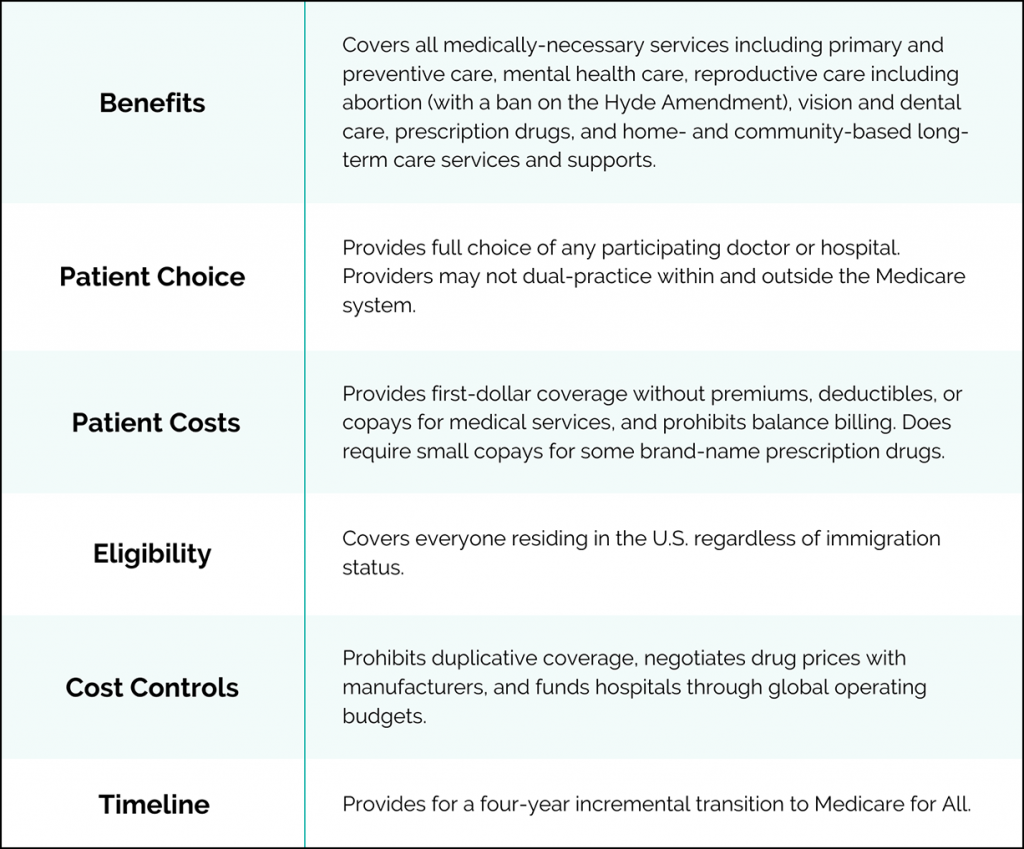
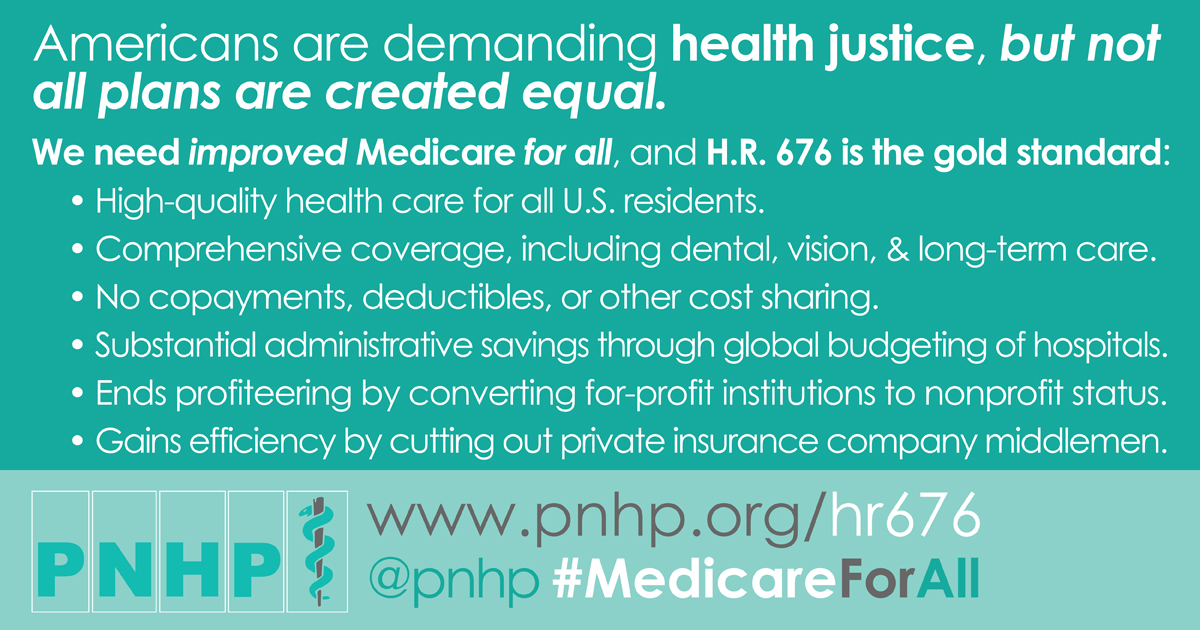
Overview of H.R. 676

Read the full text of H.R. 676 (or access a brief summary of the bill)

Read PNHP’s news release, and the news release from lead sponsor Keith Ellison (D-Minn.)

Compare H.R. 676 to the ACA (and to the short-lived GOP “replacement” bill)

List of cosponsors of H.R. 676 in the current (115th) Congress

List of organizations and governmental bodies endorsing H.R. 676 and single payer

Activism on H.R. 676

Visit PNHP’s Get Active page

Call your representative.
Click here for a list of current cosposnors (to thank) and likely cosponsors (to contact).

Write a letter to your representative.
Click here to send an editable letter to your member of Congress.

Ask your representative to join the Medicare for All Caucus.
Click here to send an editable letter to your member of Congress.

Financing a single-payer national health program

Funding H.R. 676: Executive Summary
(Friedman, University of Massachusetts-Amherst; July 2013)

“Liberal Benefits, Conservative Spending”
(Grumbach, et al., JAMA 265(19); May 15, 1991)

How Much Would a Single-Payer System Cost?

The Current and Projected Taxpayer Shares of U.S. Health Costs
(Himmelstein and Woolhandler, American Journal of Public Health, 2015)

A Comparison of Hospital Administrative Costs in Eight Nations
(Himmelstein et al., Health Affairs, Sept. 2014)

Transitioning to single-payer national health program

Beyond the Affordable Care Act: A Physicians’ Proposal for Single-Payer Health Care Reform
(Working Group on Single-Payer Program Design, American Journal of Public Health 106(6); June 2016)

A National Long-term Care Program for the United States; A Caring Vision

(Working Group on Single-Payer Program Design, JAMA 266(21); December 4, 1991)

A Better-Quality Alternative: Single-Payer National Health System Reform
(Working Group on Single-Payer Program Design, JAMA 272(10); September 14, 1994)

Cosponsor Target

Conservative Case for Single Payer

Speakers Bureau

Speakers Bureau

For 35 years, Physicians for a National Health Program (PNHP) has provided thought leadership and evidence-based solutions to the problems plaguing the U.S. health system. PNHP leaders have published research and commentary in publications such as JAMA, Health Affairs, The Lancet, and The New England Journal of Medicine. We have also provided policy advice for members of Congress, as well as testimony for U.S. House and Senate hearings.

PNHP speakers are available in every region of the U.S., and are prepared to speak on a wide range of health policy topics, such as:

  • Single-payer Medicare for All: How it works and why it’s needed
  • Racial health inequities
  • The privatization on Medicare and other publicly-funded health programs
  • Mental health and addiction care
  • America’s rural health care crisis
  • Reproductive health care in the post-Roe era

To request a PNHP speaker at your institution, please fill out our Grand Rounds request form. If you have questions about our Speakers Bureau, or wish to schedule a speaker for a public event (not a Grand Rounds), please contact us at organizer@pnhp.org or call our national office at (312) 782-6006.

Bios for select national and regional PNHP speakers appear below. Additional speakers are also available, spanning a range of specialties and geographic locations.

For the Press

PNHP has background information on single payer for the press posted here.

If you are a member of the media and wish to speak with one of our members regarding improved Medicare for all, please contact our communications specialist, Gaurav Kalwani, at gaurav@pnhp.org.

PNHP Members in the News

Dr. Adam Gaffney on “Democracy Now”

Wendell Potter on MSNBC

Wendell Potter on MoveOn

Press Releases

April 29, 2025
Doctors welcome the Medicare for All Act of 2025
April 9, 2025
Physicians condemn irresponsible and dangerous rate hike for “Medicare Advantage” corporations
March 14, 2025
Health justice groups host “shadow hearing” opposing the nomination of Dr. Mehmet Oz to lead CMS
May 29, 2024
National physicians group releases groundbreaking report revealing how corporate insurers harm patients in Medicare Advantage program
May 17, 2023
Doctors support the Medicare for All Act of 2023
February 13, 2023
PNHP celebrates win for activists as CMMI Director reveals Medicare REACH program is capping participation
December 9, 2022
Doctors call for shutdown of hopelessly compromised Medicare REACH program
May 18, 2022
Seniors, doctors, and members of Congress to launch summer of action against Medicare profiteering
May 12, 2022
Physicians to Congress: Pass Medicare for All to solve America’s coverage and hospital funding crises 
May 5, 2022
Seattle City Council, Arizona Medical Association demand end to Medicare Direct Contracting and REACH
March 8, 2022
250+ community and senior organizations reject CMS “rebranding” of Medicare Direct Contracting, demand cancellation of ACO REACH replacement
February 24, 2022
Physicians to HHS: Rebranding Won’t Fix Direct Contracting’s Fatal Flaws
February 15, 2022
Doctors and Health Advocates to HHS Sec. Becerra: End Medicare Direct Contracting, Don’t Tweak It
January 5, 2022
Members of Congress Demand an End to Medicare Direct Contracting
December 13, 2021
Experts concerned that Texas’ near-total abortion ban will cause an increase in maternal mortality
November 22, 2021
Doctors to Biden: Don’t hand Medicare to Wall Street investors
September 2, 2021
PNHP President Dr. Susan Rogers on SB8, Texas abortion ban legislation
August 23, 2021
24.4 million children – including millions with serious illnesses – had no or inadequate health coverage in 2019: Harvard study
July 29, 2021
Diabetes patients in high-deductible health plans 28% more likely to skip their medications due to cost: Harvard study
July 19, 2021
People of Color Get Little Care from Specialist Physicians: New Harvard Study
July 12, 2021
Physicians’ group launches new campaign to move the medical profession to Medicare for All
March 17, 2021
Doctors’ group endorses the Medicare for All Act of 2021
January 5, 2021
Universal Healthcare Less Costly Than Previously Projected: Harvard/UCSF Study
December 7, 2020
Emergency Press Conference On Human Rights Day to Address the Worsening COVID-19 Crisis and to Demand Medicare for All
November 23, 2020
Vermont Medical Society endorses single-payer health care reform
October 29, 2020
More than 2 million Americans Lost Health Coverage during Trump’s First Three Years in Office, Leading to Thousands of Premature Deaths: New Harvard Analysis
September 10, 2020
Americans home sick from work with Coronavirus symptoms disproportionately low-income, people of color, uninsured, and unable to afford food: Harvard study
August 12, 2020
Another physicians group endorses Medicare for All
July 27, 2020
As COVID-19 Spread in April, Work Absence due to Illness was Highest on Record: New JAMA-IM Study
July 21, 2020
81 million Americans live in homes that lack enough space and bathrooms to follow COVID-19 quarantine and isolation recommendations

For a complete archive of PNHP press releases, click HERE.

About PNHP

Physicians for a National Health Program is a single-issue organization advocating a universal, comprehensive, single-payer national health program. PNHP has more than 25,000 members, and chapters across the United States.

Since 1988, we’ve advocated for reform in the U.S. health care system. We educate physicians and other health professionals about the benefits of a single-payer system–including fewer administrative costs and affording health insurance for the 30 million Americans who have none.

Our members and physician activists work toward a single-payer national health program in their communities. PNHP performs ground breaking research on the health crisis and the need for fundamental reform, coordinates speakers and forums, participates in town hall meetings and debates, contributes scholarly articles to peer-reviewed medical journals, and appears regularly on national television and news programs advocating for a single-payer system.

PNHP is the only national physician organization in the United States dedicated exclusively to implementing a single-payer national health program.

Latest News

Case Study: Meeting With Legislators in D.C.

By Eric Naumburg, M.D.
Physicians for a National Health Program – Maryland
DC Lobby Visit 2017
On March 29, 2017, several dozen health care activists undertook a project at the U.S. Capitol; the goal was to drop off information about improved Medicare for all to each of the 535 U.S. senators and representatives.

Our purpose was to collect contact information for each health care legislative assistant (LA) and build a database for future communications. Health Over Profit organized the day and the database is available on their website here; use it to contact you legislator. 

We went in teams of two or more and divided up each building by floors. We visited each office, introduced ourselves, identified the group we represented, and told the staff person that we wished to leave information about improved Medicare for all for the health care legislative assistant. The handout was a one-pager that was formatted so that it was a quick read.

In some offices; we asked to speak with the LA or the senator/representative if they were available. This can be time consuming, but it did lead to some interesting exchanges. In general, the staff at the front desk are very polite. The LA business cards are usually sitting at the front desk. Only one door was locked: House Speaker Paul Ryan’s.

If you want to speak to specific legislator or their aide it is better to call the office and set up an appointment. Even if you have an appointment with a legislator, you may end up talking to the aide because when Congress is in session, legislators don’t have control of their daily schedules. Be prepared to leave a handout, as well as your business card, and practice what you want to say. Be sure to follow up at a later date!

Getting more co-sponsors for H.R. 676, the “Expanded and Improved Medicare for All” was not our primary goal. For co-sponsors of H.R. 676, we thanked them for their support and urged them to speak with their colleagues about becoming co-sponsors.

Photo: On the way to the Senate, 435 down, 100 to go.

The conservative case for single payer

Efficient. Effective. Practical. Make no mistake, there is a strong conservative case to be made for single payer. This is important because, as our health care crisis deepens, we need to make sure we’re speaking to all Americans. Only then can we can build a broad-based movement that pressures Congress to do the right thing.

To date, no Republican has co-sponsored H.R. 1384, the Medicare for All Act of 2019, nor did any Republican co-sponsor H.R. 676, the previous single-payer bill in the House. In order for this to happen, members need to hear from their constituents. If you live in a red district, we encourage you to call (202) 224-3121 today. (Click here to find your member of Congress.)

When speaking with a conservative member of Congress – or a conservative colleague, friend, or family member, for that matter – keep the following in mind:

Know your audience

Many single-payer advocates argue that “health care is a human right,” but conservatives may be more persuaded by appealing to the values of loyalty, sanctity, and authority. Dr. Ed Weisbart gave an excellent talk recently, titled Progressive Persuasions: Speaking Beyond the Choir, that explores this topic in detail (see video below).

Dispel common myths

Myth: Single payer is socialized medicine!
Reality: Medicare-for-all applies the principles of the free market to the delivery of health care. Under traditional Medicare, doctors and hospitals compete to attract patients through service, quality, and access – rather than competing to be in the best-reimbursed insurance plans. Medicare-for-all would open up this patient-centered free market to all Americans.

Myth: Single payer would lead to rationing!
Reality: Today’s private health insurance is incredibly restrictive, with narrow provider networks, cost-sharing, and a growing list of treatments that simply aren’t covered. Private insurance comapnies have a financial incentive to deny care, and they often do. Medicare-for-all would make it much easier for patients to access medically necessary care.

Myth: Single payer would stifle innovation!
Reality: Americans are justifiably proud of our nation’s leadership in medical innovation, but may not realize that most of those innovations are paid for using public funds. As pharmaceutical companies engage in trivial research designed to extend patents, our National Institutes of Health funds truly pioneering work. Medicare-for-all would strengthen the alignment of research with our most pressing health needs.

Expose the Canadian boogeyman

Some of the most pervasive myths about single payer relate to Canada’s Medicare program. Many Americans have heard that Canadians suffer long wait times, and flock to the United States to seek medical care. Thankfully, these myths are easily disproven. Consider the following:

•    The 2002 Health Affairs study Phantoms in the Snow found that an exceedingly small number of Canadians seek care in the U.S.

•    Waiting lists in Canada can be primarly attributed to lower health spending. Despite this, Canadians do not have to wait to be treated for life-threatening diseases and report fewer unmet health needs overall (see this NBER paper, Table 12).

•    Former Canadian Medical Association Journal editor-in-chief and one-time market proponent David Woods says single payer is essential to controlling costs.

•    George Mason University law professor Frank Buckley believes Republicans should embrace single payer, and points to the benefits of Medicare in his native Canada.

•    Bottom line? Canadian health outcomes are better than American health outcomes, including longer life expectancy and fewer chronic conditions. These gaps have been growing ever since Canada fully implemented its Medicare program in the early 1970s.

Canada Outcomes

Cutting overhead and bureaucracy

Your conservative representative may agree with you that single payer would provide high-quality care, but they may also also argue that the private sector is more efficient than the federal government, and therefore a better steward of our health care dollars.

However, it is our current, market-oriented system that generates the greatest amount of waste and profiteering. Conservatives who hate bureaucracy should be champing at the bit to do away with private insurance company overhead. A February 2017 estimate published in the Annals of Internal Medicine found that single payer would generate $504 billion in administrative savings annually.

Admin Savings

Economists and public health experts have consistently shown that single payer is an efficient and effective use of resources. Here are some prominent examples:

•    PNHP co-founders, Drs. David Himmelstein and Steffie Woolhandler, argue that single payer would allow for Liberal Benefits, Conservative Spending.

•    Nobel laureate Angus Deaton favors single payer “because it will get this [health care] monster that we’ve created out of the economy and allow the rest of capitalism to flourish.”

•    Nobel laureate and noted health care economist Kenneth Arrow lauds the Canadian system (with its private practitioners) and says single payer is “better than any other system.”

Boosting American business

Conservative members of Congress often voice concern over the global competitiveness of American business, and rising health care costs are harmful in that regard. Under single payer, U.S. firms might contribute as much to health care as they do now via a payroll tax, but they would no longer need to shop for group policies. They would also be spared the outrageous annual cost increases that have become commonplace in the large- and small-group markets.

For workers, single payer would allow those who are not a good fit for their jobs to seek more productive employment elsewhere instead of staying put in order to preserve health benefits. And would-be entrepreneurs would no longer fear striking out on their own due to a lack of health insurance.

Ultimately, improved Medicare-for-all would ensure a healthier, more financially-secure workforce. Thankfully, employers are starting to take notice:

•    The group Business Leaders Transforming Healthcare “strongly supports legislation to transition the United States to a publicly funded health care system.”

•    MCS Industries founder and owner Richard Master has produced a documentary, FIX IT: Health Care at the Tipping Point, that lays out the business case for single payer.

•    Berkshire Hathaway vice-chairman (and longstanding Republican) Charlie Munger says single payer is the solution to America’s health care woes.

•    Marks Group owner and prominent blogger Gene Marks considers himself a “smaller government, fiscally right-of-center guy,” but has concluded that single payer would be best for business.

Conservative voters are embracing single payer

Now that Congressional Republicans have unveiled the American Health Care Act, a growing number of their supporters are recognizing the empty promise of “repeal and replace.” They are demanding real reform, as evidenced by an April 2017 Economist/YouGov poll that found 46% of Republicans and 40% of Trump voters favor “Expanding Medicare to provide health insurance to every American.”

Economist Poll

Single-payer reform is vitally important, and progressives can’t go it alone. Talk to your conservative friends, colleagues, family members, and elected officials. Listen to their concerns. Let them know that a humane, efficient, high-quality health care system is possible, but only if we work together.

America: equity and equality in health

Lancet_CoverThe Lancet devotes special issue to growing U.S. health inequality

Leading British medical journal The Lancet has published a series of papers exploring persistent and growing health inequality in the United States. The series was published in the April 8, 2017 issue of The Lancet, and was curated by PNHP co-founders Drs. David Himmelstein and Steffie Woolhandler, along with Dr. Samuel Dickman.

“America: equity and equality in health” explores the effects of racial segregation, mass incarceration, economic inequality, and a lack of universal health care in the U.S. It comes at an important time in the national health care debate, as policymakers are grappling with the failure of the GOP “repeal and replace” bill, the American Health Care Act, and citizens are demanding a better health care system; one that addresses the gaps that remain after implementation of the Affordable Care Act.

Below, you can access links to the series papers; various interviews and events; national media coverage of the series; and an extensive infographic.

To read PNHP’s news release on the series, click here. The full series can be accessed for free (registration required) at thelancet.com/us-health.

***

Series Papers

Paper 1: Inequality and the health-care system in the USA
By Samuel L. Dickman, M.D., David U. Himmelstein, M.D., and Steffie Woolhandler, M.D., M.P.H.
http://thelancet.com…

Paper 2: The Affordable Care Act: implication for health-care equity
By Adam Gaffney, M.D. and Danny McCormick, M.D.
http://www.thelancet.com…

Paper 3: Structural racism and health inequities in the USA: evidence and interventions

By Zinzi D. Bailey, Sc.D., Nancy Krieger, Ph.D., Madina Agénor, Sc.D., Jasmine Graves, M.P.H., Natalia Linos, Sc.D., and Mary T. Bassett, M.D.
http://www.thelancet.com…

Paper 4: Mass incarceration, public health, and widening inequality in the USA

By Christopher Wildeman, Ph.D. and Emily A. Wang, M.D.
http://www.thelancet.com…

Paper 5: Population health in an era of rising income inequality in the USA: 1980-2015
By Jacob Bor, Sc.D., Gregory H. Cohen, M.Phil., and Sandro Galea, M.D.
http://www.thelancet.com…

Editorial: America, all things not being equal
By The Lancet
http://www.thelancet.com…

Comment: An agenda to fight inequality
By Sen. Bernie Sanders
http://www.thelancet.com…

***

Interviews & Events

Lancet Podcast: America, equity and equality in health
Interview with David Himmelstein, M.D. and Steffie Woolhandler, M.D., M.P.H.
http://www.thelancet.com…

Lancet Podcast: America, equity and equality in health
Interview with Samuel L. Dickman, M.D.
http://usa.thelancet.com…

Symposium: Income Inequality and Health in America
Boston University School of Medicine, April 10, 2017
Panel featuring Zinzi D. Bailey, Sc.D., Jacob Bor, Sc.D., Samuel L. Dickman, M.D., Adam Gaffney, M.D., and Steffie Woolhandler, M.D., M.P.H.
https://livestream.com…

Symposium: Inequality and Health in the U.S.
Harvard Medical School, April 24, 2017
Panel featuring Adam Gaffney, M.D., Samuel L. Dickman, M.D., Jacob Bor, Sc.D., Christopher Wildeman, Ph.D., and Mary T. Bassett, M.D., M.P.H. Panel moderated by Joan Reede, Harvard Medical School. Virtual welcome and remarks by Sen. Elizabeth Warren.
https://hms.mediasite.video.harvard.edu…

Symposium: Equity and Equality in Health
Roosevelt House, Public Policy Institute at Hunter College, May 1, 2017
Program featuring Mary T. Bassett, M.D., M.P.H., Paul Krugman, Ph.D., and David Himmelstein, M.D. Discussion moderated by Lilliam Barrios-Paoli, Ph.D.
http://www.roosevelthouse.hunter.cuny.edu…

***

Media Coverage

Inequality is a life and death matter
By Steffie Woolhandler, M.D., M.P.H. and David Himmelstein, M.D.

HuffPost, May 8, 2017
The Republican effort to gut the Affordable Care Act threatens a health care catastrophe. But blocking a backward move isn’t enough. The overall U.S. death rate is rising. The survival gap between rich and poor is widening. Continue reading…

The cost of economic inequality to the nation’s physical health
By Jacob Bor, Sc.D. and Sandro Galea, M.D.
The Boston Globe, April 25, 2017
After its unsuccessful push to reconfigure the U.S. health care system, the Trump administration has signaled that it will turn its attention to tax reform. While the details of the administration’s plan are still unclear, President Trump has indicated in the past a willingness to embrace measures that would greatly favor the wealthy. Continue reading…

Rich Americans live up to 15 years longer than poor peers, studies find
By Jessica Glenza
The Guardian, April 6, 2017
You can’t buy time – except, it seems, in America. Increasing inequality means wealthy Americans can now expect to live up to 15 years longer than their poor counterparts, reports in the British medical journal the Lancet have found. Continue reading…

Rich Americans Live 15 Years Longer Than Poo
r Counterparts: Study
By Anthony Cuthbertson

Newsweek, April 7, 2017
Wealth and health are intrinsically linked in the United States, with rich Americans living between 10 to 15 years longer than their poor counterparts, a study has found. A series of five papers published in the medical journal The Lancet found that a widening income gap, structural racism and mass incarceration are fueling growing health inequalities. Continue reading…

The Richest Americans Live 10 Years Longer than the Poorest
By Alice Park

Time Magazine, April 6, 2017
Money may not buy you happiness, but it may help buy you health, and ultimately a longer life. Researchers analyzing data on income disparities and health outcomes in the U.S. found that health gaps between the rich and poor are widening, and that’s translating to bigger differences in how long people live. Continue reading…

Want to Live Longer? Be Rich
By Jesse Singal

New York Magazine, April 7, 2017
You probably already know that health care in the United States is a bit of a disaster. That’s one of the primary reasons a single piece of bad luck can be ruinous for so many Americans. Continue reading…

Three Insights About Inequality in American Health Care
By Jesse Singal

New York Magazine, April 11, 2017
Lately, it has felt like the debate over Obamacare has masked some of the bigger questions swirling around the U.S. health system. Obamacare is important, yes, but America’s issues on this front run much, much deeper than the presence or absence of that one law. Continue reading…

What we know about the 30 million Americans who are still uninsured
By Julia Belluz

Vox, April 7, 2017
The size of the uninsured group is well-known, but less clear is what this group looks like. A new series in the Lancet on health inequality paints a pretty good picture. People who go without insurance in America are not refusing coverage for ideological reasons: They simply can’t afford to pay. Continue reading…

Lancet series puts spotlight on health inequity in the U.S.

By Paige Minemyer
Fierce Healthcare, April 7, 2017
Societal issues in the U.S., including systemic racism, poverty and mass incarceration, contribute to health inequity, a new series of studies has found. The Lancet released a five-part look at health inequity in the U.S., titled the “United States of Health.” Continue reading…

You Can Thank Racism, Mass Incarceration, and Our Health System for the Survival Gap Between the Rich and Poor
By Nick Keppler

Vice News, April 11, 2017
The United States’ for-profit healthcare system not only fails miserably to offer the same life-extending treatments to the poor as it does the rich, but it also reinforces racial and socioeconomic disparities, according to a wide-ranging five-part series published in the medical journal The Lancet. Continue reading…

The Prison-Health Paradox
By Olga Khazan

The Atlantic, April 7, 2017
A recent review of the impacts of incarceration on health published Thursday in The Lancet hints at a surprising upshot: Getting out of jail can be miserable, but going to jail can temporarily protect health—at least for some men. Continue reading…

When a man goes to prison, his children’s health suffers, too, study finds
By Max Blau

STAT, April 6, 2017
Researchers found that children of incarcerated men have higher rates of asthma, obesity, substance misuse, and behavioral and mental health problems. And the impact can linger for years, even into their adulthood. Continue reading…

Children Of Incarcerated Fathers Often Suffer Health Issues That Can Last Through Adulthood
By Cameron Norsworthy

Romper, April 6, 2017
Incarceration affects families emotionally and socially, and new research shows that there are long-lasting physical complications as well. According to a recent study, the children of incarcerated fathers often suffer health issues to intense degrees, and these health issues are often chronic conditions that can last all the way through adulthood. Continue reading…

Rich black people have worse health than rich white people
By Jessica Hamzelou
New Scientist, April 6, 2017
America’s health is in poor shape. The health gap between the rich and poor is now far bigger than the difference in income – that’s one of the messages from a series of papers published in The Lancet today. But wealth is only part of the problem. Continue reading…

***

Infographic

Lancet_Infographic

  • « Go to Previous Page
  • Page 1
  • Interim pages omitted …
  • Page 9
  • Page 10
  • Page 11
  • Page 12
  • Page 13
  • Interim pages omitted …
  • Page 50
  • Go to Next Page »

Primary Sidebar

  • About PNHP
    • Mission Statement
    • Local Chapters
    • Student chapters
    • Board of Directors
    • National Office Staff
    • Contact Us
    • Privacy Policy
  • About Single Payer
    • What is Single Payer?
    • How do we pay for it?
    • History of Health Reform
    • Conservative Case for Single Payer
    • FAQs
    • Información en Español
  • Take Action
    • The Medicare for All Act of 2025
    • Moral Injury and Distress
    • Medical Society Resolutions
    • Recruit Colleagues
    • Schedule a Grand Rounds
    • Letters to the Editor
    • Lobby Visits
  • Latest News
    • Sign up for e-alerts
    • Members in the news
    • Health Justice Monitor
    • Articles of Interest
    • Latest Research
    • For the Press
  • Reports & Proposals
    • Physicians’ Proposal
    • Medicare Advantage Equity Report
    • Medicaid Managed Care Report
    • Medicare Advantage Harms Report
    • Medicare Advantage Overpayments Report
    • Pharma Proposal
    • Kitchen Table Campaign
    • COVID-19 Response
  • Member Resources
    • 2025 Annual Meeting
    • Member Interest Groups (MIGs)
    • Speakers Bureau
    • Slideshows
    • Newsletter
    • Materials & Handouts
    • Webinars
    • Host a Screening
    • Events Calendar
    • Join or renew your membership

Footer

  • About PNHP
    • Mission Statement
    • Local Chapters
    • Student chapters
    • Board of Directors
    • National Office Staff
    • Contact Us
    • Privacy Policy
  • About Single Payer
    • What is Single Payer?
    • How do we pay for it?
    • History of Health Reform
    • Conservative Case for Single Payer
    • FAQs
    • Información en Español
  • Take Action
    • The Medicare for All Act of 2025
    • Moral Injury and Distress
    • Medical Society Resolutions
    • Recruit Colleagues
    • Schedule a Grand Rounds
    • Letters to the Editor
    • Lobby Visits
  • Latest News
    • Sign up for e-alerts
    • Members in the news
    • Health Justice Monitor
    • Articles of Interest
    • Latest Research
    • For the Press
  • Reports & Proposals
    • Physicians’ Proposal
    • Medicare Advantage Equity Report
    • Medicaid Managed Care Report
    • Medicare Advantage Harms Report
    • Medicare Advantage Overpayments Report
    • Pharma Proposal
    • Kitchen Table Campaign
    • COVID-19 Response
  • Member Resources
    • 2025 Annual Meeting
    • Member Interest Groups (MIGs)
    • Speakers Bureau
    • Slideshows
    • Newsletter
    • Materials & Handouts
    • Webinars
    • Host a Screening
    • Events Calendar
    • Join or renew your membership
©2025 PNHP