• Skip to primary navigation
  • Skip to main content
  • Skip to primary sidebar
  • Skip to footer

PNHP

  • Home
  • Contact PNHP
  • Join PNHP
  • Donate
  • PNHP Store
  • About PNHP
    • Mission Statement
    • Local Chapters
    • Student chapters
    • Board of Directors
    • National Office Staff
    • Contact Us
    • Privacy Policy
  • About Single Payer
    • What is Single Payer?
    • How do we pay for it?
    • History of Health Reform
    • Conservative Case for Single Payer
    • FAQs
    • Información en Español
  • Take Action
    • The Medicare for All Act of 2025
    • Moral Injury and Distress
    • Medical Society Resolutions
    • Recruit Colleagues
    • Schedule a Grand Rounds
    • Letters to the Editor
    • Lobby Visits
  • Latest News
    • Sign up for e-alerts
    • Members in the news
    • Health Justice Monitor
    • Articles of Interest
    • Latest Research
    • For the Press
  • Reports & Proposals
    • Physicians’ Proposal
    • Medicare Advantage Equity Report
    • Medicaid Managed Care Report
    • Medicare Advantage Harms Report
    • Medicare Advantage Overpayments Report
    • Pharma Proposal
    • Kitchen Table Campaign
    • COVID-19 Response
  • Member Resources
    • 2025 Annual Meeting
    • Member Interest Groups (MIGs)
    • Speakers Bureau
    • Slideshows
    • Newsletter
    • Materials & Handouts
    • Webinars
    • Host a Screening
    • Events Calendar
    • Join or renew your membership

The official blog of PNHP

2024 Annual Meeting


Register HERE for the Nov. 16 meeting!

Note: Online registration will close on Sunday, Nov. 10 at 11:59 pm Central. Because of high demand, registration at the door may be limited.


PNHP Annual Meeting

Saturday, Nov. 16 (agenda available HERE)

  • Daytime program, 9:00 am – 5:00 pm
  • Dinner program, 6:00 pm – 8:00 pm

The PNHP Annual Meeting will be held in Chicago at the Venue SIX10, located at 610 S. Michigan Ave.

Sleeping rooms will be available at the Hilton Chicago, 720 S. Michigan Ave., for $229/night + $25/night mandatory destination charge (includes internet and athletic club access, and $25/day food/beverage credit). Sleeping room reservations may be booked in two ways:

  • Online HERE
  • Call 877-865-5320 and reference “PNHP Annual Meeting”

Sleeping room reservations must be made by Friday, Oct. 25. Note that the Hilton is completely booked for nights after Nov. 17.


SNaHP Summit

Friday, Nov. 15, 12:00 pm – 6:00 pm

The SNaHP Summit will be held in Chicago at Roosevelt University, located at 430 S. Michigan Ave. This event is not affiliated with Roosevelt University.

Scholarships are available to support student and resident attendance for both the SNaHP Summit and the PNHP Annual Meeting. Please note that the application deadline has passed, and we are in the process of awarding scholarships to qualified applicants. PNHP members and the public can support PNHP’s student outreach programs by making a GIFT to the Nicholas Skala Student Fund.


Speakers

Dinner Keynote: Rep. Pramila Jayapal

Congresswoman Pramila Jayapal represents Washington’s 7th District in the U.S. House and is chair of the Congressional Progressive Caucus and co-lead sponsor of the Medicare for All Act.

Meeting Chair: Dr. Philip Verhoef

Dr. Phil Verhoef is the president of PNHP, an adult and pediatric intensivist, and a clinical associate professor of medicine at the John A. Burns School of Medicine at the University of Hawaii-Manoa.

Health Policy Update: 

  • Dr. Adam Gaffney, Past President, PNHP; Assistant Professor of Medicine, Harvard Medical School
  • Shruthi Bhuma, executive board member, SNaHP; board advisor, PNHP; M4, Chicago Medical School
  • Swathi Bhuma, executive board member, SNaHP; board member, PNHP; M4, Chicago Medical School

Plenary Discussion Panel: 

  • Dr. Abdul El-Sayed, County Public Health Director, host of the America Dissected podcast, and author of Healing Politics and Medicare for All
  • Alex Lawson, Executive Director, Social Security Works
  • Wendell Potter, President, Center for Health and Democracy
  • Dr. A. Taylor Walker, President, Committee of Interns and Residents

See our agenda for a full lineup of speakers and workshops.

This conference will not be livestreamed in its entirety, but recordings of select sessions will be made available after the meeting.


Covid Safety Protocols

Please note that our medical experts recommend the following Covid safety precautions for the conference:

  • Staying home if you are experiencing symptoms suggestive of Covid, such as a sore throat, persistent cough, or fever
  • Testing immediately before the conference
  • Vaccination, particularly with one of the updated vaccines covering newer strains
  • Wearing a face mask while not actively eating or drinking
Although we recommend these precautions, we will not be requiring proof of vaccination or a negative test result.

Previous Annual Meetings

Click HERE to access archival material from last year’s Annual Meeting in Atlanta. Click HERE to view photos from the conference.


Attending the 2024 PNHP Annual Meeting and SNaHP Summit is entirely voluntary and requires attendees to abide by any applicable rules of conduct, or local or state laws, that may be announced at any time. Attendees acknowledge the highly contagious and evolving nature of Covid-19 and voluntarily assume the risk of exposure to, or infection with, the virus by attending the Meeting, and understand that such exposure or infection may result in personal injury, illness, disability, and/or death. Attendees release and agree not to sue any persons or entities responsible for coordinating or organizing the PNHP Annual Meeting and SNaHP Summit in the event that they contract Covid-19. Attendees agree to comply with all Covid-related procedures that may be implemented at the Meeting, including mask-wearing.

PNHP Newsletter: Spring 2024

Table of contents

Click the links below to jump to different sections of the newsletter. To view a PDF version of the shorter print edition of the newsletter, click HERE.

If you wish to support PNHP’s outreach and education efforts with a financial contribution, click HERE.

If you have feedback about the newsletter, email info@pnhp.org.

PNHP News and Tools for Advocates

  • PNHP Leads Fight Against Medicare Advantage
  • PNHP Caps off 35th Anniversary at Annual Meeting
  • Heal Medicare: PNHP Launches Revamped Website
  • Meet Mandy, Our New National Organizer

Save the Date for our Annual Meeting in Chicago

Research Roundup

  • Data Update: Health care crisis by the numbers
    • Barriers to Care
    • Medicare & Medicaid Issues
    • Pharma
    • Health Inequities
    • Profiteers in Health Care
  • Studies and analysis of interest to single-payer advocates

PNHP Chapter Reports

  • California
  • Indiana
  • Kentucky
  • North Carolina
  • Washington

SNaHP Chapter Reports

  • Florida State University
  • Hofstra University
  • UNC-Charlotte
  • University of Florida

Reclaiming Medicare for the Public

PNHP in the News

  • News items featuring PNHP members
  • Op-eds by PNHP members
  • Letters to the editor by PNHP members

PNHP News and Tools for Advocates


PNHP Leads Fight Against Medicare Advantage

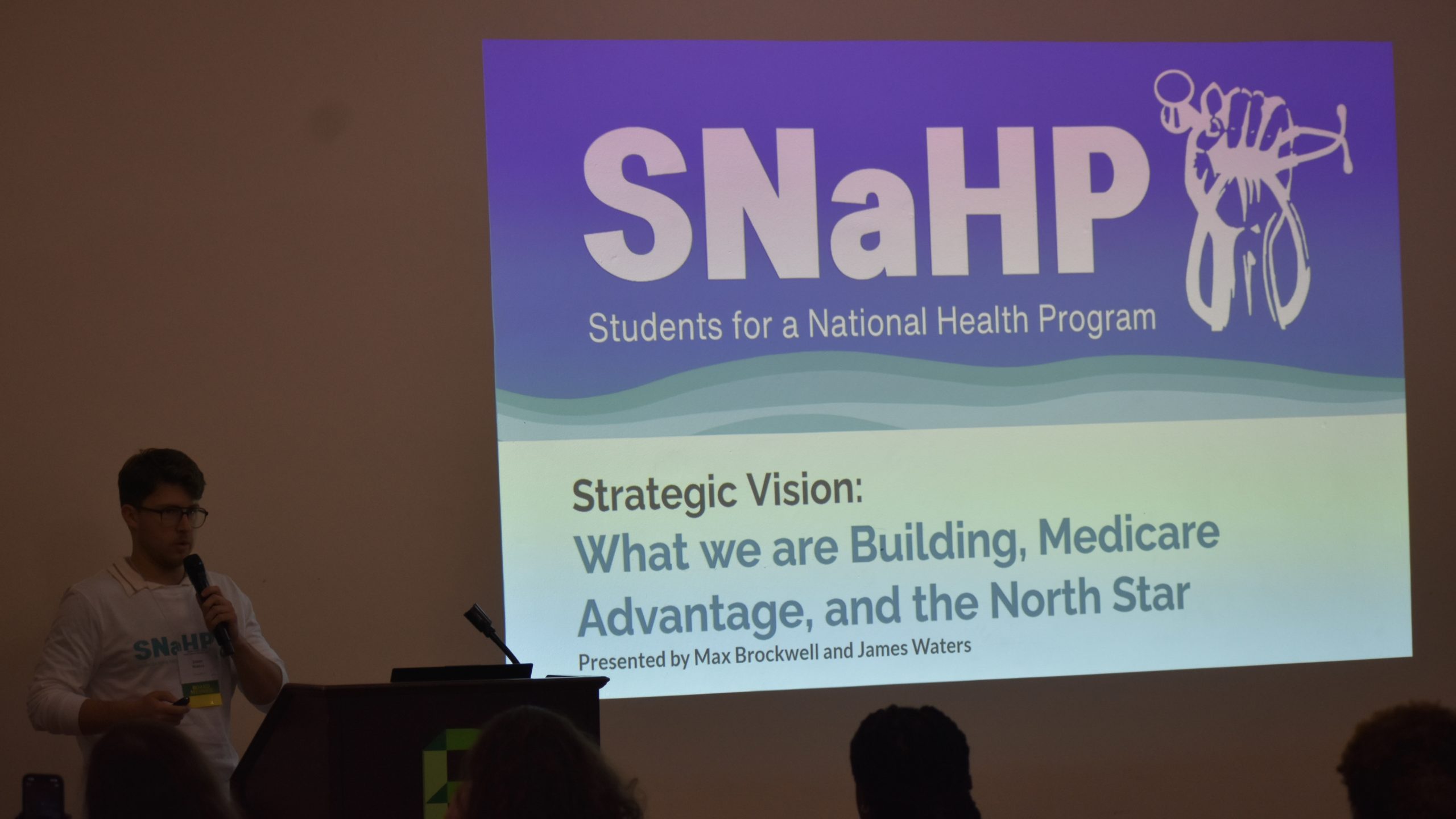
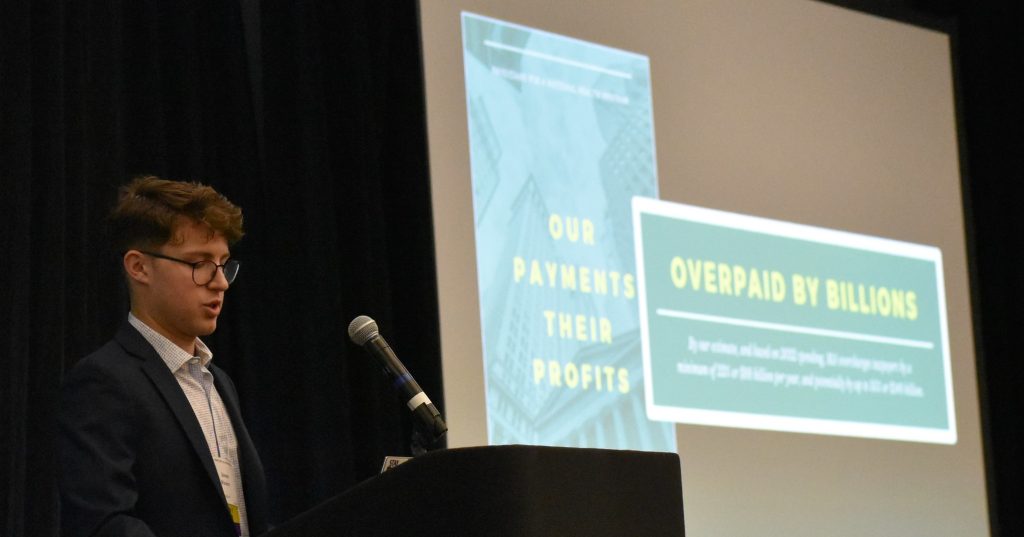
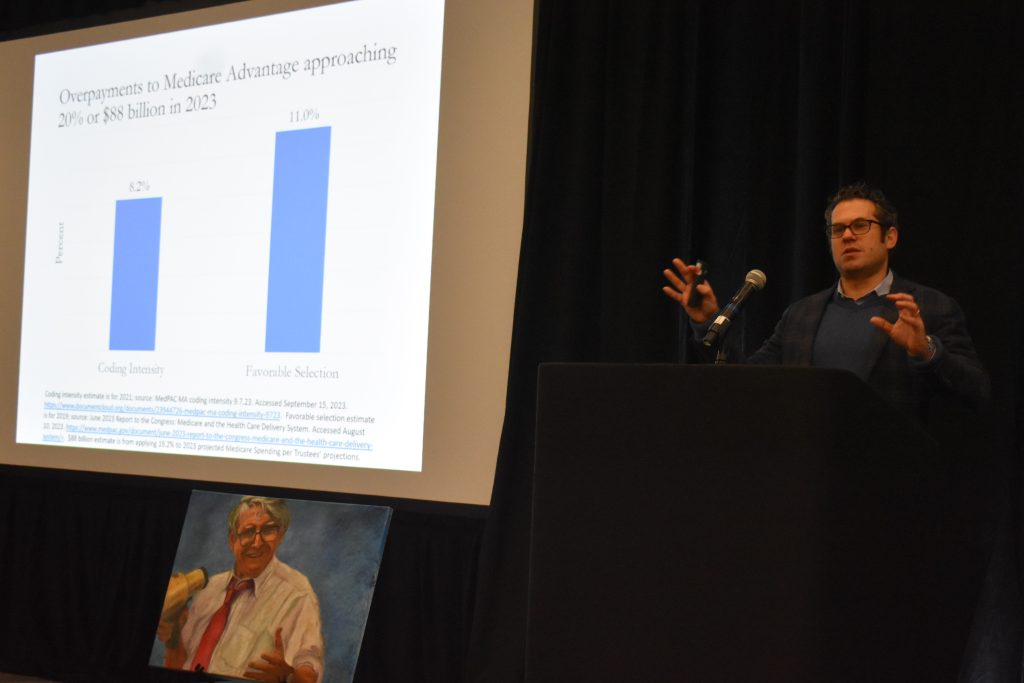
SNaHP Executive Board Member James Waters presents a Medicare Advantage update at the PNHP Annual Meeting in Atlanta on Nov. 12, 2023.

As controversies continue to build around the corporate-run Medicare Advantage (MA) program, PNHP has become a leader in the fight to crack down against its abuses and strengthen Traditional Medicare. First, in October, PNHP released a report quantifying the egregious levels of overpayments in the program. This report was covered extensively in the media and used in briefings with members of Congress, and has set the standard for discussing MA’s raiding of the Medicare Trust Fund. 

Beginning in January, PNHP chapters around the country began organizing efforts around two different letters circulating in both chambers of Congress regarding Medicare Advantage. One letter was sponsored by the insurance industry, and uncritically praised MA while calling for increased support for the program. The other letter, written by progressive members of Congress like Rep. Pramila Jayapal, Rep. Rosa DeLauro, Rep. Jan Schakowsky, Sen. Elizabeth Warren, and Sen. Sherrod Brown, outlined the many flaws in MA and the critical need to reform the program while improving benefits in Traditional Medicare.

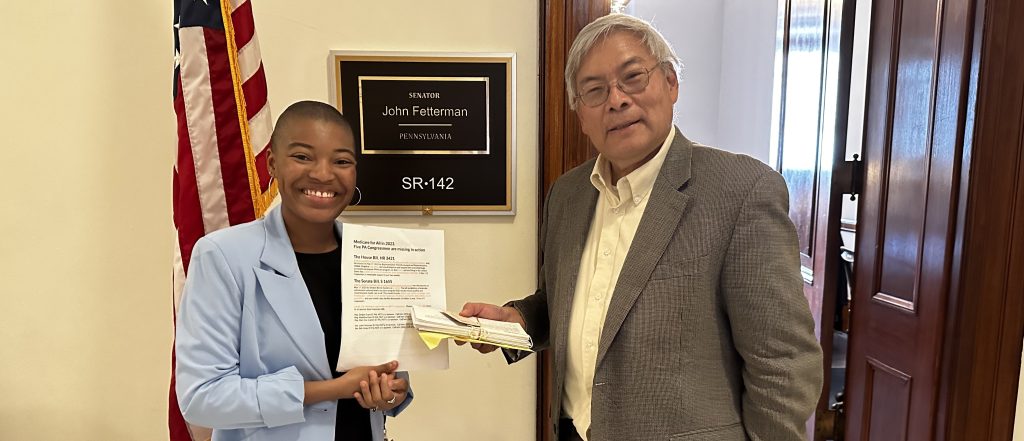
PNHP staff, members, and allied organizations set up dozens of meetings with their Congressional representatives to ask them not to sign on to the pro-industry letter, and to instead sign on to the reform letter. PNHP members helped lead over 40 meetings with members of both the House and Senate, and were able to convince several members to sign on to the reform letter that had not done so the previous year. In total, around 50 House members and 10 Senate members signed onto the reform letter.

Alongside our organizing campaign, PNHP also conducted an extremely successful email campaign urging members to contact their representatives with a message about the two MA letters. Almost 20,000 messages were sent through our email form, sending a strong signal to members of Congress that their constituents care deeply about the need to protect Medicare from privatization.

PNHP’s campaign against Medicare Advantage will continue through the year. If you would like to get involved, please contact National Organizer Mandy Strenz at mandy@pnhp.org.

back to table of contents

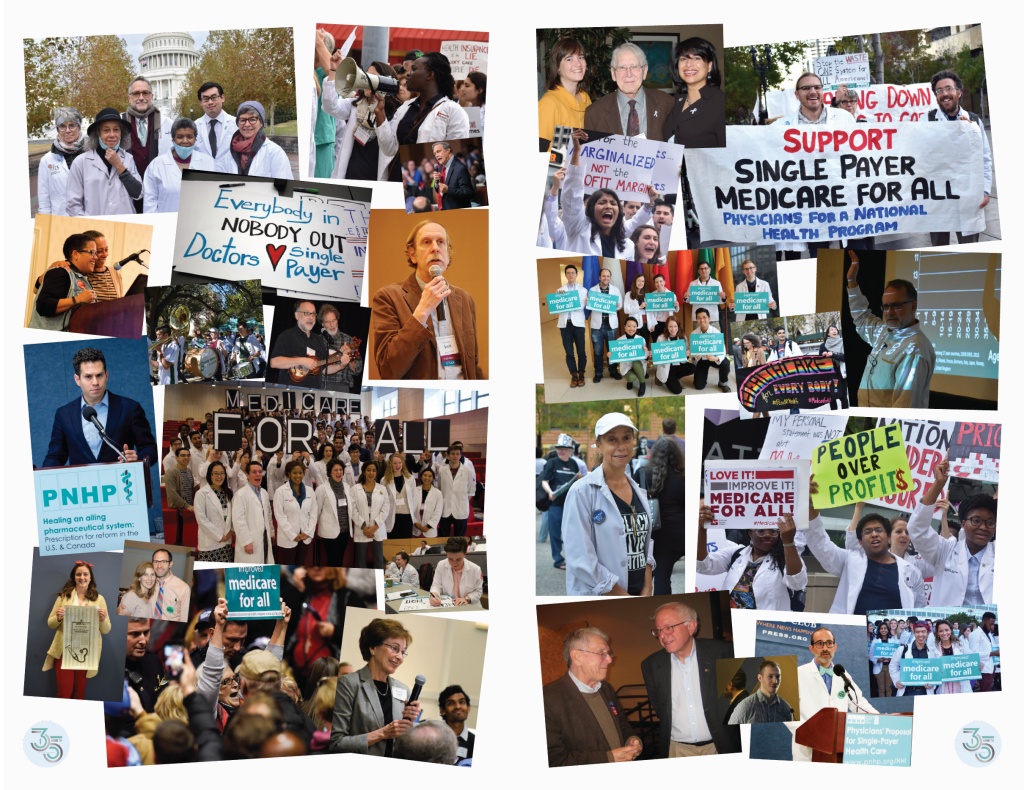
PNHP Caps off 35th Anniversary at Annual Meeting

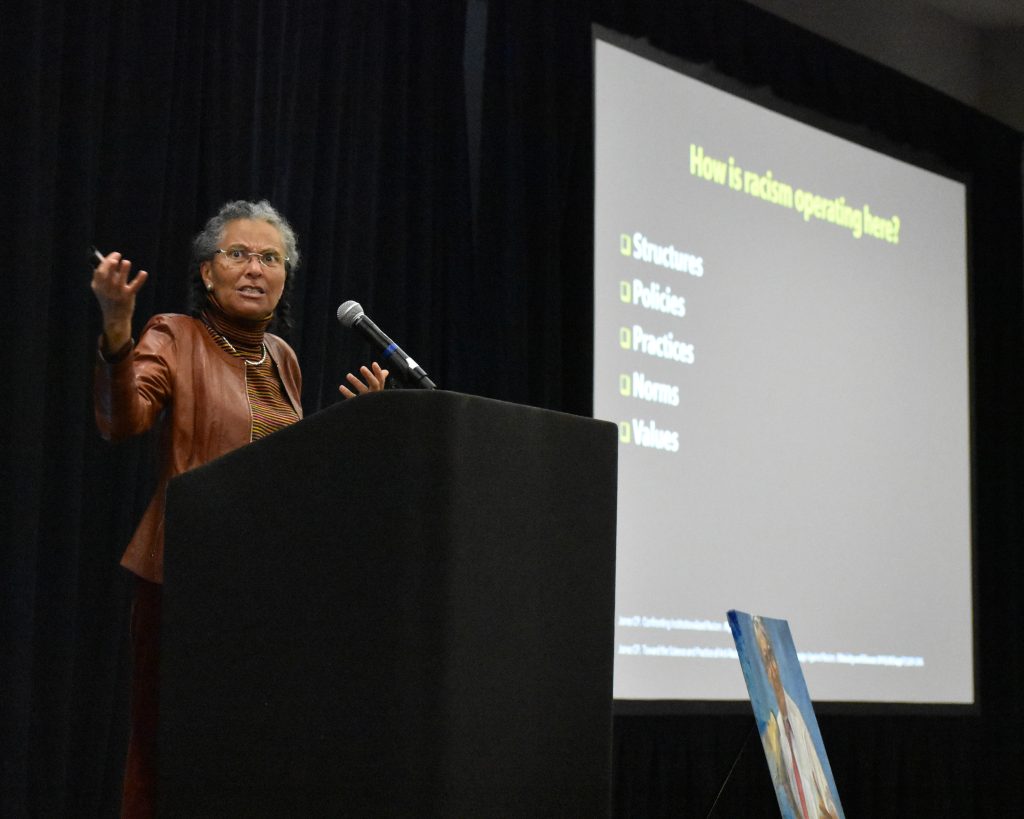
(L) PNHP and SNaHP members rally with local health justice groups to demand Medicaid expansion in Georgia on Nov. 12, 2023. (R) Dr. Camara Jones delivers the keynote address at the PNHP Annual Meeting on Nov. 11, 2023.

After a year of celebrating PNHP’s 35th Anniversary through organizing, fundraising, and activism, we capped everything off at our Annual Meeting in Atlanta. Things kicked off on Friday with the Leadership Training, featuring presentations and workshops from leaders in PNHP and SNaHP. On Saturday morning, the Annual Meeting opened with the always hotly anticipated Health Policy Update, delivered by PNHP past president Dr. Adam Gaffney and SNaHP executive board member James Patrick Waters. They touched on a wide range of topics, including declining life expectancy, the ongoing Medicaid unwinding, and the dangerous expansion of Medicare Advantage.

After another day of workshops on topics ranging from organizing to moral injury to reproductive justice, attendees gathered for this year’s keynote address, delivered by distinguished physician activist and former American Public Health Association president Dr. Camara Jones. Dr. Jones gave a thought-provoking and allegory-rich talk on recognizing and combating racial inequity, both in health and in U.S. society more broadly. 

Saturday night’s highlight was the 35th Anniversary Dinner. Members took the stage to reminisce on three-and-a-half decades of fighting for health care justice with PNHP, and to recognize national allies, past presidents, medical student leaders, and co-founders. At the end of the dinner, the Quentin Young and Nick Skala health activist awards were presented to Dr. George Bohmfalk, Dr. Diljeet Singh, and SNaHP leader Donald Bourne.

Sunday saw our SNaHP members gathered for their annual Student Summit—running their own workshops and learning from one another about activism and leadership. To end the weekend, meeting attendees piled into buses and headed off to a fantastically organized public action protesting hospital closures and demanding Medicaid expansion in Georgia. The action was even covered by the Atlanta Journal-Constitution! 

PNHP’s 35th anniversary initiatives were to build the future of our movement by supporting the work of SNaHP; ramping up our fight against corporate profiteering, with a particular focus on the so-called “Medicare Advantage” program; and greatly increasing our base of active physician members fighting for improved Medicare for All. We made substantial progress in all these areas in 2023, and will continue to do so in 2024.

back to table of contents

Heal Medicare: PNHP Launches Revamped Website

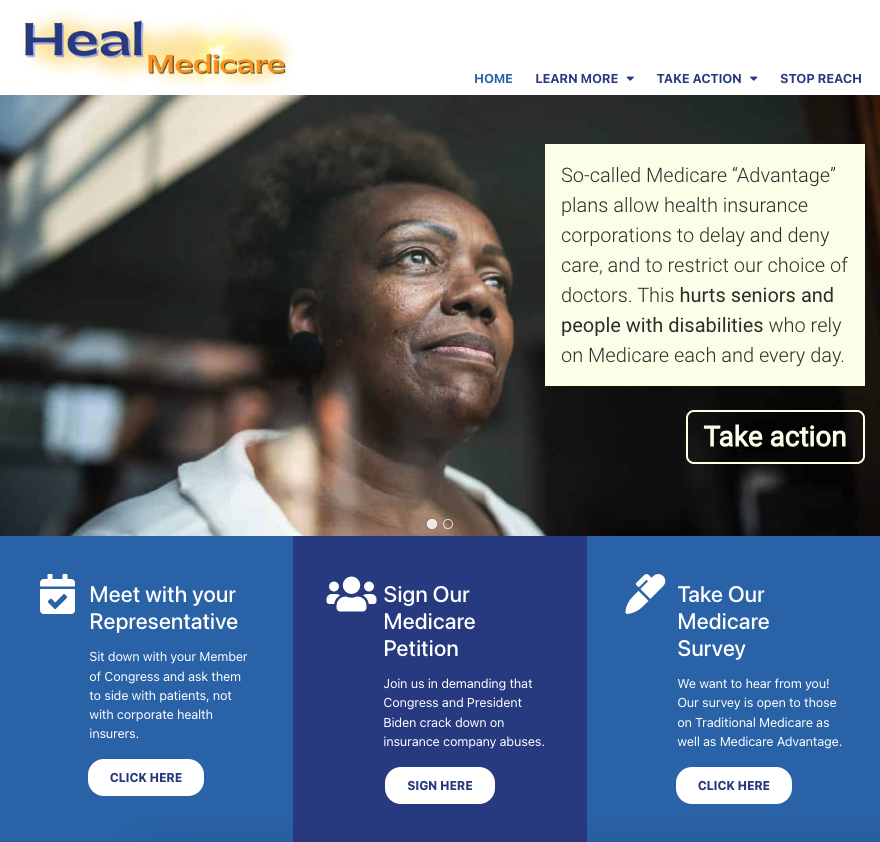
As part of PNHP’s campaign against Medicare profiteering, we have created a new website to help activists wade through the many complex issues related to both traditional Medicare and corporate-controlled Medicare Advantage (MA) plans. The new website is called HealMedicare.org, and contains many resources to help explain the dangers of MA, and how we can collectively fight back.

The two focuses of the website are education (clearly explaining the harm caused by corporations like Cigna, Aetna, and UnitedHealthcare) and activism (raising our voices and organizing an effective response). The website has already been used extensively in our 2024 MA letter campaign, and contains a legislative toolkit with a robust set of links, documents, and videos for anyone looking to engage their representatives. 

We will continue to update the site as our campaign evolves throughout the year. Please take a look, and share with anyone who is concerned for the future of our public Medicare!

back to table of contents

Meet Mandy, Our New National Organizer

Mandy Strenz, National Organizer

Previous Experience: I worked with PNHP-NY Metro as the Chapter Coordinator starting in 2021 – and before that in the fine jewelry world, with advocacy work solely in my spare time.

What drew you to PNHP? Healthcare access is a throughline in many issues I care about: climate, immigration, reproductive rights, anti-war efforts, LGBTQIA+ issues, etc. While single payer alone wouldn’t solve any of those issues, it has the potential to majorly alleviate some of the strain people feel around them. Also, I just love getting to work on things I care about every day, especially with people as committed as PNHP members are.

What are you looking forward to working on over the next 12 months? I’m looking forward to seeing PNHP chapters grow their power and influence both locally and nationally.

What’s a fun fact about yourself? I’ve yet to meet a fermented food I don’t adore – please give me some challenging ones to try!

Thanks to the generosity of donors to our 35th anniversary campaign, Mandy Strenz joins PNHP as the third member of our growing Organizing Team alongside Lori Clark and Rebecca Delay. Connect with Mandy at mandy@pnhp.org.

back to table of contents


Save the Date for our Annual Meeting in Chicago


Join us for PNHP’s Annual Meeting, scheduled for Saturday, Nov. 16 in Chicago at the Venue SIX10, located at 610 S. Michigan Ave.

Our annual Students for a National Health Program (SNaHP) Summit is scheduled for the preceding day (Friday, Nov. 15) at a TBD location in Chicago. Stay tuned for more information, including registration, at pnhp.org/meeting.

PNHP members rally for single payer near the headquarters of Blue Cross and Blue Shield in Chicago on Oct. 31, 2015.

back to table of contents


Research Roundup


Data Update: Health Care Crisis by the Numbers

Barriers to Care

Ketamine can be lifesaving, but is difficult to access: Although increasingly popular as an option for treatment-resistant depression, IV Ketamine treatments for mental illness are currently off-label and thus rarely covered by insurers, costing anywhere from $400 to $1000 per treatment. Esketamine, a nasal spray and the only ketamine drug approved for depression, carries an out-of-pocket cost of $784 a month for two inhalers. Emily Maloney, “Ketamine can be transformative for people with suicidal thoughts — if they can access it,” STAT News, 9/7/23.

Insurers deny critical treatment for eating disorders: In deciding whether to cover eating disorder treatment, insurers often emphasize metrics like weight and body mass index while minimizing patients’ serious psychiatric symptoms. For example, a teen couldn’t get her insurer to cover her eating disorder and suicidality, even after three separate clinicians vouched for her admission to a specialty program. In terms of total costs, a hospital stay for eating disorder treatment runs an average of $61,000. Of the 20 most expensive psychiatric stays among Washington youth in 2021, 40% involved those with an eating disorder. Hannah Furfaro, “Not sick enough: How insurance denials can delay lifesaving eating-disorder treatment,” Seattle Times, 9/10/23.

Abortion coverage limited or unavailable at many employers: Around one-fourth of large U.S. employers heavily restrict coverage of legal abortions or don’t cover them at all under health plans for their workers. 10% of large employers don’t cover abortion at all, and 18% cover it only in limited circumstances. In 2021, the median costs for people paying out-of-pocket in the first trimester were $568 for a medication abortion and $625 for an abortion procedure. By the second trimester, the cost increased to $775 for abortion procedures. Rachana Pradhan, “Abortion Coverage Is Limited or Unavailable at a Quarter of Large Workplaces,” KFF Health News, 10/18/23.

Insurance premiums rise for U.S. families: Premiums rose 7%, compared to just a 1% increase last year. The average premium is now just under $24,000 for families who get their coverage through employers (about 153 million people in the United States are covered under this type of insurance) The 7% increase is the largest since 2011, and was at least partially driven by high inflation. Cailley LaPara, “Health Insurance Premiums Now Cost $24,000 a Year, Survey Says,” Bloomberg, 10/18/23.

Large numbers of Americans struggle to pay for care: 43% of those with employer coverage, 57% with marketplace or individual-market plans, 45% with Medicaid, and 51% percent with Medicare said it was very or somewhat difficult to afford their health care. 54% percent of people with employer coverage who reported delaying or forgoing care because of costs said a health problem of theirs or a family member got worse because of it, as did 61% in marketplace or individual-market plans, 60% with Medicaid, and 63% with Medicare. Sara R. Collins et al., “Paying for It: How Health Care Costs and Medical Debt Are Making Americans Sicker and Poorer,” Commonwealth Fund, 10/26/23.

Child survivors of shootings face huge costs: Survivors’ health care spending increased by an average of $34,884—a 17.1-fold increase. Parents of survivors experienced a 30–31% increase in psychiatric disorders, with 75% more mental health visits by mothers, and 5–14% reductions in mothers’ and siblings’ routine medical care. Family members experienced substantially larger 2.3- to 5.3-fold increases in psychiatric disorders, with at least 15.3-fold more mental health visits among parents. Zirui Song et al., “Firearm Injuries In Children And Adolescents: Health And Economic Consequences Among Survivors And Family Members,” Health Affairs, November 2023.

Long term care causes dire financial issues: Among Americans who had $171,365 to $1.8 million in savings at age 65, those with greater long-term care needs were much more likely to deplete their savings than those who did not need long-term care. 23.6% of those who lived in a nursing home died broke. The median annual cost of a private room in a nursing home was over $100,000 in 2020, and a home health aide costs over $60,000. Six in 10 adults age 50 and older feel “mostly” or “somewhat anxious” about affording the cost of a nursing home, assisted living facility, paid nurse, or aide to assist them in retirement. Reed Abelson and Jordan Rau, “Facing Financial Ruin as Costs Soar for Elder Care,” KFF Health News, 11/14/23.

Thousands of U.S. rape victims unable to get an abortion: 65,000 rape-related pregnancies occurred in the 14 states which have passed near-total abortion bans since the Dobbs decision in 2022. Even for those states which provide exceptions for rape, abortions are extremely difficult to access. Texas alone, owing to its large population and total banning of abortion without exceptions, accounted for approximately 26,000 of these pregnancies. Jessica Glenza, “Nearly 65,000 US rape victims could not get an abortion in their state, analysis shows,” The Guardian, 1/25/24.

GoFundMe remains critical to paying for care: The annual number of U.S. campaigns on GoFundMe related to medical causes (about 200,000) was 25 times the number of such campaigns on the site in 2011. The company has estimated that roughly a third of the funds raised on the site are related to costs for illness or injury, but that could be an undercount as some campaigns are counted under different categories. Campaigns made an average of about 40% of the target amount, and there is evidence that this number has worsened over time. Elisabeth Rosenthal, “GoFundMe Has Become a Health Care Utility,” KFF Health News, 2/12/24.

back to table of contents

Medicare & Medicaid Issues

Unenrolled Medicaid-eligible adults have difficulty accessing care: 37% of adults who are eligible for Medicaid but not enrolled in the program and do not have private insurance report having a usual source of care, compared to 69.9% of Medicaid enrollees and 66.8% of Medicaid-eligible individuals with private insurance. Unenrolled Medicaid-eligible individuals are more likely to delay care due to cost concerns (21.4% compared to 7.3% of Medicaid enrollees and 9.5% of Medicaid-eligible individuals with private insurance). Compared to Medicaid enrollees, unenrolled eligible adults were also less likely to have visited a doctor within the last year (23.4% vs 65.4%), had a prescription filled (27.8% vs 67%), or stayed in a hospital (2.5% vs 12.6%). Bowen Garrett et al., “Medicaid-Eligible Adults Who Lack Private Coverage and Are Not Enrolled,” Urban Institute, August 2023.

Beneficiaries in Medicare Advantage report affordability problems: 22% of Medicare Advantage (MA) enrollees reported high health care costs that made them underinsured, compared with 13% on Traditional Medicare plus supplemental coverage. 21% of MA enrollees reported problems paying medical bills and debt, compared with 14% of those on Traditional Medicare. Despite the touting of dental benefits as part of MA plans, 30% of those with MA reported delaying or not getting dental care due to cost. Faith Leonard et al., “Medicare’s Affordability Problem: A Look at the Cost Burdens Faced by Older Enrollees,” Commonwealth Fund, 9/19/23. 

Georgia Medicaid enrollment is low: The program, which is known as Pathways and has work requirements, has only enrolled 1,343 residents in the 3 months since it began. The state previously said it delayed the reevaluations of 160,000 people who were no longer eligible for traditional Medicaid but could qualify for Pathways to help them try to maintain health coverage. But observers have said they have detected little public outreach to target populations. In addition to imposing a work requirement, Pathways limits coverage to able-bodied adults earning up to 100% of the poverty line, which is $14,580 for a single person or $30,000 for a family of four. Associated Press, “Georgia Medicaid program with work requirement has enrolled only 1,343 residents in 3 months,” 10/20/23.

Rural hospitals feel sting of Medicare Advantage growth: MA enrollment has increased fourfold in rural areas since 2010. However, its growth has imperiled the finances of small hospitals in these more remote regions, as their payments are often lower than traditional Medicare and are regularly delayed or never arrive from insurers. One profiled hospital, Mesa View, is owed $800,000 by MA plans for care already provided. Sarah Jane Tribble, “Tiny, Rural Hospitals Feel the Pinch as Medicare Advantage Plans Grow,”  KFF Health News, 10/23/23.

Halfway through Medicaid unwinding, millions disenrolled: Of the 94 million people enrolled in Medicaid and CHIP in March 2023, at the end of January, 32 million have renewed coverage and 16 million have been disenrolled. Since the start of unwinding, Medicaid enrollment has declined in every state, ranging from 32% in Idaho to 1% in Maine. Bradley Corallo, “Halfway Through the Medicaid Unwinding: What Do the Data Show?” KFF, 1/30/24.

Medicare Advantage profitability is down: Between 2019 and 2022, the profit margin in MA declined from 4.9% to 3.4%, while earnings per member declined 28%. Increased utilization is partially responsible; UnitedHealth posted its largest medical loss ratio of 85% in the fourth quarter of 2023. Humana, which relies heavily on Medicare Advantage for its business model, reported profits falling far short of expectations in its latest release and has lowered its guidance for the coming year to $16 in adjusted earnings per share. Its stock fell over 14% after the release of its last earnings report. Emily Olsen, “Medicare Advantage profitability is declining, Moody’s says,” Healthcare Dive, 1/30/24.

MA enrollees report issues with care and benefits: Larger shares of beneficiaries in MA plans than in traditional Medicare reported they experienced delays in getting care because of the need to obtain prior approval (22% vs. 13%) and couldn’t afford care because of copayments or deductibles (12% vs. 7%). 31% of MA beneficiaries reported using none of their supplemental benefits in the past year. Gretchen Jacobson et al., “What Do Medicare Beneficiaries Value About Their Coverage?” Commonwealth Fund, February 22, 2024.

MA home health patients get less care: The study compared more than 285,000 patients receiving home health care through MA and TM from 102 home health locations in 19 states. MA patients had a shorter home health length of stay by 1.62 days, and received fewer visits from all disciplines except social work. There were no differences between the two types of Medicare in inpatient transfers. MA patients had 3% and 4% lower adjusted odds of improving in mobility and self-care, respectively. MA patients were 5% more likely to discharge to the community compared with TM. Rachel A. Prusynski et al., “Differences in Home Health Services and Outcomes Between Traditional Medicare and Medicare Advantage,” JAMA Health Forum, March 1, 2024. 

back to table of contents

Pharma

States taking steps to reduce drug prices: As Medicare prepares to begin negotiating drug prices, states are taking matters into their own hands using Prescription Drug Affordability Boards. These boards set upper limits for prices paid by state and local governments, and sometimes even for commercial health plans as well. For instance, the Minnesota board will review select brand-name drugs or biologics for which the list price rose by more than 15% or more than $2,000 during any 12-month period or course of treatment lasting under 12 months. Ed Silverman, “Medicare may plan to negotiate drug prices, but some states are taking their own steps to lower costs,” STAT News, 10/11/23.

Insurers begin charging for COVID treatment: Paxlovid, the most popular antiviral COVID treatment, was covered by the government free of charge until the end of 2023. Pfizer announced that it would set the price for the drug at $1390 per course. When the U.S. government was purchasing the drug, it paid around $530 per course. The United States purchased around 24 million courses of Paxlovid. About 3.4 million doses had been given in 2023 at the time of the announcement. Michael Erman, “Pfizer to price COVID treatment Paxlovid at $1,390 per course,” Reuters, 10/18/23.

Sickle cell therapies are costly: The newly approved drugs, the first CRISPR-based gene therapies approved by the FDA, are known as Casgevy and Lyfgenia. Casgevy is priced at $2.2 million, while Lyfgenia has an even higher price of $3.1 million. These one-time therapies have prices comparable to the lifetime estimated cost of managing sickle cell disease, estimated at between $4 and $6 million. Many of the approximately 16,000 people estimated to be eligible for Casgevy in the U.S. are covered by Medicaid, which may be limited in its ability to cover the drug. Ned Pagliarulo, “Pricey new gene therapiest for sickle cell pose access test,” Biopharma Dive, December 8, 2023.

Pharma companies use patents to stifle competition: A study in JAMA found that pharmaceutical companies use “terminal disclaimers” to create “patent thickets” by filing dozens of patents on drugs that protect little of true value, but allow companies to sue to prevent the production of generic or biosimilar drugs. 48% of the 271 drug patents currently in litigation involved the use of terminal disclaimers. An analysis found a 200% increase in patents filed by companies that made few substantive changes to their drugs. From 2000 to 2015, the FDA approved 1,421 new drugs. The ratio of continuation patents increased from 0.6 in 2000 to 1.8 in 2015. These practices allow pharmaceutical companies to keep exclusivity for their drugs and keep their prices high. Ed Silverman, “Patent thickets and terminal disclaimers: How pharma blocks biosimilars from the marketplace,” STAT News, December 21, 2023.

Insulin becomes cheaper for many Americans: The three major insulin manufacturers have lowered the cost of insulin to $35 a month for most patients, and Medicare enrollees pay no more than $35 a month as part of provisions of the Inflation Reduction Act. The inflation-adjusted cost of insulin has increased 24% between 2017 and 2022. An estimated 8.4 million Americans rely on insulin to survive, and as many as 1 in 4 patients have been unable to afford their medicine. Experts have noted that manufacturers’ lowering of prices coincides with changes to Medicaid rebate rules that mean these companies will save hundreds of millions by lowering the price of their drugs. One of the companies, Eli Lilly, could avoid having to pay an additional $430 million in Medicaid rebates in 2024 by lowering their insulin price. Tami Luhby, “More Americans can now get insulin for $35,” CNN, January 2, 2024.

Senate Democrats investigate asthma inhaler prices: In the past five years, AstraZeneca, GlaxoSmithKline (GSK), and Teva made more than $25 billion in revenue from inhalers alone. One of AstraZeneca’s inhalers costs $645 in the U.S. but just $49 in the U.K. One of Boehringer Ingelheim’s inhalers costs $489 in the U.S. but just $7 in France. GSK’s Advair HFA costs $319 in the U.S. but just $26 in the U.K. About 25 million Americans have asthma, and about 16 million have chronic obstructive pulmonary disease (COPD), two conditions that could require the use of inhalers. Nathaniel Weixel, “Sanders, Democrats launch investigation into asthma inhaler pricing,” The Hill, 1/8/24.

Drugmakers hike prices on over 700 medications: The average price increase across the industry was about 4.5% at the beginning of 2024, slightly behind previous averages of about 5%. Two notable increases include Ozempic and Mounjaro, the weight-loss drugs that have exploded in popularity. Ozempic’s price rose 3.5% to $984.29 for a month’s supply, while Mounjaro rose 4.5% to about $1,000 for a month’s supply. Other increases listed include pain medication Oxycontin (9%), blood thinner Plavix (4.7%), and antidepressant Wellbutrin (9.9%). Aimee Picchi, “Drugmakers hiking prices for more than 700 medications, including Ozempic and Mounjaro,” CBS News, 1/18/24.

Americans pay more for drugs than people in other countries: Across all drugs, U.S. prices were 278% of comparison countries’ prices. U.S. gross prices for brand-name originator drugs were 422% of comparison country prices. The only category where Americans spent less was in unbranded generics, which accounted for 90% of U.S. prescription drug volume but only 8% of spending (compared to 41% of volume and 13% of spending for comparison countries). By contrast, brand-name originator drugs accounted for only 7% of U.S. prescription drug volume, but 87% of U.S. prescription drug spending (compared with 29% of volume and 74% of spending in comparison countries). Andrew W. Mulcahy, “International Prescription Drug Price Comparisons,” RAND Corporation, February 1, 2024.

back to table of contents

Health Inequities

Racial disparities in access to care for chronic pain among opioid addicts: A study of Medicare beneficiaries with chronic lower back pain and opioid use disorder found disparities in the time to receive chiropractic care. ​​Median time to chiropractic care was longest for American Indian or Alaska Native people at 8.5 days, followed by Black or African American people at 7 days, and shortest for Asian or Pacific Islander people at 0 days. After adjustment, Black or African American and Hispanic people had lower odds of receiving chiropractic care within 3 months of diagnosis compared with non-Hispanic White persons. Fiona Bhondoekhan et al., “Racial and Ethnic Differences in Receipt of Nonpharmacologic Care for Chronic Low Back Pain Among Medicare Beneficiaries With OUD,” JAMA Network Open, 9/12/23.

Unionized nursing homes more likely to report worker issues: From 2016-2021, the compliance rate for reporting workplace injuries and illnesses in nursing homes was only 40%. A study found that two years after unionization, nursing homes were 31.1% more likely than nonunion nursing homes to report workplace injury and illness data to OSHA. Further unionization could help improve workplace safety in nursing homes, a sector with one of the highest occupational injury and illness rates in the US. Adam Dean et al., “The Effect Of Labor Unions On Nursing Home Compliance With OSHA’s Workplace Injury And Illness Reporting Requirement”, Health Affairs, September 2023.

Pharmacy deserts grow in vulnerable communities: Rite Aid, CVS, and Walgreens have announced plans to collectively close an estimated 1500 stores. These store closures often hit low-income Black and Latinx neighborhoods first. An estimated 1 in 4 neighborhoods are pharmacy deserts across the country. Although the number of pharmacies in the United States has stayed at around 64,000 since 2014, pharmacies are increasingly leaving low-income and majority Black and Latinx neighborhoods and expanding in predominantly White and middle to higher-income areas, widening gaps in access. Aaron Gregg and Jaclyn Peiser, “Drugstore closures are leaving millions without easy access to a pharmacy,” Washington Post, October 22, 2023. 

Young black males with ADHD are underdiagnosed and undertreated: The odds that Black students got diagnosed with the neurological condition were 40% lower than for white students, with all else being equal. For young black males, the odds were 60% lower. Black children are 2.4 times as likely as white kids to receive a diagnosis of conduct disorder compared with a diagnosis of ADHD. Claire Sibonney, “Underdiagnosed and Undertreated, Young Black Males With ADHD Get Left Behind,” KFF Health News, 11/9/23.

Disparities in infant mortality rate persist in Alabama: Although Alabama’s overall infant mortality rate fell from 7.6 deaths per 1000 live births in 2021 to 6.7 deaths in 2022, the gap between Black and white infant mortality persisted. Among Black mothers, the rate actually increased from 12.1 in 2021 to 12.4 in 2022, while for white mothers it dropped from 5.8 in 2021 to 4.3 in 2022. Summer Harrell, “Alabama sees decrease in infant mortality rate, but racial disparities persist,” ABC 33/40, 11/16/23.

Black Medicaid heart failure patients more likely to be hospitalized: 12.7 percent of Black patients who were previously diagnosed with heart failure and could enroll in Medicaid through the Supplemental Security Income (SSI) program had a preventable hospitalization. This is nearly twice the rate of white enrollees with heart failure, of which about 7.2 percent experienced preventable hospitalizations. This effect was present in the pooled sample of 11 states for which race of patients could be assessed. In general for heart failure, asthma/COPD, and diabetes, preventable hospitalization rates were substantially higher for adults eligible for Medicaid through SSI compared with adults eligible for Medicaid through other pathways. Claire O’Brien et al., “Preventable Hospitalizations among Adult Medicaid Enrollees in 2019,” Urban Institute, January 23, 2024.

Health care workers say racism in care is a major issue: 47% of U.S. health care workers said they witnessed discrimination against patients, and 52% said that racism against patients was a major problem. Employees at health facilities with a higher percentage of Black or Latino patients witnessed higher rates of discrimination. At hospitals with a majority of Black patients, 70% of workers said they witnessed discrimination against patients based on their race or ethnicity. For hospitals with mostly Latino patients, that figure was 61%. 59% of workers younger than 40 said they faced stress due to discrimination, compared with 26% of workers 60 or older. Ken Alltucker, “Nearly half of health care workers have witnessed racism, discrimination, report shows,” USA Today, 2/18/24.

Fertility treatments out of reach for the poor: A round of IVF can cost around $20,000. For comparison, the maximum allowed income for a family of two on Medicaid in New York is just over $26,000. Although Medicaid pays for about 40% of births in the United States, and 46 states and the District of Columbia have elected to extend Medicaid postpartum coverage to 12 months, fertility treatments are still not covered under Medicaid. By contrast, 45% of companies with 500 or more workers cover IVF and/or fertility drug therapy. Michelle Andrews, “If You’re Poor, Fertility Treatment Can Be Out of Reach,” KFF Health News, February 26, 2024.

back to table of contents

Profiteers in Health Care

Medical device manufacturer reaches settlement on breathing device defects: Philips Respironics agreed to pay $479 million to settle claims that its defective continuous positive airway pressure (CPAP) devices spewed flecks of foam and gasses into the lungs of patients, causing respiratory illness and even lung cancer. More than 105,000 injuries and 385 reports of deaths that were possibly related to the foam breakdown in Philips machines have been reported to the F.D.A. Christina Jewett, “CPAP Maker Reaches $479 Million Settlement on Breathing Device Defects,” New York Times, 9/7/23. 

FTC sues private equity group for attempting to create anesthesia monopoly: The firm, Welsh Carson, owns U.S. Anesthesia Partners (USAP). The firm bought competing doctor groups in its markets to gain leverage over commercial health insurers and paid shareholders large sums by saddling the company with billions of dollars in debt. As it has grown to be by far the largest anesthesia provider in Texas, it has raised prices higher than all of its competitors to match. As of early 2020, UnitedHealthcare reported that it reimbursed USAP at rates 95% higher than its in-network median for Texas and 65% higher than the Houston average. Bob Herman and Tara Bannow, “FTC sues private equity firm Welsh Carson, U.S. Anesthesia Partners for allegedly creating a monopoly,” STAT News, 9/21/23.

Columbus hospitals relieving hundreds of millions in medical debt: Four regional hospitals are relieving approximately $335 million owed by hundreds of thousands of local residents for care received between 2015-2020. Columbus residents are eligible if they earn between 200-400% of the federal poverty line, which is about $55,500-$111,000 for a family of four. This is expected to impact around 340,000 local residents, the city estimates, with the average amount forgiven coming to nearly $1,000. Tyler Buchanan, “Columbus hospitals relieving $335M in medical debt,” Axios, 10/17/23.

UnitedHealth sued over MA denials: The lawsuit alleges that United used an AI tool to deny care to beneficiaries. According to plaintiffs, Medicare Advantage members appealed less than 1% of post-acute care denials, but 90% of those denials were reversed. UnitedHealthcare cut off hospice coverage for a patient named in the lawsuit two months after his admission, deeming it medically unnecessary and denying an appeal. The patient’s family spent as much as $168,000 out of pocket for him to remain at the hospice provider until his death. Another patient had a stroke at age 74 in October 2022 and United denied coverage for 20 days of nursing home care he received, then rejected multiple appeals, the lawsuit claims. His family paid more than $70,000 as a result. Nona Tepper, “UnitedHealth sued over AI, Medicare Advantage denials,” Modern Healthcare, 11/14/23.

Profit-seekers harm patients in assisted living: More than 800,000 older Americans reside in assisted living facilities. Most residents have to pay out-of-pocket because Medicare doesn’t cover long-term care and only a fifth of facilities accept Medicaid. The industry runs operating margins around 20%, and often charges residents with extensive needs $10,000 or more a month. The national median cost of assisted living is $54,000 a year. Investigations have found that facilities have billed residents $50 per injection, $12 for a single blood pressure check, and $93 a month to order medications from a pharmacy. Jordan Rau, “Senate Probes the Cost of Assisted Living and Its Burden on American Families,” KFF Health News, 1/25/24.

Senators grill pharma CEOs on company practices: In a hearing, Senator Chris Murphy pointed out that pharmaceutical company Johnson and Johnson spent $17 billion on stock buybacks and dividends compared to $14 billion on research and development. Senator Benrie Sanders said that Bristol Meyers Squibb charges patients $7,100 per year for blood-clot drug Eliquis in the U.S., while the same product can be purchased for $900 in Canada and just $650 in France. In 2022, prices for brand-name drugs in the U.S. were at least three times higher than those in 33 other wealthy nations. Max Zahn, “Big Pharma CEOs grilled on Capitol Hill over drug prices: 4 key takeaways,” ABC News, 2/8/24.

Private equity investment in Medicare Advantage is down: In 2023, investor groups made just four MA-related deals, the lowest number since 2017. At the peak of investment in 2021, private equity groups made 19 such deals, which then declined to 12 in 2022. From 2016 to 2023 in total, private equity groups invested in 80 Medicare Advantage companies. 45 of these investments were “add-on acquisitions” in which a Medicare Advantage company was purchased by another business the investors already owned. Nona Tepper, “Private equity Medicare Advantage investment slumps: report,” Modern Healthcare, 2/13/24.

back to table of contents


Studies and analysis of interest to single-payer advocates

“Taking Advantage: How Corporate Health Insurers Harm America’s Seniors,” Physicians for a National Health Program, May 2024. “Ultimately, the effect of enrolling in MA on the care of millions of patients is decidedly negative. The existing evidence demonstrates that MA is not doing what it promised to do, and what its participating insurers are overpaid billions to do; far from improving quality of care or outcomes, Medicare Advantage is leaving beneficiaries, health care workers, and our health care system worse off, all in the name of profit.”

“What Do Medicare Beneficiaries Value About Their Coverage?” by Gretchen Jacobson, Faith Leonard, Elizabeth Sciupac, and Robyn Rapoport, Commonwealth Fund, 2/22/24. “Delays in care resulting from prior approval requirements or unaffordable cost-sharing expenses were more likely to be reported by beneficiaries in Medicare Advantage than in traditional Medicare.”

“The burden of medical debt in the United States,” by Shameek Rakshit, Matthew Rae, Gary Claxton, Krutika Amin, and Cynthia Cox, Peterson-KFF Health System Tracker. “The SIPP survey suggests people in the United States owe at least $220 billion in medical debt. Approximately 14 million people (6% of adults) in the U.S. owe over $1,000 in medical debt and about 3 million people (1% of adults) owe medical debt of more than $10,000. While medical debt occurs across demographic groups, people with disabilities or in worse health, lower-income people, and uninsured people are more likely to have medical debt.”

“Restrictiveness of Medicare Advantage provider networks across physician specialties,” by Yevgeniy Feyman, Jose Figueroa, Melissa Garrido, Gretchen Jacobson, Michael Adelberg, and Austin Frakt, Health Services Research, 4/9/24. “Our findings suggest that rural beneficiaries may face disproportionately reduced access in these [MA] networks and that efforts to improve access should vary by specialty.”

“Older Americans Say They Feel Trapped in Medicare Advantage Plans,” by Sarah Jane Tribble, KFF Health News, 1/5/24. “Enrollment in Medicare Advantage plans has grown substantially in the past few decades, enticing more than half of all eligible people, primarily those 65 or older, with low premium costs and perks like dental and vision insurance. And as the private plans’ share of the Medicare patient pie has ballooned to 30.8 million people, so too have concerns about the insurers’ aggressive sales tactics and misleading coverage claims.”

back to table of contents


PNHP Chapter Reports


California

In California, multiple chapters continue their work on single payer and related issues. PNHP-Ventura members have created and delivered presentations around Medicare Advantage and Medicare privatization as part of grand rounds with very positive reception. The chapter also worked on an effort to pass a Ventura City Council resolution in favor of single payer. PNHP-Humboldt members have also been presenting on MA to various senior community groups, political organizations, and local events. The chapter was even able to place ads about the dangers of MA in local newspapers. Finally, PNHP-Chico, which recently restarted activities, has been delivering informational presentations, making calls to Senators to oppose cuts to social services, and planning future events.

To get involved in California, please contact Dr. Nancy C. Greep at ncgreep@gmail.com.

Indiana

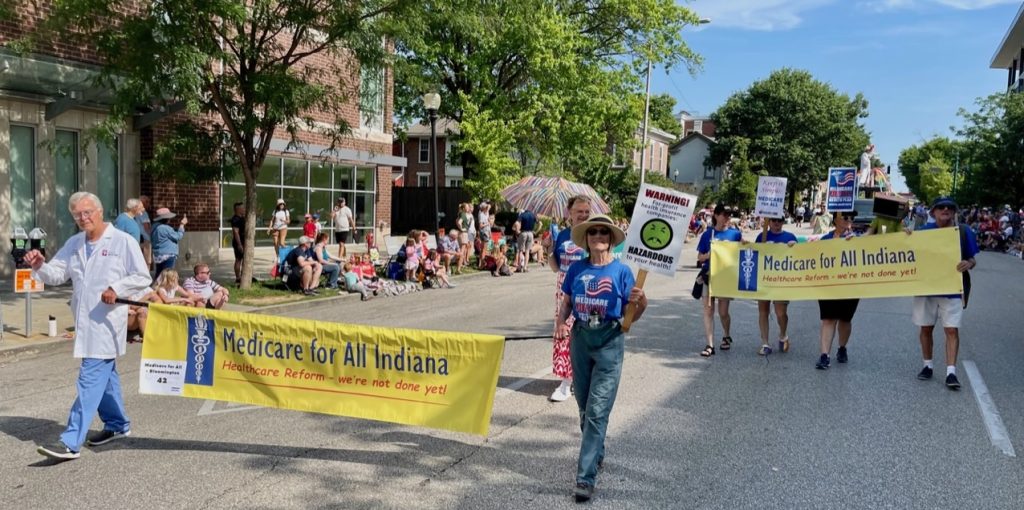
Members of Medicare for All Indiana march in a local Independence Day parade in July 2023.

Members of Medicare for All Indiana have been hard at work together with SNaHP members passing resolutions at the Indiana State Medical Association. These resolutions include supporting Medicaid access, calling on non-profit hospitals to honor their charity care obligations, and protecting voting rights and democracy. In addition, members presented on Medicare for All at the League of Women Voters’ annual meeting in June, and gave multiple presentations on Medicare privatization throughout the year, including tabling at Farmers’ markets. The chapter also sponsored showings of American Hospitals in September.

To get involved in Indiana, please contact Dr. Rob Stone at grostone@gmail.com.

Kentucky

Members in Kentucky led a protest at Humana headquarters in downtown Louisville, demanding an end to denials of care, the right to choose your doctor, an end to forced placement in MA, and the enactment of Medicare for All. The chapter also gave several presentations and hosted webinars on value-based care, single payer, and other topics. Finally, the chapter successfully persuaded the newspaper known as the Kentucky Lantern to cover the story of Baptist Health hospitals and physicians ending contracts with Medicare Advantage companies.

To get involved in Kentucky, please contact Kay Tillow at nursenpo@aol.com.

North Carolina

Members of Health Care Justice – NC march in the MLK Day parade in Charlotte on Jan. 13, 2024.

In Asheville, members of Health Care for All Western North Carolina (HCFAWNC) have worked on a number of different initiatives. In October, the chapter presented to Burke County Democrats, and in November, organized a screening of the documentary “Healing US”, adding several new members to the chapter from this event. In January, members met with North Carolina House Representative Caleb Rudow to discuss single payer and his constituents’ need for it. Members also met with Senator Ted Budd  to inform him of the failures of Medicare Advantage plans and to ask him not to sign the pro-MA letter.

To get involved in HCFA-WNC, please contact Terry Hash at theresamhash@gmail.com.

Washington

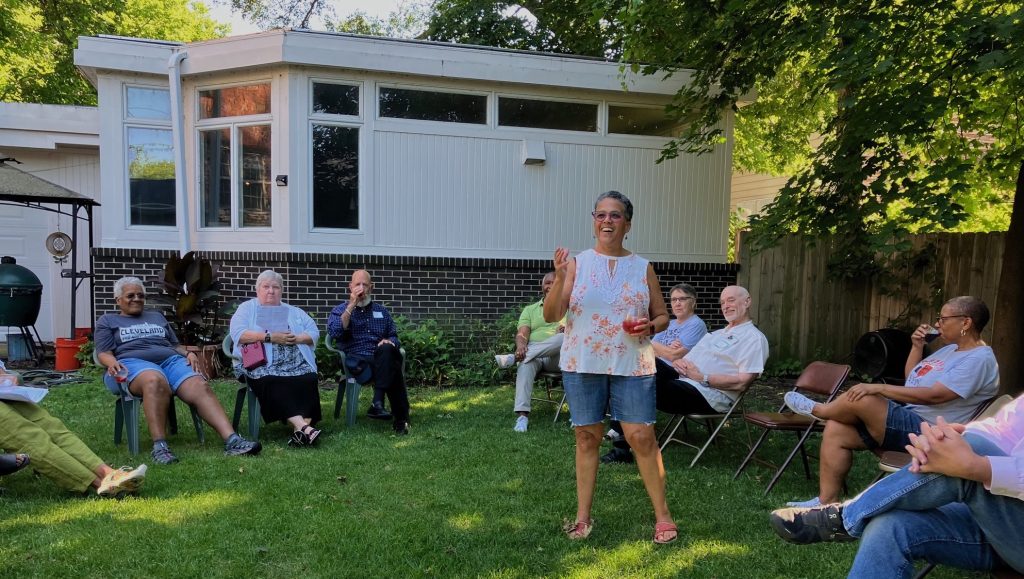
In Washington, members continued their tradition of holding monthly Zoom meetings with a theme and speaker. These included a report-back from four members and eight SNaHP students from around the state who attended PNHP’s 35th Anniversary Annual Meeting in Atlanta. The chapter also raised more than $20,000 in contributions for its George Martin Student Scholarship Fund, which provides support for activities of the 5 SNaHP Chapters in our region. Members worked hard to develop deeper and more productive collaboration with other organizations in the region to fight against the privatization of Medicare. These include Puget Sound Advocates for Retirement Action, Health Care for All WA, and Health Care is a Human Right WA. Finally, members have been writing and circulating sign-on resolutions, advocating for Single-Payer with state and Congressional legislators, and planning for public meetings and actions in the Spring of 2024.

To get involved in Washington, please contact Dr. David McLanahan at mcltan@comcast.net.

back to table of contents


SNaHP Chapter Reports


Florida State University

SNaHP Students at Florida State University have focused on recruitment and collaboration. The chapter is planning to table at several student activity fairs, and has recruited members into leadership positions in the organization. Members attended a virtual town hall with Rep. Maxwell Frost in the fall, and sent students to health care focused events around Tallahassee. The chapter also continues to collaborate with other units at FSU College of Medicine on access to care for racial and ethnic minority populations. In the coming months, students will be looking to collaborate more closely with LMSA and Pride groups in the medical school.

To get involved at Florida State University, please contact Dr. Xan Nowakowski at alexandra.nowakowski@med.fsu.edu.

Hofstra University

The SNaHP chapter at the Hofstra University Zucker School of Medicine hosted a single payer 101 lecture presented by Dr. Oliver Fein in October. Students had the opportunity to learn about the basics of single payer and how it compares to our current health system in achieving affordable and universal health care coverage.  Students also organized a letter writing and introduction to advocacy event. In this event, medical students learned the ins and outs of engaging in advocacy and the democratic process. These students then wrote to their state and national representatives to express support for a number of health policies, including single payer. Many students also wrote to state legislators in support of the New York Health Act.

To get involved at Hofstra University, please contact Brien Maney at bmaney1@pride.hofstra.edu. 

UNC-Charlotte

UNC-Charlotte students grow their SNaHP chapter at the school’s Student Org Showcase on Jan. 18, 2024.

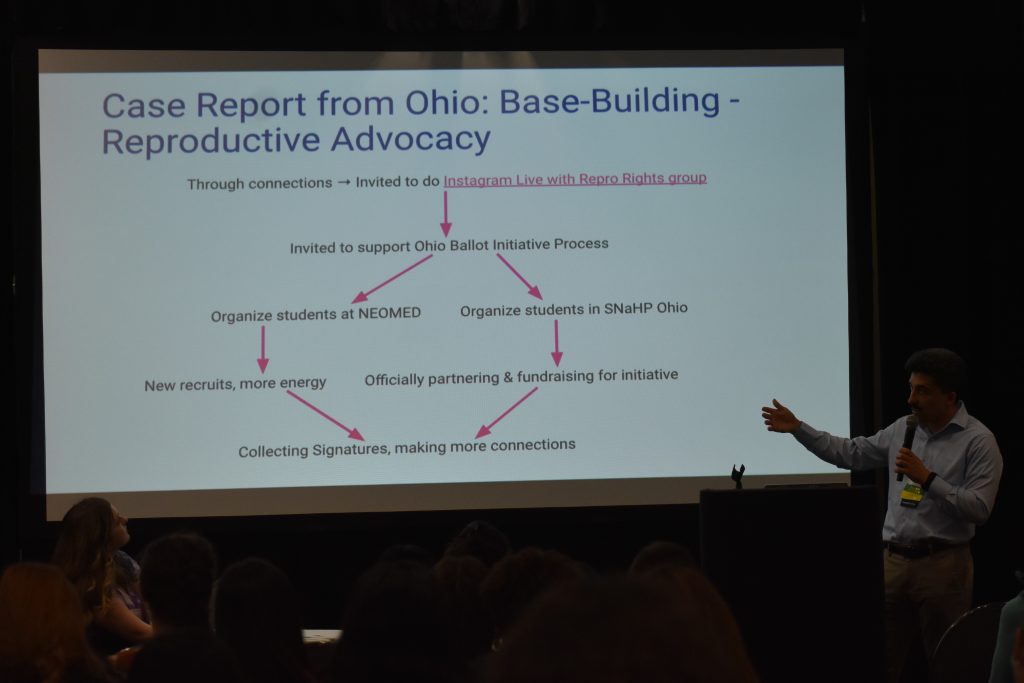
Students at the undergraduate chapter of UNC-Charlotte have held several meetings on different topics. One meeting was on understanding the legislation of health care, where students heard about the legislative side of Medicare for All from Dr. George Bohmfalk and Megan Dunn. Another meeting was on reproductive justice and healthcare, held in collaboration with the UNC-Charlotte Reproductive Justice Collective to discuss how reproductive freedom relates to Medicare for All. This event was organized using information from the reproductive justice session at the PNHP Annual Meeting. The last event held was on access to mental health care, and how Medicare for All can help eliminate barriers to accessing mental health care.

To get involved at UNC-Charlotte, please contact Kayla Walker at kwalk100@uncc.edu. 

University of Florida

University of Florida students and their allies celebrate the passage of a Medicare for All resolution in Alachua County, Fla. on Dec. 12, 2023.

Students at the University of Florida worked in collaboration with groups such as Medicare for All Florida and Alachua County Labor Coalition to pass a resolution in Alachua County in support of Medicare for All. The resolution passed on December 12th. The chapter also hosted 4 SNaHP events during Health Policy week for first-year medical students with local speakers and PNHP speakers Dr. Ed Weisbart, Dr. Marvin Malek, and Dr. Betty Keller. Finally, the chapter had great success with recruitment, increasing its membership from just 4 to 34 students in the last months.

To get involved at the University of Florida, please contact Patrick Haley at phaley1@ufl.edu. 

back to table of contents


Reclaiming Medicare for the Public

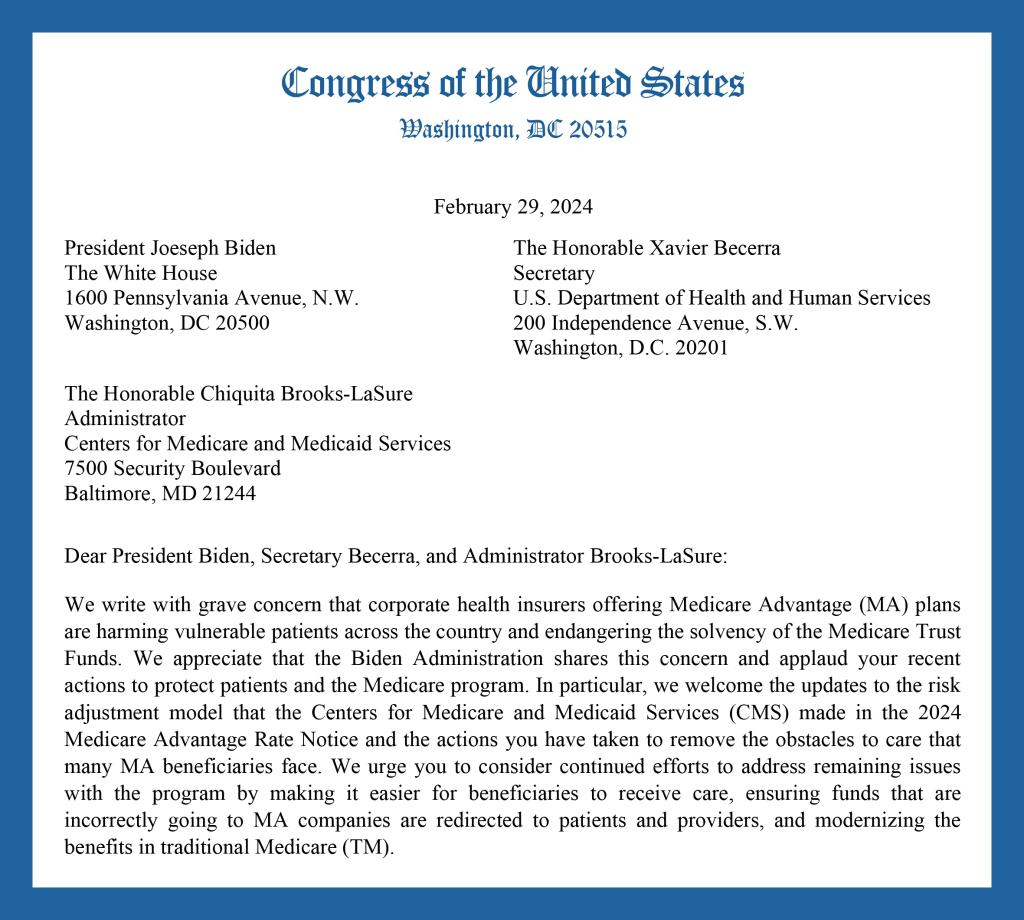
In late winter, legislators in the U.S. House and Senate sent a pair of letters to the Centers for Medicare and Medicaid Services, urging administrators to crack down on delays and denials in the so-called “Medicare Advantage” program—and to make sorely needed improvements to traditional Medicare. These letters were championed by Reps. Jayapal, DeLauro, and Schakowsky, and by Sens. Warren and Brown.

PNHP members were instrumental in convincing 60 Representatives and 10 Senators to sign on. We sent thousands of emails and met with dozens of legislators to talk about the dangers of Medicare profiteering.

For more information about how you can get involved with our legislative campaign, visit HealMedicare.org or email National Organizer Mandy Strenz at mandy@pnhp.org.

back to table of contents


PNHP in the News


News items featuring PNHP members

  • “Three quarters of ACOs in direct contracting model earned savings,” Healthcare Finance News, 10/24/23
  • “Health care choices narrow for Kentuckians in Medicare Advantage plans,” Kentucky Commonwealth Journal, 10/25/23
  • “‘This Should Be a National Scandal’: For-Profit Medicare Advantage Plans Using AI for Denials,” Common Dreams, 11/3/23
  • “Physicians gather in Atlanta to march for Medicaid expansion, AMC site,” Atlanta Journal-Constitution, 11/12/23, featuring Drs. Anwar Osborne and Mindy Guo
  • “Medicare Advantage Plans Disadvantage Many Elderly and Disabled People,” Truthout, 12/4/23, featuring Dr. Cheryl Kunis
  • “Alachua County Commission unanimously approves resolution supporting the Medicare for All Act,” Alachua Chronicle, 12/12/23, featuring Patrick Haley
  • “State lawmakers look for solutions to Georgia’s maternal mortality crisis,” Atlanta Journal-Constitution, 1/5/24, featuring Dr. Toby Terwilliger 
  • “Republicans Are Planning to Totally Privatize Medicare — And Fast,” Rolling Stone, 2/5/24, featuring Dr. Philip Verhoef
  • “Do No Harm,” Chicago Health Magazine, 4/8/24, featuring Drs. David Ansell, Susan Rogers, and Philip Verhoef

back to table of contents

Op-eds by PNHP members

  • “Healthcare Priorities for Georgia,” by Jack Bernard, Newnan Times-Herald, 11/13/23
  • “The right wing loves insurance company looting of Medicare,” by Dave Anderson, Boulder Weekly, 10/26/23
  • “It’s Halloween season, and Medicare Advantage is coming as a vampire,” by Dr. Peter Gann, Evanston Roundtable, 10/30/23
  • “Seniors, beware: Medicare open enrollment feels like ‘open season’ on older Americans,” by Dr. Carol Paris, The Tennessean, 10/30/23
  • “Medicare Advantage is a money grab by big insurers,” by Kip Sullivan, Minnesota Reformer, 11/3/23
  • “Medicare recipients should look beyond ‘benefits’ of Medicare Advantage plans,” by Dr. Jeffrey Belden, et al., Columbia Missourian, 11/6/23
  • “Medicare Advantage is giving away billions to corporate insurers. It’s time we put a stop to it.” by Dr. Diljeet Singh and Rep. Pramila Jaypal, The Hill, 11/17/23
  • “The siren call of Medicare Advantage,” by Dr. Robert S. Kiefner, Concord Monitor, 11/25/23
  • “’Medicarelessness’ Revisited After 50 Years,” by Dr. Cheryl Kunis, MedPage Today, 11/27/23
  • “Medicare Advantage is bad for patients and bad for investors,” by Dr. Philip Verhoef and Wendell Potter, STAT News, 2/28/24
  • “Overpayments to Medicare Advantage costly,” by Dr. Dwight Michael, Gettysburg Times, 3/16/24
  • “We need to act to rein in ‘prior authorization’,” by Dr. Marvin Malek, VTDigger, 4/18/24
  • “The Path Toward Medicare for All,” by Patty Harvey, North Coast Journal, 6/6/24

back to table of contents

Letters to the editor by PNHP members

  • “Politics controls health policy from upstream,” by John Steen, VTDigger, 10/22/23
  • “Medicare Advantage programs are a symptom of a sick health-care system,” by Ken Lefkowitz, Washington Post, 11/13/23
  • “Medicare ‘Dis-Advantage’ plans undermine system,” by Marion Brodkey, Santa Cruz Sentinel, 11/15/23
  • “Private insurers never deliver,” by Cris Currie, The Spokesman-Review, 11/17/23
  • “Be wary of Medicare Advantage plans,” by Patty Harvey, The TImes-Standard, 11/23/23
  • “Save Medicare from corporate profiteers,” by Leslie Nyman, Greenfield Recorder, 11/29/23
  • “Medicare ‘Advantage’ is no advantage at all,” by Dr. Susanne King, The Berkshire Eagle, 12/2/23
  • “Hospitals and Profits: Should They Coexist?” by Dr. Marc Lavietes, New York Times, 12/18/23
  • “Letter: Medicare Advantage,” by Dr. Mary McDevitt, The Sonoma Index-Tribune, 3/7/24

back to table of contents

Taking Advantage

How Corporate Health Insurers Harm America’s Seniors

Physicians for a National Health Program, May 23, 2024


Table of Contents

  • Executive Summary
  • By the Numbers
  • Introduction
  • Patient Harms: Restricting Access Through Networks
    • Patient Narrative: Restricting Cancer Care
    • Patient Narrative: Restrictive Networks
    • Provider Narrative: Ghost Networks
  • Patient Harms: Prior Authorization
    • Provider Narrative: Prior Authorization
  • Patient Harms: Limited Coverage
    • Patient Narrative: Limited Coverage
  • Patient Harms: Excessive Costs
    • Patient Narrative: Excessive Costs
  • Patient Harms: Trapped in MA
    • Patient Narrative: Trapped in MA
  • Provider Harms: Barriers to Patient Care and Administrative Burden
    • Provider Narrative: Barriers to Patient Care
    • Provider Narrative: Administrative Burden
  • Provider Harms: Corporatization of Medicine
    • Provider Narrative: Corporatization of Medicine
  • Conclusion
  • Endnotes
  • Recommended Citation
  • Acknowledgements

To view a PDF version of this report, click HERE for an interactive (web-friendly) version, HERE for a printable full-color version, and HERE for a printable black & white version.

To view a one-page printable handout, click HERE for full color and HERE for black & white.


Executive Summary

Medicare Advantage (MA), the privately-administered version of Traditional Medicare (TM), is causing significant harm to America’s patients, providers, and health care system. The insurers who run MA plans claim that they lead to better patient care and outcomes while saving money, but this is far from the truth.

Patients who sign up for Medicare Advantage are forced to deal with narrow networks which heavily restrict their access to physicians and hospitals, and are often misled about the size of these networks through inaccurate listings. They must seek prior authorization for many of the tests, treatments, and other procedures ordered by their doctor, often waiting days or weeks just to be inappropriately denied approval for necessary health care. These delays can have serious consequences for a patient’s health, even sometimes resulting in death.

MA plans aggressively advertise their supplemental perks, particularly their offering of dental, vision, and hearing benefits. However, plan benefits are often highly limited and do not come close to meeting the needs of enrollees. Even worse, patients in MA who become seriously ill or develop chronic conditions end up paying thousands of dollars for their care, often struggling to afford treatment and incurring medical debt in the process. These issues often have a disproportionate impact on the most vulnerable communities, reinforcing inequities in health care access and outcomes.

When patients encounter these issues in MA and wish to switch back to Traditional Medicare, they often find that they are unable to do so. In all but four states, regulations allow insurers to deny Medigap coverage to patients who have been in MA for more than a year. Without a Medigap policy to cover additional costs, Traditional Medicare is not an affordable option for many seniors who are then forced to remain in MA despite its many flaws.

MA doesn’t just hurt patients. Physicians, nurses, and other health care workers face serious barriers to caring for patients as a result of the excessive administrative burden placed on them by MA insurers. These workers must spend hours filling out authorization forms and fighting with insurers to get necessary care approved, limiting the time they can spend on their actual jobs. MA plans also frequently delay payments for the care of enrollees, or even refuse to pay altogether, causing serious financial harm to hospitals and medical practices that have limited resources to begin with.

Medicare was created to serve the people, and MA betrays that promise. We must rein in the abuses of MA insurers, eliminate profit-seeking in Medicare and beyond, and put an end to these egregious harms.


By the Numbers

  • 11.1-20.5 million: Hours per year wasted by medical practices on Medicare Advantage prior authorization requests
  • 11.7 million: Number of MA beneficiaries in a “narrow network” plan that excludes more than 70% of physicians in their county, based on 2017 KFF study (i) and STAT estimate of 2024 enrollment (ii)
  • 7.3 million: Number of MA beneficiaries who are underinsured based on their reporting of high health care costs, based on 2023 Commonwealth Fund study (iii) and STAT estimate of 2024 enrollment (iv)
  • 36: Number of studies cited in this paper collectively finding negative outcomes for patients and providers in MA
  • 2x: Increased likelihood of death after pancreatic surgery in cancer patients with MA, based on study in the Journal of Clinical Oncology (v)

Introduction

Insurance corporations in the privatized Medicare Advantage program are harming millions of America’s most vulnerable, while costing the Medicare Trust Fund tens of billions more than if those people enrolled in Traditional Medicare. These insurers force patients and health care workers alike to deal with unjustifiable prior authorization requirements, limited networks, endless denials of care, and inadequate coverage, severely disrupting care in the name of financial gain. This report will summarize, through a review of relevant academic literature, research, journalism, and original interviews conducted by PNHP, the many ways in which corporate-run Medicare harms both patients and health care workers.

Medicare Advantage, also known as MA or Medicare Part C, is a privately administered insurance program that uses a capitated payment structure, as opposed to the largely fee- for-service (FFS) structure of Traditional Medicare or TM. Instead of paying directly for the health care of beneficiaries, the federal government gives a lump sum of money to a third party (usually a commercial insurer) to “manage” patient care.

“Managed care” has promised two benefits: to save money, and to improve patient outcomes. Advocates of the insurance industry assert that private insurers, by dint of their profit incentive, will do a better job at preventing unnecessary expenses and promoting efficient spending. However, as we detailed in a previous report, MA has failed to realize any true savings, and in fact transfers tens of billions of dollars from taxpayers to corporations each year. (1) But what of the second measure? Even if Medicare Advantage is more expensive than Traditional Medicare, does it provide better care?

Insurers will tell you that the answer is a clear “yes,” using the same logic as when speaking about savings. After all, it’s taken for granted that companies must satisfy their customers in order to stay competitive and stay in business. This logic is both deceptively simple and deeply flawed. The literature comparing quality and outcomes of care between MA and TM challenges the claims of insurers. The Medicare Payment Advisory Commission (MedPAC), the most authoritative source of data and analysis on the Medicare program, has found no consistent pattern of better performance or outcomes under MA, despite its higher costs. (2) What’s more, the agency notes that the practice of “favorable selection” may skew quality and outcomes data in favor of MA. (3) By signing up less costly and thus generally healthier patients, insurers make it seem as though they do a better job of keeping patients healthy. (4) Even with this leg up, there is no persuasive evidence that MA outperforms TM on the whole. Insurers do not report much of the data that could help answer open questions about care in MA, further calling into question their claims about increased quality. (5)

Contrary to what insurers say, quality of care is often not the reason that beneficiaries enroll in an MA plan. They may be drawn in by misleading and aggressive marketing, as 17% of seniors have reported that advertisements led them to believe something about an MA plan that they later found out was not true. (6) They may sign up out of financial necessity, if they are unable to afford monthly TM premiums plus a supplemental Medigap policy. Their employer may only pay retiree benefits to an MA plan, a practice that has caused controversy around the country. (7) Or, most insidiously, they may be unhappy with their MA coverage but unable to switch to TM due to regulations detailed later in this paper. MA plans keep their customers through captive practices, not superior service. They make money not by providing the best medical services, but by withholding them. Ultimately, the effect of enrolling in MA on the care of millions of patients is decidedly negative. The existing evidence demonstrates that MA is not doing what it promised to do, and what its participating insurers are overpaid billions to do; far from improving quality of care or outcomes, Medicare Advantage is leaving beneficiaries, health care workers, and our health care system worse off, all in the name of profit.


Patient Harms: Restricting Access Through Networks

To examine the harm that MA does to patients, it is logical to begin with the act of seeking care from a physician or other provider. A key feature of Traditional Medicare, one which is both widely known and widely beloved, is that beneficiaries can access care at nearly any hospital or doctor in the country. The vast majority of practitioners and physicians in the U.S. participate in the program, and receive additional benefits to do so. (8) With TM, there are no out-of-network fees or differences in payments between providers. This is not the case in MA.

Medicare Advantage insurers employ networks just the same as nearly any other commercial insurance policy. Over half of MA plans are health maintenance organizations (HMOs), which tend to be more restrictive than other plans, featuring smaller networks, little out-of-network coverage, and referral requirements for specialist care. (9) These HMOs also enroll the greatest number of MA beneficiaries–around 62% of the total beneficiary population based on estimates from 2021. (10)

For most insurance plans, the ostensible goal of establishing a network is to negotiate lower payment rates with a smaller set of providers. (11) However, when it comes to MA, payment rates are largely set near or at those of Traditional Medicare, so rate negotiations are less of an incentive. Instead, narrow networks are formed with health systems that have lower utilization rates, as a means of saving money for the insurer. (12) In addition, insurers try to form networks using providers who can help them to achieve high star ratings in MA’s quality bonus program, as the ensuing reimbursement bonuses translate into extra profits for the insurer. (13) It is worth noting that the quality bonus program itself is highly flawed, and high star rating plans do not necessarily deliver better care to MA beneficiaries. (14)

The consequence of these financial incentives is that narrow physician networks are very common in Medicare Advantage. A study from KFF found that a little over one in three MA plans (35%) had a “narrow” physician network, meaning one that excluded more than 70% of physicians in a given county. (15) A further 43% of plans had “medium” networks, with anywhere from 30-69% of physicians included.

Only 22% of plans had “broad” networks that included more than 70% of physicians in the county area. On average, plans excluded over half of physicians in a county. (16) Although percentages of narrow networks for hospitals are lower, on average MA plans still only cover just over half (51%) of hospitals in a county. (17) Predictably, MA insurers often fail to meet the network adequacy standards that are set for them by the Centers for Medicare and Medicaid Services (CMS). (18)

These narrow networks persist across a variety of different specialties and categories of care. Multiple studies have found that psychiatrists are some of the most heavily restricted specialists in MA networks, with nearly two-thirds of plans covering less than 25% of psychiatrists in the network service area. (19) According to KFF’s physician study, 36% of assessed plans were even more narrow, with less than 10% of psychiatrists in the county included. (20) KFF also found that close to one-fifth of MA plans included less than five cardiothoracic surgeons, less than five neurosurgeons, less than five plastic surgeons, and less than five radiation oncologists. (21)

Evidence shows that patient demographics affect network size as well. Physicians who care for the greatest number of patients who are dual-eligible for Medicare and Medicaid (meaning patients who are both elderly/disabled and also struggling financially) have been found to have a lower chance of being included in MA plan networks. (22) The same is true for physicians who treat patients with higher levels of medical risk, which tracks with indications that MA plans actively seek to avoid such patients. (23) Patients in rural areas are also more likely to face restrictive networks across a number of specialties. (24)

Narrow networks compromise access to the best quality of care for the sickest individuals. Cancer care, already a nightmare to navigate for anyone regardless of their insurance, is especially bad for MA patients in terms of network inclusion. MA patients are much less likely than TM patients to be able to access cancer care at teaching hospitals, Commission on Cancer-accredited hospitals, or National Cancer Institute-designated centers. (25) MA patients are also less likely to have access to high-volume hospitals with more experience doing complex, high-risk surgery for cancers of the lung, esophagus, stomach, liver, pancreas, or rectum. This lack of access, largely a result of narrow networks as well as delays in receiving care, was found to have likely contributed to higher 30-day mortality rates for liver, pancreas, and stomach cancer surgeries. In other words, narrow networks are killing cancer patients. (26)

A final issue with MA networks is the prevalence of “ghost” networks. These networks claim to include providers who are not actually in the network, and sometimes no longer even exist. A study by the U.S. Senate Committee on Finance found that over 80% of identified listings for mental health providers in studied MA plans were inaccurate or unavailable. Of 120 provider listings who were contacted, researchers only succeeded in setting up an appointment with 22. (27)

Another study of dermatologists in MA networks found that more than half of the dermatologists listed had incorrect contact information, were deceased, retired, had moved, were not accepting new patients, did not accept the insurance plan, or were subspecialized. (28) Ghost networks present a huge transparency issue for MA beneficiaries, who may select a plan based on the appearance of a robust network only to find there are far fewer available providers than initially shown.

It is also worth noting that hospital networks in MA may be shrinking as health systems continue to opt out of accepting Medicare Advantage due to low reimbursement rates and the administrative burden of insurer practices like prior authorization. Dozens of hospitals, including large and well-known systems like Scripps Health and Mayo Clinic, have indicated that they will no longer take most or all MA plans because of these issues. (29) Patients, especially those in rural areas or places with few options for medical care, suffer greatly from these closures, which further decrease access to care for everyone in the community. (30)


Patient Narrative: Restricting Cancer Care


“In 2021, my wife became very seriously ill very suddenly, within a matter of 3 or 4 days, and she was diagnosed on the 5th or 6th day with category 4 brain cancer, glioblastoma, inoperable. Pretty much from that point in time, it was always a fight with insurance. Which hospital could we be in? Could we coordinate benefits between hospitals? Some services might only be covered in one hospital and other services in another hospital. What kind of treatment could she get approved for as she got progressively worse? Would she be able to be admitted to hospice? I wouldn’t wish it on anybody. It was absolutely horrible.” – Husband of MA patient, New York


Patient Narrative: Restrictive Networks


“Trying to find a dentist on my Blue Cross plan was virtually impossible. They were not accepting new patients, at least not when I told them I was a Medicare Advantage patient. After a lot of searching, I finally found a dentist, and now, what I have to do is take a ferry from my home, then drive about 20 miles into another town, and there is the only dentist I can go to. All of the travel combined takes about an hour to an hour and a half each way, when there are dentists who won’t accept Medicare Advantage patients ten minutes from my house.” – MA patient, Washington


Provider Narrative: Ghost Networks


“When Medicare Advantage plans were taking off in our area some years ago, Coventry Health, which later became a part of Aetna, sold a Medicare Advantage plan in the area that listed us as a network provider—but we weren’t. The first patient that showed up with this plan, I had to look it up and tell them we weren’t in-network, and they were furious, because this plan was sold to them on this presumption. This was bad enough and they sold this plan to enough people that I reported them to CMS for contracting issues, and they had to change their network.” – Primary care practice office manager, Missouri


Patient Harms: Prior Authorization

Even if patients are able to obtain an appointment, the challenges do not end there. Like other insurance plans, MA plans practice “utilization management,” requiring prior authorization (PA) for most tests, procedures, and medications. Ostensibly, the purpose of this practice is to prevent unnecessary use of medical services; in practice, it is often a way for insurers to delay paying for necessary care in the hopes that patients will abandon their efforts to receive it. By contrast, beneficiaries in Traditional Medicare are only required to obtain prior authorization for a small set of services, meaning delays in care due to denial are much rarer.

When it comes to its effect on patient care, prior authorization is almost universally hated by health care providers. A survey of physicians conducted in 2022 by the American Medical Association (AMA) found that 94% of physicians reported that PA caused delays in care for their patients, with 80% saying that this delay led to treatment abandonment at least some of the time. (31) 89% of physicians said that PA has a negative effect on patient treatment, with 25% of physicians even reporting that delays in treatment due to PA led to a patient’s hospitalization. (32) Although the AMA’s survey was about PA in general and not specific to PA in Medicare Advantage, the organization cited this data in an open letter to the Centers for Medicare and Medicaid Services (CMS) calling for the agency to crack down on the abuse of PA in the MA program. (33)

Many problems have been reported with the use of prior authorization in Medicare Advantage. According to KFF, in 2021, more than 35 million prior authorization requests were submitted to MA plans, of which about 2 million or 6% were fully or partially denied. (34) It is important to remember that these denials do not account for delays in approval, which can take weeks and still result in profound negative consequences for patients (nor do these statistics reflect the number of requests physicians never submit because of the anticipated hassle of approval). The appeal process for denied requests also demonstrates the true harm of this process: just 11% of the 2 million denied requests were appealed, but in those appeals, 82% of denials were overturned. (35) These findings were echoed in a report by the U.S. Department of Health and Human Services’ (HHS) Office of the Inspector General (OIG), which found that from 2014-2016, just 1% of payment or service denials in Medicare Advantage Organizations (MAOs) were appealed, but 75% of appeals overturned the initial decision. (36)

In effect, these statistics suggest that denials are often entirely arbitrary, as even one attempt to question their use results in the request’s approval in the vast majority of cases. The inpatient denial rate in MA is also higher than in other programs, with a survey by the American Hospital Association (AHA) finding that 19.1% of inpatient prior authorization requests in MA were denied, compared with 15.5% for Medicaid Managed Care patients and 11.4% for commercial insurance patients. (37) Here, too, the overturn rate on appeal was high, with 69% of MA appeals resulting in a reversal of the initial decision. (38)

Indeed, studies and reporting have demonstrated some of the magnitude and characteristics of inappropriate denials in MA. Despite statutory requirements for MA to cover all the same services as TM (and consistent claims by CMS and insurers that plans do so), an HHS OIG report from 2022 found that 13% of denials in MA, close to 1 in 7, would have been approved in TM. (39) 18% of denied requests, or close to 1 in 5, met both Medicare coverage rules and MA billing rules, meaning their denial was most charitably the result of human or system error. (40) An investigation by STAT News revealed that, contrary to claims of careful review by medical experts, insurers were using unregulated AI algorithms designed to cut off care as soon as possible based on training data, without adequate regard for the individual circumstances of the patient. (41) Another STAT investigation also revealed that the insurer UnitedHealth developed secret criteria used to deny care to patients in rehabilitation care without explanation. (42)

MA beneficiaries are aware of and concerned by the excessive delays and denials of their care as a result of prior authorization. A survey by the Commonwealth Fund found that 22% of patients on MA reported delays in care due to need for approval, compared with just 13% of TM patients. (43)


Provider Narrative: Prior Authorization


“I had a patient with several chronic diseases who was very sick and had just survived major abdominal surgery, almost miraculously. In the aftermath, she desperately needed to go to acute rehab, which is the most intensive rehab – we found a facility, she liked it, her family liked it, and then her MA plan looked at the place and said ‘No, she’s healthy enough to not go to acute rehab, we won’t authorize it.’ This was after our PM&R specialist, physical therapist, and 3 MDs on our team had told her she needed acute rehab, and that it was the only thing that would keep her out of the hospital again. And this insurer, without anyone ever looking at her, rejected that conclusion. And we knew that on Traditional Medicare this never would’ve happened.” – Internal medicine resident, Illinois


Patient Harms: Limited Coverage

Besides delaying and denying care through prior authorization, MA plans also explicitly restrict care ahead of time via the use of limits on benefits and coverage. These restrictions may, for example, set an upper bound on the number of days a patient can be admitted for an inpatient treatment, or determine what drugs will be included on a formulary.

Medicare Advantage insurers are known for aggressively advertising “supplemental benefits” such as dental, vision, and hearing. These benefits are not covered by Traditional Medicare, and thus patients on TM generally require supplemental coverage to access these services. An analysis of MA television ads found that 92% mentioned supplemental benefits as a perk of the plans, compared with just 22% touting better access to physicians. (44) What these ads fail to describe are the significant limits applied to these benefits.

59% of enrollees in an MA plan with dental coverage have a maximum benefit of $1,000 or less, beyond which any dental services will not be covered. (45) This is despite the fact that 19% of Medicare beneficiaries have reported spending more than $1,000 on dental care in out-of-pocket costs during a yearlong period. (46) Hearing services in MA are similarly restricted, as 91% of beneficiaries with hearing coverage face limits on the number of hearing aids they can receive in a given time period. (47) 32% of beneficiaries with hearing coverage have both frequency limits and a dollar limit applied to their benefit. (48) The average dollar limit for hearing coverage is $960, despite the fact that an average pair of prescription hearing aids costs over $4,000. (49) The dollar limits for vision coverage in MA are perhaps the most striking; 99% of beneficiaries receiving vision benefits have a dollar limit on coverage, and the average limit is just $160 per year. (50)

Similar coverage restrictions are present in other aspects of care as well. About 60% of MA enrollees are in plans that do not cover out-of-network outpatient mental health or substance use disorder services, with a similar number of enrollees in plans that do not cover out-of-network mental health hospitalization or opioid treatment programs. (51) A study of prescription drug coverage among 4 large MA insurers found that of the 20 most common physician-administered drugs, 17 were subject to prior authorization and 10 were subject to step therapy by at least 1 insurer (step therapy refers to a practice wherein insurers require the use of alternative treatments, and only approve the requested treatment if those prove unsuccessful). (52)

Over the period from 2018 to 2020, many of these drugs were also removed from all 4 MA- Part D (MA-PD) insurer formularies, meaning they would no longer be covered at all. Humana, for example, covered 14 of the 20 listed drugs on its Part D formulary in 2018, but by 2020 only included 4 of them. (53)


Patient Narrative: Limited Coverage


“My grandfather, who has pancreatic cancer, has to pay thousands of dollars before he gets any real coverage. On top of that, he has copays and coinsurance he needs to pay as well. He even has had to pay out-of-pocket fees for emergency life flights he needed due to complications from his chemotherapy. I know those would’ve been covered fully under Traditional Medicare.” – Grandson of MA patient, Pennsylvania


Patient Harms: Excessive Costs

Even with insurance, cost-sharing for medical services is virtually unavoidable in the United States. Traditional Medicare, for all its benefits, generally covers only 80% of the cost for outpatient services, leaving patients responsible for the other 20% (usually covered by a Medigap plan). (54) However, cost-sharing in Medicare Advantage plans is often egregious, and can lead to serious affordability issues for beneficiaries.

In a survey conducted by the Commonwealth Fund, 22% of seniors on MA reported high health care costs in the previous year, compared with 13% of seniors on TM with a Medigap supplement. (55) 41% of MA enrollees said they had problems accessing care because of high costs, compared with 35% of those in Traditional Medicare plus Medigap. Finally, 21% of those on MA reported problems paying off medical bills or debt, compared to 14% of those on TM plus Medigap. (56) Another survey from KFF found that across white, Hispanic, and Black racial groups, higher percentages of beneficiaries reported cost-related problems in MA compared to TM with a Medigap supplement. The biggest difference was among Black beneficiaries; 32% reported cost-related problems on MA, while just 20% reported the same on TM with Medigap. (57) These gaps increased for beneficiaries reported to be in fair or poor health, lending more credence to the idea that MA is especially bad for those actively dealing with significant health issues. (58)


Patient Narrative: Excessive Costs


“Like a lot of people, I thought Medicare Advantage was cheaper, and it’s supposed to cover everything Medicare covers, right? That’s the way it’s supposed to work. I made the mistake of choosing a UnitedHealth MA plan, and it was about a year later I realized what kind of hell I was in when I ended up inpatient. I was looking at $300+ dollars a night bills for being inpatient. And because of my health issues, I was ending up in the hospital nearly every six weeks, staying for a few days to a week and then coming out with these monstrous bills. As long as you’re not sick, Medicare Advantage is great – you’re spending less money! But when you do get sick, the co-pays, the co-insurance, out of pocket costs, they grow so fast, and you never hit the deductible.” – MA patient, New Hampshire


Patient Harms: Trapped in MA

One of the promises of free-market advocates in health care is the idea of “consumer choice.” The insurance industry will claim that the availability of a wide variety of plans allows beneficiaries to find one that suits their personal needs, and encourages competition among insurers that leads to better policies. However, this narrative elides the serious problems MA enrollees face in leaving the program if they find it unsuitable.

There is substantial evidence that many patients, especially those who are more ill or face high medical costs, tend to leave MA at high rates. A report by the Government Accountability Office (GAO) found that Medicare beneficiaries in their last year of life (when medical costs are generally very high) disenroll from MA back to TM at more than twice the rate of all other beneficiaries. (59) A similar study in Health Affairs found that the switching rates from MA to TM were generally higher than rates for the reverse among patients receiving high-cost services like long-term nursing home care (17% vs 3%), short-term nursing home care (9% vs 4%), and home health care (8% vs 3%). (60)

Not all enrollees have the option of leaving MA when things go wrong, though. When beneficiaries first become eligible for Medicare, they have the option of signing up for MA or TM. For their first six months of eligibility, these beneficiaries are protected by “guaranteed issue” requirements for supplemental Medigap plans. This means that Medigap insurers are not allowed to deny any senior a Medigap policy, nor can they engage in “medical underwriting” to potentially charge a higher premium based on health history or other factors. (61) This six month period is extended to twelve months when a beneficiary joins MA.

However, once this period is up, these protections disappear in all but four states. If an enrollee outside of these states signs up for MA during their initial open enrollment period, and then decides to switch to TM during the next year’s open enrollment period, they are no longer guaranteed to receive a Medigap policy, and can be denied on the basis of their medical history. Many seniors are unable to afford the 20% of costs covered by Medigap, meaning their only option is to stick with MA, even if they are unhappy with their coverage. (62) While more states do require “community rating,” wherein insurers must charge all recipients of a Medigap plan the same premiums, these protections mean little to those who are outright denied coverage to begin with. (63) Thus, MA plans get to keep many of their customers not on the basis of their high- quality services, but because they simply have nowhere else to go.


Patient Narrative: Trapped in MA


“If my husband gets older and develops more serious problems, his access to a specialist may be restricted under his MA plan. So we would like to pull him out and get him on Traditional Medicare, and my worry is that now he’s being upcoded, he has a high risk health profile, so how much is Medigap going to cost if we can get it? Who knows about these kinds of problems until later on?” – Wife of MA patient, North Carolina


Provider Harms: Barriers to Patient Care and Administrative Burden

Thus far, we have discussed the myriad harms that MA inflicts upon patients. It is worth remembering, however, that MA is not only a problem for them. Medicare Advantage makes the jobs of physicians and health care workers substantially more difficult, contributing to stress, burnout, and moral injury, which refers to the psychological impacts of working in a system that forces providers to compromise their ethical commitment to patients due to the profit-driven nature of the health care system. (64)

As discussed earlier, limited networks and prior authorization are two techniques used by MA insurers to deprive patients of care as a means of saving money. Physicians are forced to contend with these practices daily, greatly hampering their ability to adequately care for patients. Limitations in networks mean that physicians often cannot refer patients to their preferred specialist or one that is convenient to the patient, making it harder to follow through on treatment plans and increasing the odds that patients will abandon treatment. These failures in treatment can weigh heavily on physicians, especially when they result in harm to a patient’s health.

Even if patients are able to get an appointment and receive a diagnosis, the physician will often need to spend hours wrestling with the insurer to justify their desired course of action and receive prior authorization for it. These interactions can be highly frustrating; in the previously mentioned survey by the AMA, 31% of physicians reported that PA criteria rarely or never follow evidence-based guidelines approved by medical specialty societies. (65) In other words, many physicians believe that insurers are denying care based on faulty premises, rejecting the expertise of these physicians and established national guidelines in favor of their own dubious standards.

The administrative burdens of prior authorization are significant. 88% of physicians describe the burden of PA as high or extremely high. (66) 35% of physicians surveyed reported that they have needed to hire staff members to work exclusively on prior authorization. (67)

In a survey of practices conducted by the Medical Group Management Association (MGMA), groups were asked to name the type of policy most burdensome for obtaining prior authorization: 46% of groups said Medicare Advantage, compared with 32% naming commercial plans and just 4% naming Traditional Medicare. (68) 84% of practices also reported that PA requirements for MA had increased in the last 12 months. (69) When asked if the clinician hired by the insurer to review an authorization held relevant expertise to the treatment in question, 72% of groups said they did not. (70) And perhaps most strikingly, an overwhelming 97% of practices said their patients had experienced delays and denials of necessary care due to prior authorization. (71)

The AMA’s physician survey found that practices spend an average of 14 hours each week processing 45 prior authorization requests, for a mean time of about 19 minutes per request. (72) Taking this figure as a global average (keeping in mind that practices rate prior authorization in MA as more burdensome than other types), the 35 million requests KFF reported were made in 2021 would result in roughly 11.1 million hours spent just on prior authorization for Medicare Advantage. Using a higher reported average time of 35 minutes per request from the MGMA survey, this number increases to 20.5 million hours. That is just over 1200 years at a minimum, and over 2300 years at maximum–or, in health care terms, anywhere from 35 to 65 million average patient visits. (73)

Prior authorization is not the only aspect of MA that results in administrative burden to physicians. In another survey from the MGMA, roughly 86% of medical group practices reported MA chart audits as being at least moderately burdensome to the practice, with 62% reporting that audits were very or extremely burdensome. (74) Because these chart audits are often used by MA insurers to inappropriately extract more money from the Medicare fund via upcoding, this also means that physicians are incurring a significant time and resource burden for the financial benefit of insurers. This is yet another example of MA contributing to moral injury among physicians. (75)


Provider Narrative: Barriers to Patient Care


“We had a patient recommended for acute rehab. He was medically ready, but insurance denied him. We had to do an appeal, and we’re waiting on the results of the appeal, but he’s been here for 20 days, and 10 of those days have been us fighting with the insurance. In that time he’s developed pneumonia.” – Nurse and case manager, Illinois


Provider Narrative: Administrative Burden


“In one month, the staff for our two oncologists did 360 prior authorizations for their patient population–so much so that I’ve had to add another full-time equivalent employee just to do prior authorizations in the oncology unit. And every request in there is urgent.” – CEO of health system, Connecticut


Provider Harms: Corporatization of Medicine

In a general sense, physicians are increasingly under the thumb of large corporations or other entities that interfere with the practice of medicine. Approximately 74% of physicians are now employed by a hospital, health system, health insurer, private equity firm, or other corporate entity. Over a three year period from 2019-2021, the percentage of corporate-owned medical practices increased an astonishing 39%. (76) In 30% of metropolitan statistical areas (MSAs) in the United States, one private equity firm owned more than 30% of physician practices in a given specialty; in 13% of MSAs, one private equity firm owned more than 50% of practices. (77)

One significant motive for this rapid increase in corporate control of medicine is the massive profit machine that is Medicare Advantage. (78) Health insurers and private equity groups seek to control providers, encouraging them to upcode diagnoses and carefully managing the amount of care that their employees are allowed to give to beneficiaries. In one reported instance, the combined health system and insurer Kaiser Permanente called physicians during lunch breaks and after work to ask them to add more diagnoses to the charts of their patients, even offering bonuses and bottles of champagne as a reward for doing so. (79)

Another method of compelling doctors to participate in the financialization of care is through the use of “full-risk” or “global risk” models, in which physicians assume the financial risk of caring for patients and only make money if they can stay under a certain budget. MA plans have increasingly adopted such models in contracts with physician groups and health systems, leading some to fear that doctors will have to decide between providing the necessary amount of care for a patient, or meeting their budget in order to stay afloat. (80)

By placing financial concerns in the hands of physicians, MA plans subject them to moral injury. To consider profit in the determination of a patient’s care goes against the most important ethical standards that health care providers set for themselves; however, the reality is that physicians in the United States must already do this as a result of the constraints placed upon them by insurers like those in Medicare Advantage. When a physician has to prescribe a less effective medication because it is the only one covered by the patient’s plan, or when a patient must wait 3 months for a surgery that will allow them to walk without pain, profit motives have already infected the standard of care. The overt corporatization of medicine and the placing of financial incentives explicitly into the hands of physicians are simply the next logical steps in this process.


Provider Narrative: Corporatization of Medicine


“My patient was told by an MA plan that they would no longer cover a particular calcium channel blocker, and that the patient needed to be on a different one. The cost difference here could not have been significant, but they switched the coverage, and encouraged the patient to get their drugs by mail. In the wake of all this shuffling around without my involvement, the patient got confused, and was taking both medications. They came in profoundly hypotensive, and we had to keep them on IV fluids all day to avoid a hospitalization. All this came from the effort of trying to pinch a penny, but what I really noticed was this was a pulling apart of what is most important in medicine – the doctor-patient relationship, and the pharmacist-patient relationship. It was all about the dollar.” – Primary care physician, South Carolina


Conclusion

Medicare Advantage represents the worst of private insurance coming to take over the best system of health care that America has to offer. Insurers in MA prey on some of the most vulnerable among us, luring them in with false promises of superior coverage and low costs only to make every effort possible to prevent them from accessing necessary health care, all while siphoning billions of dollars from taxpayers. The more MA is allowed to expand, the more harm will come to patients, physicians, hospitals, and the health care system writ large. More patients will die waiting for care to be approved, more doctors will face tremendous burdens trying to prevent this outcome, and more hospitals in areas of critical need will close as MA plans refuse to pay for their services.

The money that goes to profit-driven insurers in MA should instead be used to improve Traditional Medicare, including by adding dental, vision, and hearing coverage as well as establishing an out-of-pocket spending cap. Traditional Medicare follows the original spirit of the program, one that was created to serve all Americans without the perverse incentives that come from a profit motive. This is the model we should be following in our health system, instead of devoting more dollars to the failed experiments of managed care. We must eliminate out-of-control profit seeking in Medicare and beyond, both by reining in the abuses of insurers via executive action and legislation, and by greatly expanding our public health insurance programs. It’s time to take Medicare back for the people.


Endnotes

  1. PNHP, “Our Payments, Their Profits,” October 2023, https://pnhp.org/system/assets/uploads/2024/01/MAOverpaymentReport_Oct2023.pdf.
  2. MedPAC, “Report to the Congress: Medicare Payment Policy,” March 2023, https://www.medpac.gov/wp-content/uploads/2023/03/Mar23_MedPAC_Report_To_Congress_SEC.pdf, 367.
  3. Ibid., 366.
  4. Ibid.
  5. Elizabeth Warren et al., “Letter to Admin Brooks-LaSure Re: MA Data,” December 7, 2023, https://www.warren.senate.gov/imo/media/doc/2023.12.07%20Letter%20to%20Admin.%20Brooks-LaSure%20re%20MA%20Data.pdf.
  6. Gretchen Jacobson et al., “The Private Plan Pitch: Seniors’ Experiences with Medicare Marketing and Advertising,” Commonwealth Fund, September 12, 2023, https://www.commonwealthfund.org/publications/issue-briefs/2023/sep/private-plan-pitch-seniors-experiences-medicare-marketing-advertising.
  7. Chris Sommerfeldt, “Retired NYC workers sue to block Mayor Adams’ latest Medicare Advantage Plan,” New York Daily News, May 31, 2023, https://www.nydailynews.com/2023/05/31/retired-nyc-workers-sue-to-block-mayor-adams-latest-medicare-advantage-plan-exclusive/.
  8. Nancy Ochieng and Gabrielle Clerveau, “How Many Physicians Have Opted Out of the Medicare Program?” KFF, September 11, 2023, https://www.kff.org/medicare/issue-brief/how-many-physicians-have-opted-out-of-the-medicare-program/.
  9. Meredith Freed et al., “Medicare Advantage 2024 Spotlight: First Look,” KFF, November 15, 2023, https://www.kff.org/medicare/issue-brief/medicare-advantage-2024-spotlight-first-look/.
  10. “Medicare Data Hub: Medicare Advantage,” Commonwealth Fund, https://www.commonwealthfund.org/medicare-data-hub/medicare-advantage.
  11. Andréa Elizabeth Caballero et al., “Are Limited Networks What We Hope And Think They Are?” Health Affairs, February 12, 2018, https://www.healthaffairs.org/content/forefront/limited-networks-we-hope-and-think-they.
  12. Laura Skopec et al., “Why Do Medicare Advantage Plans Have Narrow Networks?” Urban Institute, November 2018, https://www.urban.org/sites/default/files/publication/99414/why_do_medicare_advantage_plans_have_narrow_networks.pdf, 5.
  13. Ibid., 5-7.
  14. Laura Skopec and Robert A. Berenson, “The Medicare Advantage Quality Bonus Program: High Cost for Uncertain Gain,” Urban Institute, June 26, 2023, https://www.urban.org/research/publication/medicare-advantage-quality-bonus-program.
  15. Gretchen Jacobson et al., “Medicare Advantage: How Robust Are Plans’ Physician Networks?” KFF, October 5, 2017, https://www.kff.org/medicare/report/medicare-advantage-how-robust-are-plans-physician-networks/.
  16. Ibid.
  17. Gretchen Jacobson et al., “Medicare Advantage Hospital Networks: How Much Do They Vary?” KFF, June 20, 2016, https://www.kff.org/medicare/report/medicare-advantage-hospital-networks-how-much-do-they-vary/.
  18. Eric Krupa, “Voices of Medicare: Medicare Advantage Network Inadequacy,” Center for Medicare Advocacy, https://medicareadvocacy.org/voices-of-medicare-medicare-advantage-network-inadequacy/.
  19. Jane M. Zhu et al., “Psychiatrist Networks In Medicare Advantage Plans Are Substantially Narrower Than In Medicaid And ACA Markets,” Health Affairs, July 2023, https://www.healthaffairs.org/doi/abs/10.1377/hlthaff.2022.01547?journalCode=hlthaff.
  20. Jacobson et al., “Medicare Advantage Hospital Networks,” https://www.kff.org/medicare/report/medicare-advantage-how-robust-are-plans-physician-networks/.
  21. Ibid.
  22. Jung Ho Gong et al., “Proportion of Physicians Who Treat Patients With Greater Social and Clinical Risk and Physician Inclusion in Medicare Advantage Networks,” JAMA Health Forum, July 21, 2023, https://jamanetwork.com/journals/jama-health-forum/fullarticle/2807454.
  23. Ibid.
  24. Yevgeniy Feyman et al., “Restrictiveness of Medicare Advantage provider networks across physician specialties,” Health Services Research, April 9, 2024, https://pubmed.ncbi.nlm.nih.gov/38594081/.
  25. Mustafa Raoof et al., “Medicare Advantage: A Disadvantage for Complex Cancer Surgery Patients,” Journal of Clinical Oncology, November 10, 2022, https://ascopubs.org/doi/full/10.1200/JCO.21.01359.
  26. Ibid.
  27. Senate Committee on Finance, “Medicare Advantage Plan Directories Haunted by Ghost Networks,” May 3, 2023, https://www.finance.senate.gov/imo/media/doc/050323%20Ghost%20Network%20Hearing%20-%20Secret%20Shopper%20Study%20Report.pdf, 3.
  28. Jack S. Resneck Jr. et al., “The accuracy of dermatology network physician directories posted by Medicare Advantage health plans in an era of narrow networks,” JAMA Dermatology, December 2014, https://pubmed.ncbi.nlm.nih.gov/25354035/.
  29. Claire Wallace, “8 health systems calling it quits with Medicare Advantage: What ASCs should know,” Becker’s ASC Review, September 26, 2023, https://www.beckersasc.com/asc-coding-billing-and-collections/8-health-systems-calling-it-quits-with-medicare-advantage-what-ascs-should-know.html.
  30. Sarah Jane Tribble, “Tiny, Rural Hospitals Feel the Pinch as Medicare Advantage Plans Grow,” KFF Health News, October 23, 2023, https://kffhealthnews.org/news/article/medicare-advantage-rural-hospitals-financial-pinch/.
  31. American Medical Association, “2022 AMA prior authorization (PA) physician survey,” https://www.ama-assn.org/system/files/prior-authorization-survey.pdf.
  32. Ibid.
  33. American Medical Association et al., “Open Letter to Chiquita-Brooks LaSure,” February 13,  2023, https://searchlf.ama-assn.org/letter/documentDownload?uri=%2Funstructured%2Fbinary%2Fletter%2FLETTERS%2FPA-sign-on-letter-Part-C-and-D-rule.zip%2FPA-sign-on-letter-Part-C-and-D-rule.pdf.
  34. Jeannie Fugelsten Biniek and Nolan Sroczynski, “Over 35 Million Prior Authorization Requests Were Submitted to Medicare Advantage Plans in 2021,” KFF, February 2, 2023, https://www.kff.org/medicare/issue-brief/over-35-million-prior-authorization-requests-were-submitted-to-medicare-advantage-plans-in-2021/.
  35. Ibid.
  36. U.S. Department of Health and Human Services Office of Inspector General, “Medicare Advantage Appeal Outcomes and Audit Findings Raise Concerns About Service and Payment Denials,” September 2018, https://oig.hhs.gov/oei/reports/oei-09-16-00410.pdf.
  37. American Hospital Association, “Addressing Commercial Health Plan Challenges to Ensure Fair Coverage for Patients and Providers,” November 2022, https://www.aha.org/system/files/media/file/2022/10/Addressing-Commercial-Health-Plan-Challenges-to-Ensure-Fair-Coverage-for-Patients-and-Providers.pdf, 12.
  38. Ibid.
  39. U.S. Department of Health and Human Services Office of Inspector General, “Some Medicare Advantage Organization Denials of Prior Authorization Requests Raise Concerns About Beneficiary Access to Medically Necessary Care,” April 2022, https://oig.hhs.gov/oei/reports/OEI-09-18-00260.pdf.
  40. Ibid.
  41. Casey Ross and Bob Herman, “Denied by AI: How Medicare Advantage plans use algorithms to cut off care for seniors in need,” STAT News, March 13, 2023, https://www.statnews.com/2023/03/13/medicare-advantage-plans-denial-artificial-intelligence/.
  42. Bob Herman and Casey Ross, “UnitedHealth used secret rules to restrict rehab care for seriously ill Medicare Advantage patients,” STAT News, December 28, 2023, https://www.statnews.com/2023/12/28/medicare-advantage-united-health-navihealth-rehab-care-restrictions/.
  43. Gretchen Jacobson et al., “What Do Medicare Beneficiaries Value About Their Coverage?” Commonwealth Fund, February 22, 2024, https://www.commonwealthfund.org/publications/surveys/2024/feb/what-do-medicare-beneficiaries-value-about-their-coverage.
  44. Jeannie Fuglesten Biniek et al., “How Health Insurers and Brokers Are Marketing Medicare,” KFF, September 20, 2023, https://www.kff.org/report-section/how-health-insurers-and-brokers-are-marketing-medicare-report/#miss-out-on-benefits.
  45. Meredith Freed et al., “Dental, Hearing, and Vision Costs and Coverage Among Medicare Beneficiaries in Traditional Medicare and Medicare Advantage,” KFF, September 12, 2021, https://www.kff.org/health-costs/issue-brief/dental-hearing-and-vision-costs-and-coverage-among-medicare-beneficiaries-in-traditional-medicare-and-medicare-advantage/.
  46. Meredith Freed et al., “Drilling Down on Dental Coverage and Costs for Medicare Beneficiaries,” KFF, March 13, 2019, https://www.kff.org/medicare/issue-brief/drilling-down-on-dental-coverage-and-costs-for-medicare-beneficiaries/.
  47. Meredith Freed et al., “Dental, Hearing, and Vision Costs and Coverage Among Medicare Beneficiaries in Traditional Medicare and Medicare Advantage.”
  48. Ibid.
  49. Tom Horton, “How much do hearing aids cost?” CBS News, April 26, 2024, https://www.cbsnews.com/essentials/how-much-do-hearing-aids-cost/.
  50. Ibid.
  51. Meredith Freed et al., “Mental Health and Substance Use Disorder Coverage in Medicare Advantage Plans,” KFF, April 28, 2023, https://www.kff.org/mental-health/issue-brief/mental-health-and-substance-use-disorder-coverage-in-medicare-advantage-plans/.
  52. Kelly E. Anderson and G. Caleb Alexander, “Medicare Advantage Coverage Restrictions for the Costliest Physician-Administered Drugs,” American Journal of Managed Care, July 12, 2022, https://www.ajmc.com/view/medicare-advantage-coverage-restrictions-for-the-costliest-physician-administered-drugs.
  53. Ibid.
  54. Center for Medicare Advocacy, “Part B,” https://medicareadvocacy.org/medicare-info/medicare-part-b/.
  55. Faith Leonard et al., “Medicare’s Affordability Problem: A Look at the Cost Burdens Faced by Older Enrollees,” Commonwealth Fund, September 19, 2023, https://www.commonwealthfund.org/publications/issue-briefs/2023/sep/medicare-affordability-problem-cost-burdens-biennial.
  56. Ibid.
  57. Jeannie Fuglesten Biniek et al., “Cost-Related Problems Are Less Common Among Beneficiaries in Traditional Medicare Than in Medicare Advantage, Mainly Due to Supplemental Coverage,” KFF, June 25, 2021, https://www.kff.org/medicare/issue-brief/cost-related-problems-are-less-common-among-beneficiaries-in-traditional-medicare-than-in-medicare-advantage-mainly-due-to-supplemental-coverage/.
  58. Ibid.
  59. Government Accountability Office, “Beneficiary Disenrollments to Fee-for-Service in Last Year of Life Increase Medicare Spending,” June 2021, https://www.gao.gov/assets/gao-21-482.pdf.
  60. Momotazur Rahman et al., “High-Cost Patients Had Substantial Rates Of Leaving Medicare Advantage And Joining Traditional Medicare,” Health Affairs, October 2015, https://www.healthaffairs.org/doi/abs/10.1377/hlthaff.2015.0272?journalCode=hlthaff.
  61. Centers for Medicare and Medicaid Services, “Get ready to buy,” https://www.medicare.gov/health-drug-plans/medigap/ready-to-buy.
  62. Sarah Jane Tribble, “Older Americans Say They Feel Trapped in Medicare Advantage Plans,” KFF Health News, January 5, 2024, https://kffhealthnews.org/news/article/medicare-advantage-medigap-enrollment-trap-switch-preexisting-conditions/.
  63. Cristina Boccuti et al., “Medigap Enrollment and Consumer Protections Vary Across States,” KFF, July 11, 2018, https://www.kff.org/medicare/issue-brief/medigap-enrollment-and-consumer-protections-vary-across-states/.
  64. Simon G. Talbot and Wendy Dean, “Physicians aren’t ‘burning out.’ They’re suffering from moral injury,” STAT News, July 16, 2018, https://www.statnews.com/2018/07/26/physicians-not-burning-out-they-are-suffering-moral-injury/.
  65. American Medical Association, “2022 prior authorization physician survey.”
  66. Ibid.
  67. Ibid.
  68. Medical Group Management Association, “Spotlight: Prior Authorization in Medicare Advantage,” May 2023, https://www.mgma.com/getkaiasset/fa2103f5-a2f6-47a1-b467-4748b5007c7e/05.03.2023_PA-in-MA_FINAL.pdf, 2.
  69. Ibid.
  70. Ibid., 5.
  71. Ibid.
  72. American Medical Association, “2022 prior authorization physician survey.”
  73. Hannah T. Neprash, et al., “Association of Primary Care Visit Length With Potentially Inappropriate Prescribing,” JAMA Health Forum, March 10, 2023, https://jamanetwork.com/journals/jama-health-forum/fullarticle/2802144#:~:text=The%20median%20physician%20in%20the,or%20less%20with%20their%20patients.
  74. Medical Group Management Association, “Annual Regulatory Burden Report,” November 2023, https://www.mgma.com/getkaiasset/423e0368-b834-467c-a6c3-53f4d759a490/2023%20MGMA%20Regulatory%20Burden%20Report%20FINAL.pdf, 5.
  75. Reed Abelson and Margot Sanger-Katz, “‘The Cash Monster Was Insatiable’: How Insurers Exploited Medicare for Billions,” New York Times, October 8, 2022, https://www.nytimes.com/2022/10/08/upshot/medicare-advantage-fraud-allegations.html.
  76. Physicians Advocacy Institute, “Physician Employment and Acquisitions of Physician Practices 2019-2021 Specialties Edition,” June 2022, https://www.physiciansadvocacyinstitute.org/Portals/0/assets/docs/PAI-Research/Physician%20Practice%20Trends%20Specialty%20Report%202019-2022.pdf?ver=MWjYUAcARbuGP9uxcgQkPw%3d%3d, 5.
  77. Richard M. Sheffler et al., “Monetizing Medicine: Private Equity and Competition in Physician Practice Markets,” American Antitrust Institute, July 10, 2023, https://www.antitrustinstitute.org/wp-content/uploads/2023/07/AAI-UCB-EG_Private-Equity-I-Physician-Practice-Report_FINAL.pdf, 4.
  78. Reed Abelson, “Corporate Giants Buy Up Primary Care Practices at Rapid Pace,” New York Times, May 12, 2023, https://www.nytimes.com/2023/05/08/health/primary-care-doctors-consolidation.html.
  79. Reed Abelson and Margot Sanger-Katz, “The Cash Monster was Insatiable.”
  80. Phil Galewitz, “Medicare Advantage plans shift their financial risk to doctors,” Modern Healthcare, October 8, 2018, https://www.modernhealthcare.com/article/20181008/NEWS/181009920/medicare-advantage-plans-shift-their-financial-risk-to-doctors.

Recommended Citation

Physicians for a National Health Program, “Taking Advantage: How Corporate Health Insurers Harm America’s Seniors,” May 23, 2024, https://pnhp.org/harmsreport.


Acknowledgements

Physicians for a National Health Program (PNHP) is grateful to the following individuals and organizations for their feedback and support. Without them, this report would not be possible:

  • ASO Communications
  • Diane Archer, Just Care USA
  • Gretchen Jacobson, The Commonwealth Fund
  • James G. Kahn, M.D., M.P.H.,University of California, San Francisco
  • Eagan Kemp, Public Citizen
  • David Lipschutz, Center for Medicare Advocacy
  • Dhyan Wolf, Video Editor

We also wish to thank the dozens of patients, family members, physicians, allied health professionals, and Medicare supporters who shared their stories with us. Interview excerpts that appear in this report have been edited for clarity.

The PNHP Policy Committee worked closely with Communications Specialist Gaurav Kalwani to author this report. The committee consists of: Donald Bourne, M.D./Ph.D. 2027; Stephen Kemble, M.D.; Mark Krasnoff, M.D.; Susan Rogers, M.D.; Kip Sullivan, J.D.; Kay Tillow; James Patrick Waters, MS4; and Ed Weisbart, M.D.

Document Removed

This document has been removed from public access for one of the following reasons:

  1. Privacy concerns
  2. Outdated content
  3. Incorrect content
  4. No longer available

If you require information from this document, please contact us to request access.

2023 Annual Meeting Materials

PNHP’s 2023 Annual Meeting in Atlanta drew physicians, students, and health justice activists from across the country for a weekend of learning, organizing, and direct action. Please see below to access a selection of archival recordings, slideshows, and handouts from the meeting. To view photos from the meeting, visit our Flickr page.

During the conference, we encouraged attendees to post to social media using the hashtag #PNHP2023. Click here to read member tweets, and be sure to follow PNHP on Twitter and Facebook so you can continue sharing single-payer content in the future.


Leadership Training (Nov. 10)

Agenda & schedule for the Leadership Training

Single Payer 101, presented by Diljeet Singh, MD, DrPH, Vice President, Physicians for a National Health Program (download slideshow here)

Welcome Message, presented by Philip Verhoef, MD, PhD, President, Physicians for a National Health Program

Transform your chapter’s people power into effective action, presented by Toby Terwilliger, MD, C0-Chair, PNHP Georgia Steering Committee; George Bohmfalk, MD, Chair, Health Care Justice – North Carolina; and Morgan Moore, Executive Director, Physicians for a National Health Program, NY Metro Chapter, (download slideshow here)

Narrative change and building relationships with elected officials, presented by Rebecca Cerese, Health Engagement Coordinator, Health Advocacy Project, North Carolina Justice Center; and Max Brockwell, Political Advocacy Co-Chair, Students for a National Health Program, (download slideshow here)

Introduction to direct action: agitate, educate, organize!, presented by Ksenia Varlyguina, MPH

Rooted in radical change: organizing, advocacy, mobilizing, presented by Andy Hyatt, MD, Board Adviser, Physicians for a National Health Program; and Richard Bruno, MD, MPH, Board Adviser, Physicians for a National Health Program

Building strong leaders and powerful SNaHP chapters, presented by James Moore, Media Co-Chair, Students for a National Health Program; and Yosha Singh, Executive Board Member, Students for a National Health Program, (download slideshow here)

Closing, debrief, and evaluation, presented by Lori Clark, National Organizer, Physicians for a National Health Program; and Ksenia Varlyguina, MPH

Lessons from house staff union organizing: Overcoming fear and building power, presented by Andy Hyatt, MD, Board Adviser, Physicians for a National Health Program (download slideshow here)


Annual Meeting (Nov. 11)

Agenda & schedule for the Annual Meeting

SNaHP Welcome: Building the single payer movement, presented by Ryan Parnell, Executive Board Member, Students for a National Health Program; Constance Fontanet, Infrastructure Co-Chair, Students for a National Health Program

Health Policy Update, presented by Adam Gaffney, MD, MPH, Past President, Physicians for a National Health Program; with James Waters, Executive Board Member, Students for a National Health Program, on Medicare Advantage, (Dr. Gaffney slideshow—with alternate visuals by Dr. Ed Weisbart—here; James Waters slideshow here)

Messaging Medicare (dis)Advantage, by Jay Marcellus, Director of Narrative, ASO Communications, with an introduction by Ed Weisbart, MD, Board Secretary, Physicians for a National Health Program, (download Medicare Advantage messaging report here; access ASO Communications messaging guides here)

PNHP’s MA Campaign, presented by Jack Bernard, former Director of Health Planning for the State of Georgia

Building Progressive Power: Lessons from Georgia, discussion featuring Keron Blair, Chief of Field and Organizing, New Georgia Project; and Sanjeev Sriram, MD, MPH, National Board Member, Physicians for a National Health Program

SNaHP Plenary: SNaHP’s Moment to Move the Movement Forward, panel featuring Sanjeev Sriram, MD, MPH, National Board Member, Physicians for a National Health Program; Alankrita Olson, MD, National Board Member, Physicians for a National Health Program; and Richard Bruno, MD, MPH, Board Adviser, Physicians for a National Health Program; moderated by Robertha Barnes, Executive Board Member, Students for a National Health Program

Opportunities for federal action, presented by Alex Lawson, MPP, Executive Director, Social Security Works; and Amirah Sequeira, MPhil, Legislative Director, National Nurses United (learn more about the Medicare for All Act of 2023 here)

The “advantage” of stealth advocacy, presented by George Bohmfalk, MD, Chair, Health Care Justice – North Carolina; Corinne Frugoni, MD, Co-Chair, Humboldt Health Care for All/PNHP; Patty Harvey, Co-Chair, Humboldt Health Care for All/PNHP; and Ed Weisbart, MD, Board Secretary, Physicians for a National Health Program

Moral injury: What is it? How to talk about it and what the hell does it have to do with PNHP?, presented by Carol Paris, MD, National Board Member, Physicians for a National Health Program; Diljeet Singh, MD, DrPH, Vice President, Physicians for a National Health Program; and Janine Petito, MD, (download handout here)

Lessons from the labor movement, presented by Rose Roach, National Coordinator, Labor Campaign for Single Payer; and Rita Valenti, RN, Board Member, Healthcare-NOW!

Building a national movement through state and local organizing, presented by Mallika Sabharwal, MD, formerly active with Kentuckians for Single Payer Health Care; Ashley Duhon, MD, Board Adviser, Physicians for a National Health Program; Hugh Foy, MD, National Board Member, Physicians for a National Health Program; and Henk Goorhuis, MD, former Board Chair, Maine AllCare; moderated by Oliver Fein, MD, Chair, Executive Committee, Physicians for a National Health Program, NY Metro Chapter

Building your chapter’s power through game changing resolution campaigns, presented by Max Brockwell, Political Advocacy Co-Chair, Students for a National Health Program; and Joey Ballard, (download slideshow here)

The intersection of reproductive justice and single payer: The work continues, presented by Diljeet Singh, MD, DrPH, Vice President, Physicians for a National Health Program; Martha Livingston, PhD, Vice-Chair, Board of Directors, Physicians for a National Health Program, NY Metro Chapter; Michael Massey, Executive Board Member, Students for a National Health Program; Amir Jones; and Ashley Duhon, MD, Board Adviser, Physicians for a National Health Program, (download slideshow here)

Addressing racist blindspots in our movement, presented by Sanjeev Sriram, MD, MPH, National Board Member, Physicians for a National Health Program; Robertha Barnes, Executive Board Member, Students for a National Health Program, (download slideshow here)

How Medicare for All can alleviate mass incarceration, presented by Mark Spencer, MD, (download slideshow here)

Problems of commodification in health care, presented by Martin Shapiro, MD, PhD, MPH; and Erin Fuse Brown, JD, MPH, (Dr. Shapiro slideshow here; Erin Fuse Brown slideshow here)

Keynote address: Confronting Racism Denial: Naming Racism and Moving to Action, by Camara P. Jones, MD, MPH, PhD, Past President, American Public Health Association, with an introduction by Robertha Barnes, Executive Board Member, Students for a National Health Program, (download slideshow here)


35th Anniversary Dinner

PNHP celebrated 35 years since our incorporation with a special anniversary dinner that included tributes to our allies, past presidents, student leaders, and co-founders.

  • Program booklet (access PDF version here)
  • Photos from our history (play slideshow here)
  • 35th anniversary program (access slideshow here)


Health Activist Awards

Dr. Quentin Young Health Activist Award, presented to George Bohmfalk, MD, Chair, Health Care Justice – North Carolina by Diljeet Singh, MD, DrPH, Vice President, Physicians for a National Health Program

Dr. Quentin Young Health Activist Award, presented to Diljeet Singh, MD, DrPH, Vice President, Physicians for a National Health Program by Ashley Duhon, M.D., Board Adviser, Physicians for a National Health Program

Nicholas Skala Student Activist Award, presented to Donald Bourne, Executive Board Member, Students for a National Health Program by Ashley Duhon, M.D., Board Adviser, Physicians for a National Health Program


SNaHP Summit (Nov. 12)

Agenda & schedule for the SNaHP Summit

When you don’t think you can: An honest conversation about obstacles to advocacy, discussion featuring Philip Verhoef, MD, MPH, President, Physicians for a National Health Program; Claudia Fegan, MD, National Coordinator, Physicians for a National Health Program; Alankrita Olson, MD, National Board Member, Physicians for a National Health Program; and Ksenia Varlyguina, MPH; moderated by Emily Huff, Education Co-Chair, Students for a National Health Program

How to talk about single payer so people will listen, and listen so people will talk, presented by Emily Huff, Education Co-Chair, Students for a National Health Program; Cortez Johnson, Infrastructure Co-Chair, Students for a National Health Program; and Ed Weisbart, MD, Board Secretary, Physicians for a National Health Program (download slideshow here)

Building relationships and holding our elected officials accountable, presented by Edward Si, Executive Board Member, Students for a National Health Program; Ben Williams; and Carol Paris, MD, National Board Member, Physicians for a National Health Program, (download handout here)

Building your career in SNaHP and PNHP – Telling your health care advocacy story, by Isabella Pavkov, Infrastructure Co-Chair, Students for a National Health Program; and Michael Massey, Executive Board Member, Students for a National Health Program, (download slideshow here)

Stop Cop City: Intersections with health care and lessons learned, by Hamdi Abdi; Ruby Rousseau (download slideshow here)

Closing session, presented by Ryan Parnell, Executive Board Member, Students for a National Health Program; Constance Fontanet, Infrastructure Co-Chair, Students for a National Health Program


Public Action (Nov. 12)

PNHP members from across the country joined PNHP Georgia and local health justice activists for a march and rally demanding full Medicaid expansion in Georgia … and for the city to reclaim the recently closed Atlanta Medical Center and recommit to using it as a health resource for the community.

March starting at Martin Luther King Jr. National Park

Rally at the Atlanta Medical Center

This public action attracted media attention from the Atlanta Journal-Constitution (article here; medical student op-ed here). Less than one week later, it was reported that Georgia House Republicans were seriously considering full Medicaid expansion.

Grand Rounds Speaker Resources

For 35 years, PNHP has been a trusted source of data and policy proposals, shedding light on our broken health care system and the promise of Medicare for All. Members of PNHP’s Grand Rounds speakers’ bureau have a unique opportunity to educate fellow health care providers about Medicare for All and recruit more like-minded physicians to our movement.

Below you will find sample slide sets in the consistent PNHP style, and additional resources to help you prepare for your next speaking event and encourage your audience to get involved.

Be sure to tell us about your speaking engagements by filling out THIS FORM. If you have questions, please contact National Organizer Rebecca Delay at rebecca@pnhp.org.


Sample Slide Sets

Featured presentations

  • Medicare for All 101
  • Health inequities and MFA
  • Reproductive health and MFA
  • Maternal mortality and MFA
  • Mental health and MFA

Promoting PNHP to your audience

  • Learn more about PNHP slide—add this to the end of your talks!
  • Join PNHP slide—for audiences that are ready to become members today!
  • Sign-up sheet (print PDF)
  • Sign-up form (online version)

Add-ons

  • Four key slides for presentations on Medicare for All (short)
  • What is PNHP? (short)
  • Why do Physicians want MFA? (short)
  • How insurers harm seniors in Medicare Advantage (short)

Resources for Grand Rounds Speakers

  • Tips for PNHP Grand Rounds Speakers (Google Doc)
  • Tips for PNHP Grand Rounds Speakers (PDF)
  • Health Policy Update from the 2023 PNHP Annual Meeting (PowerPoint)
  • Recruiting Members through Presentations (Zoom training session; email admin@pnhp.org for the password to access the recording)

Recording of Grand Rounds Speakers Training

PNHP Newsletter: Fall 2023

Table of contents

Click the links below to jump to different sections of the newsletter. To view a PDF version of the shorter print edition of the newsletter, click HERE.

If you wish to support PNHP’s outreach and education efforts with a financial contribution, click HERE.

If you have feedback about the newsletter, email info@pnhp.org.

PNHP News and Tools for Advocates

  • PNHP Holds Messaging Training on Medicare Advantage
  • Massachusetts Medical Society Passes Single-Payer Resolution
  • PNHP Joins Be A Hero at DC Rally Against Corporate Profiteering in Medicare
  • Meet Rebecca, Our New National Organizer

Come to Atlanta for PNHP’s Annual Meeting

Research Roundup

  • Data Update: Health care crisis by the numbers
    • Barriers to Care
    • Medicare & Medicaid Issues
    • Pharma
    • Health Inequities
    • Profiteers in Health Care
  • Studies and analysis of interest to single-payer advocates

PNHP Chapter Reports

  • Georgia
  • New Hampshire
  • New York
  • Eastern Pennsylvania
  • West Virginia

SNaHP Chapter Reports

  • Florida State University
  • Penn State
  • University of Buffalo
  • University of Minnesota-Twin Cities
  • University of Missouri-Columbia

35th Anniversary House Parties

PNHP in the News

  • News items featuring PNHP members
  • Op-eds by PNHP members
  • Letters to the editor by PNHP members

PNHP News and Tools for Advocates


PNHP Holds Messaging Training on Medicare Advantage

On August 24th, PNHP hosted a training for members and activists on how to talk about Medicare Advantage (MA) to different audiences. Drs. Ed Weisbart and Susan Rogers, as well as PNHP staff Dixon Galvez-Searle and Gaurav Kalwani, each gave an overview on the best tactics to use when speaking to physicians, members of the public, and policymakers about MA.

Below are some of the most important elements to consider in your own activism. These tips will be especially helpful when you are attempting to get people to fill out our beneficiary and physician surveys, sign our MA petition, and join PNHP.

For Physicians

  • Connect with personal and patient stories: Regardless of their level of policy knowledge, physicians will resonate most with your own stories of how MA has brought harm to your patients or others.
  • Focus on professional autonomy: Emphasize the ways in which MA prevents physicians from doing their jobs, by making them deal with prior authorization, claim denials, and other headaches. Make sure you name specific insurance companies as the culprit here.

For the General Public

  • Qualify the term “Medicare Advantage”: While it’s best to be clear when using the term Medicare Advantage and avoid potentially turning someone off with terms like “Medicare Disadvantage,” you can emphasize the problems with the program by calling it something like “corporated-controlled Medicare Advantage” or “so-called Medicare Advantage.” 
  • Focus on “reclaiming” Medicare: Remind people that Medicare is their program, paid for by their tax dollars, which are currently being funneled into big insurance companies while undermining our beloved public insurance programs.

For Policymakers

  • MA is radically changing Medicare: Remind them that Medicare was created to be a social insurance program, and that letting insurers take it over is a fundamental change to that model. Insurer “innovations” like narrow networks and prior authorization are contrary to the spirit of the program, lead to worse care outcomes, and have no place in Medicare.
  • MA redirects public dollars to private hands: MA costs more than TM, and that money is going directly from taxpayers into corporate profits. This money was supposed to be spent on patient care, and it should be.

For Everyone

  • Lead with shared values, not problems: You’ll have more success connecting with people by opening with easily agreeable statements. Data supports focus on family, community, fairness, and freedom, so use openings like: “Do you have a minute to talk about making sure seniors in our community get the best possible care?” 
  • Don’t shield the culprits from view: Insurance companies are not well-liked by anybody in this country, so it’s important to make them the face of Medicare Advantage, rather than the government. Make sure to specify the companies doing harm here, and show that they are the ones raiding the Medicare trust fund. Avoid using statements that imply the government is “broken”, which could make private alternatives seem more attractive.
  • Focus on tangible patient harms: Have stories and data ready to go that show why narrow networks, surprise bills, and care delays/denials are harmful and even fatal to patients. Explain how traditional Medicare does not have these problems, and why private insurance always will. 
  • Inspire hope: Don’t exclusively go negative, because we want people to believe that things can change. Talk about the improvements we want to see in Medicare, and the future we’re fighting for. 

Find more materials on Medicare Advantage in our latest Kitchen Table Campaign toolkit, and at ProtectMedicare.net.

back to table of contents

Massachusetts Medical Society Passes Single-Payer Resolution

Following many months of intense and dedicated organizing by PNHP members and allies in the state, the Massachusetts Medical Society (MMS) House of Delegates passed a resolution stating: 

“That the MMS supports and will advocate for universal access to equitable, comprehensive, affordable, high-quality, administratively streamlined health care through a national health program, as well as through legislation at the state level, and will continue to explore and evaluate payment structures that may be able to achieve these goals.”

This exciting development in Massachusetts offers inspiration and several useful lessons for members to apply in their own efforts to pass single-payer resolutions in various regional and specialty-based medical societies.

Dr. C. Frazer Shipman, a member of PNHP for 30 years, helped lead this campaign from the beginning. The effort began at the district-level, with a resolution based on one of PNHP’s sample resolutions receiving positive feedback in the Franklin District Medical Society, and from there making its way to the full state House of Delegates in 2022. Over the next year, the resolution team recruited many PNHP members who were also part of the MMS to testify in support of the resolution. Because of these efforts, testimonies were 3-to-1 in favor of single payer.

“I used PNHP data and their sample resolution to work with members of my local district,” said Dr. Shipman. “Many Mass physicians and Medicare for All advocates worked hard to pass the wording quoted above, including the Berkshire and Hampshire Districts, PNHP National, the Boston PNHP Chapter, and Mass-Care.”

By working together with like-minded allies, understanding the environment of their medical society, and planning an extensive campaign of recruitment and engagement, these physicians and advocates were able to push Massachusetts health care in a more progressive direction.

If you would like to do the same in your local medical society, please reach out to our national organizer, Lori Clark, at lori@pnhp.org to discuss beginning your own resolution campaign.

back to table of contents

PNHP Joins Be A Hero at DC Rally Against Corporate Profiteering in Medicare

Dr. Steve Auerbach (R) joins a contingent of New York City retirees, organizers from Be a Hero, and activists from other Medicare-for-All advocacy groups for an anti-Medicare Advantage action in D.C. on July 25.

On July 25th, PNHP joined with Be a Hero and other organizational allies as well as members of Congress like Senator Elizabeth Warren (D-MA), Rep. Mark Pocan (D-WI), and Rep. Barbara Lee (D-CA) to rally against corporate raiding of taxpayer dollars through the Medicare Advantage program. 

Members of Congress and advocates alike spoke about the myriad issues with Medicare Advantage, told personal stories of loved ones who were harmed by the greed of the insurance industry, and demanded a true solution to the health care woes of this country that would provide coverage to each and every person.

Introducing Rep. Lee, PNHP’s own Dr. Steve Auerbach stated the problem succinctly. “Denials and delays and narrow networks are killing Americans every day,” he said. “The leeches of private insurance are sucking out taxpayer dollars that should be going to patient care. Medicare Disadvantage is bad for patients, doctors, and hospitals.”

Several members of Congress pointed to issues in prior authorization, upcoding, and other abuses that give away money to corporate insurers while leading to worse care for seniors and people with disabilities.

“It is time to crack down on these abuses,” said Senator Warren. “Instead of giving away extra money to private insurance companies, we can strengthen traditional Medicare.”

The rally was followed by a day of lobbying, wherein advocates visited various Congressional offices to speak with their elected officials on the need to crack down on the corrupt and corporate-controlled Medicare Advantage program.

back to table of contents

Meet Rebecca, Our New National Organizer

Rebecca Delay, PNHP National Organizer

Previous Experience: I am a recent Master’s in Public Policy graduate with a certificate in health policy. The scope of my experience ranges from Congressional intern to lobbying with Planned Parenthood and publishing research in The Contraception Journal.

What drew you to PNHP? Throughout my career, I have been trying to find the bridge between my interests in health and medicine, with the world of politics. PNHP provided me the outlet to use my health policy background to pursue my personal activism goals.

What are you looking forward to working on over the next 12 months? I am excited to bring a rejuvenated enthusiasm to the PNHP team and network. I also look forward to creating partnerships within the single-payer movement with other social justice organizations.

What’s a fun fact about yourself? I am a dedicated sports fan, originally from Oakland, CA. Go Raiders!

back to table of contents


Come to Atlanta for PNHP’s Annual Meeting and 35th Anniversary celebration

Dr. Camara Jones will deliver the keynote address at this year’s Annual Meeting.

PNHP’s 2023 Annual Meeting and Leadership Training, along with the 2023 SNaHP Summit, will be held Nov. 10-12 in Atlanta. We will celebrate 35 years since PNHP’s incorporation, strategize for the path to achieving Medicare for All, and hear from our keynote speaker, Dr. Camara Jones.

Camara P. Jones, M.D., M.P.H., Ph.D., is a family physician, epidemiologist, and past president of the American Public Health Association whose work focuses on naming, measuring, and addressing the impacts of racism on the health and wellbeing of the United States and the world.

When planning your travel, don’t forget to join us for PNHP’s 35th Anniversary celebration dinner on Saturday, Nov. 11, and stay for a public action on Sunday, Nov. 12. More event details (including hotel booking information and meeting registration) can be found at pnhp.org/meeting.

You can send a student to the 2023 SNaHP Summit, being held in Atlanta in conjunction with PNHP’s Annual Meeting, by making a gift to the Nick Skala Student Activist Fund. Use the card enclosed with this newsletter or go to pnhp.org/SkalaFund to support the future of our movement.

back to table of contents


Research Roundup


Data Update: Health Care Crisis by the Numbers

Barriers to Care

At least 1.7 million Americans rely on health sharing plans: Data from 16 sharing plans provided the first national count of the number of Americans relying on these schemes, which arrange for people to pay one another’s medical bills. At least 11 of the plans operated in or advertised in all 50 states; these plans are usually organized around people with common religious beliefs. Because sharing plans are not held to the same consumer protections and regulations as insurance plans, costs can easily spiral out of control. Markian Hawryluk, “At Least 1.7M Americans Use Health Sharing Arrangements, Despite Lack of Protections,” KFF Health News, 6/14/23.

Majority of insured adults experience problem using health coverage: 58% say they have experienced a problem using their insurance in the past 12 months–these include denied claims, network issues, and pre-authorization issues. Adults in fair or poor health as opposed to good health were more likely to experience problems, with 67% of these adults reporting an issue. Among the 58% who had problems, 17% were unable to receive recommended care as a result. 15% experienced a decline in their health, and 28% said they paid more than they expected for care. Pollitz et al., “KFF Survey of Consumer Experiences with Health Insurance,” KFF, 6/15/23.

Data on denials is shrouded in mystery: There is a serious lack of transparency around data on insurance claim denials. Limited government data suggests insurers deny between 10% and 20% of claims, but these are only aggregated numbers and do not explore differences in types of care or insurance. 85% of people with insurance say they want regulators to compel insurers to disclose how often they deny claims. Robin Fields, “How Often Do Health Insurers Say No to Patients? No One Knows,” ProPublica, 6/28/23.

Hospital consolidation leads to inpatient pediatric service closures: A study in JAMA Pediatrics found that inpatient pediatric services had decreased across the study period, going from being offered at 41.5% of 4,876 hospitals in 2011 to 32.6% of 4,551 hospitals in 2020. Of 1,088 hospitals further studied, 235 joined a larger health system during the study period. Joining a larger health system was significantly associated with a loss of inpatient pediatric services within five years. Dave Muoio, “Hospital consolidation followed by inpatient pediatric service closures, study finds,” Fierce Healthcare, 6/6/23.

Healthcare costs projected to grow 7% in 2024: Factors accounting for this increase include providers dealing with higher expenses and seeking rate increases during contract negotiations with insurers. The projection, made by consultants at  PricewaterhouseCoopers, tops previous estimates in 2022 and 2023, which were 5.5% and 6%, respectively. To create these estimates, the consultancy spoke with actuaries who work with insurers covering 100 million employer-sponsored members and 10 million Affordable Care Act members to forecast healthcare inflation. Results were weighted by each health plan’s size. Alex Kacik, “Healthcare costs to grow 7% next year: PwC,” Modern Healthcare, 6/29/23.

Patients with Parkinson’s disease face barriers seeing a neurologist: An estimated 90% of people living with Parkinson’s disease (PD) in the U.S. are covered by Medicare. PD beneficiaries number 685,116, or 1.2% of the total Medicare population. Compared to the overall Medicare population, 56.3% are male (vs 45.6%), 77.9% over age 70 (vs 57.1%), 14.7% people of color (vs 20.7%), and 16.0% are rural residents (vs 17.5%). 40% of PD beneficiaries did not see a neurologist at all during the calendar year, and only 9.1% visited a movement disorder specialist. Few beneficiaries diagnosed with PD use recommended services such as physical, occupational, or speech therapy. People of color and rural residents were least likely to access a neurologist or therapy services. Despite 52.9% of beneficiaries being diagnosed with depression, only 1.8% had a clinical psychology visit. Pearson et al., “Care access and utilization among Medicare beneficiaries living with Parkinson’s disease,” NPJ Parkinson’s Disease, 7/10/23.

Youth face issues accessing opioid addiction medication: From 2015 to 2020, the proportion of buprenorphine prescriptions dispensed for youths age 12-19 decreased for commercial insurance from 29.8% to 22.9%, for self-pay from 13.2% to 7.6%, and for assistance from 18.2% to 8.9%. While total prescriptions dispensed decreased 17.5%, the proportion of prescriptions paid by Medicaid, the payer with the greatest share of prescriptions in 2020, increased from 27.1% to 44.3%. In the South, prescriptions had higher out of pocket costs, a higher proportion were paid by self-pay and assistance, and a lower proportion were paid by Medicaid. Prescriptions in rural counties followed similar patterns to the South. Terranella et al., “Out-of-Pocket Costs and Payer Types for Buprenorphine Among US Youth Aged 12 to 19 Years,” JAMA Pediatrics, 8/7/23.

Price of elder care continues to increase: Fueled by increases in the elderly population, the price of nursing home care increased by an average of 2.4% each year between 2012 and 2019, for a cumulative increase of 20.7%. In 2021, the median cost to stay in a private room in a nursing home in the U.S. is $9,034 per month. The median cost to stay in a semi-private room in a nursing home was $7,908 a month, and the median cost to stay in an assisted living facility was $4,500 per month. Alejandra O’Connell-Domenech, “Price of elder care soars as demand increases, baby boomers age,” The Hill, 8/13/23.

back to table of contents

Medicare & Medicaid Issues

Medicaid disenrollments continue: As of August 24, at least 5.4 million Americans have lost their Medicaid coverage. Disenrollment rates vary from 72% in Texas to 8% in Wyoming. Across all states, 74% of people have lost coverage for procedural reasons rather than changing eligibility. In the 15 states reporting age breakouts, more than 40% of disenrollments were of children. KFF, “Medicaid Enrollment and Unwinding Tracker,” 8/24/23.

Crowdfunding is only hope for many diabetes patients: A study examining 313 crowdfunding campaigns found that the median goal for campaigns was $10,000, and only 14% of campaigns reached their goal, though with a median of $2,600 raised. 27% of people said they had insurance, but nearly all said their out of pocket costs were too high or coverage was too sparse. 6% requested money specifically for insulin, 10% requested money for insulin pumps, and 6% requested money for a continuous glucose monitor. Kristen Monaco, “When Insurance Doesn’t Cut It, Diabetes Patients, Turn To Crowdfunding,” MedPage Today, 6/7/23.

Medicare Advantage Payments higher than previously estimated: MedPAC has estimated annual overpayments in Medicare Advantage to be about 6% of $27 billion. A new study estimates that, because of the impact of “favorable selection,” this amount is actually closer to more than 20% or $75 billion annually. Adriel Bettelheim, “Medicare Advantage overpayments higher than estimated: study,” Axios, 6/14/23.

Medicare Advantage quality bonus program has questionable benefits: Combined, United Healthcare and Humana received $4.7 billion in bonuses for their MA plans last year. Issues in star rating calculation, difficulty in measuring quality, and rating inflation contribute to a system where payments do not reflect actual quality of care. In 2014, the average star rating across Medicare Advantage contracts was 3.86, compared with 4.15 in 2023. Mari Devereaux, “Medicare Advantage quality bonus program needs reform: Urban Institute,” Modern Healthcare, 7/6/23.

Medicare Advantage insurer pays largest fraud settlement in Maine state history: Martin’s Point Health Care Inc. will pay almost $22.5 million to resolve allegations of submitting inaccurate codes for MA enrollees to increase Medicare payments. The company was accused of submitting inaccurate diagnosis codes for enrollees in Maine and New Hampshire between 2016 and 2019. The allegations against the provider originated from a whistleblower complaint; the whistleblower will receive a portion of the settlement, around $3.8 million. AP, “Health care provider to pay largest Medicare fraud settlement in Maine history,” 7/31/23.

CMS sets higher payment hikes for hospitals: Inpatient hospitals will receive a higher rise in payments from CMS than initially proposed. Acute care hospitals in compliance with various guidelines will receive a 3.1% net increase in Medicare payments in fiscal 2024, an increase from the original hike of 2.8% proposed in April. CMS also set a 0.2% reimbursement increase for long-term care hospitals. Lauren Berryman, “CMS sets pay hikes for inpatient, long-term care hospitals,” Modern Healthcare, 8/1/23.

Georgia Medicaid work program off to slow start: Despite projections from the Georgia Department of Community Health that indicated up to 100,000 people could benefit from Georgia’s Medicaid work program, known as Pathways to Coverage, just 265 applications had been approved by August of this year. At the same time, Georgia has cut more than 170,000 adults and children from Medicaid as it continues its review of the 2.7 million Medicaid recipients in the state. Sudhin Thanawala, “Georgia Medicaid program with work requirement off to slow start even as thousands lose coverage,” AP, 8/19/23.

back to table of contents

Pharma

Severe shortages in cancer drugs: A survey of cancer centers revealed that 93% of centers are experiencing a shortage of carboplatin, and 73% are experiencing a shortage of cisplatin. These medications are used to treat a wide variety of cancers, including lung, breast, prostate, and gynecologic cancers, as well as lymphomas and leukemias. Only 64% of centers reported being able to keep all patients on a carboplatin regimen without delays or claim denials. National Comprehensive Cancer Care Network, “NCCN Releases Statement Addressing Ongoing Chemotherapy Shortages; Shares Survey Results Finding More than 90% of Cancer Centers are Impacted,” 6/7/23.

Large drug distributor sued by tribe over opioid crisis: A lawsuit was filed by the Cherokee Nation on behalf of the entire 400,000-citizen tribe in Oklahoma state court, alleging negligence on the part of the distributor, Morris & Dickson. The suit states that between 2010 and 2014, the distributor shipped more than 3.7 million pills to just five pharmacies in counties populated by tribal members. More than 5,200 people died of drug overdoses in Oklahoma from 2014 to 2020. David Ovalle, “Opioid distributor, already facing license revocation, sued by tribe,” Washington Post, 6/8/23.

Drug and supply chain burdens plague health systems: Large health systems are seeing shortages of upwards of 600 products and 200-300 drugs a month. Providers are 2.5 times more likely to experience shortages on products in markets that have two or fewer manufacturers accounting for more than 80% of market share. Nearly half of respondents (48.6%) to a survey of health and supply chain officials said they had to cancel or reschedule cases or procedures at least quarterly in 2022 due to product shortages. Adriel Bettelheim, “Health systems plagued by spot shortages scramble for essentials,” Axios, 6/29/23.

$2.9 million gene therapy for severe hemophilia approved by FDA: Roctavian was approved for adult patients with severe cases of hemophilia A. Approval was based on a three-year study showing a 50% reduction in annual bleeding incidents among 134 patients who received the treatment. Traditional infusions for this condition cost about $800,000 annually for a typical patient. The maker estimates about 2,500 U.S. patients will be eligible to receive the therapy under the terms of the FDA’s approval. Last year, Hemgenix, a similar gene therapy for hemophilia B, was approved and became the most expensive drug of all time at $3.5 million. Matthew Perrone, “$2.9 million gene therapy for severe hemophilia is approved by FDA,” AP, 6/29/23.

Nevada reaches $1 billion in total opioid settlements: Nevada reached a $285 million settlement with Walgreens regarding the chain’s role in the opioid epidemic. Nevada’s total anticipated payments from opioid claims now amount to $1.1 billion. Most recently, the state reached a $193 million agreement with Teva Pharmaceuticals in June and a $152 million deal with CVS in May. AP, “Nevada secures $285M opioid settlement with Walgreens, bringing total settlements to $1 billion,” 7/5/23.

5 largest pharma firms earned $81.9 billion last year: The combined stock buybacks and dividends of the companies increased by $4.4 billion and $2.5 billion, respectively, from 2021 to 2022. Pfizer’s net income was over $31.4 billion during fiscal 2022, a 42.5% increase from 2021. Shareholders of Pfizer received more than $10.9 billion in stock dividends and buybacks. Last year, Merck’s net income was over $14.5 billion, and more than $7 billion was spent on shareholder dividends. Taylor Giorno, “Top 5 largest US pharma firms’ net earnings topped $81.9 billion last year: watchdog,” The Hill, 7/24/23.

Uninsured patients paying up to $330 for Eli Lilly’s insulin: Despite the company’s pledge to cut its list price for its insulin to $25 per vial, a survey of more than 300 pharmacies across all 50 states by Senator Elizabeth Warren’s office found that uninsured patients paid an average of $98 for the drug. A third of drug stores charged $164 or more for the company’s insulin, with the highest-priced pharmacy charging $330. Chain stores charged uninsured patients an average of $123 per vial, compared to $63 at independent pharmacies. Patrick Wingrove, “Uninsured US patients pay up to $330 for Eli Lilly’s $25 insulin, Senator Warren says,” Reuters, 7/13/23.

back to table of contents

Health Inequities

Burden of obesity falls on marginalized groups: Non-Hispanic Black adults have the highest obesity rates of any racial group–four out of five Black women have obesity. Approximately 45.6% of Hispanic adults are living with obesity as well. The prevalence of obesity is six times higher in rural America compared to urban America, and poverty is strongly correlated with obesity. Despite this, coverage is limited, and less than 2% of those eligible for anti-obesity medications are prescribed them. Health Equity Coalition for Chronic Disease, “Advancing Equity: The Urgent Need to Confront Disparities in Obesity,” June 2023.

OBGYNs say effects of Dobbs decision overwhelmingly negative: 68% of 569 board-certified OBGYNs surveyed say the effects of the decision have made the management of pregnancy-related emergencies worse, while 64% say the ruling has worsened pregnancy-related mortality. 70% believe that the decision has widened racial and ethnic inequities in maternal health care. 61% of OBGYNs practicing in states where abortion is banned are worried about their own legal risk when making decisions on patient care. Kim Bellware and Emily Guskin, “Effects of Dobbs on maternal health care overwhelmingly negative, survey shows,” Washington Post, 6/21/23.

Black, rural, southern women most in need of maternal care assistance aren’t getting it: Not one site funded by a federal program created to improve rural maternity care is located in the Southeast, which has the largest concentration of predominantly Black rural communities. Among the initial 2019 grant awardees, the awardee in Texas reported that 91% of people it served were Hispanic. New Mexico’s awardee reported that 59% of recipients were Hispanic, and Missouri reported that 22% of beneficiaries were Black. In all cases, the majority were Medicaid enrollees. Sarah Jane Tribble, “Black, Rural Southern Women at Gravest Risk From Pregnancy Miss Out on Maternal Health Aid,” KFF Health News, 6/22/23.

Transgender individuals face higher suicide rates: A study of individuals in Denmark found that transgender individuals had a rate of suicide attempts 7.7 times higher than nontransgender individuals. The study also found that transgender individuals have a 3.5 times higher suicide mortality and a 1.9 times higher suicide-unrelated mortality Suicide attempt rates per 100,000 person–years were 498 for transgender individuals and 71 for nontransgender individuals. Erlangsen et al., “Transgender Identity and Suicide Attempts and Mortality in Denmark,” JAMA, 6/27/23.

State-level maternal mortality rates are higher for Black and Native individuals: In 2019, maternal mortality rates in most states were higher among American Indian and Alaska Native and Black populations than among Asian, Native Hawaiian, or Other Pacific Islander; Hispanic; and White populations. Between 1999 and 2019, observed median state mortality rates increased from 14 to 49.2 among the American Indian and Alaska Native population, 26.7 to 55.4 among the Black population, 9.6 to 20.9 among the Asian, Native Hawaiian, or Other Pacific Islander population, 9.6 to 19.1 among the Hispanic population, and 9.4 to 26.3 among the White population. In each year between 1999 and 2019, the Black population had the highest median state maternal mortality rate. Fleszar et al., “Trends in State-Level Maternal Mortality by Racial and Ethnic Group in the United States,” JAMA, 7/3/23.

Rural Americans struggle to afford health care: As compared with similarly high-income nations, rural Americans have a harder time affording medical care and are more likely to skip care because of costs. 22.8% of rural Americans have had serious problems paying or were unable to pay medical bills, compared to 8.9% of rural Australians and 6.5% of rural Canadians. Similarly, 36% of rural Americans skipped needed care due to costs, compared with 14.4% of rural Canadians and 11.3% of rural French. Munira Z. Gunja, “Rural Americans Struggle with Medical Bills and Health Care Affordability,” The Commonwealth Fund, 7/24/23.

Hispanic families kept out of Medicaid by poor administration: Reaching someone at Florida Medicaid’s call center took an average of two and a half hours for Spanish speakers, compared with 36 minutes for English speakers. The longest delay experienced for an English speaker in the study was just 50 minutes, far shorter than the average wait for Spanish speakers. Almost a third (30%) of all Spanish calls were disconnected before the caller reached a human being; by contrast, only 10% of English calls were dropped. UnidosUS, “At Florida’s Medicaid call center, long and discriminatory delays prevent eligible families from keeping their health care,” 8/17/23.

back to table of contents

Profiteers in Health Care

California hospitals ask for bailout despite billions in profits: The California Hospital Association has requested a $1.5 billion bailout from the state government, despite the hospital industry taking in $9.2 billion in patient revenue in 2021. One of the country’s richest hospitals, Cedars-Sinai Health System in Los Angeles, received a $28 million grant from a charity that collects money from other hospitals, many of which serve California’s poorest residents. Samantha Young and Angela Hart, “California Hospitals Seek a Broad Bailout, but They Don’t All Need It,” KFF Health News, 5/5/23.

Class action lawsuit against Aetna and Optum proceeds: A judge for the U.S. District Court for the Western District of North Carolina certified the class-action lawsuit, which includes more than 87,700 people and nearly 2,000 health plans. The suit alleges that Aetna and Optum used misleading billing practices, developing “dummy code” that was intended to bury fees and pass off administrative fees as medical expenses. The initial plaintiff sued in 2015 after her cost for physical therapy doubled under an Aetna plan. Nona Tepper, “Aetna, Optum to face revived ‘dummy code’ lawsuit,” Modern Healthcare, 6/7/23.

Fraudsters trick poor and homeless people into signing up for unaffordable ACA plans: The federal agency overseeing the marketplace said that for the fiscal year ending September 30, 2022, the agency received more than 25,000 complaints from people saying that they had been enrolled in policies without their consent or that incorrect information was submitted for them by an agent or broker. CMS said it performed more than 700 license verifications because of these issues during the same period. Daniel Chang, “Fraudsters Are Duping Homeless People Into Signing Up for ACA Plans They Can’t Afford,” KFF Health News, 6/13/23.

Nonprofit hospitals collect public money while exacerbating debt: 41% of adults in the U.S. have some form of medical debt, and 73% of adults with past-due medical debt report owing at least some of that debt to hospitals. Nearly 60% of community hospitals in the country are privately operated nonprofits, and while these nonprofit hospitals received $28 billion in tax benefits in 2020, they only spent about $16 billion on free or reduced-price charity care. The median nonprofit hospital only spends 1.5% of hospital expenses on charity care. Brian Stauffer, “In Sheep’s Clothing: United States’ Poorly Regulated Nonprofit Hospitals Undermine Health Care Access,” Human Rights Watch, 6/15/23.

Physician-owned hospitals have lower costs: An analysis of around 1,100 non-physician owned hospitals and 150 physician-owned hospitals found that prices negotiated between hospitals and commercial insurers for eight common procedures were 33.7% lower at physician-owned hospitals compared with non-physician owned hospitals. This could potentially be due to the fact that physician-owned hospitals treat fewer Medicaid patients and provide less charity care, although these factors were controlled for in the study. Wang et al., “Comparison of Commercial Negotiated Price and Cash Price Between Physician-Owned Hospitals and Other Hospitals in the Same Hospital Referral Region,” JAMA Network Open, 6/23/23.

Private equity grows in anesthesiology and emergency medicine: From 2009 to 2019, physician groups owned by private equity or publicly traded companies grew from 3.2% and 8.6% of the national anesthesia and emergency medicine markets, respectively, to 18.8% and 22.0%. Over the same period, the five largest independent anesthesia practices and five of the six largest independent emergency medicine practices were acquired by private equity or publicly traded companies. Also during this period, the share of the population living in a highly concentrated anesthesia market increased from 16.8% to 34.4%. Adler et al., “Measuring private equity penetration and consolidation in emergency medicine and anesthesiology,” Health Affairs Scholar, July 2023.

Biden administration takes aim at facility fees: The Biden administration announced a plan to mandate transparency in facility fees, which are charged by hospitals when they provide services in an outpatient location. In 2022, a 15-minute doctor visit in a hospital-owned clinic cost Medicare $189, of which facility fees accounted for $121 of the charge. The same visit cost $92 in a freestanding doctor’s office. Between 2004 and 2021, facility fees in emergency departments rose by 531%. Annalisa Merelli, “New Biden initiative targets controversial hospital ‘facility fees’ that often surprise patients,” STAT News, 7/7/23.

Health CEOs made more than $4 billion last year: The CEOs of more than 300 publicly traded health care companies made a combined $4 billion in 2022. This number is actually an 11% decrease from the $4.5 billion CEOs made in 2021. The 10 highest-paid CEOs made a collective $1.4 billion. The average health CEO salary for 2022 was $13 million. The median bonus payment for these CEOs was around $700,000. Once again, the highest-paid CEO overall was Moderna’s Stéphane Bancel, who took in $398 million. Herman et al., “Health care CEOs hauled in $4 billion last year as inflation pinched workers, analysis shows,” STAT News, 8/17/23

back to table of contents


Studies and analysis of interest to single-payer advocates

“Alleviating Medical Debt in the United States,” by Nishant Uppal, M.D., M.B.A.; Steffie Woolhandler, M.D., M.P.H.; and David U. Himmelstein, M.D., New England Journal of Medicine, 9/7/23. “The persistence of medical debt and low levels of charity care at nonprofit hospitals (despite the financial assistance mandate in the Affordable Care Act) indicate that more muscular policies are needed.”

“How Health Insurers and Brokers Are Marketing Medicare,” Jeannie Fuglesten Biniek; Alex Cottrill; Nolan Sroczynski; Meredith Freed; Tricia Neuman; Breeze Floyd; Laura Baum; and Erika Franklin Fowler, KFF, 9/15/23. “TV ads for Medicare Advantage often showed images of a government-issued Medicare card or urged viewers to call a ‘Medicare’ hotline other than the official 1-800-Medicare hotline. More than a quarter of all airings (27%) included a government-issued Medicare card or image that resembled it, including 28% of insurer-sponsored airings and 21% of airings sponsored by brokers and other third-party entities, a trend that CMS has flagged as potentially misleading to beneficiaries. Roughly 16% of airings featured a privately-run phone line described as a ‘Medicare’ hotline, most of which were sponsored by brokers and other third-party entities.”

“Medicare’s Affordability Problem: A Look at the Cost Burdens Faced by Older Enrollees,” by Faith Leonard; Gretchen Jacobson; Sara R. Collins; Arnav Shah; and Lauren A. Haynes, Commonwealth Fund, 9/19/23. “The likelihood of having problems paying medical bills or debt was significantly higher for older adults with Medicare Advantage than those with traditional Medicare. Differences in the percent with medical bill or debt problems were significant among those with income between 200 percent and 399 percent of FPL and not statistically significant for those with higher or lower incomes.”

“Our Payments, Their Profits: Quantifying Overpayments in the Medicare Advantage Program,” by Physicians for a National Health Program, October 2023. “By our estimate, and based on 2022 spending, Medicare Advantage overcharges taxpayers by a minimum of 22% or $88 billion per year, and potentially by up to 35% or $140 billion. By comparison, Part B premiums in 2022 totaled approximately $131 billion, and overall federal spending on Part D drug benefits cost approximately $126 billion. Either of these—or other crucial aspects of Medicare and Medicaid—could be funded entirely by eliminating overcharges in the Medicare Advantage program.”

“Tiny, Rural Hospitals Feel the Pinch as Medicare Advantage Plans Grow,” by Sarah Jane Tribble, KFF Health News, 10/23/23. “Medicare Advantage growth has had an outsize impact on the finances of small, rural hospitals that Medicare has designated as ‘critical access.’ Under the designation, government-administered Medicare pays extra to those hospitals to compensate for low patient volumes. Medicare Advantage plans, on the other hand, offer negotiated rates that hospital operators say often don’t match those of traditional Medicare.”

back to table of contents


PNHP Chapter Reports


Georgia

In Georgia, members held a 35th anniversary social and fundraiser, attracting over 40 attendees and raising just over $2000. The chapter also hosted the Atlanta premiere of “American Hospitals,” as well as a Universal Health Care Symposium at Grady Memorial Hospital.

To get involved in Georgia, please contact Dr. Elizabeth McCord at eomccord@gmail.com.

New Hampshire

In New Hampshire, members of Granite State PNHP hosted two public screenings of the film “American Hospitals,” and held post-film panel and discussion sessions. The chapter is also currently planning a campaign to have the New Hampshire Medical Society pass a resolution endorsing a “Simplified Public Payer System.” Finally, members will gather at the Dartmouth-Hitchcock Academic Center for a PNHP membership meeting this fall.

To get involved in New Hampshire, please contact Donald Kollisch at Donald.o.kollisch@dartmouth.edu.

New York

Activists in New York City celebrate the 58th anniversary of Medicare, while calling for an end to privatization.

In New York, the PNHP NY-Metro chapter joined forces with local health justice advocacy groups, especially retiree groups opposing MA, to celebrate Medicare’s birthday outside Sens. Gillibrand and Schumer’s offices on July 28, 2023. With approximately 70 participants in attendance, activists celebrated with a piñata and cupcakes before attempting to deliver two oversized birthday cards to the legislative offices. This summer, the chapter also had its first in-person fundraising reception since 2019, celebrating their 2023 Single Payer Champions. This year, the chapter honored CIR-SEIU, local business Buunni Coffee, and NY-Metro board member Dr. Marc Lavietes. Approximately 80 people bought tickets, and the reception included live music and a silent auction.

To get involved in the New York metropolitan area, please contact Mandy Strenz at mandy@pnhpnymetro.org.

Eastern Pennsylvania

Dr. Walter Tsou (R) delivers postcards to the office of Sen. John Fetterman (D-PA).

In Eastern Pennsylvania, chapter members visited Rep. Dwight Evans (D-PA) on the 58th anniversary of Medicare to ask him to cosponsor the Medicare for All bill. The chapter also met with state representative Arvind Venkat, who is also a physician from the Pittsburgh area, to discuss the possibility of proposing a state single-payer bill. On June 3, members gathered at Mt. Airy Day, a major community event in Philadelphia where they collected over 200 postcards for Congressional leaders to support a national single payer bill.  These cards were hand-delivered to Senators Casey and Fetterman and Representatives Evans, Scanlon, Houlihan, Dean, and Boyle.

To get involved in Eastern Pennsylvania, please contact Dr. Walter Tsou at macman2@aol.com.

West Virginia

Our chapter in West Virginia continues to grow, and its website went live for the first time in March. Members have been holding regular monthly meetings with speakers on topics such as health care economics, social security, and updates from other state chapters. Efforts continue on membership recruitment at renewal at both state and national levels, as well as national phone banking efforts.

To get involved in West Virginia, please contact Dr. Daniel Doyle at doyledan348@gmail.com.

back to table of contents


SNaHP Chapter Reports


Florida State University

SNaHP students at Florida State University have been busy recruiting new members, tabling at student events, and giving presentations. The chapter has also participated in advocacy efforts at the state level through their partnership with the recently consolidated Florida chapter of PNHP. Finally, the chapter has begun collaborating with the SNaHP chapter at the University of Florida, and both chapters are planning to host an event together in the coming year.

To get involved at Florida State University, please contact Xan Nowakowski at xnowakowski@fsu.edu.

Penn State

Students at Penn State have been working hard to prepare for the upcoming school year. The chapter has been working with their Hershey campus counterpart on goals of recruitment and becoming fixtures on their respective campuses. Some of their plans include strategizing around activities fairs, organizing a summer social event to stir conversation around single payer, and putting together a six-part fall seminar series to educate students on the health system and how they can work to fix it with Medicare for All.

To get involved at Penn State, please contact Andrew Meci at ameci@pennstatehealth.psu.edu.

University of Buffalo

At the University of Buffalo, SNaHP students tabled during orientation week for incoming M1 students and had many sign up to be a part of the organization. Members also attended a Community Health Fair at the local Hopewell Baptist Church hosted by the Student National Medical Association; they used this opportunity to go out in the community and educate their neighbors on PNHP’s mission and the benefits of a national healthcare system.

To get involved at the University of Buffalo, please contact Colin Marchincin at cmarchin@buffalo.edu.

University of Minnesota-Twin Cities

University of Minnesota-Twin Cities medical students celebrate their city council victory on Instagram.

The SNaHP chapter at University of Minnesota-Twin Cities co-hosted a viewing and panel discussion of “American Hospitals,” along with Minnesota Nurses Association, PNHP MN, Health Care for all MN, SEIU MN, MN COPAL, and Arts and Medicine UMN. Members met with City Council member Robin Wonsley to request that the Minneapolis City Council create a resolution opposing the merger of hospital systems Fairview Health Services and Sanford Health. The resolution passed unanimously, and the merger was later canceled. Finally, five chapter members participated in PNHP MN’s summer internship program.

To get involved at the University of Minnesota Twin Cities, please contact Sonja Knudson at knuds155@umn.edu. 

University of Missouri-Columbia

Students at the University of Missouri-Columbia’s SNaHP chapter organized a monthly repeating voter registration event at their community health clinic for uninsured patients. The chapter also organized a speaking event with PNHP Board Secretary Dr. Ed Weisbart, who spoke to students about reaching across the aisle on discussions around Medicare for All. Finally, members held an educational event for medical students to learn the basics on the Medicare and Medicaid programs.

To get involved at the University of Missouri-Columbia, please contact Lauren Nowakowski at Lmndn9@umsystem.edu. 

back to table of contents


35th Anniversary House Parties


PNHP National Coordinator Dr. Claudia Fegan and immediate past PNHP President Dr. Susan Rogers hosted a house party in Illinois which was attended by 15 people. Highlights included an engaged discussion on single payer, vegetarian hors d’oeuvres, and homemade sangria! Almost everyone who attended donated, and a lapsed member rejoined PNHP along with making a sizable donation. Drs. Fegan and Rogers also secured 7 new donors, had a new member join, and even inspired an attending couple to host their own event! From a goal of $2000, they raised over $2800.

PNHP national coordinator Dr. Claudia Fegan (standing) and PNHP immediate past president Dr. Susan Rogers hosted a 35th anniversary house party during Medicare anniversary weekend in late July.

PNHP Board Member Dr. Eve Shapiro hosted a house party in Arizona along with a co-host. Dr. Shapiro invited people who she knew were interested in the issue of single payer, but not all of them were health professionals. Many invitees came from connections with the local Democratic Party and other progressive activists. Dr. Shapiro felt that having guests invite their own interested friends was key to hosting a successful event, as was encouraging discussion and providing plenty of food and drinks. From a goal of $3500, Dr. Shapiro raised over $4600.

Dr. Nancy Greep hosted a house party in California. She sent out invitations to friends, people who signed PNHP petitions, and neighbors. Dr. Greep invited SNaHP students who really livened up the party and were great at communicating about PNHP with guests. She also prepared a short PowerPoint presentation for guests, which helped to explain PNHP’s mission and what donations would be used for. Overall, Dr. Greep raised $2000.

Dr. Nancy Greep (back row, holding dark blue mock picture frame) hosted a 35th anniversary house party during Medicare anniversary weekend in late July.

PNHP member Dr. Leo Alonso hosted a house party in Florida. He invited about 18 friends who shared like-minded views on health care. Dr. Alonso prepared PNHP goodies like stickers and pens, and included a QR code to make on-the-spot donations. After a dinner of homemade pizza and Cuban sandwiches, everyone gathered for a lively and cerebral discussion on Medicare for All, asking questions about how the program would work, common arguments against it, and related issues like fraud in Medicare Advantage. 

Dr. Wayne Strouse hosted a house party in New York. Although some of the planned activities couldn’t be carried out due to weather and timing issues, the party was nonetheless successful. Dr. Strouse gave a talk about his experiences living and working in New Zealand, drawing on his experience with the single-payer health care system there to explain what PNHP was working toward in the U.S. The party successfully brought in new donors to PNHP, and raised $1300 on a $500 goal.

Dr. Jessica Schorr Saxe hosted a house party in North Carolina along with Dr. Susan Rucker and Dr. Andrea Desantis. They had food from countries with single-payer, and info by each food station on that country’s particular health system. About 35 people attended from a variety of backgrounds. The hosts spent a few minutes speaking about PNHP and the goals of the fundraising, and then gave a brief ask with the pitch of what PNHP is up against from the investment industry. Several new members and donors came out of the party, and hosts raised  over $7600!

back to table of contents


PNHP in the News


News items featuring PNHP members

  • “Drug costs lead millions in the US to not take medications as prescribed, according to CDC,” CNN, 6/2/23, featuring Dr. Adam Gaffney
  • “13 Things You Never Knew You Could Negotiate,” Women.com, 7/17/23, featuring Dr. David Himmelstein
  • “Seattle crowd: ‘Medicare for All! Everybody in, nobody out!’,” People’s World, 8/15/23, featuring Bryce Walker
  • “Maine Medical Association says American healthcare system needs an overhaul,” Maine Monitor, 9/11/23
  • “Insurers Are Gaming Medicare–To The Tune Of $140 Billion,” The Lever, 10/4/23, featuring Dr. Ed Weisbart
  • “Medicare Advantage Overbills Taxpayers by $140 Billion a Year—Enough to Wipe Out Medicare Premiums,” Common Dreams, 10/4/23, featuring Dr. Ed Weisbart
  • “Physician group slams insurers for overcharging taxpayers for Medicare Advantage,” Medical Economics, 10/10/23
  • “There is Too Much Medicare Marketing,” Kiplinger, 10/11/23

back to table of contents

Op-eds by PNHP members

  • “Health-care workers hamstrung by law denying care to some,” by Dr. A. Joseph Layon, Orlando Sentinel, 7/28/23
  • “The Time Has Come for Medicare for All,” by F. Douglas Stephenson, LA Progressive, 7/29/23
  • “Just buy it back already,” by Thomas Lane, Minnesota Reformer, 8/11/23
  • “Single-payer health care will help solve many problems, not every problem,” by Dr. Samuel Metz, Bend Bulletin, 8/15/23
  • “Inside the Big Business of Blood,” by Dr. Adam Gaffney, New Republic, 8/16/23
  • “As We See It: SB 1089 establishes governance board to create universal health care plan,” by Dr. Mike Huntingon and Dr. Bruce Thomson, Corvallis Gazette-Times, 8/29/23
  • “California Says No to Privatizing Medicare,” by Patty Harvey, North Coast Journal, 9/21/23
  • “The Great Medicaid Unwinding,” by Dr. Adam Gaffney, The Nation, 10/6/23
  • “Medicare (Dis)Advantage,” by Barry Hermanson, San Francisco Bay View, 10/22/23
  • “Medicare Advantage plans may work well for you, until you get sick,” by Dr. Marvin Malek, VTDigger, 10/23/23

back to table of contents

Letters to the editor by PNHP members

  • “The problem with upcoding under Medicare Advantage,” by Dr. Julie Pease, Portland Press Herald, 8/1/23
  • “Make health care work for all,” by Dr. Alan Unell, The Columbian, 9/4/23
  • “Save on health care,” by Dr. Henry Abrons, San Francisco Chronicle, 9/7/23
  • “Correct income inequality among doctors,” by Dr. George Bohmfalk, Washington Post, 9/8/23
  • “We need a single-payer system in the US,” by Dr. Christine Ebert-Santos, Summit Daily, 9/12/23
  • “Where do politicians stand on universal care?” by Patty Harvey, Times-Standard, 9/14/23
  • “Health care for all,” by Dr. Walter Tsou, Philadelphia Inquirer, 9/26/23
  • “Another Reason for Universal Healthcare,” by Dr. Joanne Mallett, Arizona Daily Star, 9/28/23
  • “Seniors should avoid Medicare Advantage plans,” by Dr. Ann Troy, Marin Independent Journal, 10/7/23
  • “Join Margo in support of ‘Medicare for All’,” by Dr. Michael Marek, Aspen Daily News, 10/9/23
  • “Medicare for All our best solution,” by Dr. Tom Jenkins, Chattanooga Times Free Press, 10/14/23
  • “Medicare Malady: A second opinion,” by Dr. Ann Troy, Pacific Sun, 10/17/23
  • “Protect it,” by Dr. Christine Llewellyn, Virginian-Pilot, 10/20/23
  • “It’s Medicare ‘DISadvantage’,” by Dr. Jeff Sklar, Riverdale Press, 10/20/23
  • “Politics controls health policy from upstream,” by John Steen, VTDigger, 10/22/23

back to table of contents

2023 Annual Meeting


Online registration has closed—but onsite registration will be available in Atlanta!


Location

The PNHP Annual Meeting and SNaHP Summit will be held at the Crowne Plaza Atlanta – Midtown, located at 590 W Peachtree St NW, Atlanta, GA 30308.

Sleeping rooms are available at the Crowne Plaza for $169/night and may be booked two ways:

  • Online HERE, click “Book Now” and use the group code PNH in the “rate preference” selection.
  • Call 404-877-9000 and ask to speak with a reservations agent. Be sure to mention you are booking with the Physicians for a National Health Program group.

Sleeping room reservations must be made by Thursday, Oct. 19.


Schedule of Events

Note changes to the schedule from previous years when planning your travel.

  • Full Annual Meeting agenda HERE
  • Full Leadership Training agenda HERE
  • Full SNaHP Summit agenda HERE

Friday, Nov. 10

  • Optional Single Payer and PNHP 101 session, 12:00 p.m.
  • Leadership Training, 1:00 p.m. – 5:10 p.m.
  • Note: There is no Leadership Training dinner this year
  • SNaHP and residents session with CIR, 7:00 p.m. – 8:30 p.m.

Saturday, Nov. 11 

  • SNaHP welcome session, 8:00 a.m.
  • PNHP Annual Meeting, 9:00 a.m. – 5:15 p.m.
  • Dedicated SNaHP Summit sessions will be held throughout the day
  • Member Interest Group meetings and social hour, 5:15 p.m. – 7:00 p.m.
  • PNHP’s 35th Anniversary Dinner, 7:00 p.m. – 9:00 p.m.

Sunday, Nov. 12

  • SNaHP Summit, 9:00 a.m. – 12:00 p.m.
  • Regional meetings, 9:30 a.m. – 10:30 a.m.
  • PNHP Board of Directors meet and greet, 11:00 a.m. – 12:00 p.m.
  • Public Action, early afternoon, exact start time and location TBA, expect to finish by 3:00 p.m. – bring your white coat!

To request a meeting for a Member Interest Group (MIG), please contact deputy director Matt Petty at matt@pnhp.org.

This conference will not be livestreamed in its entirety, but recordings of select sessions will be made available after the meeting.


Speakers

Keynote Speaker: Camara P. Jones, MD, MPH, PhD, “Confronting Racism Denial: Naming Racism and Moving to Action”

Dr. Camara Jones is Past President of the American Public Health Association and Commissioner, O’Neill-Lancet Commission on Racism, Structural Discrimination, and Global Health.

Health Policy Update: Adam Gaffney, MD, MPH and James Waters

Dr. Adam Gaffney is Past President of PNHP, assistant professor of medicine at Harvard Medical School, and a pulmonary and critical care physician at Cambridge Health Alliance. James Waters is an executive board member of SNaHP and third-year medical student at Cooper Medical School of Rowan University.

Messaging Medicare Advantage: Jay Marcellus

Jay Marcellus is Director of Narrative at ASO Communications, which applies tools from cognition and linguistics to uncover where people are capable of going and how to use our words, images, and stories to move them. ASO has more than a decade’s experience creating, testing, and implementing narratives to achieve progressive wins in the U.S., Australia, and elsewhere.

Building Progressive Power, Lessons from Georgia: Keron Blair

Keron Blair is Chief of Field and Organizing at the New Georgia Project, a nonpartisan effort to register, civically engage, and build power in Georgia for its growing population of Black, brown, young, and other historically marginalized voters.

Meeting Chair: Philip Verhoef, MD, PhD

Dr. Phil Verhoef is president of PNHP, an adult and pediatric intensivist, and clinical associate professor of medicine at the John A. Burns School of Medicine at the University of Hawaii-Manoa.


Student and Resident Scholarships

Scholarships are available to students and residents to cover a portion of the cost of travel, and for housing in PNHP’s block of student rooms. Apply today HERE; more information is available HERE. Applications are due by August 31.

PNHP members and the public can support PNHP’s student outreach programs by making a GIFT to the Nicholas Skala Student Fund.


Related Action

The Georgia chapter of PNHP is organizing a public action on Sunday, November 12. We will meet at the Martin Luther King, Jr. National Historical Park at 1:00 p.m. and march to the recently closed Atlanta Medical Center for a rally at 1:30 p.m.

PNHP-GA will be joined by national PNHP members, health professionals attending the annual meting of the American Public Health Association, and numerous local health justice organizations to demand full Medicaid expansion in Georgia.


Related Event

The 2023 Health Activist Dinner at APHA will be held on Sunday, Nov. 12, at Paschal’s. Registration and information on honorees will be available soon. PNHP is a co-sponsor of this event.


Covid Safety Protocols

PNHP’s Board of Directors and medical experts have established the following Covid safety protocols for the conference:

  • Vaccination requirement within the last 12 months; to ease on-site registration, please email your proof of vaccination to admin@pnhp.org
  • Facemasks recommended while not actively eating or drinking


Previous Annual Meetings

Click HERE to access archival material from last year’s Annual Meeting in Boston. Click HERE to view photos from the conference.


Attending the 2023 PNHP Annual Meeting and SNaHP Summit is entirely voluntary and requires attendees to abide by any applicable rules of conduct, or local or state laws, that may be announced at any time. Attendees acknowledge the highly contagious and evolving nature of Covid-19 and voluntarily assume the risk of exposure to, or infection with, the virus by attending the Meeting, and understand that such exposure or infection may result in personal injury, illness, disability, and/or death. Attendees release and agree not to sue any persons or entities responsible for coordinating or organizing the PNHP Annual Meeting and SNaHP Summit in the event that they contract Covid-19. Attendees agree to comply with all Covid-related procedures that may be implemented at the Meeting, including mask-wearing.

Kitchen Table Campaign: Medicare Disadvantage

PNHP is committed to focusing on specific “Kitchen Table” issues, to show how single-payer Medicare for All would address Americans’ most pressing health care problems. See below for materials related to our Summer 2023 issue, the so-called “Medicare Advantage” program, and scroll to the bottom for a list of additional topics.

Medicare Disadvantage (Summer 2023)

What happened when policymakers invited big insurance companies like Cigna and UnitedHealthcare to administer Medicare benefits? Nothing good. These companies followed the same old script: restricting seniors’ choice of doctor, delaying or denying medically necessary care, and laughing all the way to the bank.

We encourage you to share the materials below with your colleagues, family members, friends, and neighbors during the summer of 2023 to remind them that the growth of Medicare Advantage is a kitchen table issue…and that Medicare for All would deliver better coverage, more meaningful choices, and true financial freedom.


Learn more about Medicare Advantage

  • One-pager: Medicare Advantage; Bad for Patients, Great for Profiteers
  • Policy primer: The Problems with Medicare Advantage
  • Comparison chart: Medicare Advantage vs. Medicare for All
  • PNHP comment: CMS Should Terminate the Medicare Advantage Program
  • PowerPoint slides: Don’t Let Naked Profiteering Destroy our Medicare

Raise the alarm about Medicare profiteering by writing an op-ed or letter to the editor. Looking for tips on getting published? Email PNHP communications specialist Gaurav Kalwani at gaurav@pnhp.org.


PNHP report on Medicare Advantage overpayments

In the fall of 2023, PNHP published a report detailing the many ways that so-called “Medicare Advantage” plans overcharge taxpayers. We found that total overpayments amount to at least $88 billion, and potentially up to $140 billion, each and every year.

By simply eliminating these excess payments, we could fund valuable improvements to the Traditional Medicare program, such as eliminating Part B premiums altogether or adding comprehensive dental, vision, and hearing benefits.


Dr. Ed Weisbart: Don’t let naked profiteering destroy our Medicare

Presented by PNHP national board secretary Dr. Ed Weisbart to members of Puget Sound Advocates for Retirement Action (PSARA) on March 20, 2023. PowerPoint slides available HERE.


Survey for physicians and Medicare beneficiaries

  • Short survey for Medicare beneficiaries (online and print versions)
  • Short survey for physicians (online and print versions)
  • One-page fact sheet to accompany the survey
  • Medicare Advantage petition, available at pnhp.org/MAPetition

We urge our members and chapters to distribute these surveys at public events! Questions? Email PNHP national organizer Lori Clark at lori@pnhp.org.


Day of action in Washington, D.C.

PNHP was proud to join our friends at Be a Hero, Social Security Works, Public Citizen, and National Nurses United—along with dozens of New York City retirees, legislative champions, and patients affected by Medicare Advantage—for a DC Day of Action on July 25, 2023.


Host a house party in support of our MA campaign

  • Complete house party planning guide, including FAQs, a checklist, and a sample house party agenda
  • Complete house party communications guide, including sample language for emails, texts, voicemails, and social media posts
  • Set up your very own personal fundraising page to fight Medicare privatization

Fighting profiteering in the Medicare program is one of the main priorities of PNHP’s 35th anniversary campaign. Questions? Email PNHP national organizer Lori Clark at lori@pnhp.org.


Social media materials

Download our series of eight (8) “scam alert” graphics HERE, and an additional Medicare Advantage meme HERE. Questions about social media? Email PNHP communications specialist Dixon Galvez-Searle at dixon@pnhp.org.


Additional topics

Review previous installments of the Kitchen Table Campaign, and stay tuned for additional topics in the future:

  • Surprise billing (January 2020)
  • Racial health inequities (February 2020)
  • Rural health (March 2020)
  • Pandemics and public health emergencies (April 2020)
  • COVID-19 and racial health inequities (Spring 2020)
  • COVID-19 endangers health care workers (Summer 2020)
  • Measuring candidate health plans (Fall 2020)
  • Mental health care (Spring 2021)
  • Maternal mortality (Summer 2021)

PNHP Newsletter: Summer 2023

Table of contents

Click the links below to jump to different sections of the newsletter. To view a PDF version of the shorter print edition of the newsletter, click HERE.

If you wish to support PNHP’s outreach and education efforts with a financial contribution, click HERE.

If you have feedback about the newsletter, email info@pnhp.org.

PNHP News and Tools for Advocates

  • SNaHP students pass neutralization resolution at the AMA-MSS
  • PNHP members host 35th anniversary house parties
  • House party attendance and donations … make it fun!
  • Medicare for All bills introduced in Congress
  • PNHP wins crucial victory against ACO REACH

Save the Date: Nov. 10-12 in Atlanta

Research Roundup

  • Data Update: Health care crisis by the numbers
    • Barriers to Care
    • Medicare & Medicaid Issues
    • Pharma
    • Health Inequities
    • Coverage Matters
    • Profiteers in Health Care
  • Studies and analysis of interest to single-payer advocates

PNHP Chapter Reports

  • California
  • Maine
  • New York
  • North Carolina
  • Oregon
  • Pennsylvania
  • West Virginia

SNaHP Chapter Reports

  • SNaHP Ohio
  • Creighton University (Arizona)
  • Dell Medical School (Texas)

How You Can Support the Medicare for All Act

PNHP in the News

  • News items quoting PNHP members
  • Op-eds by PNHP members
  • Letters to the editor by PNHP members

PNHP News and Tools for Advocates


SNaHP Students Pass Single-Payer Neutralization Resolution at AMA Medical Student Section

(L to R) SNaHP leaders Shruthi Bhuma, Joely Hannan, Donald Bourne, Joey Ballard, and Swathi Bhuma celebrate their victory at the AMA student meeting on June 8.

Four years ago, SNaHP students and community allies led an action at the annual meeting of the American Medical Association (AMA). The aim was to expose the AMA’s involvement in the Partnership for America’s Health Care Future, a dark money lobbying group that pulled together some of health care’s biggest profiteers to spread misinformation about Medicare for All.

Activists rallied outside the AMA meeting and organized a die-in during the opening ceremonies, garnering significant attention from media, political figures, and physicians as to the AMA’s inclusion in the insidious collective. Shortly after, the AMA was forced to withdraw from the partnership.

While getting the AMA out of the group was a huge victory, it remains a stubborn obstacle to the advancement of the single-payer movement and does not represent the true views of the majority of doctors across the country. That is why four years after their initial action, a group of SNaHP students have successfully passed a resolution at the AMA Medical Student Section calling on the AMA to remove all anti-single payer language from its stances and drop its decades-long opposition to Medicare for All.

SNaHP students worked on this effort for months, researching the resolution process, planning out their testimony, and establishing plans for every potential scenario at the meeting. Their work paid off, and the resolution passed unanimously. 

“Surveys show that more and more physicians are open to the idea of a single-payer system,” said Donald Bourne, an M.D./Ph.D. student at the University of Pittsburgh and a member of the resolution group. “It’s time our AMA updates its policies in accordance with the viewpoints of its membership.”

Now that the resolution has passed, the next goal is to get it through the AMA House of Delegates and ensure that the AMA entirely retracts its opposition to single payer. This will lay the foundation for a campaign to have them fully and openly endorse improved Medicare for All, and finally become a true representative for our physicians.

If you are interested in helping lead an effort to get a single-payer resolution passed in any medical society you are a member of, fill out our campaign interest form HERE. Questions? Email lori@pnhp.org for more information!

back to table of contents

Members Host House Parties for PNHP’s 35th Anniversary

PNHP president Dr. Phil Verhoef urges single-payer supporters to ramp up their activism during a video that played during 35th anniversary house parties.

As part of our 35th anniversary campaign, PNHP is raising funds for a variety of important goals. During our first phase, we sought to build support for our SNaHP student activists, and in the second, we are digging deep on efforts to protect Medicare from privatization. Several PNHP members have hosted house parties with like-minded colleagues, family, and friends to raise money for our initiatives and introduce more people to PNHP and the Medicare for All movement.

We interviewed members to learn more about their experience hosting a party for PNHP. If you are interested in hosting but unsure how to get started, check out these tips! 

If you have additional questions, please contact lori@pnhp.org for more information on how to get started. 

back to table of contents

Getting House Party Attendance and Donations … Make it Fun!

“We featured food from countries with universal health care! Poutine (Canada), sushi (Japan), Chinese (Taiwan), pasta (Italian), and pretzels/pretzel dough balls (Germany), with wine/beer only from such countries. We let people arrive and mingle, and then around 6, we gathered for a short presentation and then a stimulating discussion about single payer and issues at both the local and national level. Have fun with it, don’t stress, and be flexible!” – Dr. Philip Verhoef, HI

“It was great to have a co-host to help with invites (together we invited over 150 people) and coordinating food. We asked people who we know are interested in the issue, although not necessarily health professionals, and invited many people we know through our connections with the local Democratic party. Having margaritas to drink helped also!” – Dr. Eve Shapiro, AZ

“We did a phone banking session to reach out to members, and also sent out digital invites. We additionally created a 4-person Host Committee that was responsible for sending a separate invitation to 10-15 potential donors. We held the event at a local tavern and had some appetizer platters and custom PNHP 35th Anniversary cake and cookies. We had a book display and several activities that served as conversation starters: a single payer board where attendees could vote on the strongest argument for single-payer healthcare, a wheel to spin for PNHP merch and free drinks, and other games. I would encourage people to team up with a co-host or two as that can really increase the odds of having more people attend and donate.” – Dr. Belinda McIntosh and PNHP Georgia

back to table of contents

Medicare for All Bills Introduced in Congress

In May, Sen. Bernie Sanders and Reps. Pramila Jayapal and Debbie Dingell introduced in both houses of Congress the Medicare for All Act of 2023. Senator Sanders and Representative Japayal held a town hall meeting before the bill was introduced, where PNHP leaders Dr. Adam Gaffney and Dr. Sanjeev Sriram spoke on the need for this crucial legislation.

“As a critical care physician, I have seen patients with life-threatening illnesses from chronic conditions that were not treated because they could not afford the care,” said Dr. Gaffney. “Medicare for All will solve that.”

Dr. Sriram remarked on the latest crisis in American health care, as the Medicaid unwinding process threatens to remove insurance coverage for millions of vulnerable families and children. “If you don’t pick up the phone at the right time, or if you don’t fill out a form correctly,” he said, “your family and your kids could lose your Medicaid. We need a better system.”

The Medicare for All Act of 2023 includes a number of improvements and changes to the previous version of the bill in the areas of women’s and LGBTQ+ health, which have both been under attack across the country. All reproductive health care, including abortion care and contraception, are now explicitly covered under this legislation, and the same is true of all gender affirming care.

“These additions are extremely important to me as a physician, an activist, and an advocate for women’s health,” said PNHP Vice President Dr. Diljeet Singh. “Given the current campaign against women and the LGBTQ+ community in the U.S., it is crucial that we stand up for their right to access these necessary and often lifesaving treatments.”

back to table of contents

PNHP Wins Crucial Victory Against ACO REACH

Since the inception of Direct Contracting in the final days of the Trump administration, and its rebranding as the REACH program by the Biden administration in early 2022, PNHP has led the charge against this dangerous attempt to privatize Traditional Medicare. REACH allows third-party entities (often private insurers) to administer Traditional Medicare benefits. Under this program, seniors and people with disabilities who specifically choose a government-run plan are instead pushed into private management, often without their knowledge or consent.

PNHP was quick to recognize the dangers of REACH, and put together a coalition of over 300 grassroots organizations from across the country to demand an end to the program. We were joined in our efforts by members of Congress like Rep. Pramila Jayapal, as well as thousands of individual activists. Together, we applied consistent pressure on the Biden administration to end REACH and save Medicare from further corporate encroachment.

After months of campaigning, our work paid off. In a speech given to the California Public Employees’ Retirement System (CalPERS) on January 17, Center for Medicare and Medicaid Innovation (CMMI) Director Liz Fowler revealed that there are no plans to further expand the number of organizations or beneficiaries in the controversial model.

While the fight to end the program immediately and permanently is not over, PNHP’s victory on REACH demonstrates the power of our activism and the importance of fighting to protect Medicare as the necessary foundation for a true single-payer health care system. We will continue these efforts as we mount a campaign against rampant profiteering in the Medicare Advantage program.

back to table of contents


Save the Date: Nov. 10-12 in Atlanta


Join us for PNHP’s in-person Annual Meeting, Leadership Training, and SNaHP Summit—scheduled for Nov. 10-12 in Atlanta.

Celebrate 35 years of single-payer advocacy with a weekend of learning, strategizing, and organizing … as well as our special 35th anniversary dinner on Sat., Nov. 11.

PNHP activists rally outside Grady Hospital in Atlanta during our last annual meeting there, in 2017.

back to table of contents


Research Roundup


Data Update: Health Care Crisis by the Numbers

Barriers to Care

Family caregivers report worse experiences with for-profit hospice care: A survey of over 600,000 respondents across 3107 hospices found that caregivers reported worse experiences on all measures at for-profit hospices compared to non-profit hospices. Overall, 31.1% of for-profit hospices rated 3 or more points below the national average rating, compared to just 12.5% of non-profit hospices. Additionally, more non-profit hospices were highly rated, with 33.7% of non-profit hospices scoring 3 or more points above the national average and only 21.9% of for-profit hospices doing the same. Price et al., “Association of Hospice Profit Status With Family Caregivers’ Reported Care Experiences,” JAMA Internal Medicine, 2/27/2023.

More paid sick leave leads to more cancer screenings: In areas with policy-driven paid sick leave mandates, breast cancer screenings increased up to 4% and colorectal cancer screenings increased between 6-8%. Looking solely at workers who were gaining sick leave for the first time under new mandates, breast cancer screenings went up 9-12% and colorectal cancer screenings went up 21-29%. Callison et al., “Cancer Screening after the Adoption of Paid-Sick-Leave Mandates,” New England Journal of Medicine, 3/2/23.

Long COVID patients more likely to struggle with care access: Adults with post-COVID-19 condition (PCC, or long COVID) were more likely to report challenges meeting health care needs when compared with adults never diagnosed with COVID, or who had COVID but recovered. Adults with long COVID were more likely to report issues with cost (27% vs 18.3% and 17.5%), finding clinicians accepting new patients (16.4% vs 10.1% and 10.7%), getting a timely appointment (22% vs 14.4% and 13.9%), and getting health care authorization (16.6% vs 10.8% and 10.3%). Karpman et al., “Health Care Access and Affordability Among US Adults Aged 18 to 64 Years With Self-reported Post–COVID-19 Condition,” JAMA Network Open, 4/10/23.

Access to gender-affirming care is in increasing danger: 19% of transgender youth live in states where gender-affirming care for children is banned. At least 11 states exclude coverage of gender-affirming care in state Medicaid programs, while 15 states ban care for transgender youth entirely. In the first three months of 2023, more bills have been introduced attacking transgender health care than in the last 6 years combined. In April of 2023, Missouri became the first state to effectively ban care for all transgender people, regardless of age. Movement Advancement Project, “LGBT Policy Spotlight: Bans on Medical Care for Transgender People,” April 2023.

After Roe, Americans report abortions as harder to get: 54% of Americans say it would be very easy or somewhat easy to get an abortion where they live, down from 65% in 2019. 42% say it would be very difficult or somewhat difficult, up 10% from 2019. 34% of adults say that abortions should be easier to access in the area where they live, an increase of 8% from 2019. 62% of Americans say that abortion should in general be legal in all or most cases, largely unchanged from four years ago. Pew Research Center, “Nearly a Year After Roe’s Demise, Americans’ Views of Abortion Access Increasingly Vary by Where They Live,” 4/26/23.

Medical debt associated with significantly higher cancer mortality: For every one percent increase in the population with medical debt, there was a 1.12 increase in death rates (per 100,000 person-years) from cancer. The highest increases associated with medical debt were seen in lung cancer, colorectal cancer, and female breast cancer. In counties where the exact amount of medical debt was known, for every $100 increase in the median debt carried by the population, there was a statistically significant increase of 0.86 per 100,000 person-years in age-adjusted mortality rates for all malignant cancers. Hu et al., “Association of medical debt and cancer mortality in the US,” Journal of Clinical Oncology, 5/31/23.

Higher co-pays for heart failure and diabetes medications lead to nonadherence: Insured patients with heart failure and diabetes who had high or medium co-pays for their medications (defined as greater than $50 or between $10 and $50) were less likely to have an adequate level of medication adherence than those with low co-pays (defined as less than $10). For GLP1-RA therapies like Trulicity, adherence was achieved for 71.9% with a low co-pay, 65.7% for a medium co-pay, and 59.9% with a high co-pay. For SGLT2i therapies like Farxiga, adherence was achieved for 77.1% with a low co-pay, 71.5% with a medium co-pay, and 72.1% with a high co-pay. Essien et al., “Association of Prescription Co-payment With Adherence to Glucagon-Like Peptide-1 Receptor Agonist and Sodium-Glucose Cotransporter-2 Inhibitor Therapies in Patients With Heart Failure and Diabetes,” JAMA Network Open, 6/1/23.

Medical debt burdens 1 in 10 adults in Los Angeles county: 810,000 residents of the county owe a total of more than $2.6 billion as of 2021. ​​Medical debt in the county disproportionately affects the uninsured and underinsured, low-income residents, and Black and Latino populations, and negatively impacts factors such as housing, employment, food security, and access to prescriptions and health care. Roughly 30% of adults with trouble paying medical debt owe less than $1,000. About half of those who took on credit card debt to pay off the bills or were unable to pay for necessities owe less than $2,000. Work, “Personal Medical Debt in Los Angeles County Tops $2.6 Billion, Report Finds,” KFF Health News, 6/7/23.

back to table of contents

Medicare & Medicaid Issues

Arkansas plans shortest Medicaid redetermination timeline: Although more than one-third of Arkansas’ three million residents depend on Medicaid, state officials announced plans to complete the redetermination process in just half a year, raising fears that many in the state will be kicked off the rolls despite still being eligible. In 2018, new Medicaid work requirements in Arkansas led to an estimated 140,000 people losing coverage, despite 95% of those affected still being eligible. Over 420,000 people have been identified by the state as appearing to be ineligible and needing to go through redetermination, with an additional 240,000 going through the regular renewal process over the year. Messerly, “Why one state’s plan to unwind a Covid-era Medicaid rule is raising red flags,” Politico, 2/27/2023.

Medicare Advantage now covers half of all eligible beneficiaries: Of the 59.8 million people in Medicare Part A and B, 30.2 million are on a private plan. In 2007, just 19% of the eligible population was in the program, but that figure has grown steadily each year. In 2021, MA enrollees submitted a total of 35 million prior authorization requests. Biniek et al., “Half of All Eligible Medicare Beneficiaries Are Now Enrolled in Private Medicare Advantage Plans,” KFF, 5/1/23.

Early Medicaid unwinding data shows disenrollment is largely procedural: Of those evaluated, the disenrollment rate ranges from 10% in Virginia to 54% in Florida. In Indiana, West Virginia, Arkansas, and Florida, more than 80% of those taken off the rolls lost coverage due to procedural reasons rather than changing eligibility. In Florida alone, nearly 250,000 people have lost their Medicaid coverage. Tolbert et al., “What Do the Early Medicaid Unwinding Data Tell Us?” KFF, 5/31/23.

Medicare Advantage overpayments lead to huge insurer profits: A significant portion of the $2.8 billion insurer Humana made in profit in 2022 was due to Medicare Advantage overpayments, and without those payments, it could have suffered a loss of as much as $900 million. In total, the federal government overpaid an estimated $20.5 billion to private insurers running Medicare Advantage plans. Because of these overpayments, Medicare costs from 2023 to 2031 will be $600 billion higher than if Medicare Advantage beneficiaries were instead enrolled in traditional Medicare. Cunningham-Cook and Perez, “The $20 Billion Scam At The Heart Of Medicare Advantage,” The Lever, 5/26/23.

Medicaid is crucial for improving health equity: Large proportions of groups of color depend on Medicaid for insurance coverage. Among adults below 65, 29% of Black people, 22% of Hispanic people, 33% of American Indian or Alaska Native people, and 38% of Native Hawaiian or Other Pacific Islander people are on Medicaid. The numbers are even higher for minors, with 60% of Black children, 55% of Hispanic children, 59% of American Indian or Alaska Native children, and 52% of Native Hawaiian or Other Pacific Islander children on Medicaid. Hispanic and Black people are predicted to be disproportionately affected by the disenrollment process, and face greater rates of churn in renewing coverage. Medicaid expansion has helped reduce racial and ethnic disparities in coverage, and of the 1.9 million people in a coverage gap in non-expanding states, 32% are Black and 24% are Hispanic. In general, nearly two-thirds of the 7.4 million people eligible for Medicaid but not enrolled are people of color. Guth et al., “Medicaid and Racial Health Equity,” KFF, 6/2/23.

back to table of contents

Pharma

Eli Lilly avoids Medicaid rebates by cutting insulin prices: A provision in the Inflation Reduction Act forces drug producers to pay Medicaid rebates when they increase the price of drugs faster than the rate of inflation. An additional provision in the American Rescue Plan removes a cap on the price of these rebates, which currently are restricted to the drug’s list price, in 2024. To avoid having to pay Medicaid $150 per vial of Humalog, Eli Lilly lowered the price of the drug by 70%, and additionally lowered the price of its biosimilar drug Lispro to $25 a vial, after years of dramatically raising prices for both medications. Wilkerson, “By cutting insulin prices, Eli Lilly avoids paying big Medicaid rebates,” STAT News, 3/6/23.

Foundation charges $83,000 for unproven cancer drug: The medication, a customized five-month series of vaccine shots, costs $83,000 out of pocket and is being sold under an FDA policy that allows drugmakers to charge patients for unproven medicines under compassionate use (although actually charging patients in such cases is rare). So far, 26 patients have ordered the drug. The drug is reported to be promising by scientists but has no guarantee of success. Saltzman, “Foundation stirs controversy by charging cancer patients $83,000 for unproven but promising experimental drug,” Boston Globe, 3/4/23.

Biden administration fines 27 drugmakers for price increases: For raising the prices of medication faster than the rate of inflation, the administration will fine drugmakers Pfizer, AbbVie, Gilead, Endo, Leadiant Biosciences, and Kamada. Pfizer had the highest number of medications on the list, with five drugs named (and one more made by a company Pfizer recently acquired for $43 billion). The drugmakers will have to pay Medicare back by the amount the price hike exceeded inflation, though the actual payments will not be due until 2025. Cohrs, “Biden administration to fine manufacturers of 27 medicines for price hikes,” STAT News, 3/15/23.

Moderna plans to increase price of vaccines: Following the end of COVID-19 emergency provisions, Moderna and Pfizer both plan to increase the price of their vaccines, with Moderna charging $130 a shot up from the $25-30 charged during the pandemic. The U.S. government contributed $1.7 billion toward research and development leading to the company’s vaccine. Moderna CEO Stéphane Bancel reportedly made $398 million last year from a combination of salary, bonuses, and realized gains of stock. The company also repurchased $3.3 billion in shares in 2022. Newman, “Moderna CEO defends price of COVID shot at Senate hearing,” Healthcare Dive, 3/22/23.

Johnson & Johnson proposes settlement for cancer-causing talc powder: The company agreed to pay $8.9 billion to roughly 70,000 plaintiffs to settle claims that its talc powder caused ovarian cancer and mesothelioma. Under this plan, each plaintiff would receive roughly $120,000, while the average medical costs for an ovarian cancer patient are around $225,000. If the presiding judge accepts the deal, 75% of plaintiffs would need to sign off on the offer for it to take effect. In previous litigation regarding the talc powder, Johnson & Johnson faced a verdict of $4.7 billion, later reduced to $2.1 billion after appeals. In 2020, the company settled 1,000 cases for $100 million. Dunleavy, “Johnson & Johnson’s $8.9B bankruptcy settlement is ‘unworkable,’ talc plaintiff lawyer says,” Fierce Pharma, 4/10/23.

Teva to pay $193 million to Nevada in opioid settlement: The settlement concerns Teva’s use of marketing practices that fueled opioid addiction, and follows a nationwide settlement of $4.3 billion with the company last year. Teva’s settlement with Nevada will be paid in installments from 2024 to 2043. From 1999 to 2020, over half a million people in the U.S. have died of drug overdose, with opioids being involved in a significant portion of those overdoses. Pierson, “Teva to pay Nevada $193 million over role in opioid epidemic,” Reuters, 6/7/23.

back to table of contents

Health Inequities

Racial disparities in child gun injuries and deaths widened during pandemic: The lowest rate of child shootings was found in non-Hispanic White children, at 0.54 per 100,000 person-years, and the highest rate was found in non-Hispanic Black children, at 21.04 per 100,000 person-years. The Black-White disparity in relative risk grew from 27.45 to 100.66 during the pandemic. The Hispanic-White disparity tripled, and the Asian-White disparity nearly tripled. Overall, there was nearly a 2-fold increase in child firearm assault rates. Jay et al., “Analyzing Child Firearm Assault Injuries by Race and Ethnicity During the COVID-19 Pandemic in 4 Major US Cities,” JAMA Network Open, 3/8/23.

Sudden unexpected infant deaths rise significantly among Black children: Although general infant mortality reached a record low in 2020, sudden unexpected infant deaths (SUID), which include SIDS as well as accidental suffocation or strangulation, did not. The SUID rate for non-Hispanic Black children saw by far the most significant rise, going from 192.1 deaths per 100,00 live births in 2017 to 214 deaths per 100,000 live births in 2020. The ratio of SUID in non-Hispanic Black infants compared to non-Hispanic White infants went from 2.2 in 2017 to 2.8 in 2020. Shapiro-Mendoza et al., “Sudden Unexpected Infant Deaths: 2015–2020,” Pediatrics, 3/13/23.

Maternal mortality in the U.S. continues to increase: Deaths due to pregnancy and childbirth continued to rise significantly in 2021. 1205 women died of maternal causes in 2021, compared with 861 in 2020 and 754 in 2019. The overall maternal mortality rate for 2021 was 32.9 deaths per 100,000 live births, compared with 23.8 in 2020 and 20.1 in 2019. Mortality rates increased across all racial and ethnic groups studied; the rate for non-Hispanic Black women was 69.9, 2.6 times the rate for non-Hispanic White women of 26.6. Hoyert, “Maternal Mortality Rates in the United States, 2021,” National Center for Health Statistics, March 2023.

Poverty is the fourth-leading cause of death in the U.S.: In 2019 alone, 183,000 deaths among people aged 15 years or older were associated with poverty. Poverty caused 10 times as many deaths as homicide. Only heart disease, cancer, and smoking are responsible for more deaths. People living with incomes less than 50% of the U.S. median have roughly the same survival rates as those with greater incomes until their 40s, at which point the two groups diverge and those in poverty die at significantly higher rates. Brady et al., “Novel Estimates of Mortality Associated With Poverty in the US,” JAMA Internal Medicine, 4/17/23.

Racial disparities in premature pandemic deaths: For all groups of color, premature death rates (defined as death before age 75) saw a steeper increase than in White people. From 2019 to 2022, the increase in the Hispanic premature death rate was 33%, compared with 14% for White people. Premature deaths among White people resulted in an average of 12.5 years of life lost, compared to 19.9 years of life for Hispanic people and 22 years of life for American Indian and Alaska Native people. Communities of color make up 40% of the total U.S. population, but saw 59% of the country’s premature pandemic deaths. McGough et al., “Racial disparities in premature deaths during the COVID-19 pandemic,” Peterson-KFF Health System Tracker, 4/24/23.

LGBTQ youth are in a mental health crisis: 41% of LGBTQ young people seriously considered attempting suicide within the last year, and 14% actually attempted it, with even higher rates being reported among transgender youths, nonbinary youths, and youths of color. 56% of LGBTQ young people who wanted mental health care were not able to get it. Just 38% of LGBTQ young people found their home to be LGBTQ-affirming. Nearly 1 in 3 LGBTQ young people said their mental health was poor most of the time or always due to anti-LGBTQ policies and legislation. Nearly 2 in 3 LGBTQ young people said that hearing about potential state or local laws banning people from discussing LGBTQ people at school made their mental health a lot worse. The Trevor Project, “2023 U.S. National Survey on the Mental Health of LGBTQ Young People,” 5/1/23.

Many Black Americans live in cardiological care deserts: An estimated 16.8 million Black Americans live in counties with limited access to cardiology specialists, with over 2 million of these living in counties with no cardiologists whatsoever. Residents in these counties may have to commute well over 80 miles to receive cardiological care. Heart disease is the leading cause of death for non-Hispanic Black men and women, and predominantly Black counties have an average score of 4.6 on the cardiovascular risk index, as compared to the national average of 2.9. Cisneros, “More Than 16 Million Black Americans Live in Counties With Limited or No Access to Cardiologists,” GoodRx, 5/2/23.

Inequities exist in treatment of opioid use disorder: Although Black people in the United States have seen a greater increase in opioid overdose-related mortality than other groups since 2010, racial differences in prescription of medications used to treat addiction remain. A sample of Medicare claims data from 2016-2019 identified 25,9054 events related to opioid use disorder. Of these, 15.2% were in Black patients, 8.1% in Hispanic patients, and 76.7% in White patients. Buprenorphine was given after 12.7% of events in Black patients, compared with 18.7% in Hispanic patients and 23.3% in White patients. Naloxone was given after 14.4% of events in Black patients, compared with 20.7% in Hispanic patients and 22.9% in White patients. Benzodiazepines were given after 23.4% of events in Black patients, compared with 29.6% in Hispanic patients and 37.1% in White patients. Barnett et al., “Racial Inequality in Receipt of Medications for Opioid Use Disorder,” New England Journal of Medicine, 5/11/23.

Even highly rated hospitals give disparate care: Across all hospitals in a study of more than 10 million patients in 15 states, Black and Latino patients experienced 34% higher rates of sepsis after surgery than white patients, and Black patients experienced 51% higher rates of dangerous blood clots as surgery-related complications. Even at “A”-rated hospitals, the rate of perioperative hemorrhage in white patients was 2.01 cases per 1,000 at-risk discharges, compared with 2.80 cases for Black patients. Devereaux, “Health, safety disparities persist in highly rated hospitals: Leapfrog Group,” Modern Healthcare, 6/7/23.

back to table of contents

Coverage Matters

Insurance coverage moderates inequalities in cancer diagnosis: Among women with cervical cancer, non-White women of all studied racial and ethnic groups had lower proportions of diagnosis of early-stage cancer. In terms of coverage, 57.8% of women with private or Medicare insurance received an early-stage diagnosis, compared with 41.1% of women with Medicaid or who were uninsured. More than half of the racial and ethnic inequities in diagnosis of advanced-stage cancer were found to be associated with lack of insurance coverage, ranging from 51.3% for Black women to 55.1% for Hispanic or Latina women. Holt et al., “Mediation of Racial and Ethnic Inequities in the Diagnosis of Advanced-Stage Cervical Cancer by Insurance Status,” JAMA Network Open, 3/10/23.

Veterans struggle with financial burdens of health care: 12.8% of veterans reported problems paying medical bills, 8.4% had foregone medical care, and 38.4% were somewhat or very worried about paying medical bills if they got sick or had an accident. The percentage of veterans somewhat worried about paying medical bills was lower for veterans with VA health care only (22.8%) and those with Tricare (16.3%) compared to veterans with private insurance, both with VA health care (33%) and without VA health care (30.2%). Cohen and Boersma, “Financial Burden of Medical Care Among Veterans Aged 25–64, by Health Insurance Coverage: United States, 2019–2021,” National Center for Health Statistics, 3/22/23.

Uninsured face disparities in cancer risk factors: While 12% of Americans smoked cigarettes in 2021, 20% of the uninsured smoked. Quit ratios among those who have smoked were lower for the uninsured as well, with 67% overall vs. 40% for the uninsured. 64% of women aged 45 years and older were up to date with breast cancer screening, but only 29% of uninsured women. 75% of women 25-65 were up to date with cervical cancer screening, but only 58% of uninsured women. 59% of adults 45 years and older were up to date with colorectal cancer screening, but only 21% of uninsured adults. American Cancer Society, “Cancer Prevention & Early Detection: Facts & Figures 2023-2024,” 5/2/23. 

Anti-poverty programs ameliorate brain development and mental health issues: Programs like TANF and Medicaid reduce neurological issues associated with child poverty. For example, in some states, disparities in hippocampal volume between high and low income children were 43% smaller in states that expanded Medicaid than those that did not. Disparities in internalization of psychological issues between high and low income children were similarly smaller in Medicaid-expanding states than non-Medicaid-expanding states. Weissman et al., “State-level macro-economic factors moderate the association of low income with brain structure and mental health in U.S. children,” Nature Communications, 5/2/23.

Vulnerable mothers depend on Medicaid or must self-pay: In 2021, 51.6% of births were covered by private insurance, 41% by Medicaid, 3.4% by other insurance, and 3.9% by self-pay. Self-paying mothers were more likely to receive late or no prenatal care. 78.8% of mothers under 20 were on Medicaid, compared with 27.4% of mothers aged 35 and over. Just 10.4% of mothers with less than a high school education had private insurance, compared with 84.8% of mothers with a bachelor’s degree or higher. Similarly, mothers with less than a high school education were most likely to self-pay at 13.2%. Among Black and Hispanic mothers, 64% and 58.1% of deliveries, respectively, were covered by Medicaid, compared with 22.5% of Asian, 23.2% of American Indian or Alaska Native, 28.9% of Native Hawaiian or other Pacific Islander, and 28.1% of white mothers. Valenzuela, “Characteristics of Mothers by Source of Payment for the Delivery: United States, 2021,” National Center for Health Statistics, May 2023.

back to table of contents

Profiteers in Health Care

Hospital industry group narrative does not match data: Despite claims from these groups that hospitals are in a dire financial situation, profit margins hit all-time highs in 2021, and hospitals received almost $200 billion in government subsidies. In addition, tax exemptions for nonprofit hospitals in 2020 were estimated at around $28 billion, nearly double the total cost of charity care provided by these hospitals at $16 billion. Herman, “Hospitals are not crumbling, Medicare experts tell Congress,” STAT News, 3/20/23.

Cigna denies claims without reading them: Over a period of two months in 2022, Cigna denied over 300,000 requests for payment, spending an average of 1.2 seconds on each case. A single medical director working for the insurer reportedly rejected roughly 60,000 claims in one month. Corporate documents show that Cigna estimated only 5% of people would appeal a denial from their system. Rucker et al., “How Cigna Saves Millions by Having Its Doctors Reject Claims Without Reading Them,” ProPublica, 3/25/23.

Nonprofit hospitals do not spend enough on charity care: Of 1773 nonprofit hospitals evaluated, 77% spent less on charity care than they received in tax breaks (referred to as a “fair share deficit”). The total of all fair share deficits amounted to $14.2 billion–enough to erase the medical debts of 18 million Americans or rescue 600 rural hospitals from closure. Many of the hospitals with the largest deficits received millions in COVID-19 relief aid and ended the year with high net incomes. The hospital with the highest fair share deficit, UPMC Presbyterian Shadyside, saw a difference of $246 million. Lown Institute, “Fair Share Spending, 2023,” 4/11/23.

Health insurance CEOs see record-breaking salaries: In 2022, the CEOs of the seven major publicly traded health insurance and services conglomerates — CVS Health, UnitedHealth Group, Cigna, Elevance Health, Centene, Humana, and Molina Healthcare — combined to make more than $335 million. This number is 18% higher than the previous record from 2021, mostly due to increasing stock prices. Just one executive, Joseph Zubretsky of Molina, made $181 million as head of a company that owes 80% of its revenue to Medicaid programs. Herman, “Health insurance CEOs set another record for pay in 2022,” STAT News, 4/27/23.

back to table of contents


Studies and analysis of interest to single-payer advocates

“Century-Long Trends in the Financing and Ownership of American Health Care,” by Adam Gaffney, M.D., M.P.H.; Steffie Woolhandler, M.D., M.P.H.; and David U. Himmelstein, M.D., The Milbank Quarterly, 4/24/23. “Over the past century, the tax-financed share of health care spending has risen from 9% in 1923 to 69% in 2020; a large part of this tax financing is now the subsidization of private health insurance. For-profit ownership of health care facilities has also increased in recent decades and now predominates for many health subsectors. A rising share of physicians are now employees. US health care is, increasingly, publicly financed yet investor owned, a trend that has been accompanied by rising medical costs and, in recent years, stagnating or even worsening population health.”

“The Association of Childbirth with Medical Debt in the USA, 2019-2020,” by Jordan Cahn M.D., M.Sc.; Ayesha Sundaram M.D.; Roopa Balachandar M.D.; Alexandra Berg M.D.; Aaron Birnbaum M.D.; Stephanie Hastings D.O.; Matthew Makansi M.D.; Emily Romano M.D.; Ariel Majidi M.D.; Danny McCormick M.D., M.P.H.; & Adam Gaffney M.D., M.P.H., Journal of General Internal Medicine, 5/18/23. “Postpartum women experience higher levels of medical debt than other women; poorer women and those with common chronic diseases may have an even higher burden. Policies to expand and improve health coverage for this population are needed to improve maternal health and the welfare of young families.”

“The $20 Billion Scam At The Heart Of Medicare Advantage,” by Matthew Cunningham-Cook and Andrew Perez, The Lever, 5/26/23. “Humana is the most prominent example of how insurers have built a major cash cow out of systematically overbilling Medicare Advantage, the private Medicare program operated by private interests. These overpayments are symptomatic of a broader profit-driven policy agenda that seeks to completely privatize Medicare, one of the nation’s most popular social programs, and lock program recipients into subpar private insurance plans, even when they get sicker and need the best care possible.”

“Projected Health Outcomes Associated With 3 US Supreme Court Decisions in 2022 on COVID-19 Workplace Protections, Handgun-Carry Restrictions, and Abortion Rights,” by Adam Gaffney, M.D., M.P.H.; David U. Himmelstein, M.D.; Samuel Dickman, M.D.; Caitlin Myers, Ph.D.; David Hemenway, Ph.D.; Danny McCormick, M.D., M.P.H.; Steffie Woolhandler, M.D., M.P.H., JAMA Network Open, 6/1/23. “Outcomes from 3 Supreme Court decisions in 2022 could lead to substantial harms to public health, including nearly 3000 excess deaths (and possibly many more) over a decade.”

“It’s Not Just You: Many Americans Face Insurance Obstacles Over Medical Care and Bills,” by Reed Abelson, New York Times, 6/15/23. “The survey also underscored the persistent problem of affordability as people struggled to pay their share of health care costs. About 40 percent of those surveyed said they had delayed or gone without care in the last year because of the expense. People in fair or poor health were more than twice as likely to report problems with paying medical bills than those in better health, and Black adults were more likely than white adults to indicate they had trouble.”

back to table of contents


PNHP Chapter Reports


California

In California, multiple chapters have been at work on several initiatives. PNHP-Ventura members Dr. Helen Petroff and Dr. Leslie-Lynn Pawson attended the All Members Advocacy Meeting of the California Academy of Family Physicians (CAFP) in Sacramento. There, Dr. Petroff and Dr. Pawson presented testimony to the CAFP Board of Directors in support of their resolution supporting single payer. Members also conducted a presentation on single payer to the student volunteers and nursing staff at the WestMinster Free Clinic in Oxnard, CA, in order to build their pipeline of activists. PNHP-Humboldt has passed several resolutions against Medicare privatization, placed ads for universal health care in a local publication, and is currently promoting a presentation of the film “American Hospitals.” Multiple chapters also attended a protest against Rep. Kevin McCarthy to advocate for the protection of Social Security and Medicare.

To get involved in California, please contact Dr. Nancy C. Greep at ncgreep@gmail.com. 

Drs. Nancy Greep (R) and Stephen Vernon carry a PNHP California banner at rally against U.S. House Speaker Kevin McCarthy’s stances on Medicare and Social Security.

Maine

Members of Maine AllCare held a statewide town hall-style meeting with about 40 attendees, providing updates on chapter activities and hosting a Q&A. The chapter also completed a series of six lunchtime information sessions with state legislators on a variety of aspects of universal health care, including the effects of our current system on rural providers. Finally, outreach to the Maine congressional delegation on Medicare for All continues.

To get involved in Maine, please contact Karen Foster at kfoster222@gmail.com.

New York

In New York, PNHP-NY Metro had their annual Lobby Day in support of the NY Health Act. This year they took the special step of having the introductory cohort of their Universal Health Legislative Advocacy Fellowship schedule, coordinate, and lead the meetings. The chapter also hosted a forum on maternal health and the shortcomings of the current health system for mothers. Discussing how racism impacts quality of and access to care for mothers of color, the event highlighted the stories of a number of patients who spoke at a panel with birth workers. Finally, members held a showing of “American Hospitals” followed by a panel discussion.

To get involved in New York, please contact Mandy Strenz at mandy@pnhpnymetro.org.

North Carolina

Drs. Jessica Schorr Saxe (L) and George Bohmfalk (R) meet with HHS Secretary Xavier Becerra during his recent visit to North Carolina.

In Charlotte, members of Healthcare Justice-NC spoke with HHS Secretary Xavier Becerra on his visit to North Carolina and encouraged him to reverse Medicare privatization via Medicare Advantage and ACO REACH. Members also participated in a health fair at Johnson C. Smith University, an HBCU in Charlotte. Board Member Dr. Doug Robinson gave the first of several mini-lectures to Mecklenburg County Commissioners to encourage them to pass a resolution supporting Medicare for All. Finally, chapter chair Dr. George Bohmfalk met with Georgia senator Jon Ossoff to discuss Medicare for All.

To get involved in Charlotte, please contact Dr. George Bohmfalk at gbohmfalk@gmail.com.

In Asheville, members of Health Care for All Western North Carolina (HCFAWNC) participated in the MLK Peace March and obtained signatures for the Medicare for All petition they’re presenting to the city council this year. Additionally, members held several presentations at local Democratic meetings and in retirement communities. Finally, the chapter presented a Medicare for All resolution to the Asheville Reparations Commission’s Health & Wellness Subcommittee, where it was well received.

To get involved in HCFA-WNC, please contact Terry Hash at theresamhash@gmail.com.

Oregon

In Oregon, members sponsored a panel at the Oregon Health Forum entitled “Lessons from Abroad: What can other nations teach Oregon about efficient healthcare?” Panelists included Dr. Donald Berwick of Massachusetts, Dr. Irene Papanicolas of Brown University, Reginald Williams of the Commonwealth Fund, and Jack Friedman of PacificSource Health Plans. The moderator was Tina Edlund, former healthcare advisor to past governor Kate Brown. The chapter also issued a letter supporting full legislative funding of SB 1089, a bill to establish a universal health care plan for Oregon.

To get involved in Oregon, please contact Dr. Samuel Metz at pnhp@samuelmetz.com.

Pennsylvania

In Western Pennsylvania, members met with newly elected Rep. Chris Deluzio in advance of the release of the new Medicare for All bill. They discussed the health ramifications of the train derailment in East Palenstine, OH, which is located on the border of PA, in his district, and revisited the case of Libby,  Montana, where the federal government provided Medicare for all residents of the area after a disaster. They also met with newly elected Congressional Rep. Summer Lee to discuss the release of the Medicare for All bill, and successfully encouraged her to sign on. Members also had several meetings with Allegheny County Council representatives to explore the possibility of placing a non-binding referendum supporting a single-payer health care system on the ballot.

To get involved in PNHP-Western Pennsylvania, please contact Judy Albert at jalbertpgh@gmail.com.

West Virginia

Our chapter in West Virginia continues to grow, and its website went live for the first time in March. Members have been holding regular monthly meetings with speakers on topics such as health care economics, social security, and updates from other state chapters. Efforts continue on membership recruitment at renewal at both state and national levels, as well as national phone banking efforts.

To get involved in West Virginia, please contact Dr. Daniel Doyle at doyledan348@gmail.com.

Drs. Bill Bronston (L) and Elaine Silver-Melia attend a screening of “American Hospitals” in Sacramento on April 26.

back to table of contents


SNaHP Chapter Reports


SNaHP Ohio

The collection of chapters comprising SNaHP Ohio have come together to form the first statewide SNaHP Coalition, which they will use to organize, pass resolutions, and advocate for single payer health care at the state level. One of their first efforts was to pass a resolution at the Ohio State Medical Association eliminating previous policy language explicitly opposing Medicare for All and public options, which they successfully did. The group is also fundraising for organizations leading the Ohio abortion ballot initiative through sales of merchandise promoting Medicare for All.

To get involved with SNaHP Ohio, please contact Justin May at mayjf@mail.uc.edu.

Northeast Ohio Medical University students attend a meeting of the Akron City Council on March 13. Students testified in support of using Covid recovery funds to relieve medical debt.

Creighton University (Arizona)

SNaHP students at Creighton University in Arizona collaborated with the Creighton Justice in Medicine club to host a Single Payer 101 and myth-busting event and discussion, which was attended by over 20 students. The chapter also created a Political Advocacy Committee to write and pass resolutions, and met with organizers, PNHP members, and other students to plan a resolution campaign. Finally, members hosted events on health care economics and an educational event on ACO-REACH.

To get involved with SNaHP at Creighton University, please contact Allison Benjamin at allisonbenjamin7@gmail.com. 

Dell University (Texas)

Students at Dell University in Texas held a lecture series over the course of a semester for medical students and undergrads on issues in the U.S. health system, the promise of single payer, and community organizing to achieve it. Featured speakers included Ed Weisbart, M.D. (PNHP), Liana Petruzzi, Ph.D. (UT Austin Social Work), Kellen Gildersleeve, R.N. (National Nurses United, Austin), Rachel Madley, Ph.D. (US Rep. Pramila Jayapal), and Yosha Singh, M.P.H. (Dell Med SNaHP). The chapter also worked with Austin City Council member Vanessa Fuentes to lobby the city to introduce a resolution in support of Medicare For All, which was passed in early May. Lastly, the chapter’s co-presidents wrote an op-ed on the urgency of Medicare For All and why it can particularly benefit Texas in the context of Medicaid unwinding after the public health emergency. The op-ed was published in the Austin Chronicle and was used as the basis for planning an op-ed workshop for our members which is forthcoming.

To get involved with SNaHP at Dell University, please contact Rohit Prasad at rohit.prasad@utexas.edu.

back to table of contents


How You Can Support the Medicare for All Act


  • Visit https://pnhp.org/legislation, where you can read about the bills and use our simple webform to send a cuztomizable email message to your representative and both of your senators, based on whether or not they have co-sponsored. 
  • Schedule an in-person meeting with your representative and with each of your senators—or with a health policy staffer at their district office. 
  • Write an op-ed or letter to the editor supporting the Medicare for All Act.

back to table of contents


PNHP in the News


News items quoting PNHP members

“No, COVID-19 isn’t ‘over’—but millions of Americans’ Medicaid coverage is about to be,”  The Real News Network, 4/7/23, featuring Dr. Margaret Flowers

“A conversation with doctors who support universal healthcare,” KALW, 4/12/23, featuring Dr. Susan Rogers

//pnhp.org/system/assets/uploads/2023/07/SusanRogers_KALW.mp3
  • “Medicare Advantage Industry ‘Scare Tactics’ and Lobbying Intensify Over Efforts to Curb Fraud,” Common Dreams, 3/21/23
  • “149 Black healthcare leaders to know | 2023,” Becker’s Hospital Review, 4/26/23, featuring Dr. Claudia Fegan
  • “We Don’t Just Need Medicare for All — We Need a National Health System,” Jacobin, 5/2/23, featuring Dr. Steffie Woolhandler and Dr. David Himmelstein
  • “The Healthcare Long March: Why Exposing Evils of Medical Debt Doesn’t Fix the Problem,” FAIR, 5/8/23, featuring Dr. Johnathon Ross
  • “‘Health care is a human right’: Morales proposes bill to create ‘Medicare for all’ healthcare system,” ABC 6, 5/15/23, featuring Dr. J. Mark Ryan
  • “1 in 5 U.S. Seniors Now Skip Meds Because of Cost,” HealthDay, 5/22/23, featuring Dr. Adam Gaffney

back to table of contents

Op-eds by PNHP members

  • “Feeding time at the trough of Medicare,” by Dr. Robert S. Kiefner, Concord Monitor, 4/4/23
  • “Medicare for All is the Timely Solution for Texas Health Care,” by Yosha Singh and Rohit Prasad, The Austin Chronicle, 4/14/23 
  • “We Can and Must Enact Medicare for All,” by F. Douglas Stephenson, LA Progressive, 5/31/23
  • “A better health care system would ensure insurance for all,” by Dr. Norma Morrison, TimesNews, 6/1/23
  • “The free market can’t save American health care,” by Dr. Jay Brock, Richmond Times-Dispatch, 6/4/23
  • “What all seniors need to know about Medicare,” by Dr. Christine Llewellyn, Virginian-Pilot, 6/10/23
  • “Why Are Corporate Healthcare Fraudsters Being Handed ‘Get Out of Jail Free Cards?” by Kay Tillow, Common Dreams, 6/12/23
  • “Medicaid ‘unwinding’ is pulling the rug from under us,” by Dr. Jane Katz Field, VT Digger, 7/23/23

back to table of contents

Letters to the editor by PNHP members

  • “Even with Obamacare, Americans aren’t getting adequate health care,” by Dr. Jay Brock, Washington Post, 3/12/23
  • “Support ‘Medicare for All’ legislation,” by Dr. Mark Pettus, The Berkshire Eagle, 4/22/23
  • “Medicaid Options for Arizonans: Medicare for All Best,” by Dr. Joanne Mallett, Arizona Daily Star, 5/2/23
  • “People wouldn’t be kicked off Medicaid if we had Medicare-for-all,” by Richard Bruning, Washington Post, 5/18/23
  • “The case for single-payer health care in Massachusetts,” by Dr. Henry Rose, The Berkshire Eagle, 5/27/23
  • “When Corporations Take Over Health Care,” by Dr. Cheryl Kunis, New York Times, 5/21/23
  • “Documentary focuses on health systems,” by Patty Harvey, Times Standard, 5/25/23
  • “Physicians’ group fights health-care discrimination,” by Dr. Leonardo Alonso, Orlando Sentinel, 6/16/23
  • “Medical care should be available to all,” by Richard Bruning, Baltimore Sun, 6/18/23
  • “Single-payer system would eliminate need for nurse-staffing laws,” by Dr. Daniel Bryant, Portland Press Herald, 7/5/23

back to table of contents

The Medicare for All Act of 2023

On May 17, 2023, Rep. Pramila Jayapal, Rep. Debbie Dingell, and Sen. Bernie Sanders introduced the Medicare for All Act in the U.S. House (H.R. 3421) and U.S. Senate (S. 1655). These landmark pieces of legislation would finally establish a single-payer national health program in the United States.

PNHP welcomes these bills and urges Congress to move quickly to guarantee universal coverage, comprehensive benefits, and zero out-of-pocket costs for all U.S. residents.

Overview of the Medicare for All Act

  • Brief summaries covering major features of the House bill and Senate bill
  • In-depth summary covering each section of the House Bill
  • Medicare for All fact sheet providing context for the Senate bill
  • PNHP’s news release celebrating the launch of the Medicare for All Act, as well as news releases from lead sponsors Rep. Pramila Jayapal and Sen. Bernie Sanders
  • Full text of the Medicare for All Act (H.R. 3421, U.S. House)
  • Full text of the Medicare for All Act (S. 1655, U.S. Senate)

Activism on the Medicare for All Act

  • Send an email to your representative and and ask them to co-sponsor the bill.
  • Call your representative and senators at (202) 224-3121 and ask them to co-sponsor.
  • Schedule an in-person meeting with your representative and with each of you senators—or with a health policy staffer at their district office; this is a crucial part of building relationships with your legislators.
  • If your representative or senator is already a co-sponsor, thank them for their support and ask them to be even more public in their single-payer advocacy. See the Congressional website for a list of current co-sponsors in the House and Senate.
  • Seek out allied organizations, both locally and nationally, to expand the reach of your activism. Review these lists of hundreds of organizations that have endorsed Medicare for All in the House and Senate.
  • Write an op-ed or letter to the editor supporting the Medicare for All Act.

Introductory town hall

PNHP national board member Dr. Sanjeev Sriram and PNHP past president Dr. Adam Gaffney participated in a Medicare for All Town Hall with fellow health professionals and single-payer champions on May 16, 2023.

Introductory press conference

Social media graphics

PNHP Newsletter: Spring 2023

Table of contents

Click the links below to jump to different sections of the newsletter. To view a PDF version of the shorter print edition of the newsletter, click HERE.

If you wish to support PNHP’s outreach and education efforts with a financial contribution, click HERE.

If you have feedback about the newsletter, email info@pnhp.org.

PNHP News and Tools for Advocates

  • PNHP celebrates 35th anniversary
  • PNHP welcomes new president Dr. Philip Verhoef
  • Organizing team brings pediatricians into single-payer activism

Save the Date: Nov. 10-12 in Atlanta

Research Roundup

  • Data Update: Health care crisis by the numbers
    • Barriers to Care
    • Health Inequities
    • Coverage Matters
    • Commercial Insurance
    • Profiteers in Health Care
    • Medicare and Medicaid Privatization
    • Pharma
  • Studies and analysis of interest to single-payer advocates

PNHP Chapter Reports

  • California
  • Georgia
  • Kentucky
  • Maine
  • Missouri
  • New Jersey
  • New York
  • North Carolina
  • West Virginia
  • Wisconsin

Protect Medicare Photo Petition

PNHP in the News

  • News items quoting PNHP members
  • Op-eds by PNHP members
  • Letters to the editor by PNHP members

PNHP News and Tools for Advocates


PNHP celebrates 35th anniversary

This year, PNHP celebrates 35 years since its founding in 1988. In the decades since its beginning, our organization has grown from a small handful of physicians in a room in Massachusetts to over 26,000 members in chapters across the country, as well as thousands of medical students on dozens of campuses. During that time, we have cemented ourselves as leaders in the fight for health justice in the United States. Our ideas formed the intellectual foundation of the single-payer movement, and the Medicare for All bill as it exists today is a product of our expertise.

To commemorate these achievements and look forward to an even brighter future, PNHP has launched a 35th anniversary campaign, which kicked off with an activist meeting on February 23rd. Attendees new and old from across the organization came together to reminisce about their entrance into PNHP and the single-payer movement. Participants discussed our many recent accomplishments, such as successfully pressuring the Biden administration to freeze the REACH program and helping to pass single-payer resolutions in cities like Atlanta. At the end of the meeting, former president Dr. Susan Rogers and SNaHP leader Emily Huff laid out the plans for the year ahead.

The 35th anniversary campaign will go on throughout the year. First, we will use it to build support for the future of our movement, our SNaHP student activists. Next, we will dig deep on our efforts to protect Medicare from privatization, which threatens to kill Medicare for All before it has even started. Finally, we will use the campaign to greatly expand our circle of active physician members. Our efforts will culminate at the PNHP Annual Meeting in Atlanta on November 10-12, where we will convene with a much stronger and more formidable organization.

In order to make this initiative as successful as possible, we will need your help. Please go to pnhp.org/35years to learn more about our different fundraising and volunteer opportunities, including signing up to host a house party as well as starting a peer to peer fundraising campaign. We have an incredibly exciting year ahead of us, as we begin to build the power we need to finally win improved Medicare for All. 

back to table of contents

PNHP welcomes new president Dr. Philip Verhoef

Dr. Verhoef began his term as president in December of last year, taking over from past president Dr. Susan Rogers. He is an adult and pediatric intensivist, as well as a Clinical Associate Professor of Medicine at the John A. Burns School of Medicine at University of Hawaii-Manoa. 

He first became interested in the movement in the late 2000s when working as a resident in California during a time when doctors were trying to get a single-payer bill passed in the state. Dr. Verhoef moved to Chicago and shortly thereafter joined up with PNHP-Illinois and the Illinois Single Payer Coalition, eventually becoming President of both groups. He joined PNHP’s national board as an adviser in 2014, and since then has been an integral part of our organizing and strategic efforts across the country.

At a time when we are on one hand facing threats to our public health care in the form of Medicare Advantage and REACH, and on the other seeing public interest and enthusiasm for single payer at its highest level ever, he is well poised to lead PNHP on both fronts. Under Dr. Verhoef, we will generate the widespread grassroots support and political power required to take on the insurance companies, build a base of allies, and finally win the health care system that all of us deserve. We would be remiss not to thank our immediate past president Dr. Susan Rogers for her indomitable leadership over the last few years, which has made PNHP a more powerful organization ready to meet these challenges. Please join us in giving her our gratitude, and welcoming Dr. Verhoef as our new president!

PNHP immediate past president Dr. Susan Rogers (L) and PNHP president Dr. Phil Verhoef at the 2022 Annual Meeting in Boston.

back to table of contents

Organizing team brings pediatricians into single-payer activism

Pediatricians and medical students across PNHP’s membership have begun working on a campaign to bring more pediatricians into our movement, with the eventual goal of getting pediatric societies in America to endorse single payer as the only real solution to the health care problems that children and families face in this country. We interviewed Sam Accordino, a medical student and SNaHP member on the organizing team, to learn more about their work.

PNHP Pediatric Organizing Team members; Front row (L to R): Dr. Philip Gioia, Michael Massey, Dr. Winnie Lin, Dr. Eve Shapiro, Dr. Jane Katz Field, Dr. Steve Auerbach; Back row (L to R) Dr. Phil Verhoef, Dr. Sanjeev Sriram, Dr. Ndang Azang-Njaah.

What drew you to the pediatric organizing campaign? I was drawn to this campaign because it presented an opportunity to advocate for the betterment of health care in America, particularly as it relates to that of children and families. I felt that this initiative was something that I had a passion for being involved with, as I have a particular interest in becoming a pediatrician in my future.

What are you most excited about working on in the campaign over the next few months? I am most excited about getting to collaborate with current pediatricians, while also learning about their experiences with health care and the ways that they became inspired to support this campaign.   

Why should other pediatricians and medical students join the campaign? Other pediatricians and medical students should consider joining this campaign because it presents an involving and rewarding commitment to bettering the health of the children in America that we are empowered and dedicated to care for either now or in the future.  

If you are interested in becoming a part of the pediatrics organizing team, please contact lori@pnhp.org! 

back to table of contents


Save the Date: Nov. 10-12 in Atlanta


Join us for PNHP’s in-person Annual Meeting, Leadership Training, and SNaHP Summit—scheduled for Nov. 10-12 in Atlanta.

We’ll convene for a weekend of single-payer workshops, plenary sessions, keynotes, and (most importantly) opportunities to meet with like-minded colleagues who are fighting for health justice across the U.S.

PNHP activists rally outside Grady Hospital in Atlanta during our last annual meeting there, in 2017.

back to table of contents


Research Roundup


Data Update: Health Care Crisis by the Numbers

Barriers to Care

Banning abortion would increase maternal mortality by 24%: A nationwide abortion ban would lead to an estimated additional 210 maternal deaths per year. Among non-Hispanic Black people, deaths would increase by 39%. Looking at only the states which have banned or are likely to ban abortion, maternal mortality increases vary, with some states seeing as much as a 29% increase. Stevenson et al., “The maternal mortality consequences of losing abortion access.” SocArXiv, 6/29/2022.

Americans are skipping therapy to save money: A third of American adults in therapy reported canceling a session due to out-of-pocket costs, and 48% of these adults say they would quit therapy altogether if costs increased. Among adults who stopped going to therapy, 22% cited the cost as a reason, and 15% cited changes of their insurance coverage. The average out-of-pocket monthly cost for therapy is $178, and reaches as high as $300 a session in some major cities. Ingram, “Cost Remains Significant Barrier to Therapy Access, Verywell Mind Survey Finds,” Verywell Mind, 5/9/2022.

Health care costs more concerning to Massachusetts residents than pandemic: Residents ranked the cost of care as three times as important as the pandemic. 42% of residents have put off care because of the cost, and 26% have put off purchasing prescription drugs. 80% believe it is extremely important to take action on health care costs, and 85% believe that the government should be doing more on this issue. Every age group and income bracket ranked cost as their most important issue in health care currently. Blue Cross Blue Shield of Massachusetts, “Massachusetts Residents Cite Health Care Costs, Not COVID, As Primary Health Care Concern,” 9/8/2022.

Americans are deeply dissatisfied with American health care: 56% of Americans believe that health care is handled poorly (defined as “not too well or not at all well”) in the United States. 74% believe that prescription medication costs are handled poorly, and 70% say the same about mental health care. Nearly 80% of Americans are at least moderately concerned about getting access to quality health care. This fear is especially pronounced among Black and Hispanic Americans, with almost 60% expressing extreme concern about access to quality care. Meanwhile, two-thirds of Americans view health care coverage as a government responsibility, and about 40% of Americans support a single-payer health care system. Seitz, “Americans give health care system failing mark: AP-NORC poll,” Associated Press, 9/12/2022.

Sexual assault survivors deal with extreme costs after seeking care: Emergency department costs for sexual assault survivors seeking medical care averaged $3,551. Survivors of sexual abuse during pregnancy faced the highest costs, at an average of $4,553. Just one-fifth of survivors seek out medical care after an assault, with fear of high costs being a likely contributor. 16% of these patients were expected to pay their bills out-of-pocket, and even individuals with employer-sponsored insurance paid an average of 14% of the total emergency visit cost. Dickman et al., “Uncovered Medical Bills after Sexual Assault,” New England Journal of Medicine, 9/15/2022.

1 in 10 individuals in the US has medical debt: 15.3% of uninsured individuals carry medical debt, compared with 10.5% of privately insured individuals. The mean amount of medical debt in 2018 was $21,687 per debtor. Factors such as hospitalization, disability, being on a high-deductible health plan, being on a Medicare Advantage plan, and having no insurance coverage were associated with a higher risk of having medical debt. Living in a Medicaid-expansion state was associated with a lower risk of medical debt. Losing insurance coverage, becoming newly disabled, and becoming newly hospitalized between 2017 and 2019 was associated with taking on medical debt by the latter year. Himmelstein et al., “Prevalence and Risk Factors for Medical Debt and Subsequent Changes in Social Determinants of Health in the US,” JAMA Network Open, 9/16/2022.

Adults with diabetes are skipping doses: More than 1.3 million Americans have skipped insulin doses, delayed purchasing the drug, or otherwise rationed it due to escalating costs. Around 16.5% of American adults with diabetes who need insulin did not take their dosage as prescribed due to financial considerations. Around 20% of younger adults have rationed insulin, as compared with 11% of adults 65 and older. Insulin rationing is higher among Black individuals compared to White and Hispanic individuals. Gaffney et al., “Prevalence and Correlates of Patient Rationing of Insulin in the United States: A National Survey,” Annals of Internal Medicine, November 2022.

Out-of-pocket spending in health care growing fast: In the United States, Out-of-pocket health care expenditures rose 10.4% in 2021, the highest rate in several decades. This increased spending was driven at least partially by demand for dental services, eyeglasses, and medical supplies. By contrast, overall health spending only grew by 2.7%, in large part due to a lower level of pandemic-related spending. Medicaid spending grew by 9.2%, Medicare spending by 8.4%, and employer health spending by 6.5%. Owens, “Out-of-pocket health costs spiked in 2021,” Axios, 12/15/2022.

back to table of contents

Health Inequities

Access to in-school mental health services decreases for Black and Latino students in New Jersey: From 2008 to 2020, the statewide average of mental health professionals in public schools in New Jersey went from 8.2 per 1,000 students to 8.6 per 1,000 students. For White students, this number went from 7.4 to 8.5. However, the number of mental health professionals for Black students went from 10.3 to 8.5, and the number of professionals for Latino students went from 9 to 8.4. In general, the poverty rates for Black and Hispanic children in New Jersey are more than three times that of White or Asian children. Weber, “New Jersey’s Black Students Suffer a Decline in Access to School Mental Health Staff,” New Jersey Policy Perspective, 9/7/2022.

Racial disparities in mortality increase for many groups during the COVID-19 pandemic: With a few exceptions, almost all racial and ethnic groups across all ages saw an increase in their all-cause mortality rate compared to White individuals at the start of the pandemic, and during subsequent COVID surges. Before the pandemic, Black individuals of all ages had a mortality rate 1.19 times that of White individuals. During the initial wave of the pandemic, this rate increased to 1.77 times White individuals. For American Indian or Alaska Native individuals under age 65, all-cause mortality rates went from 1.74 times White individuals pre-pandemic to 2.25 times during the summer 2021 surge. While Asian and Hispanic populations had lower all-cause mortality rates as compared with White populations before the pandemic, these advantages shrank during the initial and subsequent COVID waves. Aschmann et al., “Dynamics of racial disparities in all-cause mortality during the COVID-19 pandemic,” PNAS, 9/20/2022.

Black Michiganders comprised 60% of Monkeypox cases in the state, but only 17% of vaccine doses: 70% of the doses of the Monkeypox vaccine in Michigan went to White residents. Although Detroit, a majority Black city, saw 38% of Michigan’s known monkeypox infections, with 102 of the state’s 265 identified cases, the first doses of the vaccine went to Oakland and Washtenaw counties. Shamus, “Black Michiganders got 60% of monkeypox cases, only 17% of vaccines,” Detroit Free Press, 9/29/2022.

Maternity care deserts increase in the United States: Since 2020, an additional 1,119 counties in the US have become maternity care deserts, areas with little or no access to maternity care services. Overall, more than 2.2 million women of childbearing age live in a maternity care desert, and more than 146,000 babies have been born in these deserts since 2020. Medicaid covers nearly half of births in maternity care deserts, compared with 40.1 percent in counties with full maternity care access. In 2020, 1 in 4 Native American babies and 1 in 6 Black babies were born in areas of limited or no access to maternity care services. “Nowhere to Go: Maternity Care Deserts Across the U.S.,” March of Dimes, October 2022.

Veteran care wait time disparities increase during pandemic: In the pre-pandemic era, Black and Hispanic veterans had waiting times which were on average 2.1 days longer and 1.3 days longer, respectively, than White veterans for orthopedic services. During the pandemic, wait times for both orthopedic and cardiology services increased for Black, Hispanic, and White veterans, with Black and Hispanic veterans seeing an overall greater increase in wait time in both categories. Black veterans saw mean wait time increases of 4.7 days for cardiology and 4.1 days for orthopedics, Hispanic veterans saw increases of 5.1 days for cardiology and 4.4 days for orthopedics, and White veterans saw increases of 4.5 days for cardiology and 3.8 days for orthopedics. Gurewich et al., “Disparities in Wait Times for Care Among US Veterans by Race and Ethnicity,” JAMA Network Open, 1/3/2023.

back to table of contents

Coverage Matters

Out-of-pocket costs for Naloxone soar for uninsured patients: From 2014 to 2018, the average out-of-pocket cost for the opioid overdose reversal medication Naloxone decreased by 26% for insured patients, but increased by 606% for uninsured patients. This increase was even higher for some specific brands of the drug. From 2015 to 2016, the average out-of-pocket cost to uninsured patients for the brand Evzio rose 2429%. Peet et al., “Trends in Out-of-Pocket Costs for Naloxone by Drug Brand and Payer in the US, 2010-2018,” JAMA Health Forum, 8/19/2022.

Adults in Medicaid-enrolled families largely unaware of renewals resuming: 62% of adults with family Medicaid enrollment heard nothing at all about Medicaid eligibility redetermination and the coming end of the continuous coverage requirement. 16.2% of adults heard some about this issue, while 15.7% heard only a little. Just 5% of adults reported hearing a lot about future Medicaid renewals. Of those who had heard from a state agency or health plan about the upcoming change, only 21.3% were told how to get assistance with the process, and only 29% were informed of their options should they become ineligible for Medicaid. Haley et al., “Most Adults in Medicaid-Enrolled Families Are Unaware of Medicaid Renewals Resuming in the Future,” Urban Institute, 11/15/2022.

Young adults in Medicaid-expansion states see improved cancer survival: In states that expanded Medicaid, two-year overall survival for young adult cancer patients rose from 90.4% to 91.9%. In states that did not expand Medicaid, survival increased from 89% to 90.1%, giving the Medicaid-expansion states an advantage of around 0.4%. Survival rate increases associated with Medicaid expansion were concentrated by type in female breast cancer and by stage in patients with stage IV disease. Ji et al., “Survival in Young Adults With Cancer Is Associated With Medicaid Expansion Through the Affordable Care Act,” Journal of Clinical Oncology, 12/16/2022.

Fewer postpartum hospitalizations in states that expanded Medicaid: The rate of hospitalizations of either the newborn baby or mother in the first 60 days following birth decreased by 17% in states that expanded Medicaid. Approximately 75 percent of this decrease can be attributed specifically to a smaller number of childbirth-related hospitalizations. The rate of hospitalization between 61 days and six months after birth decreased by 8% in Medicaid-expansion states as well. Steenland and Wherry, “Medicaid Expansion Led to Reductions in Postpartum Hospitalizations,” Health Affairs, January 2023.

Millions set to lose Medicaid coverage as public health emergency ends: As the government winds down the Medicaid continuous coverage requirement, millions of Americans may lose their coverage either through ineligibility or by falling through the cracks of the renewal process. Anywhere between 5 and 14 million Americans could be kicked off their current Medicaid coverage, with the federal government estimating 6.8 million people will lose coverage despite still being eligible under Medicaid requirements. In the years since the pandemic began, the number of Americans on Medicaid and CHIP, the Children’s Health Insurance Program, grew by almost 20 million, to a total enrollment of 90.9 million. Yu, “6.8 million expected to lose Medicaid when paperwork hurdles return,” NPR, 1/24/2023.

back to table of contents

Commercial Insurance

Patients with chronic diseases face substantially higher financial difficulties: Comparing commercially insured individuals with no chronic conditions to those with 7-13 chronic conditions, the latter group had higher probabilities of having medical debt in collections (7.6% vs 32%), delinquent debt (14% vs 43%), and a low credit score (17% vs 47%). Among those with medical debt in collections, the estimated amount owed for those with several chronic conditions was also significantly higher ($784 vs $1252). Becker et al., “Association of Chronic Disease With Patient Financial Outcomes Among Commercially Insured Adults,” JAMA Internal Medicine, 8/22/2022.

Claim denials and delayed insurer payments increasing: 67% of healthcare leaders have seen an increase in denied claims in the past year, compared with 33% of leaders who saw an increase in denied claims in 2021. In hospitals, the initial claim denial rate increased from 10.2% in 2021 to 11% in 2022. Denial value went from 1.5% of health systems’ gross revenue in January 2021 to 2.5% in August 2022. Providers are also waiting longer for payment from insurers, with the proportion of claims taking more than 90 days after reception to be paid rising from 32% in January 2021 to 37% in August 2022. Deveraux, “Health systems see increasing claim denials as payer ‘delay tactic,’” Modern Healthcare, 11/21/2022.

Lack of competition in health insurance markets: Health insurance giants dominate the market in the United States, and are gaining even more control. 75% of metro areas lacked a competitive market for commercial insurance, compared with 73% the previous year. In 91% of regions, one insurer controlled at least 30% of the market. When it came to Medicare Advantage, a single carrier enrolled more than half of beneficiaries in 34% of markets. In most states, two insurers hold at least 50% of the overall market share. Tepper, “Health insurance markets lack competition, AMA reports,” Modern Healthcare, 11/1/2022.

back to table of contents

Profiteers in Health Care

Private equity’s takeover of medicine continues: In 2021, private equity firms spent over $200 billion on more than 1,400 health care acquisitions. Companies owned or managed by these firms have paid fines of more than $500 million since 2014 to settle at least 34 lawsuits under the False Claims Act. Some specialties, such as anesthesiology and gastroenterology, have been largely taken over by private equity, while regulators ignore the more than 90% of private equity investments that fall below the government’s $101 million antitrust review threshold. Schulte, “Sick Profit: Investigating Private Equity’s Stealthy Takeover of Health Care Across Cities and Specialties,” Kaiser Health News, 11/14/2022.

Vaccine producers keep billions in payments for canceled doses: Gavi, the humanitarian vaccine organization, purchased Covid vaccines from drug companies as part of its global vaccination program known as Covax. These companies together made $13.8 billion from the vaccines distributed through the program so far, but they refuse to return the $1.4 billion paid for vaccine orders that have since been canceled as the program winds down. Novavax, for example, is refusing to refund $700 million for vaccines it never gave to the program. Nolen and Robbins, “Vaccine Makers Kept $1.4 Billion in Prepayments for Canceled Covid Shots for the World’s Poor,” New York Times, 2/1/2023.

Nursing home owners paid themselves millions while residents suffered: Of the more than 600 nursing homes in New York, almost half hired companies run or controlled by their owners to perform various services, paying themselves well above market rates while the federal government doled out millions of dollars of pandemic relief money to those same homes. Together, these corporations made profits of $269 million on an average margin of 27%, while conditions in homes steadily deteriorated among staff shortages and scores of deaths from COVID and other illnesses. Rau, “Nursing home owners drained cash while residents deteriorated, state filings suggest,” NPR, 1/31/2023.

back to table of contents

Medicare and Medicaid Privatization

Department of Justice joins False Claims Act lawsuit against Cigna: The suit was filed in 2017 by a service provider for Cigna’s Medicare Advantage (MA) subsidiary. Cigna is accused of using improper diagnosis coding to cheat the government out of $1.4 billion during the years 2012-2019. The codes used to collect this money allegedly did not reflect the actual condition of patients, and diagnoses lacked the testing and imaging information necessary to prove the existence of the ailments. Moreover, the beneficiaries did not receive treatment for the conditions that were reported on the diagnostic codes. Kacik, “DOJ joins Cigna Medicare Advantage Fraud Case,” Modern Healthcare, 8/25/2022.

Centene settles overcharging allegations with 14 states: The company, which is the nation’s largest Medicaid managed care operator, has reached settlements with these states to resolve allegations of overcharging state Medicaid programs for prescription drugs. These settlements to date have totaled over $800 million dollars in the following states: California, Texas, Ohio, Indiana, Illinois, Mississippi, Iowa, Kansas, New Hampshire, Washington, Oregon, Massachusetts, New Mexico, and Arkansas. The largest settlements thus far have been in California ($215 million), Texas ($165 million), and Ohio ($88 million). Liss, “Centene reaches $215M settlement with California,” Healthcare Dive, 2/9/2023.

Big Insurers expanding Medicare Advantage plans in 2023: Aetna is expanding its MA offerings from 1,875 counties to 2,014 counties. UnitedHealthcare is growing from 2,629 counties to 2,798 counties. Elevance Health, formerly Anthem, which has more than 1.6 million MA beneficiaries, is expanding into 210 new counties. Cigna will expand from 477 counties to 581 counties, and Humana will expand to 140 new counties. Jaspen, “Big Health Insurers Will Expand Medicare Advantage to Hundreds of New Counties for 2023,” Forbes, 10/1/2022.

Government audits uncover millions in Medicare Advantage overpayments: 90 audits which examined billings from 2011 through 2013 uncovered around $12 million in net overpayments for the care of just over 18,000 patients. 71 audits uncovered net overpayments, and 23 audits showed overpayments of over $1,000 per patient on average. UnitedHealthcare and Humana accounted for 26 of the 90 audits. Schulte and Hacker, “Audits – Hidden Until Now – Reveal Millions in Medicare Advantage Overcharges,” Kaiser Health News, 11/21/2022.

Medicare Advantage plans associated with higher mortality for complex cancers: For patients undergoing surgery for cancers located in the lungs, esophagus, pancreas, stomach, liver, and rectum, enrollment in an MA plan was associated with a lower probability of treatment in a high-volume hospital with physicians experienced in treating complex cancers. Compared with patients in Traditional Medicare, patients in MA with stomach and liver cancer were 1.5 times likelier to die within a month after their surgeries, and patients with pancreatic cancer were twice as likely to die in the same time frame. Patients on Traditional Medicare were more likely to be treated at a teaching hospital (23% vs 8%), a hospital accredited by the Commission on Cancer (57% vs 33%), or a National Cancer Institute-designated cancer center (15% vs 3%). Raoof et al., “Medicare Advantage: A Disadvantage for Complex Cancer Surgery Patients,” Journal of Clinical Oncology, 11/10/2022.

New audits in Medicare Advantage will recoup hundreds of millions in overpayments: The audits will proceed under a new rule finalized by the Biden administration. The first year of audits will cover 2018 plans, from which the government estimates it will get back $479 million from MA insurers. Over the next decade, from 2023 to 2032, this number is expected to increase to $4.7 billion, which is overall higher than the previous estimate of $381 million per year from annual audits. Herman and Bannow, “Medicare Advantage insurers to repay billions under final federal audit rule,” STAT News, 1/3/2023.

MA plans denying inpatient claims at greater rates: Inpatient claim denial rates for MA plans through November 2022 stood at 5.8%, as compared with 3.7% for all other payer categories. Looking just at payers within MA, providers wrote off 8.5% of inpatient revenue as uncollectible in 2022, up from 4.7% in 2021. In terms of overall revenue, providers wrote off 3.6% as uncollectible in 2021 and 5.9% as uncollectible in 2022. Many MA plans have adopted strict criteria for authorization which has led to this increased rate of inpatient denial. Lagasse, “Medicare Advantage plans denying more inpatient claims,” Healthcare Finance, 2/21/2023.

back to table of contents

Pharma

Online prescriptions drive huge pharmaceutical profits: An explosion in telehealth has led to increased prescription of drugs through the internet, with one prescribing service estimating that more than 90% of eligible patients who finish their intake forms get a prescription for the drug they clicked on. The drug industry spends $25 billion a year on marketing, and has recently increased its direct-to-consumer ad spending as a result of this newfound wave of telehealth prescriptions. Between 1997 and 2016, online direct ad spending by pharmaceutical companies increased by around $500 million. Palmer, “‘This is pharma’s dream’: How drugmakers are turning telehealth into a marketing gold mine,” STAT News, 9/14/2022.

High drug prices are not justified by research and development costs: For 60 drugs approved by the FDA between 2009 and 2018, there was no correlation between estimated research and development investments and drug costs at launch, 1 year after launch, or in the year 2021. These drugs accounted for 17.7% of all drugs authorized by the FDA over the period. The idea that high prices are needed to make back the money spent on creating the drug is thus unsupported by data. Wouters et al., “Association of Research and Development Investments With Treatment Costs for New Drugs Approved from 2009 to 2018,” JAMA Network Open, 9/26/2022.

Drugmakers raising prices on a large group of medications: Companies including Pfizer, GlaxoSmithKline, and Sanofi are expected to raise prices on more than 350 drugs in 2023. These price increases come after pharmaceutical companies already raised prices on more than 1,400 drugs in 2022, the most since 2015. The average increase in drug prices was 6.4% in the previous year. Some drugs with planned price increases include the shingles vaccine Shingrix (7%), the CAR-T cell therapies Abecma and Breyanzi (9%), and the autoimmune treatment Xeljanz (6%). Erman and Steenhuysen, “Exclusive: Drugmakers to raise prices on at least 350 drugs in U.S. in January,” Reuters, 12/30/2022.

Novel drugs are debuting at record high prices: The median annual price for drugs newly approved by the FDA in 2022 is $222,003. The median in the first half of the year was $257,000, and the median in the second half was $193,900. One of the drugs approved in the second half of 2022, a one-time gene therapy known as Hemgenix, is the most expensive drug in history at $3.5 million. The average price of a newly launched cancer drug in 2021 was $283,000, up 53% from the average price in 2017. Beasley, “U.S. new drug price exceeds $200,000 median in 2022,” Reuters, 1/5/2023.

back to table of contents


Studies and analysis of interest to single-payer advocates

“Arizona’s debt collection reform – a small step towards health justice,” by Christopher Robertson; Steffie Woolhandler; David U Himmelstein, The BMJ, 11/23/22. “US patients can incur medical debt either because they lack health insurance coverage (11.4% of Arizonans; 8.6% of Americans nationwide) or because their insurance policies leave them exposed to substantial costs through deductibles and co-payments, which federal law allows to be as high as $15,000 a year for families. As a result, Americans carry a total of at least $88bn in medical debt, and it’s the most common adverse item on credit reports.”

“Hospital Expenditures Under Global Budgeting and Single-Payer Financing: An Economic Analysis, 2021-2030.” by Adam W. Gaffney; David U. Himmelstein; Steffie Woolhandler; James G. Kahn, International Journal of Social Determinants of Health and Health Services, 1/30/23. “We estimate that non-federal hospital operating budgets will total $17.2 trillion between 2021 and 2030 under current law versus $14.7 trillion under single-payer with global budgeting.”

“LIFE AND DOLLARS: a health care insider’s account of how prior authorization really works.” Anonymous, HEALTH CARE un-covered, 1/30/23. “By having prior authorizations in place, did anything actually improve in your overall patient population? The answer is probably no, because the purpose of prior authorizations is to save dollars, not improve patient outcomes, regardless of what they say.”

“Accountability for Medicare Advantage Plans is long overdue.” by Physicians for a National Health Program, 3/1/2023. “The long unbroken record of gaming the payment system and overpayments to MA plans without evidence for improved outcomes (and easily gamed quality metrics do not qualify as evidence of improvement) point to the folly of expecting capitated fiscal intermediaries to reduce Medicare cost.”

“Chronic Illness in Children and Foregone Care Among Household Adults in the United States: A National Study,” by Narm, Koh Eun M.D., M.S.; Jenny Wen, M.D., M.P.H.; Lily Sung, M.D., M.S.; Sofia Dar, M.D.; Paul Kim, M.D.; Brady Olson, M.D.; Alix Schrager, M.D.; Annie Tsay, M.D.; David U. Himmelstein, M.D.; Steffie Woolhandler, M.D., M.P.H.; Natalie Shure, M.A.; Danny McCormick, M.D.; Adam Gaffney, M.D., Med Care, 4/1/2023. “Adults living with children with chronic illnesses may sacrifice their own care because of cost concerns. Reducing out-of-pocket health care costs, improving health coverage, and expanding social supports for families with children with chronic conditions might mitigate such impacts.”

back to table of contents


PNHP Chapter Reports


California

In California, PNHP-CA members across various chapters have been busy with a myriad of initiatives. PNHP-Ventura led a successful effort to get the City Council of Ojai to pass a resolution in support of single payer. During the recent open enrollment period, organized groups of PNHP-Humboldt County members attended Medicare Advantage information sessions, using questions to expose the deficiencies of MA programs and urge seniors in attendance not to sign up. PNHP-Napa convinced Congressman Mike Thompson to write to Secretary Becerra and ask him to terminate REACH. Finally, PNHP Bay Area organized a webinar on building business support for single payer. Members of all chapters have also been presenting on single payer at a variety of conferences, CME sessions, and Grand Rounds.

To get involved in California, please contact Dr. Nancy C. Greep at ncgreep@gmail.com.

Activists in Humboldt County, Calif. draw attention to the privatization of Medicare. Photo credit: Mark Larson

Georgia

PNHP-GA leader Dr. Henry Kahn.

In Georgia, PNHP members hosted a Fall Social at Manuel’s Tavern in Atlanta. Over 15 chapter members joined the event, and shared stories about their lived experiences with our failing health care system. Steering Committee members Belinda McIntosh and Henry Kahn collaborated with the Florida PNHP chapter on various outreach efforts, strengthening the relationship between the two groups. Finally, the chapter engaged with members of the Atlanta City Council prior to their historic passing of a resolution supporting the Congressional Medicare for All bill HR 1976.

To get involved in Georgia, please contact Dr. Elizabeth McCord at eomccord@gmail.com. 

Kentucky

In Kentucky, members of Kentuckians for Single Payer Healthcare (KSPH) produced weekly radio shows, interviewing physicians and others on issues related to local health care, VA care, value-based payments, and Medicare privatization. Two of the shows featured members of the Board of Supervisors in Dunn County, Wisconsin, and Dr. Pam Gronemeyer in southern Illinois, on their successful Improved Medicare for All ballot questions. Several members participated in the presentation of a Grand Rounds on health care systems sponsored by the Greater Louisville Medical Society for the Kentucky Medical Association. In December, KSPH hosted a virtual webinar on Medicare Privatization and ACO REACH featuring Dr. Corinne Frugoni, past president of PNHP-CA.  Finally, members worked to get union and central labor council resolutions passed calling for an end to ACO REACH.

To get involved in Kentucky, please contact Kay Tillow at nursenpo@aol.com or Dr. Garrett Adams at kyhealthcare@aol.com. 

Maine

In Maine, members worked on a campaign to endorse candidates for the state legislature and recognize those who support the mission to bring universal single-payer health care to all Maine residents. In addition, the chapter launched a weekly series of Lunch and Learns for Maine legislators, with speakers from current and former members of Maine AllCare as well as the related 501(c)(4) organization Health Care for All Maine. Finally, members of the chapter are participating on a committee of the Maine Medical Association to update their statement on health reform, with the goal of achieving an endorsement of language around single payer and universal health care.

To get involved in Maine, please contact Karen Foster at kfoster222@gmail.com. 

Missouri

PNHP members in Missouri held a Zoom meeting to discuss several items mainly related to efforts to educate people across the state about single-payer health care. They talked about whether and how PNHP strategies might be applied in the state, how best to utilize the documentary “American Hospital,” and possibilities for an online book club. Several members have also committed to making calls to get lapsed members back into the organization. Even without in-person gatherings, the chapter continues to work on building power and advocating for fundamental health care reform in Missouri.

To get involved in Missouri, please contact Dr. Ed Weisbart at missouri@pnhp.org.

“American Hospitals,” the new documentary from business leader Richard Master, premieres this spring.

New Jersey

The New Jersey chapter, also known as the NJ Universal Health Care Coalition, conducted a poll in collaboration with the Rutgers University Eagleton Center for Public Interest Polling which found that 70% of New Jersey voters support Medicare for All. In addition, members of the chapter met with Congresswoman Mikie Sherill to express their strong opposition to the REACH program (part of a larger campaign of writing letters to all NJ legislators informing them of the issue). Dr. Lloyd Alterman also had a letter to the editor on ACO REACH published in the state’s largest paper, the Star Ledger.

To get involved in New Jersey, please contact Dr. Alterman at lloydalterman52@gmail.com. 

New York

In New York, PNHP-NY Metro Chapter is helping to build power through its inaugural cohort of the Universal Healthcare Legislative Advocacy Fellowship. This nine month program is intended for students and providers new to the movement, and focuses on building a set of advocacy and organizing skills that will enable them to become leaders in organizing efforts like the push for the NY Health Act. The chapter also held a picnic in Central Park to welcome new students to their programs and do outreach for the fellowship program as well as the Annual Meeting. Finally, the chapter is continuing to support the campaign against the city’s attempt to move retirees onto a Medicare Advantage plan – in particular, they have helped allies to develop strategic tools and institute an educational forum allowing a wide coalition of healthcare and labor groups to engage with the NY City Council.

To get involved in New York, please contact Mandy Strenz at mandy@pnhpnymetro.org.

Dr. Oli Fein (center) joins a rally in support of New York City retiree’s health benefits on Oct. 30.

North Carolina

In North Carolina, members of Health Care for All-NC wrote and distributed a Medicare-for-All Voter Guide designed to inform the state’s residents about whether candidates supported a universal single-payer health system. The information in this nonpartisan guide was gathered using a candidate questionnaire compiled by Dr. Jonathan Kotch, Jonathan Michels, and SNaHP member Emma Tayloe. By compelling representatives to take a stand on the issue and keeping voters informed, chapter members helped to advance the cause of single payer in the state.

To get involved in Health Care for All-NC, please contact Jonathan Michels at jonscottmichels@gmail.com. 

In Asheville, members of Health Care for All Western North Carolina (HCFA-WNC) threw a postcard party, mailing out over 100 postcards to help get out the vote in the area. The chapter also presented on “Why M4A” now to the retirement community of Givens Estates, and showed the PNHP video on ACO REACH to OLLI, an educational program series for retired citizens in the area. Members also participated in a Holiday Parade for Peace along with the Only One Earth Coalition.

To get involved in HCFA-WNC, please contact Terry Hash at theresamhash@gmail.com.

Members of Health Care for All Western North Carolina—including Dr. Steve Legeay (R) and Jeri Legeay—march in the Asheville Holiday Parade hosted by the One Earth Coalition on Nov. 19.

Health Care Justice NC in Charlotte has been gathering contact information and emailing legislative aides of all HR 1976 cosponsors, as well as Democratic members of the Energy & Commerce and Ways & Means Committees, to encourage them not to sign the annual letter circulated by the health insurance lobby expressing support of Medicare Advantage. The chapter also raised money that allowed five student leaders to attend the annual meeting in Boston last year. Finally, board member Zach Thomas composed, produced, and performed with other members in “Roll, Justice, Roll,” a new music video promoting Medicare for All with an emphasis on racial, gender, and other injustices.

To get involved in Health Care Justice NC, please contact Dr. George Bohmfalk at gbohmfalk@gmail.com. 

West Virginia

One of PNHP’s newest chapters, in West Virginia, continues its activities around membership, education, and collaboration. Recruiting new members continues to be a top priority, with the chapter conducting phone outreach to state members and participating in the national membership renewal drive. A website is under development, and monthly meetings continue to be held featuring speakers from across the organization and beyond. Lawmakers in the state have not been receptive to visits or letters, so PNHP-WV has organized several protests at their offices to make their voices heard in ways that cannot be ignored. Finally, the chapter continues to collaborate on occasion with other groups working on health care reform, such as the WV Citizen Action Group and the WV Health Care for All Coalition.

To get involved in West Virginia, please contact Dr. Daniel Doyle doyledan348@gmail.com.

Wisconsin

The PNHP chapter in Wisconsin held a get together for medical students at Hoyt Park in Madison, which drew 30 attendees. There, members discussed issues related to medical education, research, patient access to care, and health care disparities. The chapter also hosted a booth at the Wisconsin LaborFest in Madison to promote Medicare for All. Finally, the chapter interviewed 3 candidates for the Wisconsin Senate race to ascertain their views on health care and promote PNHP’s vision of Medicare for All to them.

To get involved in Wisconsin, please contact Dr. Timothy Shaw at wisconsin.pnhp@gmail.com.

PNHP Wisconsin members Dr. Laurel Mark (L), Dr. Mark Neumann (center), and Madrigal von Muchow (R) table at the Wisconsin LaborFest on Sept. 5.

back to table of contents


Protect Medicare Photo Petition


Medicare advocates have stood up by the thousands to demand the Biden administration end the REACH program—a transparent attempt to privatize Traditional Medicare that threatens the future of public health care in the U.S.

Nearly 20,000 have signed our online petition, and many have also submitting photo petitions. To submit your own photo petition, print this sign, take a selfie with it, and email your photo to lori@pnhp.org.

PNHP leaders use our photo petition sign to demand an end to the Medicare REACH program.

PNHP has posted more than 200 #StopREACH photo petitions to our social media channels, demonstrating widespread support for ending the program. Please share the following threads on your personal accounts!

  • #StopREACH Photo Petitions 1: Twitter | Facebook
  • #StopREACH Photo Petitions 2: Twitter | Facebook
  • #StopREACH Photo Petitions 3: Twitter | Facebook
  • #StopREACH Photo Petitions 4: Twitter | Facebook
  • #StopREACH Photo Petitions 5: Twitter | Facebook
  • #StopREACH Photo Petitions 6: Twitter | Facebook
  • #StopREACH Photo Petitions 7: Twitter | Facebook
  • #StopREACH Photo Petitions 8: Twitter | Facebook
  • #StopREACH Photo Petitions 9: Twitter | Facebook

back to table of contents


PNHP in the News


News items quoting PNHP members

  • “Measure 111 asks Oregon voters to decide if healthcare should be a fundamental right,” KLCC, 10/17/22, featuring Dr. Samuel Metz
  • “Many Insured Americans Are an Injury Away From Bankruptcy: Study,” HealthDay, 11/15/22, featuring Dr. Stephen Kemble
  • “AARP Is Welcoming the Privatization of Medicare,” Jacobin, 11/22/22, featuring Dr. Susan Rogers
  • “North Texas Home to Two of the Greediest Stories in Healthcare,” D Magazine, 1/13/23, featuring Dr. Susan Rogers
  • “American Exceptionalism in One Heartbreaking, Grotesque Tweet,” Common Dreams, 1/25/23, featuring Dr. Adam Gaffney
  • “Board Considers Alternatives to Statewide Gas Tax, Signs Letter of Support for Senior Living Community in McKinleyville and More,” Lost Coast Outpost, 2/1/23, featuring Patty Harvey and Dr. Corinne Frugoni
  • “Students push single-payer health care system resolution,” Creightonian, 2/26/23, featuring India Claflin

back to table of contents

Op-eds by PNHP members

  • “What’s Wrong with Medicare Advantage?” by Dr. Stephen Kemble, Indypendent, 10/6/22
  • “Be Careful and Do Some Research Before You Sign Up for ‘Medicare Advantage’,” by Patty Harvey and Dr. Corinne Frugoni, Lost Coast Outpost, 10/13/22
  • “Medicare for All can put Georgia hospitals on solid financial footing,” by Jack Bernard, Atlanta Journal-Constitution, 10/14/22
  • “Medicare Advantage? Medicare Disadvantage would be a better name.” by Dr. Jessica Schorr Saxe, The Charlotte Observer, 10/25/22
  • “Commentary: Our health care system kills 168 people a day,” by Dr. Jay Brock, Fredericksburg Free Lance Star, 10/29/22
  • “As I See It: Understanding Medicare Advantage,” by Dr. Bruce Thomson, Albany Democrat-Herald, 10/13/22
  • “Enrolling in Medicare? What you should know about TV time, fraud and what’s next,” by Dr. Robert Stone, The Herald-Times, 11/17/22
  • “Medicare Advantage’s plan is no such thing,” by Dr. Jay Brock, Fredericksburg Free Lance Star, 11/25/22
  • “Medicare Advantage or taking advantage? Deadline for enrollment nears.” by Dr. Edward Chory, Lancaster Online, 11/27/22
  • “Plenty of benefits of single-payer healthcare,” by Winchell Dillenbeck, Eureka Times Standard, 12/2/22
  • “Milennials can save Medicare,” by Alexa D’Angelo, New York Daily News, 12/2/22
  • “New to Medicare? Please consider this,” by Dr. Emily Kane, Juneau Empire, 12/3/22
  • “Is it Medicare Advantage or Medicare Disadvantage?” by Jack Bernard, Charleston Gazette-Mail, 12/5/22
  • “Traditional Medicare is under attack,” by Dr. Jack Mayer, Vermont Digger, 12/14/22
  • “Big Pharma spent more on Stock buybacks and Dividends than on Research and Development even during COVID,” by F. Douglas Stephenson, Informed Comment, 1/8/23
  • “Private entities are chiseling away at Medicare as we know it,” by Patty Harvey and Dr. Corinne Frugoni, Times Standard, 1/14/23
  • “Is Medicare there for those who need it?” by Dr. Mary McDevitt, Sonoma County Gazette, 1/31/23
  • “Democrats and Republicans agree: Cut the waste in Medicare Advantage,” by Diane Archer and Dr. Susan Rogers, The Hill, 2/9/23
  • “How to address the unsustainably rising healthcare costs,” by Kenneth Dolkart, New Hampshire Business Review, 2/9/23
  • “Privatizing Medicare is the wrong way to go,” by Joshua Freeman, Arizona Daily Star, 3/2/23

back to table of contents

Letters to the editor by PNHP members

  • “Direct Contracting Allows Companies to Control the Healthcare of Medicare and Medicare Supplement Beneficiaries,” by Mike Gatton, Connecticut Examiner, 9/28/22
  • “Medicare Privatization,” by Mike Gatton, Arizona Daily Star, 10/1/22
  • “Have you heard about Medicare Direct Contracting?” by Mike Gatton, Hudson Reporter, 10/10/22
  • “How Private Insurers Exploit Medicare,” by Cheryl Kunis, The New York Times, 10/23/22
  • “‘Advantage’ plans are eroding Medicare’s mission,” by Lloyd Alterman, New Jersey Star-Ledger, 10/23/22
  • “Don’t fall for the Medicare ‘disadvantage’ scam,” by Richard Cook, Southern Maryland News, 10/31/22
  • “Medicare changes incentivize less care,” by Pat Russo, Tribune Chronicle, 11/9/22
  • “The disadvantaged of Medicare Advantage,” by Robert Kiefner, Concord Monitor, 11/9/22
  • “Local Illinois vote suggests Medicare for All is popular,” by Pam Gronemeyer, St. Louis Post Dispatch, 11/14/22
  • “Medicare Advantage may be a scam,” by Ellen Kaczmarek, Asheville Citizen Times, 11/16/22
  • “Don’t be fooled by Medicare Advantage,” by Hal Chorny, Daily Freeman, 11/23/22
  • “Between Medicare Advantage promotions,” by Pat Kanzler, RN, Times Standard, 11/25/22
  • “Medicare (Dis)Advantage,” by Barbara Ross, News Tribune, 11/27/22
  • “Medicare Advantage’s Big Disadvantage,” by Dwight Oxley, Wall Street Journal, 11/30/22
  • “Scam tactics of Medicare Advantage plans should be covered in The Tribune,” by Christine Helfrich, Salt Lake Tribune, 12/4/22
  • “A Better Hospital Model,” by Sarah K. Weinberg, The New York Times, 12/10/22
  • “Health care: Profit-making sickness,” by Walter J. Alt, The Seattle Times, 1/4/23
  • “Health care inequity,” by G. Richard Dundas, Times Argus, 1/19/23
  • “Denying patients, rewarding physicians,” by Hal Chorny, Daily Freeman, 1/20/23
  • “Health care should be available and affordable for all,” by G. Richard Dundas, Brattleboro Reformer, 1/24/23
  • “Stop ACO REACH,” by Patty Harvey, Mad River Union, 1/24/23
  • “Access to health care should be expanded, not restricted,” by Henry Kahn, Atlanta Journal-Constitution, 1/24/23
  • “REACH could privatize Medicare,” by Doris Chorny, River Reporter, 2/9/23
  • “Medicare Advantage is a bad deal for patients and taxpayers,” by Michael Hamant, Arizona Daily Star, 2/10/23
  • “Don’t let Corporate America Take Over Medicare,” by Paul Cooper, Shawangunk Journal, 2/21/23
  • “Our state needs a single payer system,” by Chris Van Hemelrijick, The Independent, 2/23/23
  • “Liz Fowler on the Defensive (for now),” by Paul Cooper, Hudson Valley One, 3/1/23

back to table of contents

  • « Go to Previous Page
  • Page 1
  • Page 2
  • Page 3
  • Page 4
  • Interim pages omitted …
  • Page 50
  • Go to Next Page »

Primary Sidebar

  • About PNHP
    • Mission Statement
    • Local Chapters
    • Student chapters
    • Board of Directors
    • National Office Staff
    • Contact Us
    • Privacy Policy
  • About Single Payer
    • What is Single Payer?
    • How do we pay for it?
    • History of Health Reform
    • Conservative Case for Single Payer
    • FAQs
    • Información en Español
  • Take Action
    • The Medicare for All Act of 2025
    • Moral Injury and Distress
    • Medical Society Resolutions
    • Recruit Colleagues
    • Schedule a Grand Rounds
    • Letters to the Editor
    • Lobby Visits
  • Latest News
    • Sign up for e-alerts
    • Members in the news
    • Health Justice Monitor
    • Articles of Interest
    • Latest Research
    • For the Press
  • Reports & Proposals
    • Physicians’ Proposal
    • Medicare Advantage Equity Report
    • Medicaid Managed Care Report
    • Medicare Advantage Harms Report
    • Medicare Advantage Overpayments Report
    • Pharma Proposal
    • Kitchen Table Campaign
    • COVID-19 Response
  • Member Resources
    • 2025 Annual Meeting
    • Member Interest Groups (MIGs)
    • Speakers Bureau
    • Slideshows
    • Newsletter
    • Materials & Handouts
    • Webinars
    • Host a Screening
    • Events Calendar
    • Join or renew your membership

Footer

  • About PNHP
    • Mission Statement
    • Local Chapters
    • Student chapters
    • Board of Directors
    • National Office Staff
    • Contact Us
    • Privacy Policy
  • About Single Payer
    • What is Single Payer?
    • How do we pay for it?
    • History of Health Reform
    • Conservative Case for Single Payer
    • FAQs
    • Información en Español
  • Take Action
    • The Medicare for All Act of 2025
    • Moral Injury and Distress
    • Medical Society Resolutions
    • Recruit Colleagues
    • Schedule a Grand Rounds
    • Letters to the Editor
    • Lobby Visits
  • Latest News
    • Sign up for e-alerts
    • Members in the news
    • Health Justice Monitor
    • Articles of Interest
    • Latest Research
    • For the Press
  • Reports & Proposals
    • Physicians’ Proposal
    • Medicare Advantage Equity Report
    • Medicaid Managed Care Report
    • Medicare Advantage Harms Report
    • Medicare Advantage Overpayments Report
    • Pharma Proposal
    • Kitchen Table Campaign
    • COVID-19 Response
  • Member Resources
    • 2025 Annual Meeting
    • Member Interest Groups (MIGs)
    • Speakers Bureau
    • Slideshows
    • Newsletter
    • Materials & Handouts
    • Webinars
    • Host a Screening
    • Events Calendar
    • Join or renew your membership
©2025 PNHP